Tag Archives: Education

Virtual Connections

Lisa May Thomas is a dance artist trained at Laban London and specializes in working with the moving image. Starting points come from her observations on the moving human form and a curiosity around the language of the body and of the stories, memories and experiences it contains. Her practice is led through somatic enquiry, improvisation and authentic movement techniques. She has worked substantially with new technologies, specifically with Interactive Scientific on the project ‘danceroom Spectroscopy’, a multi-award winning Sci-Art collaborative project which explores new languages and crossovers on the interface of physics research, interactive arts, education, performance and technology.

Code as Muse videos

Featuring : Cybernetic Serendipity (ICA) – Late Night Lineup (1968) …………….. The story of Cybernetic Serendipity Music ……………. Karl Sims: Evolving Virtual Creatures with Genetic Algorithms……………. Thomas Ray: Project Tierra ……………. Robert Rowe: Iannis Xenakis and Algorithmic Composition.

Notes Towards a History of Art, Code and Autonomy

“In this paper I will present a view of developments in the history of art, code, and autonomy. This view is not intended to be complete or all embracing but it traces a significant and often ignored line of development in twentieth century art as seen from the perspective of the author’s experience.” Paul Brown studied at Liverpool Polytechnic, and then at the Slade School of Art, London, in the late 1970s. At the Slade he was part of a pioneering group, working with generative systems that would later become known as artificial life or ‘alife’. In 1988 he moved to Australia, where he has become a central figure in the development of the electronic arts, both in that country and internationally.

The Color of Data

Fernanda Viégas and Martin Wattenberg are pioneers in data visualization and analytics. Their research has helped shape the field, and the systems they’ve built are used daily by millions of people. As leaders of Google’s data visualization research group, they focus on finding new ways for users to understand and explore data. Viégas and Wattenberg are also known for visualization-based artwork, which has been exhibited in venues such as the Museum of Modern Art in New York, London Institute of Contemporary Arts and the Whitney Museum of American Art

Multiple Contemporaries & Sacred Indian Art

The indelible connect between art, faith, and life transcends stylistic, geographical, chronological, and ideological boundaries. It traverses beyond past and present, human studies and sciences, or classical/folk/traditional and contemporary art. There is empirical evidence in civilizational footprints, of the profound bond between arts and spirituality. This is reflected in multiple contemporaries be it in Indian sacred art, or cultures from around the globe.

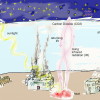
Steven Faivus: The Greenhouse Effect

Steven Faivus is a high school science teacher and alto saxophonist. He has been developing science arts materials in high schools for over 25 years. His Mission? To Understand and Appreciate Nature. His website ‘Singing Scientific-Science Through the Arts’ (www.singingscientific.com) uses illustration, video, poetry, story and song to provide a deeper understanding of Global Warming and Climate Change.

The Tattoo: Drawing on the Body

Today, tattoos are seen everywhere. Paraded on the streets, on television and even in celebrity culture. Danielle Groves reveals the significance of the history of tattooing in various cultures and how this has influenced modern times. In this article she discusses the evolution of technology and imagery, how women have impacted on the ‘New Tattoo’, and the key movements that pushed underground art into the mainstream.

Drawing as a way of knowing

“My current work is about drawing as a way of knowing and about knowing about drawing as a way of knowing”. Gemma Anderson is an artist, researcher and university lecturer whose practice is at the interface of art and science. She has worked on different collaborative projects with mathematicians and natural scientists and has recently completed her PhD ‘Drawing as Epistemology for Morphology’. She is currently artist in residence for the Northern Ireland Science Festival (2016) and also at Imperial College (Mathematics department).

Drawing and Educating

Professor Anita Taylor is a practicing artist, exhibition organiser, published writer and Dean of the School of Art and Design, at Bath Spa University, UK. Prior to becoming the Dean Anita was Director and CEO of the National Art School in Sydney, Australia (2009-13); Director of The Centre for Drawing, a University-wide Research Centre of the University of the Arts London, and Dean of Wimbledon College of Art. She is the founding Director of the Jerwood Drawing Prize project, the pre-eminent annual open exhibition for drawing in the UK.