Extract from ‘Consciousness Came First’
Dr Edi Bilimoria is an award-winning author, engineer, and international speaker with over fifty years of study in the Perennial Philosophy. ‘Consciousness Came First’ is a unique, panoramic and powerful book bridging the gulf between contemporary science and the philosophy of the ages. Aimed at the general rather than the specialist academic reader, it is essential reading for all those attempting to unravel the mysteries of life in the modern age. Based on his monumental award-winning four-volume work ‘Unfolding Consciousness: Exploring the Living Universe and the Intelligent Powers in Nature and Humans’, it is arguably the most radical and persuasive reappraisal of the subject in decades.
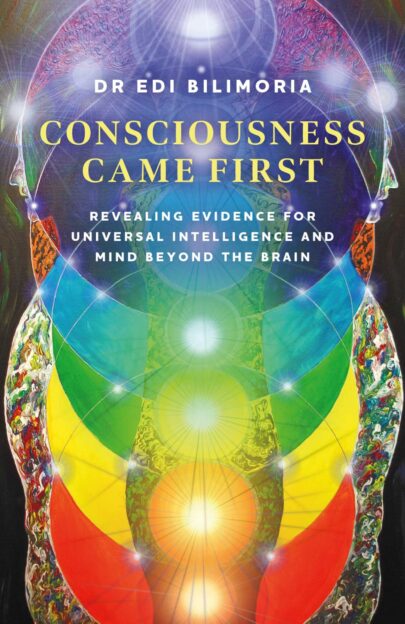
Extract from Consciousness Came First – Foreword
I regard consciousness as fundamental. We cannot get behind consciousness. I regard matter as derivative from consciousness. Everything that we talk about, everything that we regard as existing, postulates consciousness.
— Max Planck
Since the dawn of time, the exhortation by sages of all ages and cultures to know ourselves and thereby to know humanity and the world of which we are a part, is, of course, a perennial entreaty. It would be presumptuous, indeed, to profess to have found the ultimate dictum. However, we may claim in this book to have advanced a few small footsteps towards this supreme, but never-ending quest of self-enquiry.
But what is meant by the disarmingly simple injunction, ‘Know Thyself’? Does it refer merely to our body, which obviously assumes that we are just our body and nothing else? Or does the totality of our being comprise our physical body as well as subtle bodies on higher levels than the physical – giving us form and expression at those levels – all subsumed under the guidance of an overarching master principle? This master principle, we aver, is none other than consciousness.
In this book we deal with the unfolding of consciousness – the primary principle of all existence – and its expression through various bodies, subtle and material, on all planes of being from the divine and spiritual to the material and physical. Our scope of enquiry and terms of reference will embrace the universal, ageless wisdom and the corroboration of some of its tenets by modern science.
It is important to understand what is meant by the universal, ageless wisdom. It is known under a variety of terms, all conveying the essential meaning of eternal truth. This corpus of wisdom addresses the oneness of all life and the intrinsic divinity of all that exists. It is the root of all religions, sciences and philosophies that have burgeoned like magnificent fruits from the branches emanating from the central trunk of the Tree of Wisdom. As the term implies, it is the unbounded wisdom of all ages and all times. It can be discerned in the doctrines of the East and the West, from antiquity to the present.
Rudiments of the eternal wisdom (another common term) may be found scattered among the folklore of aboriginals, and so-called primitive peoples, in every region of the globe. It informs the core teaching of the world’s religions and constitutes the matrix of the laws of science as we shall see.
A more specific reference to this universal wisdom is occult science. The term occult simply means ‘hidden’ from the Latin ‘to hide’; hence the science of the secrets of nature – otherwise known as the Hermetic or Esoteric Sciences. Alchemy is a science to which Sir Isaac Newton (1642–1727) devoted his life. It is an aspect of the universal occult science and means the chemistry of the invisible or hidden aspect of the laws of nature.
‘Perennial Philosophy’ in its original and authentic rendering of philosophia perennis – which is virtually synonymous with ‘Eternal Wisdom’ – will be used throughout this book as a generalising term, and for good reason. The humanitarian, philosopher, and physician Albert Schweitzer (1874–1965) likened the evergreen characteristic of perennialism to a tree that seasonally bears the same type of fruit – but never exactly the same fruit, symbolizing that the eternal wisdom – ever One in essence – must periodically be given new expression and communicated in an updated idiom to suit the epoch in question.
Neuroscience and neurobiology are burgeoning subjects of research but this massive effort is based on the materialistic assumption that the physical brain generates consciousness. Are scientists confusing or conflating mind with its mode of expression? In contrast, the knowledge gained through occultism makes our conception much more meaningful and richer by illuminating the inner guiding forces and intelligence which underlie all natural processes and phenomena.
The pursuit of intellectual knowledge for its own sake, which is so fashionably the way of science, is therefore alluring only to those who are not aware of, or choose to ignore, the inner life and the great mysteries of life that challenge us daily on all sides.
The frantic research nowadays to find a physical basis for consciousness is concentrated almost exclusively on the physical brain. That most mysterious and sublimely intimate organ, the heart, is almost completely ignored. The Perennial Philosophy the world over – whether we look to the Greeks, Egyptians or Indians – disseminates the cardinal teaching about the heart in relation to the whole constitution of the human being. How can science, then, ever hope to acquire even a partial, let alone a complete, understanding of consciousness by such neglect of the central organ in the human body?
The central message of this book is that the so-called laws of nature are anything but blind or mechanical in character. They are conscious principles acting as the instrumental functions of Divine Consciousness. The universe is guided by intelligences at different levels of existence. This underlying, all-pervading Divine Consciousness guides and co-ordinates the exercise of these functions in various spheres. This is why we find perfect co-ordination, harmony, symmetry and intelligent direction and control everywhere in nature.
Since time immemorial, sages and seers have all unequivocally affirmed that the material arts and sciences are the mere shadows of Divine Wisdom. One of the most important contributions of occultism is that beside the visible and tangible world which we perceive through our physical senses, there are worlds of a subtler nature. These can also be apprehended by means of subtler faculties which exist in an undeveloped state in the vast majority of people, but which have been refined to an extraordinary degree by those whom we call adepts and occultists.
Another key aim of this book is to show that man and the universe, down to the minutest particle of matter, are imbued with consciousness, goal-orientated evolution and purpose. It argues that once the human state is understood, each human being will realise for himself his unique role in a purposeful universe guided by love and intelligence. It also demonstrates that the human being is a triumph of nature whose future growth and splendour has no limits.
…………………………………………..
https://edibilimoria.com/
Get the Full Experience
Read the rest of this article, and view all articles in full from just £10 for 3 months.
No comments yet.