The Silent Reverberation of Materiality
Sculptor Dr Gindi is an artist of the elemental, a material thinker who pursues philosophical inquiry through a deep engagement with extra-human sensibility. Attuned to the resonation of material things, she is also a sculptor of words, deploying a distinctive, poetic idiom to elicit the conditions through which something new can be sensed. For Dr Gindi, the artist is a conduit through which the art forces of nature reveal a world in the process of becoming, rendering tangible a thought or sentiment in the process of finding form. Beyond the allure of the enchanting surface she hearkens to the ‘silent reverberation of materiality’ and in sentiments reminiscent of Whitman, speaks in this interview of its utterance. She discusses her ideas and work with Jill Marsden, Professor of Literature and Philosophy, The University of Bolton, UK. She is the author of ‘After Nietzsche: Notes Towards a Philosophy of Ecstasy’ (Palgrave 2002) and assorted essays on Nietzsche, aesthetics, modernism and literary thinking.

Dr Gindi (courtesy of Braschler Fischer)
Professor Jill Marsden: To begin, the question of influence is always the obvious one and also the hardest to ask in an interesting way: people like to locate things in relation to what they already know of course, and to a very large extent must do so. But artists like to show the previously un-known, something for which the senses have no names. With this in mind, what would you say about the role of ‘recognition’ in your work?
Dr Gindi: In my work, recognition plays a role akin to a lantern in the dark – it illuminates just enough for the senses to find their footing in the unknown. It’s not about showing you the same old postcard. It’s about that spark of connection, a bridge between what’s etched in your memory and what’s waiting to be discovered in the hidden crevices of perception.
Recognition, like an old friend, can lull you into complacency if you’re not careful. It’s easy to stay in the comfort of what you already know, but my work invites you to take a step into the twilight zone of sensory exploration. Or – paraphrasing Nietzsche – it’s like opening a door to a room you didn’t even know existed in the mansion of your perception.
Sometimes artists apply ideas to the medium they work with, and the ideas inform the work in an almost Platonic way. And sometimes the ideas are drawn out of the medium itself, and only later are integrated into speech. They are two very different ‘directions of travel’ but I sense in your work a third process at work. Could you say something about this interplay of ‘internal’ and ‘external’ forces in relation to your creative practice?
The delicate dance between the internal and the external, the intricate tango of ideas and medium, are woven together in a symphony of form and content. We find ourselves entangled in the enigma of creation.
In the realm of sculptural endeavor, I am confronted with a trinity of forces: The artist’s embodied mind, the medium’s essence, and the emergent dialogue that transpires between them. The conventional dichotomy between imposing ideas onto the medium and extracting ideas from within it collapses upon closer examination. It is here that we enter the realm of the Hegelian synthesis, where the dialectical energies intermingle in a whirl that transcends mere thesis and antithesis.
You see, the Platonic impulse, like a sculptor’s chisel, chips away at the raw material of thought to reveal a nascent truth waiting to be unveiled. The form emerges from the ethereal realm of premises and takes shape in the terrestrial realm of substance. But here we must pause! For what if the medium itself yearns to be heard, to whisper its own secrets? This is the Kantian murmur, the silent reverberation of materiality seeking expression.
So, in my sculptural praxis, I beckon forth a tertium quid, a third entity that haunts the borderlands of thought and matter. Here, the medium is not a passive receptacle or a stubborn adversary, but a co-conspirator. It murmurs, indeed, but it also resonates with the very echoes of my contemplation. The clay, the stone, the metal – they possess an agency, a recalcitrant will to engage in a discourse of their own.
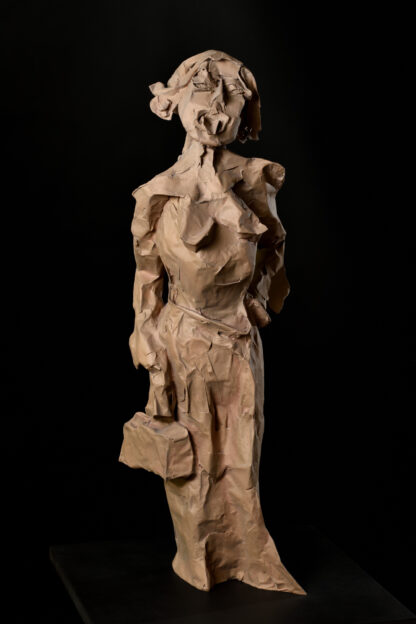
Dr Gindi: Je m’en fous. Bronze. H 87 x W 37 x D 26 cm, 2023
As I lay my hands upon the unshaped matter, my ideas meld not merely with its surface, but infiltrate its very core. The medium’s history, its geological memory, its tactile sensibility – all intertwine with my thoughts, birthing an uncanny offspring. It is an alchemical transmutation, where external becomes internal, and internal becomes external, in a chiasmic dance that defies the tidy compartments of conventional wisdom.
The resultant form is a palimpsest of dialogues – the medium’s murmurs entwined with the artist’s musings, inseparable yet distinct. This is the true interplay of ‘internal’ and ‘external’ forces. It is a melange of energies that surges forth in the act of creation, a harmonious dissonance that echoes across the corridors of time.
We need to embrace the paradox, relish the intermingling of these forces, for it is in this liminal space that the raw material of existence finds its voice, and the artist, a mere vessel, orchestrates the symphony of being.
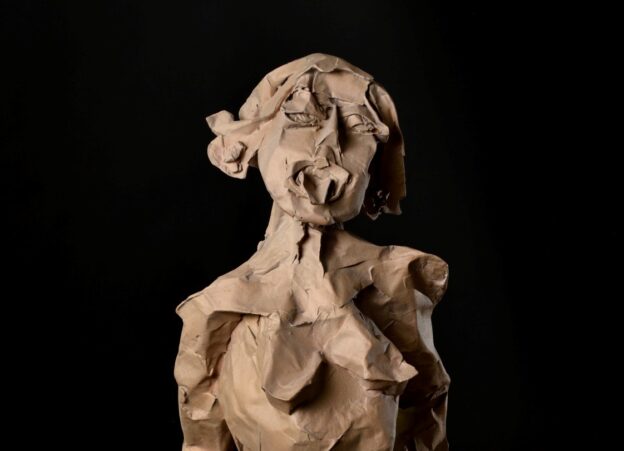
Dr Gindi: Je m’en fous (detail). Bronze. H 87 x W 37 x D 26 cm, 2023
Building on these insights, I would be interested to hear more about your specific engagement with materiality as a sculptor. To what extent is the field of sculpture different from other arts in this respect, and in what ways does it share its concerns with other arts? I’m asking this because She That Spreads the Winds looks almost as if it has been created in dialogue with dance or music.
I model my work in clay; foundries then transform the initial figure into bronze. Bronze sculptures possess a unique quality that often conveys a sense of timeless essence. I find myself captivated by the transformative art of patination, a process that beautifully embodies the fleeting aspect of existence. The shades and textures it bestows upon my creations are nothing short of ideal; they intricately enhance the narratives or mysteries I aim to uncover. This patination breathes further life into my work, elevating it, refining its form, and gradually revealing its distinct and heightened character.
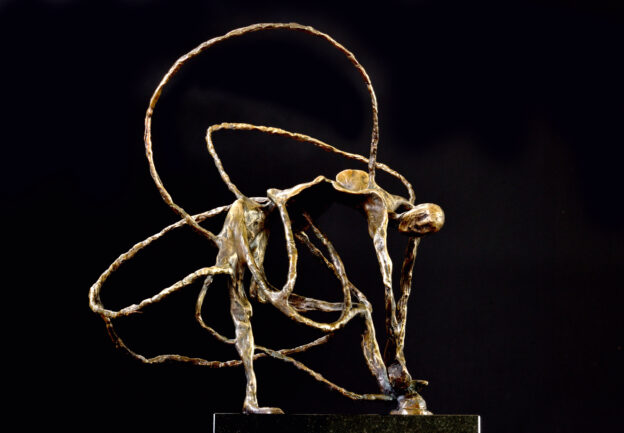
Dr Gindi: She that spreads the Winds. Bronze. H 37 x W 32 x D 23 cm, 2021
Consider, if you will, my creation titled She That Spreads The Winds. This piece features a figure who takes a spirited leap into the unexplored currents of the wind, unfurling her wings in a majestic display. Through this artwork, my intention was to depict a realm forever in motion, where undulating waves of energy create a constant dance, an eternal music. She That Spreads The Winds is a testament to embracing boundlessness, allowing the passage of time to gently weave its way through her fleeting form. As she spreads the winds, she gracefully glides alongside them, finding delight in a moment that transcends the constraints of materiality itself.
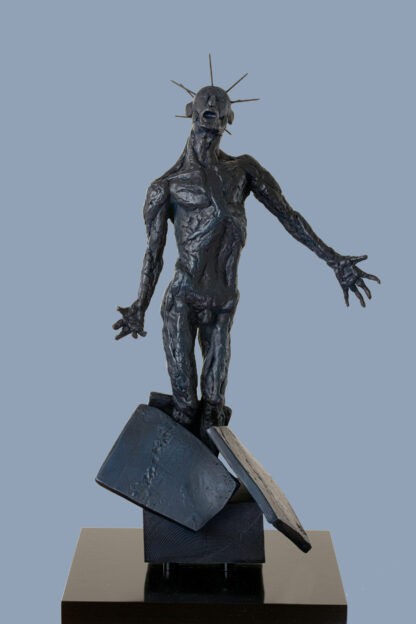
Dr Gindi: Materializing. Bronze. H 57 x W 30 x D 20 cm, 2021
Moving on to another work, you say of ‘Materializing’ that ‘Something gaunt wakes up in a sweltering crate, stretches, unfolds into pulp and spine’. This has echoes of Kafka and Beckett, a comment perhaps on the torment of following a death-bound trajectory or the pain of assuming an achieved form. What thoughts of embodiment are stammering to be born in these convulsed moments?
Well, what is the human condition? We are a mind, a soul, a consciousness, thrown into a specific moment, hurled into flesh and bonds and given form in the furnace of life. That situation creates a certain tension and dissent. The tension of ascent and decay, which I have explored in Materializing. But that is not the whole story. There is also the deliciousness of the human condition, The Sweetness of Being, the excitement of Flying into Life, the energy and potentiality of existence, the transcendent sense of the infinite trembling within flesh. So that sense of the joy and terror of existing in a material form, that is something that inspires my work.
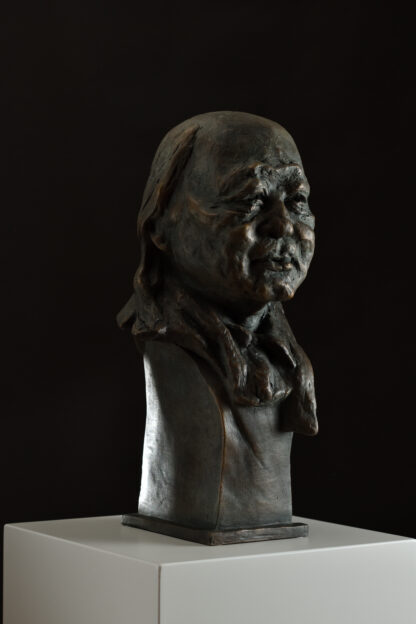
Dr Gindi: The Sweetness of Being. Bronze. H 42 x W 21 x D 22, 2022
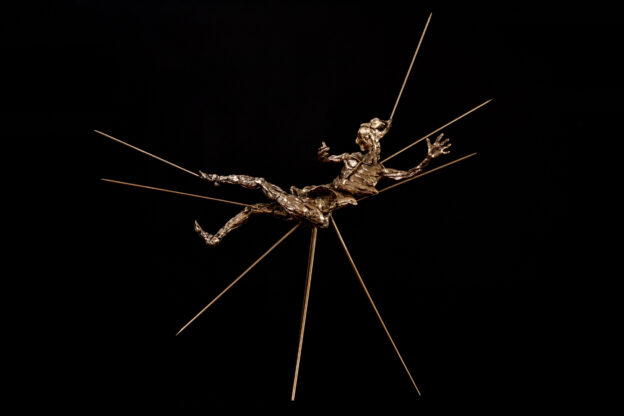
Dr Gindi: Flying into Life. Bronze. H 69 x W 74 x D 30 cm, 2021
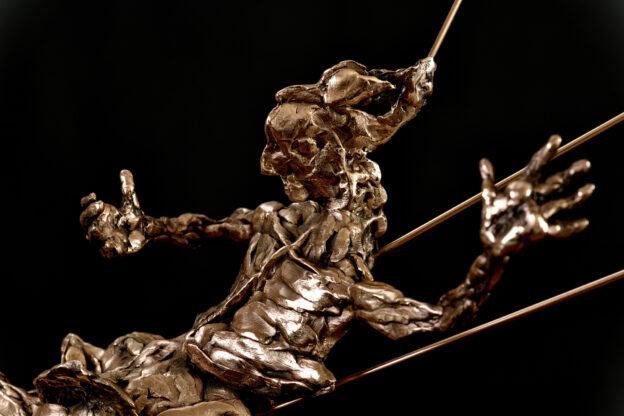
Dr Gindi: Flying into Life (detail). Bronze. H 69 x W 74 x D 30 cm, 2021
The pulse of life reverberates through sinews, shaping the contours of what is to be. Pulp and spine—the tender yielding of substance, the resilient scaffold that scaffolds being. The pulp, like the raw clay of creation, malleable and responsive, surrenders itself to the sculptor’s touch, a canvas for the articulation of existence. The spine, the axis of resilience, channels the energies of existence, a bridge between ethereal thought and corporeal sensation.
In these convulsed moments: Embodiment, the nexus where mind and matter embrace, manifested as a fervent inquiry into the clamour of existence. Substance and attribute entwine.
Given your interest in the reverberation of materiality, I would like to ask if you are attracted to the ‘new materialisms’ that are currently much in favour in the humanities and social sciences. Do you have any further thoughts on this fascination with the non-human agency of matter and, correlatively, the rapidly changing materiality of the ‘human condition’?
The contemporary thinkers of ‘New Materialism’, like Nietzsche before them, reject the dualistic separation of the human and non-human, mind and matter, and instead, emphasize the entanglement and interdependence of all entities in the world.
Some aspects of that broad movement do appeal to me. Particularly if it’s a materialism that is open to the infinite. Philosopher Jelena Djuric wrote recently:
A new materialist worldview doesn’t have to mean abolishment of spirituality, it can possess a sacredness aligned to immanence, whereby, transcendence does not have to oppose the world.
I also believe that humans and non-human agents inter-act in an open system and become something new and posthuman. This has always happened in human history. For example, a caveman fashions flint into a weapon, and they become something new, a new sort of agent, interacting with their ecosystem in a new way. Much later, scientists working in a laboratory interact with microscopes and germs and create a new flow of information and agency.
Artists are also working in this sort of open system – there is the artist, their material and technologies, the audience, and the invisible network of ideas. All have agency and desires. What does the clay want, and finally the artist? What is yearning to come into being?
As the sculptor’s hand shapes clay, as the philosopher’s gaze uncovers hidden truths, we find ourselves on the threshold of a new era. Here, in the corridor of post-humanist materiality, the sculptures of self and other meld, and the boundaries of form and essence blur. Let us savor this composition, for it is the sculpture of a new dawn — a dawn where the artist, the poet, the thinker, the scientist, and the material fuse, giving birth to a virtual tapestry woven from the threads of possibility and the fabric of the universe itself.

Dr Gindi: Toccata Infinata. Bronze. H 57 x W 34 x D 23 cm, 2023
I found myself thinking about the poet Rilke when engaging with your work, perhaps because the idea of ‘infinity’ threads through his poetic ideas, but perhaps also because of the influence of sculpture on his poetry. Certainly, there is a connection here with your attempts to expand the boundaries of art in to the world of thought. Is it helpful to reflect on these convergences of ‘material thinking’?
I read Rilke early on and I liked his poetry. And you are right, his poetry is influenced by sculpture – he worked as Rodin’s assistant for some time. Some of Rilke’s greatest poems refer to sculptures, like his Torso of the Archaic Apollo, in which the ancient statue seems to ‘burst like a star’ before him. What a wonderful image – as if the stone carved thousands of years ago still glows like a piece of uranium with hidden yet infinite power and energy. And in the same poem, Rilke writes
for here there is no place
that does not see you. You must change your life.
To me, the poet is suggesting that when you encounter a great work of art, it truly is an encounter, a meeting. You look at the work of art but it also looks into you, and makes demands of you. This is a mysterious idea, but it’s something Plato also suggested in his dialogue Ion, where he suggests the artist and their art-work act like a sort of magnet, pulling the attentive spectator towards the infinite. Rilke seems to me to share this Platonic conception of the artist as a link or conductor to the infinite. He once wrote: ‘We are the bees of the invisible. We wildly collect the honey of the visible, to store it in the great golden hive of the invisible’.
The bees, tireless artisans of nature, embark on their quest to gather the nectar of the visible world. Their journey mirrors our human endeavour—our ceaseless pursuit of experiences, knowledge, and sensory delights. Yet, it is in the act of collecting that a profound alchemy transpires. The honey, distilled from the ephemeral blossoms of the world, is not merely consumed but stored—a transformation from fleeting sensation to enduring essence. The great golden hive of the invisible becomes a repository for these distilled moments, a sanctuary where the tangible is transmuted into the infinite.
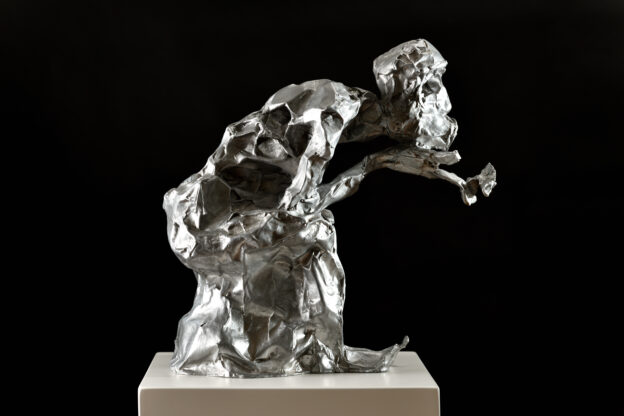
Dr Gindi: In Reverie. Aluminium. H 35 x W 20 x D 35 cm, 2022
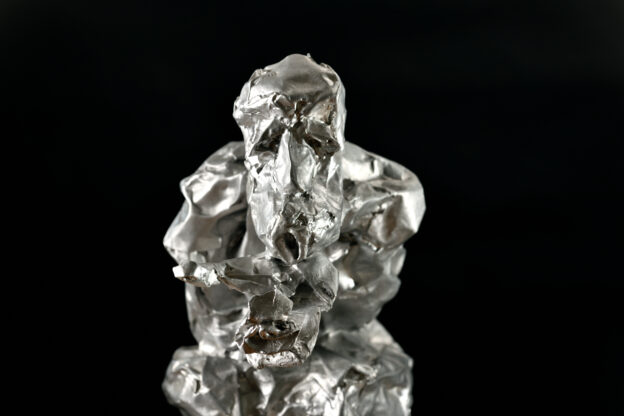
Dr Gindi: In Reverie (detail). Aluminium. H 35 x W 20 x D 35 cm, 2022
In contemplating your own work you have had recourse to existentialist ideas about the question of the meaning of being and the anguish of human finitude. Do you feel, as with Nietzsche, that art is a counterforce to nihilism and if so, how might we think this in our contemporary world?
It very much depends. Nietzsche was of course something of an elitist – he thought most humans simply mimic each other and nihilistically follow the herd, without really contributing anything vital or new.
On the other hand, anyone who reads Nietzsche notices he is not a misanthropic pessimist, though he often seems like that. He is an optimist. He says that God may be dead, we may live in a cold universe without a certain cosmology or teleology. But we can create meaning, we can treat our lives like works of art. How do we overcome ourselves, how do we go beyond nihilism, beyond cynicism, how can we create moments of beauty and become the sculptors of our better selves?
Nietzsche once commented that ‘without music, life would be a mistake’. He thought the arts had a redemptive power in a universe without any given meaning. Sometimes he spoke of art as an illusion, a necessary illusion in the face of the horror of existence. We must learn to affirm life, he suggested, and to smile like the figures do in ancient Greek sculptures – thus nullifying nihilism.
Finally, if it is right to see our era as the historical manifestation of nihilism, a world in which despair is too tempting an indulgence whilst hope for enlightenment seems naïve, what would it mean to affirm existence through your art?
Optimism naively clings to the illusion of progress and perpetual sunshine. It is a crutch for those who dare not confront the abyss within themselves and the vast void that looms beyond. To embrace optimism is to succumb to the seductive allure of a dream, a dream that blinds one to the harsh realities of suffering, decay, and the ceaseless wheel of fate.
Pessimism, on the other hand, is the refuge of the disheartened, the sanctuary of those who crumble beneath the weight of existence’s burdens. To be a pessimist is to shroud oneself in the shadows of despair, to surrender the will to power that courses through every fibre of our being. Pessimism wallows in the muck of self-pity and laments, incapable of recognizing the potential for transformation and triumph that lurks within the chaos.
I am neither the slave of optimism nor the prisoner of pessimism. Like Rilke, I strive to accept the great golden hive of the invisible, and to love it.
……………………………………
All images copyright and courtesy of Dr Gindi
Get the Full Experience
Read the rest of this article, and view all articles in full from just £10 for 3 months.
No comments yet.