The Matter of Time
Ariane Koek is a British independent producer, curator and writer recognised internationally for her transdisciplinary work in arts, science, technology and in the creation of new residency programmes. She was the initiator and founder of Arts at CERN (2009 – 2015) – the first officially organised international arts programme by CERN – the world’s leading particle physics laboratory, Geneva, Switzerland. In this article she discusses the work of Montreal-based interdisciplinary artist François Quévillon, who explores the interactions among environmental changes, societal issues, and technological developments.

Pyrocumulus, Orbiting Bauxite and Cryptocristallin. François Quévillon’s exhibition La Terre en suspens at OBORO, Montreal, 2023. Photo credit : François Quévillon
It’s a millisecond versus a billion years. Technological time versus geological time. Currently our world appears to be locked in a deadly war between two different versions of linear time. Elements, such as rare earth elements, which are contained in minerals, which have been harboured in the earth for billions of years, are now being extracted with increasing rapidity to power our technology. Deep time transformed into quick time. We are consuming these rocks and minerals far faster than they can re-form. We are literally dematerializing the planet — and as we do so, we are running out of time.
It is these critical paradoxes that are at the centre of the work of the French-Canadian artist François Quévillon. Ever since his residency at Gros Morne National Park in 2017, he has focused on rocks and minerals. His work over twenty years has always been an investigation into the nature of materiality — whether liquid, gas, or solid matter. But for the past six, he has found a new focus with geology, which combines the environmental, societal and ethical issues that are close to his heart. His work does not preach about these issues. Instead, it subtly raises questions in the audience’s mind by luring them in with the beauty and skill of his image-making and his creative use of technology.

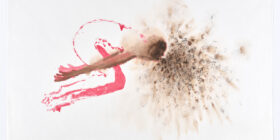
Pyrocumulus. François Quévillon’s exhibition La Terre en suspens at OBORO, Montreal, 2023. Photo credit : François Quévillon
Key to this is his work possessing an unsettling and uncanny quality, too: his images walk the line between the ‘heimlich’ and the ‘unheimlich’ — the familiar and the strange (1) — and so his work has a beguiling liminality. Take for example the lenticular print Pyrocumulus. As the audience moves around, it changes shapes, forms and textures. Molten matter appears to momentarily transform into a volcanic ash cloud, blooming like a flower. (2)
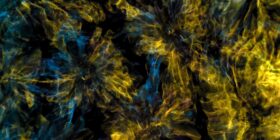
Or take Cryptocristallin, which could be a blown-up image of a microorganism under the microscope. It’s in fact the interior of a geode rendered with depth of field. (3) The accompanying hissing soundtrack, drawn from volcanic activity, evokes the energy needed to form the rock, giving it a life that breaks down the distinction between dead and living matter.

Cryptocristallin by François Quévillon.

Cryptocristallin. François Quévillon’s exhibition La Terre en suspens at OBORO, Montreal, 2023. Photo credit : François Quévillon
His installation Esker / Lithium has an even more complex liminality, partly due to the depth of his research over several years. A haunting 3D scan on a wall appears at first glance to be an unusual natural forest clearing. The clue that there is more to this than meets the eye is the mobile phone connected to the image by an electric cable, like an umbilical cord. The clearing is in fact on a prospection site for the extraction of lithium, which the phone depends on for power. The phone, which is faulty and frequently runs out of power, in turn rests on the image of a mining exploration hole, supported by a pallet of plastic bottles containing spring water collected nearby — a subtle comment on extractivism and consumerism.

Esker / lithium. François Quévillon’s exhibition La Terre en suspens at OBORO, Montreal, 2023. Photo credit : François Quévillon
The subliminal questions raised by these juxtapositions trigger what François calls “reflective discomfort.” He is deliberately trying to provoke this feeling in his work, and it is a discomfort that he feels too, because he is using new technology to research, create and exhibit his work, which is also contributing to the extraction and destruction of the planet’s geology. He is just as much implicated in what is happening in our world as we all are. But equally, he is fascinated by the creative possibilities technology offers both him and the viewer, opening our perceptions to new experiences and understandings of our world.

Esker / lithium. François Quévillon’s exhibition La Terre en suspens at OBORO, Montreal, 2023. Photo credit : François Quévillon

Esker / lithium. François Quévillon’s exhibition La Terre en suspens at OBORO, Montreal, 2023. Photo credit : François Quévillon
Érosions 3 is another piece with many layers to it. Put on the VR headset, and the rocks which François scanned on the coasts of the Saint-Laurent are transformed into undulating waves of particles of light and colour. The boundary between the shoreline and water are eroded, and the work evokes a new geological materiality beyond human perception — the “vital materialism” which the philosopher Jane Benett talks about, where all matter is a form of life, whether it is unconscious or not. (4) Technology gives us a portal into seeing rocks as mobile and flexible in this digital realm. Yet in real life, rocks move, and their movement is at the centre of their ‘being-ness’ as any geologist will confirm: they form, reform, and transform over time, and are masters of metamorphosis. They just do this in time stretched over thousands and millions of years, which are far beyond human beings’ bodily experiences of time. In fact, rocks are immortal, except for attrition by weather and the elements, as well as their destruction by humans. Maybe part of our fascination — as well as disregard — for rocks is an unconscious jealousy at their immortality. We are literally destroying them in order to live on borrowed (deep) time.

Érosions 3. François Quévillon’s exhibition La Terre en suspens at OBORO, Montreal, 2023. Photo credit : François Quévillon

Érosions 3. François Quévillon’s exhibition La Terre en suspens at OBORO, Montreal, 2023. Photo credit : François Quévillon
Érosions 3 can also be read as a critique of the world as solipsistic. When a person enters the room and puts on the VR headset, unbeknownst to them they both trigger sound and images which other visitors in the room encounter. The headset wearer can neither hear nor see what is happening outside their own experience. They are at the centre of their own universe — true members of the Anthropocene. (5)

Érosions by François Quévillon.

Érosions by François Quévillon.
But there is hope, too, in François’s work. Rooting: Le Rocher shows roots gripping tenaciously to rocks with such vigor that it is almost palpable. Life will always find a way. In his book The Order of Time, the physicist Carlo Rovelli sets a riddle to test the nature of reality. He posits that a stone and a kiss are in fact the same. They are both an event held together by time:
“The hardest stone in the light of what we have learned from chemistry, from physics, from mineralogy, from geology, from psychology, is in reality a complex vibration of quantum fields, a momentary interaction of forces, a process that for a brief moment manages to keep its shape, to hold itself in equilibrium before disintegrating again into dust.” (6)

Rooting : Le Rocher by François Quévillon.

Rooting : Le Rocher. François Quévillon’s exhibition La Terre en suspens at OBORO, Montreal, 2023. Photo credit : François Quévillon
In the end, François’ work — which investigates the geology of media and the media of geology with their different materialities — hints at this: a state of existence which is even beyond that of the vital materialists for whom everything exists as equals. Instead, as Carlo Rovelli shows, what really matters at the end of the day is time — and the forces that interact and give shape to both a stone and a kiss. Time matters. Time is a form of mattering — of making meaning and shaping the world/s in which all beings exist. We are time.

Cryptocristallin, Rooting : Le Rocher and Tablelands in Suspension. François Quévillon’s exhibition La Terre en suspens at OBORO, Montreal, 2023. Photo credit : François Quévillon
……………………….
Footnotes
- See Sigmund Freud’s essay The Uncanny (1919).
- The title Pyrocumulus refers to fire clouds formed when warm air rises. The piece also evokes Chinese myths which link clouds with rocks — seeing them as the same things, an expression of matter,despite one being aerosol and the other solid. See Paul Prudence, The Lithic Imaginary (Sternberg Press, 2023).
- The title of the work teasingly and deliberately also evokes crypto art and NFTs — a form that François has so far refused to work with.
- Jane Bennett, Vibrant Matter: A Political Ecology of Things (Duke University Press, 2010).
- Anthropocene is the name given to an unofficial unit of geologic time made popular by biologist Eugene Stormer and chemist Paul Crutzen in 2000. It is used to describe the most recent period in Earth’s history when human activity started to have a significant impact on the planet’s climate and ecosystems.
- Carlo Rovelli, The Order of Time (Penguin Roverhead Books, 2018).
……………………………………..
This text was originally commissioned by the artist-run centre OBORO, in Montreal, on the occasion of François Quévillon’s exhibition La Terre en suspens, presented April 15-May 20, 2023.
Montreal-based interdisciplinary artist François Quévillon explores the interactions among environmental changes, societal issues, and technological developments. In his practice, he explores the phenomena of the world and perception by implementing processes sensitive to fluctuating environmental conditions and human interference. His work, much of it developed during artist residencies, has been presented internationally for over two decades at exhibitions and events such as Connecting the Dots (Mexico), Sundance’s New Frontier exhibition (Park City), Spaces Under Scrutiny at the Knockdown Center (New York), International Symposium on Electronic Art (Gwangju, Dubai and Albuquerque), Flora and İnsan Eli Değmiş at Kalyon Kültür (Istanbul), .dreams at the Theatre of Digital Art (Dubai), Open Media Art Festival (Seoul), Festival Internacional de Linguagem Eletrônica (São Paulo), IndieBo (Bogotá), Mirage Festival (Lyon), Festival de la Imagen (Manizales), Climate Art Collection @ Transmediale Vorspiel (Berlin), Mois Multi (Québec City), MUTEK, Elektra and International Digital Art Biennal (Montréal). Different iterations of his solo exhibition entitled La Terre en suspens have presented in Canada since 2021.
All images copyright and courtesy of François Quévillon.
Get the Full Experience
Read the rest of this article, and view all articles in full from just £10 for 3 months.

No comments yet.