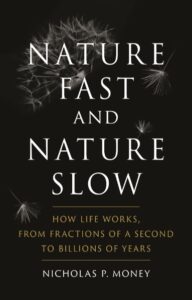
On ‘Nature Fast and Nature Slow’
Nicholas P. Money (Nik Money) is a gentleman of letters, mycologist, and professor at Miami University in Oxford, Ohio. He is the author of popular science books that celebrate the diversity of the microbial world. His latest book, ‘Nature Fast and Nature Slow: How Life Works, from Fractions of a Second to Billions of Years’, is a vision of biology set within the entire timescale of the universe. It is about the timing of life, from microsecond movements to evolutionary changes over millions of years.
Richard Bright: Can we begin by you saying something about your background?
Nik Money: I was born in Oxford in 1962 and adopted by wonderful parents who were teachers. I attended comprehensive schools as a teenager, invested a lot of time in misbehaviour, and surprised my peers by receiving an offer to study at Bristol University. Bristol was among the great fortunes of my life. I majored in botany and minored in microbiology (as we say in the USA). The Bristol faculty were inspiring professors who transformed my interests in natural history into a passion for scientific exploration that has driven my career as a teacher, researcher, and writer. One of the great lessons of my undergraduate experience was that I had so much to learn. I remember noticing the books that fellow students in the classics and humanities were carrying to their classes and began to read these authors alongside my immersion in biology.
At Bristol I became fascinated with fungal biology and after graduation I studied with John Webster for my PhD at Exeter. John was the greatest practitioner of experimental mycology at that time, so his was the perfect lab for me. A postdoc at Yale followed my three years in Devon, and two years later I moved on to a research position in Colorado. After Colorado I worked briefly in Delaware and Kentucky before settling at Miami University in Oxford, Ohio. From Oxford to Oxford. When I accepted the postdoc at Yale, I had every intention of staying in America, not as an escape from my Englishness, but rather as a simpler conviction that this was the country where I wanted to live. Watching the televised Moon Landings as a child convinced me that the United States was the best place for a scientist.
There is, of course, a parallel personal story of relationships and remarkable experiences across six decades, but this biography has gone deep enough for present purposes. Turning 60 this year, my love for America has become strained by politics, but as a scientist I feel as eager as ever to explore fresh fields and pastures new—as John Milton put it so deftly.
RB: Have there been any particular influences to your ideas and work?
NM: My Lincolnshire grandmother comes first. She took me out to the Fenlands to find natterjack toads, to the woods to teach me the names of plants, and to the Red Chalk outcrops near Louth to collect fossils. I did not appreciate how much she influenced me until relatively recently; too late, of course, to thank her properly. Richard Dawkins comes next. His 1976 book, The Selfish Gene, was a game-changer for me, and his persuasive rhetoric as a public intellectual made him my hero. In my own research field, a highly eccentric mycologist called Reginald Buller (1874-1944) has been the principal source of inspiration. Buller spent most of his career in Winnipeg, Manitoba, and his magnum opus, Researches on Fungi, remains the greatest single contribution to the science of mycology since the eighteenth century. Buller was an ingenious scientist whose experiments on fungal biomechanics highlighted the tedium of the descriptive taxonomic work that dominated the field. Much of my research can be viewed as a modern extension of questions posed by Buller about the way that fungi grow and reproduce.
In broader terms, the writers whose books have had the greatest influence on my thinking are Darwin, Melville, and Milton: On the Origin explains most things in life; Moby Dick verges on the hallucinogenic in its beauty and horror, and Lycidas is my favourite poem. As if my foregoing comments were insufficient proof, these choices underscore my status as a privileged white Anglo-American male academic.
RB: What is the focus of your research?
NM: I concluded my career as a lab scientist in 2016, with the graduation of my last PhD student. This was a very deliberate decision that favored my aspirations as a science writer and released me from the burden and frequent disappointment of grant submissions. My final research project concerned the condensation of water on the surface of mushroom spores. I know that this does not sound very promising, but the formation of water droplets on the microscopic spores drives their release from the gills of the fruit body (which is a biomechanical marvel) and may also affect the formation of raindrops in clouds (which is very newsworthy). The idea that fungal spores can influence rainfall seems far-fetched until we pair my experiments with the fact that an Avogadroian number of spores weighing millions of tons circulates in the global atmosphere. With a collective surface area equal to the continent of Africa, these particles could be driving rainfall in places where they are most concentrated.
Turning to my writing, my current research is taking me in two directions. My immediate project is a book on the interactions between fungi and the human body, which involves the ecology of the skin, respiratory allergies, supportive and damaging fungi in the gut, lethal brain infections, mushroom poisonings, and the importance of fungi as a source of drugs. This is a field of inquiry whose science has been overshadowed by wishful thinking and mistruths promoted by ‘inspirational’ speakers. By introducing an objective reading of the science, my book will provide readers with a reliable and entertaining resource on the richness of the human-fungal symbiosis. My second project began as an exercise in pandemic escapism and stars the iconic single-celled organism, Amoeba proteus.
RB: Can you say something about your recent book, Nature Fast and Nature Slow: How Life Works, from Fractions of a Second to Billions of Years? What are its aims and structure?
NM: This book was written with the aim of engaging readers with the mechanisms of biology that escape the second-to-second timescale that dominates our conscious experience. We are trapped in a tiny sliver of the immense timeline of nature, and science has the singular power to widen our understanding of the faster and slower phenomena of life. Spectroscopic methods in chemistry and ultra-high-speed video are examples of the technologies that reveal the fastest events in nature, and the methods of geological investigation allow us to grasp the fantastic history of biology. Imagination plays a vital role in this investigation too. It is so important to encourage students to place each scrap of information that they learn in their classes into a wider perspective. A table of reaction constants for enzymes is an unlikely source of inspiration until we close our eyes and translate these numbers into the whirl of biochemical reactions in a cell.
Regarding structure, the book presents ten short chapters, each dedicated to a specific slice of time to illustrate organisms and biological mechanisms that populate everything from microseconds to billions of years.
RB: The book explores a wide range of temporal processes and time spans, did your research throw up any surprises for you, in regards to your previously held understanding of biological timescales?
NM: The biggest surprises for me in my exploration of timescales came through teaching an undergraduate seminar titled, The Science and Art of Time, with my colleague, Billy Simms, a renowned multimedia artist. Following the same plan as the book, we dedicated each week of this class to a single timeframe, beginning with fractions of a second and ending with billions of years, with Billy speaking to artistic impressions and me to the science. Billy shared images captured with high-speed cameras and time-lapse sequences with the students, along with paintings, sculptures, novels, plays, and films that address the theme of time in an explicit fashion; I introduced the biological processes that I covered in the book. I also discussed the philosophy of time, drawing on the work of J. M. E. Taggart, author of The Unreality of Time (1908), the prolix and impenetrable Henri Bergson, Thomas Nagel, and others. Samuel Beckett became the star of the course through Billy’s references to Waiting for Godot (1952) and That Time (1975). My book, like Beckett’s plays, is filled with evocations of entropy. At the level of thermodynamics, life is nothing more, or less, than a fashionable alternative to the tiresome business of heating rocks and water.
The students enlivened the classes by sharing their reflections on time, including their scepticism toward studies showing that the average attention span is waning and that a goldfish can maintain its focus longer than a human. Cell phones, video games, and social media have been identified as the presumptive catalysts for this behavioural change. This argument did not impress my students, who spoke to the difficulty of defining attention and pointed out that some video gamers are so transfixed by esports that they collapse from exhaustion.
RB: What are your favourite organisms you discovered while researching the book?
NM: Jellyfish, or rather jellyfish stingers, grabbed my attention as I explored some of the faster mechanisms in nature. Jellyfish stingers or nematocysts are plump, poisonous urns, which house barbed darts that are discharged in less than one microsecond (one millionth of a second). Box jellyfish use these darts to stun their prey and humans are stung when we get in their way. Similar weapons are produced by single-celled protists, including a marine dinoflagellate that uses a multi-barrelled stinger to fire a dozen darts into its prey. This is a miniature gatling gun. The explosive detonation of nematocysts is comparable to mechanisms of spore discharge in some fungi. In my own research, we used cameras running at one million frames per second to record footage of these mechanisms. These are the fastest airborne flights in nature and include the burst of spores from a pressurized tube called an ascus at 115 kilometres per hour (72 mph). This is nature very fast.
Moving on to the longer intervals of time, whales are featured in the chapter on centuries as some of the longest-lived animals, and also in the chapter on millions of years to illustrate the speed of mammalian evolution. The lifespan of bowhead whales exceeds 200 years. This was established by analysing the proteins in the eye lenses of whales killed by modern native whalers. Antique harpoon tips have also been found in these beautiful animals, showing that they had survived attacks in the nineteenth century. The evolution of bowheads and other whales is an inspiring story that begins in the Eocene Epoch with the slow transformation of species related to the tiny mouse deer or chevrotain found in the tropics. Fossils of early whales provide snapshots of the modification of land mammals into ‘amphibians’ that browsed on plants growing along riverbanks, walking whales with webbed feet, and fully marine animals shaped like enormous eels. Whale evolution shows how the common body plan seen in mammalian embryos has been stretched and compressed, and nipped, tucked, and patched to generate a submarine bestiary in a few million years. The story of turtle evolution is equally stunning.
RB: Are there any theories of how animals who move fast experience time as opposed to those that move more slowly?
NM: Smaller animals tend to have a fast ‘flicker fusion frequency’, meaning that their brains process more images per second than larger animals. Experiments show that dragonflies perceive more than two hundred distinct images in a second, which is two or three times faster than humans. There is a weak relationship between this processing speed and metabolic rate and this overlaps with faster movements. Drawing on a variety of studies, we are left with the impression that time may seem to pass more slowly for smaller animals, which enjoy more action in a few minutes than we pack into an hour. Adult female mayflies are tasked with finding a mate, mating, and laying eggs inside five minutes. I imagine that they allow themselves 15 seconds for a summer holiday, taking the time to clean their wings and luxuriate in the warmth of the afternoon sun.
RB: In terms of human perceptions of time, is there a difference between an infant’s perception and a person in old age? And why do you think we experience time as passing faster as we get older?
NM: I’ll begin this answer with a passage from the book: ‘My grandmother shared this scrap of wisdom with me in her great age: “You’ll be surprised by how fast it all goes. I was a little girl just the other day and look at me now”. And then she laughed her frog-croaky laugh at the silliness of it all, turning a somewhat maudlin reflection over her afternoon tea into something quite beautiful’. Her experience is almost universal and there are at least two mechanisms at work here. As infants we have something approaching a dragonfly view of life. We have so much to learn and with comparatively little repetition in our experiences we appear to process more information per second than later on. In other words, we are accumulating data more swiftly as children than adults, which may have the effect of stretching the seconds of our conscious experience. As adults, when we have seen most things before, seconds seem to pass more swiftly. Days and weeks seem to fly by in the busiest years of our lives. There is not an immense amount of data to support this viewpoint, but this certainly seems to make sense. The more common solution concerns remembered experience: on our fifth birthday, each of the previous years has occupied 20% of our consciousness; by our fiftieth birthday, a year has shrunk to 2% of the journey. This may explain why the previous year seems slow for the child, fast for the adult. I am not convinced that these ideas provide a compelling explanation of the perception of time, but I like the idea that the child sees the world as a rapidly changing kaleidoscope and that we lose this impression of the furious animation of life as we age.
RB: Nature Fast and Nature Slow explores the temporal scale. Do you think there is a correspondence between this and the spatial scale and, if so, what is the correspondence? (Perhaps there could be a follow-up, Nature Small and Nature Big?)
NM: I have certainly thought about a follow-up: Nature Small and Nature Big: Weighing Life from Fractions of a Gram to Trillions of Tons, or maybe reverse the order here. I would love to write this in the future. At the trillions of tons end of the spatial scale we weigh the entire biosphere, which represents less than one billionth of the mass of Earth: exagrams (10 to the power 18 grams) of organic biology ride on six thousand octillion grams (6 x 10 to the power 27 grams) of inorganic chemistry and more than one million Earths could fit inside the Sun. Size and speed are correlated throughout nature. Each species sit at a particular position along a spectrum that runs from fast and small, to big and slow.
I find it interesting to think about the cumulative mass of the biosphere over the history of biology. Life has been recycling elements for around 4 billion years and has been energized by the immensely greater loss of solar mass. The closing sentence of Nature Fast and Nature Slow speaks to the interplay of the temporal and the spatial throughout these festivities: ‘The cell has remained the irreducible unit of life for 100 quadrillion seconds, modified into bacteria and crawling amoebas, and multiplied into bristlecone pines and the bodies of whales, and will persist until the Sun runs out of fuel and melts the biosphere, returning Earth to the purity of its geological beginnings’.
RB: Finally, has your research and book changed your thinking?
NM: The greatest impact of the book on my thinking came with the process of writing the last chapter, titled, ‘Beginnings: Billions of Years’. This impression verges upon the woo-woo, but bear with me for a couple of sentences. The ‘Billions of Years’ chapter concerns the greatest mystery in science, which is the origin of life. Physicists will claim that the origin of the universe is a bigger problem, and they certainly have a right to be wrong. Interestingly, there are some similarities between the challenges in solving both puzzles. Equations that work very well for the expanding universe lose their grip upon the first instant of time, and while evolution by natural selection explains the diversification of organisms, the appearance of the first cell is an enigma.
As I explored the current literature in this field, I developed an increasingly eerie impression that most of the pieces of the puzzle are available now, waiting for someone to look at them with fresh eyes and grasp how they fit together. James Watson did something like this with his models of DNA in 1953. The genesis of the first cell is considerably more complex than the structure of a molecule, but we need a Watson for the cell, someone who can bring a new insight to the problem.
As a boy, I remember being mesmerized by the sight of gnats glinting in sunbeams in my garden. They seemed, as I write in the book, to be a ‘magical part of nature, spun from the pure chemistry of the air’. I hope that we will solve how life is spun from chemistry in the time left for me.
Thank you for inviting me to answer these provocative questions and I hope that readers will tease out some interesting strands from this response.
Nik Money, Oxford, Ohio, June 2022
…………………………………………
Get the Full Experience
Read the rest of this article, and view all articles in full from just £10 for 3 months.
No comments yet.