Biophilia
Laura Stack is a visual artist, educator, and eco-enthusiast residing in Minneapolis, MN. She creates biological abstract paintings, ink collages & installations informed by science, science fiction, and the natural world. Her work alludes to fictional organisms and plays with the tension between organic and synthetic.
Richard Bright: Can we begin by you saying something about your background?
Laura Stack: The compulsion to create is what makes us human. My creativity and artistic sensibility allow me to best express my observations of the world around me. The physical engagement of making objects with my hands is a way of collecting and processing experiences.
I could be a geologist or biologist, but my true calling is the arts. I received a BFA from the University of WI-Madison and an MFA from the University of Kansas. My education focused on painting and color theory. Studying with Professor Marjorie Krelick, a Joseph Albers student, inspired me to explore color interaction in my art-making practice.
Along with pursuing a career in the Arts and my studio practice, I have been a Fine Arts educator for 25 years at the University of Minnesota Art Department, The Minneapolis College of Art and Design, and other colleges in the Twin Cities area.
It’s no wonder my artwork focuses on observing natural phenomena. Exploring the natural world was a significant part of my childhood. I grew up in a landscape that is a geological wonder. Baraboo, Wisconsin, is an area rich in lakes, rock formations, and gorges formed by glaciation and other natural processes over eons of the earth’s history. Devils Lake, one of the most ancient and unusual rock outcroppings in North America, was just a few miles from my home. Many days of my childhood were spent scrambling over immense quartzite boulders and swimming in the lake’s deep, dark waters. One couldn’t help but marvel at the area’s geology. This childhood experience fueled a keen interest in geology and biology and a strong desire to understand the processes that created them.
RB: What is the underlying focus of your work?
LS: The content of my mixed media paintings and collages is best described as:
- Reverence for life and the natural world, Biophilia.
- The interconnectedness of life forms and how they interpenetrate and change each other continuously.
- Observation of natural phenomena in-flux, growing, transforming, or mutating.
- Fascination with Synthetic Biology, the “New Natural,” the bridge between non-life and life.
My response to the following interview questions and accompanying art images elaborates on these core themes. The artwork included spans from 2001-2022.
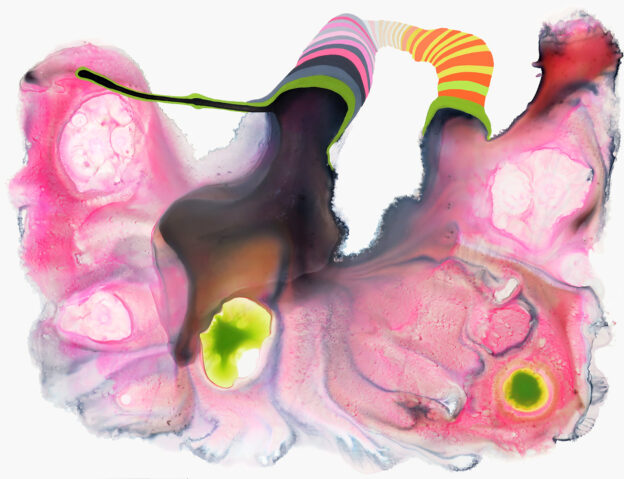
Life Form 4, ink & gouache on panel, 20″ x 26″, 2019
RB: Have there been any particular influences to your ideas and work?
LS: As a visual artist, one might assume that my primary influence was art history and other artists’ work. This is not the case. Painters and digital artists inspire me, but I don’t look to emulate their work. My curiosity about the scientific underpinnings of the natural world and biotechnology motivates my art’s content and visual sensibility. I look to the fields of biology, synthetic biology, fractals, color theory, and ecology. Research that informs my current art practice includes the writings of Ed Regis in his book What Is Life?: Investigating the Nature of Life in the Age of Synthetic Biology, biologist Merlin Sheldrake’s Entangled Life: How Fungi Make Our Worlds…, James Lovelock’s Gaia Theory, biologist Edward O. Wilson’s Biophilia Hypothesis, and Forest Ecologist, Suzanne Simard’s Finding the Mother Tree. Biology-inspired science fiction also activates my imagination from writers such as Jeff VanderMeer, Adrian Tchaikovsky, Margaret Atwood, and Sue Burke.
Observing the natural world around me in my day-to-day practice informs my artwork’s content and visual composition. Observational drawing is part of my practice, forcing the drawer to study the subject carefully. I maintain a pollinator garden and cultivate native plants to support the biome in which I live. I’ve been fortunate to experience diverse landscapes, including the pristine Bruce Trail in Ontario, Canada, the lush, mountainous rural areas of Southern China, the deserts of the American southwest, and the high peaks of the European Alps. I seek out natural spaces and engage in slow, intentional observation.
Ralph Waldo Emerson speaks to this in his essay Nature by inviting us to imagine how differently we would view the stars if they were revealed for only one night every thousand years:
“… The point is that the sublime, the heavenly, is all around us; it’s this very pervasiveness that blinds most of us, most of the time, to its majesty. Rather than falling to our knees in nightly transports of reverence and awe, we barely take the time to glance upward at this spectacle.”
RB: You have described the different series of your works as being like “a journal of discovery and event” of your life. Can you say more about this?
LS: Making art is like keeping a journal. I look at my artwork over the last twenty years and recognize what event or life stage a specific body of work represents. I do not tell the evolving painting or collage what it should be. In contrast, the finished artwork reveals what I was experiencing or grappling with at the time. The Fruiting Bodies and Synthetic drawings series illustrate this awareness.
Fruiting Bodies series, 2001. Large-scale charcoal drawings.
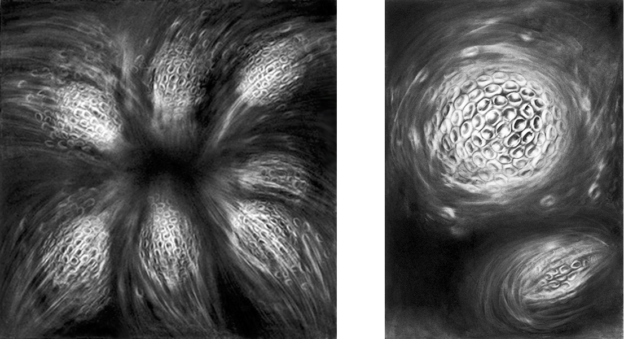
Fruiting Bodies #22 and #16, charcoal on paper, 40″ x 40″

Fruiting Bodies #22, solo exhibit High Touch at the Minneapolis Institute of Art, Mpls., MN, 2002.

Fruiting Bodies, solo exhibition High Touch at the Minneapolis Institute of Art, Mpls., MN, 2002.
Fruiting Bodies series. I held my father’s hand as he took his last breath and felt his final heartbeat pass away. A heightened perception of “the pulse of life” immediately enveloped me and is still present in my awareness. This experience lingers and has informed my art for the past 22 years. “What is Life” is a question I contemplate in my art practice. As an atheist, I wonder, “what happened to that energy that was my father?” Since I do not rely on religious doctrine to answer this question, the art-making process is a means for seeking understanding.
Through the Fruiting Bodies drawings, I seek an other-worldliness, removed from everyday life, traveling in the inner world of breath and pulse of living forms. A repetition of expanding and contracting forms that teeter between the concrete and the ephemeral. The process of making this art is contemplating the transitory, the place between the known and unknown where the existence of living things are in flux.
Michael McCarthy, a writer and environmentalist, reminds us in his book The Moth Snowstorm: Nature and Joy, that experiences of wonder from encounters with nature’s life force, can
“…jolt us into the realisation of how remarkable not only our own but all existence actually is.”
Synthetic series, 2004. Large-scale mixed media drawings.
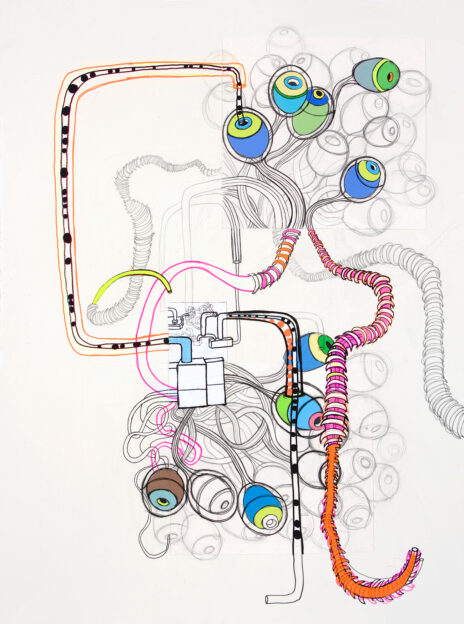
Tubulation (Synthetics), mixed media & collage on paper, 60″ x 40″, 2004
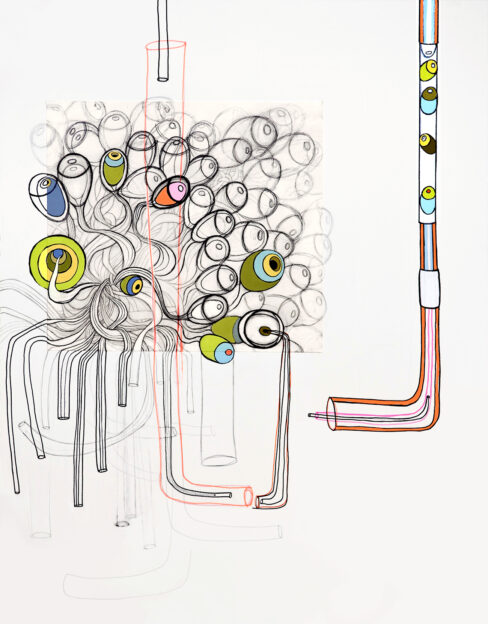
Flail (Synthetics), mixed media & collage on paper, 60″ x 40″, 2004
Synthetic series. The experience of having a child born with a congenital disability has opened my awareness of the capabilities of technology-based life support systems. My son was born with (TEF) tracheal esophageal fistula; his esophagus ended in a pouch and was not attached to his stomach. This condition required multiple surgeries where his life was in surgeons’ hands and high-tech medical equipment. Tubular forms are imprinted in my memory as the carriers of life support; They provided nutrients, disposed of waste products, dispensed medicines, and breathed for him.
Not surprisingly, tube-shaped forms appeared in this drawing series created after my son’s surgeries were completed. Both the drawings Flail and Tubulation feature a synthetic intrusion into a biological form. As with my son, the transition is jarring and unnatural, just as it felt to see my son attached to multiple tubular contraptions, even if they were life-saving. Tubulous bodies also appear in my recent Life Form series from 2020.
RB: How important is the concept of ‘transience’ in your work?
LS: The notion of transience and phenomena in-flux is a central theme of my work. In addition to the Fruiting Bodies drawings I just discussed, the theme of flux and growth carries over into the Fluere, Shapeshifter, and Life Form painting and collage series.
For example, I see Life Form #5 (below) as a frozen moment in the cycling process of growth. In minutes the form is going to change its configuration. The striped bulbous shape will bulge out and shrink inward as it grows and breaths. In the fluid background, the inky edges are puddling, dissolving, bubbling, and forming branching patterns into the white space of the paper. In Life Form #7 (below), the protruding striped body spreads and extends around itself.
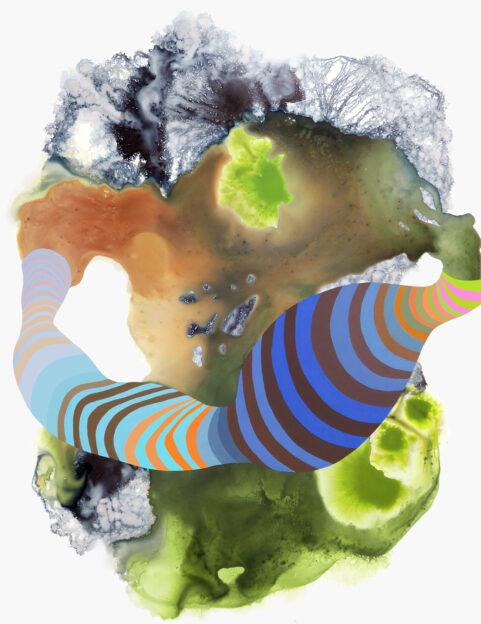
Life Form #5, Ink & gouache on panel, 26″ x 20″, 2019
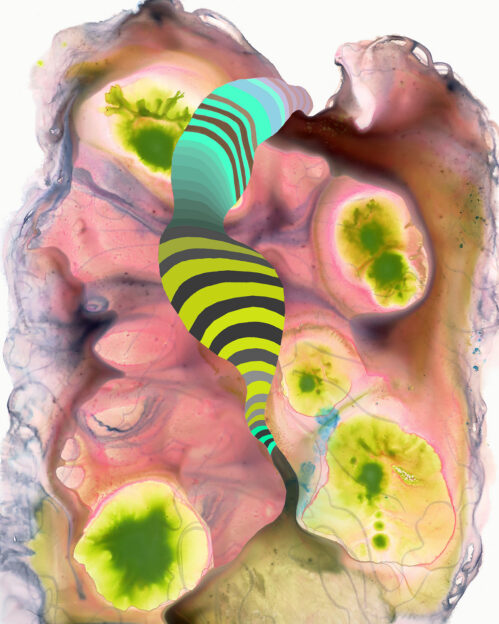
Life Form #7, Ink & gouache on panel, 26″ x 20″, 2019
RB: Is creating and making work with your hands an important part of your working process?
LS: The physical act of painting & drawing is primary to my art-making. This process enhances my creativity and is a means of meditation that keeps me “in the moment”. While I work on the computer using Photoshop to explore visual ideas and do color studies, I’m most engaged in the hands-on moving of the paint. This physicality is in keeping with my background as a dancer as I use gestural movements and engage my entire body when applying the paint. My physical mark on the paper gives my paintings movement and presence as an extension of myself.
RB: There is a wonderful sense of flow in your works as if the viewer is witnessing the changing of forms through space and time as they were being created, but also a frozen moment in the process of becoming. Your series Fluere is a good example. Could you say more about the Fluere series?
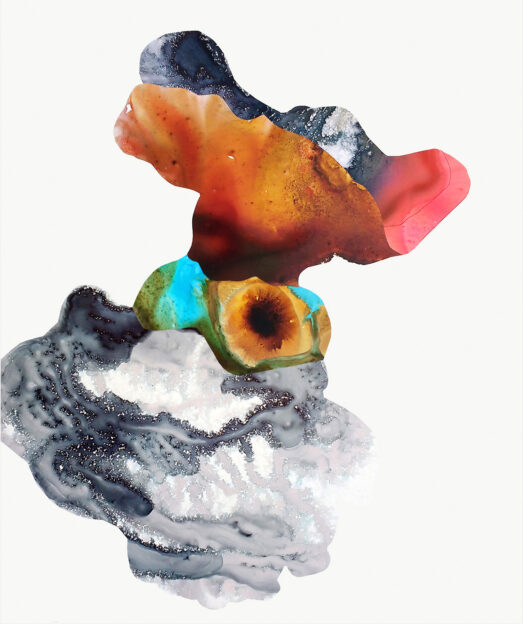
Fluere #3, Ink painting collage on paper, 26″ x 20″, 2017
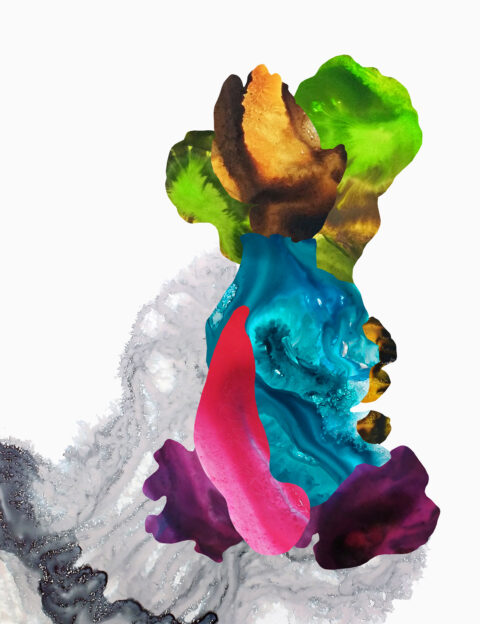
Fluere #7, Ink painting collage on paper, 26″ x 20″, 2017
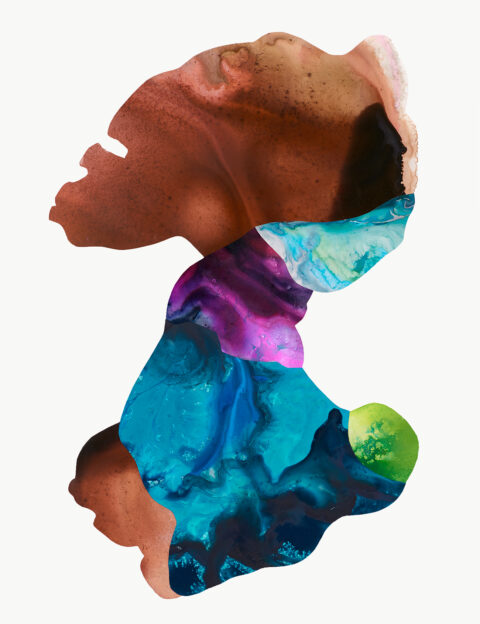
Fluere #16, Ink painting collage on paper, 26″ x 20″, 2017
The sense of flow and flux in the Fluere ink paintings and collages is the residue of my painting process, which moves between control and chance. Through my physical gestures and the fluidity of the ink, I aim to create a frozen moment in the process of growth or transformation. I begin with an ink drawing of a natural form or pattern that inspires me, such as an exotic mushroom, nudibranch mollusk, or cascading water. After the image is drawn, I coax the wetted ink across the paper’s surface, corralling, halting spread, and encouraging its direction. Once dry, I cut and graft together different ink paintings to make a collage composite, which I call “indeterminate bodies.” They are a snapshot of an unnatural specimen or cycling phenomena.
As abstractions, these ink collages have no inherent scale and may represent internal or external processes, depending on the viewer’s interpretation. That their experience might diverge from what I intuitively intend is of no consequence, for each person brings their own experiences into play as familiar textures, images, and colors trigger their memory.
RB: Can you share something about your mixed media series Life Form and Shapeshifter? What were the inspiration for these works?
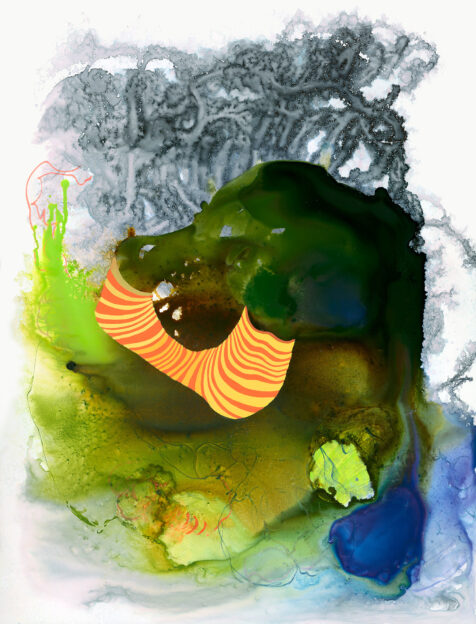
Life Forms #2, Ink & gouache on panel, 26″ x 20″, 2019
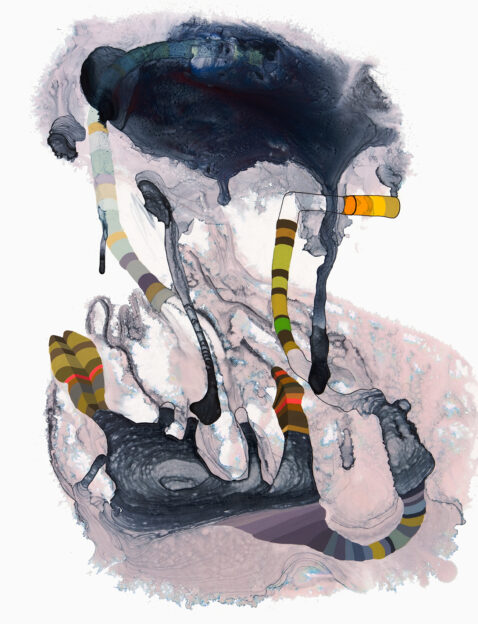
Shapeshifter #19, Ink & gouache on panel, 26″ x 20″, 2016
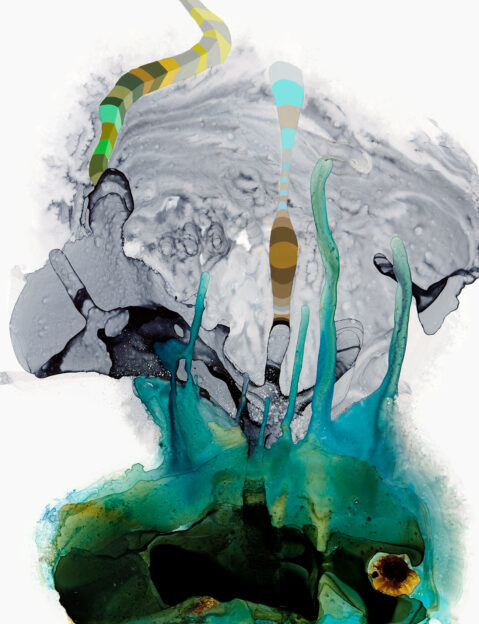
Shapeshifter #20, Ink & gouache on panel, 26″ x 20″, 2016
LS: I’m fascinated with the dichotomy that living things can now comprise synthetic elements. What constitutes “Life” is elusive due to synthetic biology and gene-editing tools like Crispr that alter and repair DNA. We respond to this new and unfamiliar technology with awe, anxiety, marvel, and contestation. I explore this paradigm shift by creating paintings that are an imagined view of artificial life in what I call the “new natural.”
When engaged in painting, I envision otherworldly life forms existing in an environment with its own physical laws. Beautiful freaks of the natural world, such as fungi, microfauna, and marine invertebrates (nudibranch), inspire my work’s abstract imagery and color, as do geologic processes of lava flow and branching. I use controlled and improvisational approaches with gouache and ink, rendering imagined tubular, striped forms that jet out from a fluid, inky primordial landscape.
One can view my biological paintings as microscopic, macroscopic, internal and bodily, or external: Life Forms growing and mutating, evolving towards an amalgam of the natural and the artificial.
RB: What projects are you currently working on?
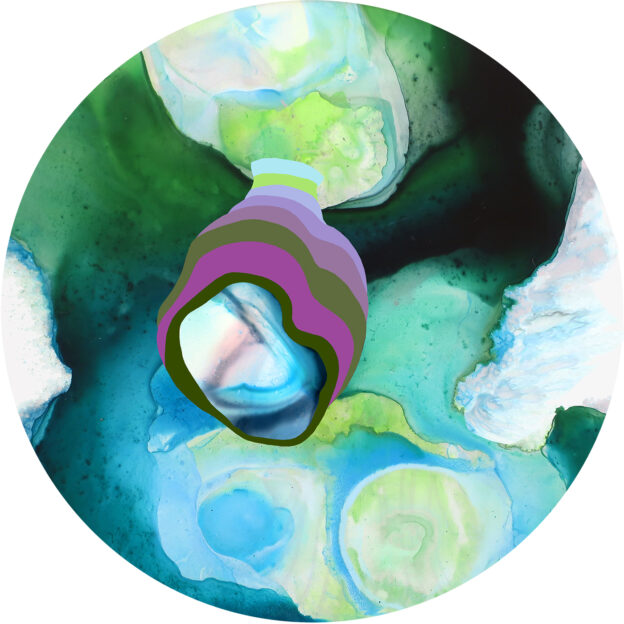
Designer Organism #11, Ink on circular wood panel, 18″ x 18″, 2022
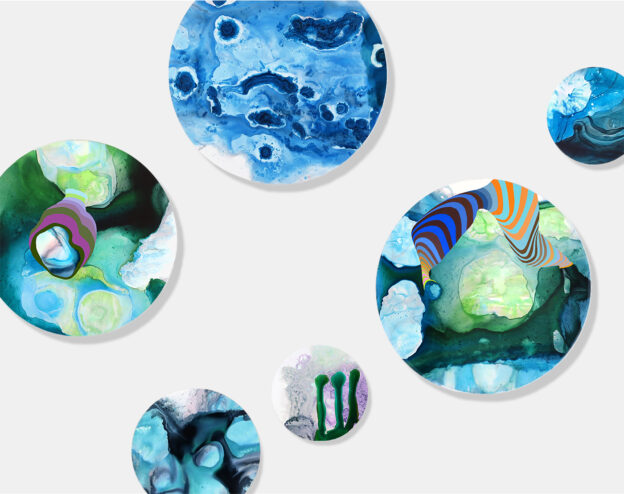
Designer Organisms installation, solo exhibition at Rosalux Gallery, Minneapolis, MN, 2022
LS: My current project is Designer Organisms, a mixed media painting series that focuses on imagined life forms. Like my Life Form series, these paintings continue to explore ideas relating to synthetic biology and phenomena in-flux, growing, transforming, or mutating.
In this body of work, I use the circle format to allude to viewing a petri dish specimen through a microscope or a window into another world. As I work on the paintings, I imagine living organisms developing before my eyes. I am both observer and creator, but I do not control them and am left to observe the self-replicating cells …. guided by some other force.
For my next solo exhibition at Rosalux Gallery in 2023, I plan to do a dynamic site-specific installation comprised of clusters of circular paintings that develop new growth patterns throughout the month of the exhibit.
………………………………………
Website: https://www.laurastackart.com/
Instagram: https://www.instagram.com/laurastackart/
All images copyright and courtesy of Laura Stack
Get the Full Experience
Read the rest of this article, and view all articles in full from just £10 for 3 months.
No comments yet.