Rohini Devasher: One Hundred Thousand Suns
Rohini Devasher is an international artist and amateur astronomer based in Delhi, India. Her practice spans film, drawing and printmaking, mapping the ‘antagonism’ of time and space. ‘One Hundred Thousand Suns’ is another kind of rendering of the Sun, assembled from data that is both historical and contemporary. work explores the notion that there may be multiple readings and avatars of data depending on the site, the observer, and the mode and method of observation, collection and preservation.
One Hundred Thousand Suns is another kind of rendering of the Sun, assembled from data that is both historical and contemporary. This data is collected in the form of glass photographic plates, hand-drawn drawings and calculations from the archives of the historical Kodaikanal Solar Observatory in South India. Kodaikanal is one of only two observatories in the world that have over 120 years of continuous data on the Sun.
One Hundred Thousand Suns work explores the notion that there may be multiple readings and avatars of data depending on the site, the observer, and the mode and method of observation, collection and preservation.
These observations are further layered with data sets from NASA’s Goddard Space Flight Center Scientific Visualization Studio, the Solar Dynamics Observatory Science Team and the Virtual Solar Observatory. Devasher also draws on interviews she has conducted with eclipse chasers and her observations and eclipse data collected in 2009, 2019 and 2021.
Rohini Devasher says: “On a planetary scale, digital twinning starts with the presumption that something like the Earth is essentially knowable. It got me thinking about the nature of modelling systems, the distance between the ‘truth’ of a model and what it actually embodies. The final piece is less of an alternative digital twin and more of a speculative, metaphoric assemblage of ways in which the sun has been recorded and observed.”
The work consists of 4 ‘paradigms’ explored through separate digital channels showing simultaneously over four large screens.
Paradigm 1: Sun Drawings explores the notion of observation over time using naked-eye drawings of the solar disk created between 1902 and 1904. It explores the nature of drawing when faced with an object that is not only unfamiliar but one which is in most cases difficult to understand, see and draw.
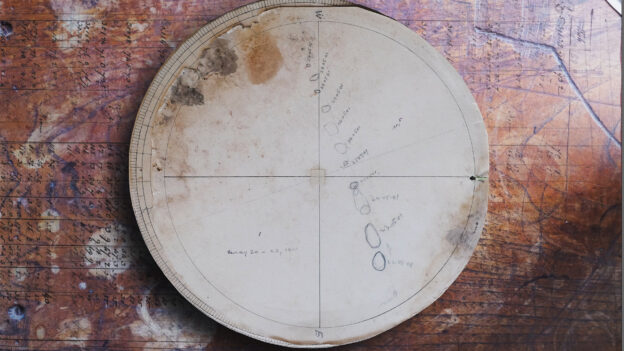
Rohini Devasher: One Hundred Thousand Suns – Paradigm 1 (Still Frame) 2022
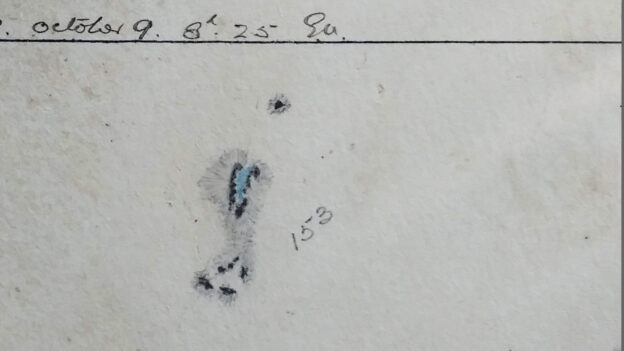
Rohini Devasher: One Hundred Thousand Suns – Paradigm 1 (Still Frame) 2022
Paradigm 2: Twin Suns considers the Sun as both knowable and unknowable. It focuses on the collections of lost, never to be repeated moments, captured using 19th century glass plate photography. Devasher has layered these moments with carbon paper drawings on copper sheets. She says: “Most copper on Earth was forged in very massive stars. These supergiant stars later exploded as supernovae, catapulting the newly minted copper into space.”
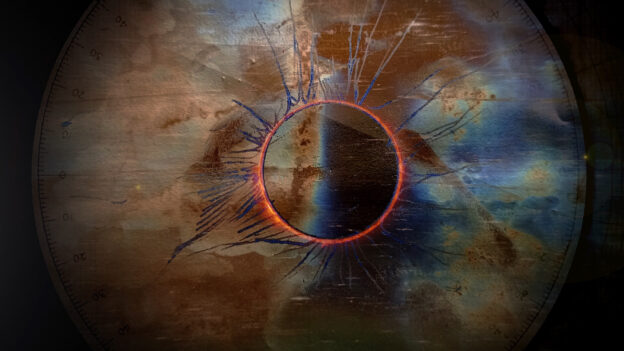
Rohini Devasher: One Hundred Thousand Suns – Paradigm 2 (Still Frame) 2022
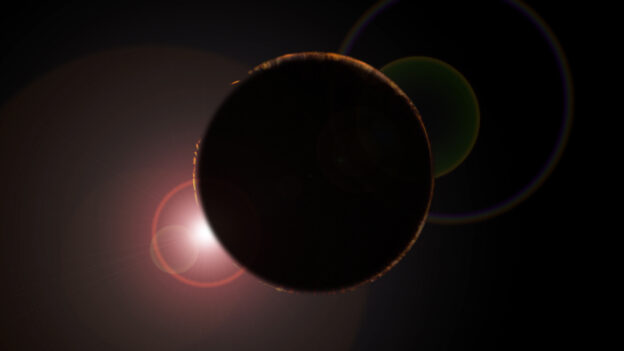
Rohini Devasher: One Hundred Thousand Suns – Paradigm 2 (Still Frame) 2022
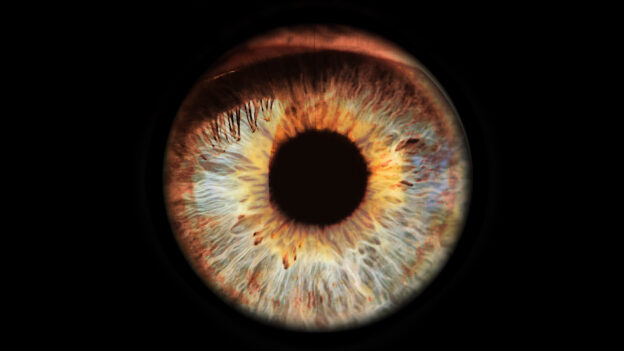
Rohini Devasher: One Hundred Thousand Suns – Paradigm 2 (Still Frame) 2022
Paradigm 3: Site features the instruments and people at the historical Kodaikanal Observatory, some of whom have been observing the Sun for four generations.
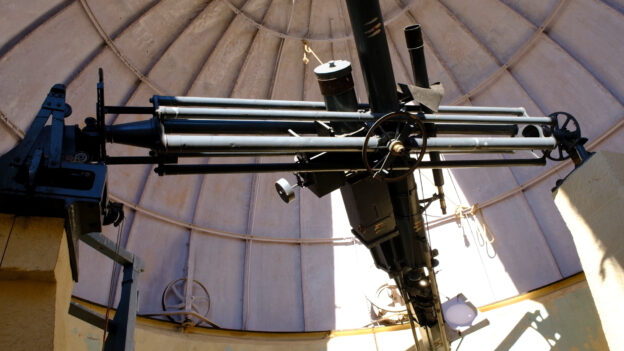
Rohini Devasher: One Hundred Thousand Suns – Paradigm 3 (Still Frame) 2022_
Paradigm 4: Eclipse offers a meditation on the light from our Sun caught in the beam of the 60-metre tunnel telescope at the Kodaikanal Solar Observatory. The voices of data of eclipse chasers who devote their lives to standing in the shadow of the Moon form the soundtrack.
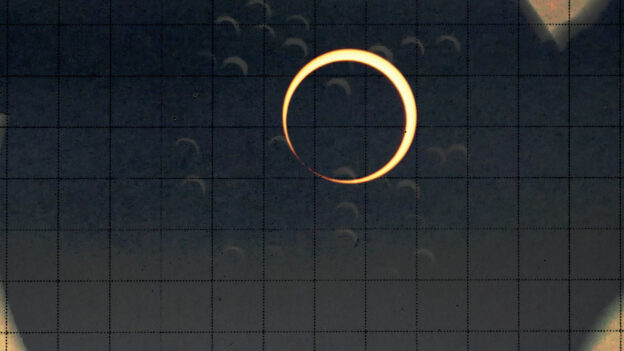
Rohini Devasher: One Hundred Thousand Suns – Paradigm 4 (Still Frame) 2022
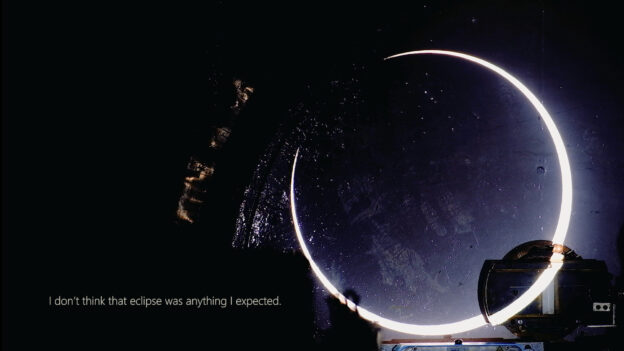
Rohini Devasher: One Hundred Thousand Suns – Paradigm 4 (Still Frame) 2022
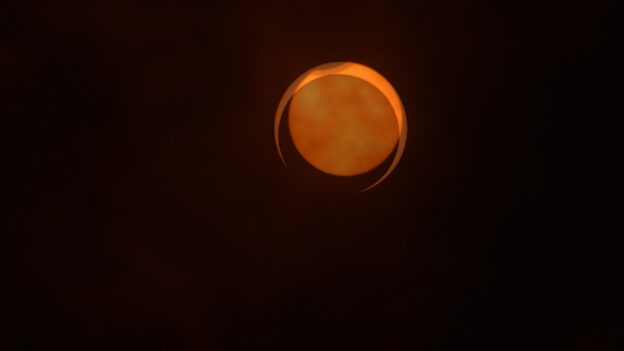
Rohini Devasher: One Hundred Thousand Suns – Paradigm 4 (Still Frame) 2022
Each paradigm within One Hundred Thousand Suns also contains a specific acoustic rendering of the sun, using data, voice, music and sound.
Rohini Devasher says: “Much of my work looks at the role of ‘observation’ and the ‘field’ or ‘site’. But I had never previously thought of myself as working with data. The ODI has helped me recognise that data is how we observe what we care about. It can be a mirror. It is not a natural phenomenon. I wanted to make a work that pushes slightly against the idea of data as detached, disinterested or neutral. What’s most exciting is the data created not by a single person but through collaborative effort.”
…………………………
About Rohini Devasher
Rohini Devasher is an artist and amateur astronomer. Her practice, spanning films, drawing and printmaking, maps the antagonism of time and space. It walks the fine line between wonder and the uncanny, foregrounding the ‘strangeness’ of encountering, observing and recording both environment and experience. Her current research focuses on the twin aspects of the Earth’s skies – its celestial constants on one hand and the mutable objects of the atmosphere on the other. In August 2021, Devasher and Pallavi Paul co-founded Splice, an artistic and curatorial collaborative practice.
Devasher’s work has been shown at the Rubin Museum, New York (2021), the Sea Art Festival, Busan (2021), To the Edge of Time at KU Leuven Library galleries for the Kunst Leuven City Festival (2021), the 14th Sharjah Biennial (2019) among others.
About the ODI
The ODI is a non-profit with a mission to work with companies and governments to build an open, trustworthy data ecosystem. We work with a range of organisations, governments, public bodies and civil society to create a world where data works for everyone. Our work includes applied research; consultancy services; training; and providing free reports, tools and webinars.
The embedding of an artist into the ODI’s work is a key part of the structure of the organisation. The residency ran from July 2021 to March 2022 online, with Devasher taking part in the Open Data Institute Global Summits in 2021 and 2022.
About Data as Culture
The Data as Culture programme is a world class contemporary art programme for artists and organisations interested in working with data and network culture critically and materially. Our projects challenge and expand public understanding of data and how it may affect and reflect our lives. Leading and emerging artists are invited to create new work for wide audiences at the ODI, online and at public venues in the UK and internationally. Our art programmes and partnerships have reached hundreds of thousands of people, on and off line. New calls for commissions are announced on an ongoing basis.
Get the Full Experience
Read the rest of this article, and view all articles in full from just £10 for 3 months.


No comments yet.