Patrick Huse: Harvesting Wasteland
Patrick Huse is a Norwegian painter and multi-media artist. He studied landscape art and conceptualism during the late 1970’s and early 1980’s. His works incorporate techniques as painting, drawing, photograph, video, wall based text material and objects. In the early 1990’s he started a project titled Rethinking Landscape, a trilogy consisting of the three parts: ‘Nordic Landscape’, ‘RIFT’ and ‘Penetration’. The traditional landscape art still plays a role as an artistic reference, but through a series of exhibitions from the mid-1990’s and later, he has challenged landscape art in a way which makes his project unique. In this interview with art and ecology author, John K. Grande, he discusses his ideas and work.

Patrick Huse, 2022
“I often experience that we see pictures through other pictures, making a cultural comparison instead of seeing what the art or the artist is trying to convey,” Norwegian artist Patrick Huse has stated. Born in Oslo, Norway in 1948, Huse has held numerous major exhibitions, particularly in northern countries and venues, such as the Lillehammer Art Museum, the Rogaland Art Museum (Norway), Akureyri Art Museum (Iceland), Katuaq Greenland Cultural Centre (Greenland) and the Nunatta Sunakkutaangit Museum in northern Canada. Patrick Huse’s work insists on a dialogue with the landscape, and involves an ecological dialogue between humanity and nature. As Huse states: “One thing, which is quite clear, is that our problems are no longer local, because so many environments on earth are struggling with the same issues. With better communications we have become aware of how much we share in this regard.” Huse works in a variety of media including photography, video, printmaking and painting. Not only does landscape as metaphor enter into his visual dialogues but equally issues of language, and the way language can define one’s experience, as with the Saami of Scandinavia or the Inuit of Greenland and Canada. The art of Patrick Huse draws attention to the time-honoured struggle between civilization and nature. His solo exhibitions include Intimate Absence held at the Henie Onstad Art Center in Norway Hafnarborg Institute of Culture and Fine Art in Iceland, the RidduDuottarMuseat/ Tha Saami Collections-Karasjok, Norway and the Qaqortoq Museum, Greenland
(2006-2009). Recent shows include Social Topics of Landscape at the Nils Aas Art Museum / Stiklestad National Culture Center, Norway (2017), Subtle Inquiry I at the Rovaniemi Art Museum, Finland and Oppland Art Center, Lillehammer, Norway (2018-2020) and Fallow Land at the Kunsthall in Bergen, Norway (2022). Patrick Huse’s art is in the collections of the National Museum of Art, Norway, The British Museum, UK, the Pori Art Museum, Finland, the Rovaniemi Art Museum / City of Rovaniemi Art Collection, Finland, the Preus Museum, Norway, the Reykjavik Art Museum, Iceland, the Henie Onstad Art Center, Norway, the Lillehammer Art Museum, Norway, and the Hafnarborg Institute of Culture and Fine Art, Iceland and the Ammassalik Museum, Greenland.
……………………..
John K. Grande: You have devoted much of your time to the north, working in the circumpolar nations – Russia, Sami areas, Iceland, Greenland and Arctic Canada. As an artist working outside the pull of the centre, do you feel your practise can bring something new to us all?
Patrick Huse: What’s new today? I see that to some extent we try to conquer lost or forgotten knowledge. For me, the new must be a search for simplicity, a simplicity you can find in the Arctic. If my artwork somehow communicates that kind of simplicity, it might affect others. Mainly the most radical position today is a conservative one. Today, it seems like polarization is stronger than ever, but debate concerning center / periphery could be outdated. Inclusion and cooperation are main concerns that can create necessary understanding and connect people.
JKG: Can you tell me how the Encounter project in Greenland evolved?
PH: Me and the Arctic has a rather long history back to my first stay in Greenland in 1982. Partly the quest has been searching for different knowledge in the landscape that could be added to my agency. Landscape has been a fulcrum for my artwork. Adalsteinn Ingolfsson, the Icelandic art historian and writer once wrote: “Patrick Huse is one of the few painters I know who believed in the constructed landscape as “an instrument of complete expression” capable of engaging our deepest emotions”. So, with the Encounter project located in Arctic Canada, Nunavut on Devon Island and its Houghton Impact crater formed 31-32 million years ago during the Early Oligocene period. A place where all life was destroyed some 1700 meter into the ground by the power in the meteoric impact. This place I wanted to visit and include in a landscape project because of its nakedness and desolation.
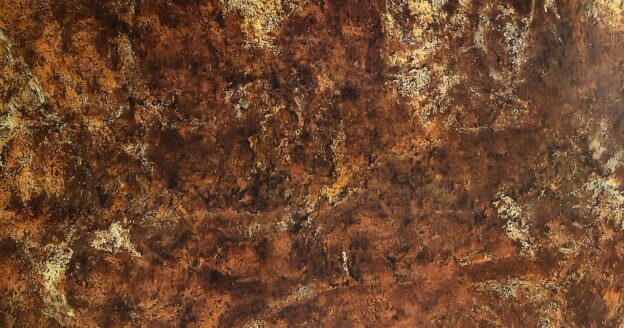
Patrick Huse, Discharge & Fermentation I, oil on canvas 200 x 420 cm
JKG: Nature in art exceeds a landscape vision and we ourselves are a part of nature. How do you perceive landscape – as a verb or a noun?
PH: With or without man, the landscape is a noun. Man is both the solution and part of the problem.
JKG: Cultures that are truly integrated with nature generally don’t destroy the world they are part of. The Sami, or the Innu, for instance, are peoples you know well.
PH: Noam Chomsky, somewhere said, indigenous people have the solution. If we relate to traditional knowledge I to a large degree, agree. If you go to remote settlements the consumption is low and pollution accordingly. The problem today is that the whole planet is infected with extreme growth and market economy. To me the simplicity of remote settlements talks to me in a manner I can recognize and affect me deeply, partly because it gives room for meditation and gives us more of the economy we have least of. It’s called time.

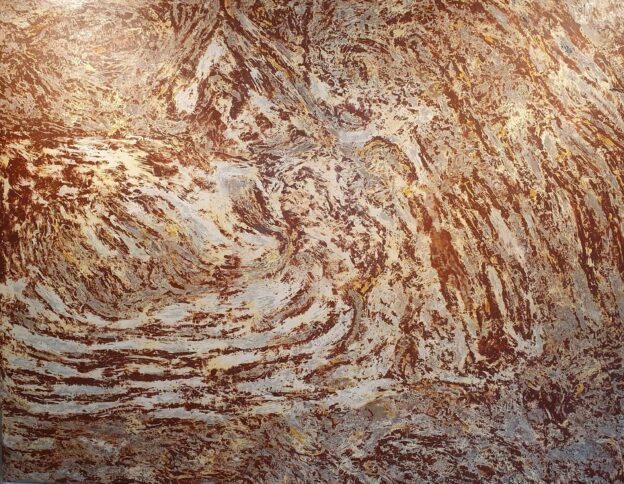
Patrick Huse, Ideal Destination, oil on canvas, 180 x 180 cm
JKG: Iceland is a land that seem to be in perpetual transformation. Your Rift series inspired by the landscapes of Iceland are very “empty” spatial zones, almost otherworldly. The details have an abstract essence and are still based in real elements one finds in such environments. How do you choose where you work? Why are you drawn to these places?
PH: Iceland became in a way a picture of the opposition between nature and culture for me. While culture constantly expresses preservation, the Icelandic landscape visually clearly shows that nature is constantly changing, happening with or without our influence. This spoke to me on a human level, this nature of which we are also a part of. This experience was in many ways groundbreaking, both in my artistic work and my understanding of nature. In the RIFT project I selected the lava landscape in all its dimensions. There is something fundamental about it. You use the word “empty”. Empty in our Western world is when the landscape has no cultural objects in it. How can a landscape be empty when it’s filled with itself? So “empty” in this context is cultural construction and will only reduce the landscape’s inherent intrinsic value.
JKG: And what is your process? Do landscapes without people or cultural references have a value as yet not integrated into aesthetics tautologies precisely because we see landscape as a resource, or in art, as a subject?
PH: We cannot recreate nature or the part of nature we call landscape. At its best, at different levels, we can only cultivate it. Folke Edwards, the Swedish art historian ones wrote: “Man exists there only through his absence, as a ritual memory of the past”.
JKG: Do you believe there is a power dynamic to way of representing the land in art and how do you deal with that?
PH: I do not really understand the question, but what you give value becomes valuable.
JKG: I see your approach as non-conformist. I believe you see a lot of art being made as a kind of process of simplification and reduction of meaning. All this encourages a fearful denial of the physics and entropic processes that are life…
PH: It seems that the world is going towards a meaningless state, but to reduce meaning you need meaning. I have my own background and my own experiences and I would like to shape my own future based on my own experience. For me, life is a valuable place and I like to live in my experience. It is a meaningful life and I try to give meaning to something I find valuable.
With life as in nature, one thing that makes nature interesting is its uninterrupted interaction with the past.
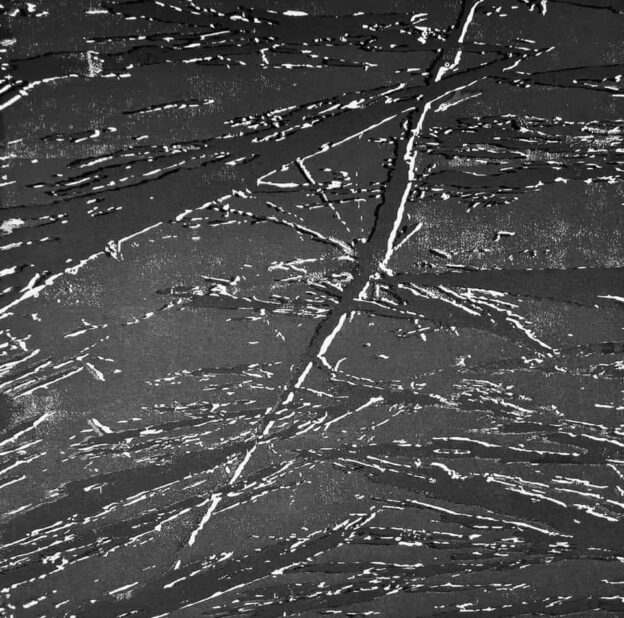
Patrick Huse, Increasing Violence II woodcut
JKG: And it often seems the art world seeks to deny that connectedness to the past. Does your art relate to storytelling? Often, we sense a narrative on place and identity that relates to geological history, and a more personal human history of perceiving a place that relates to memory…
PH: Of course, to understand the land, we need stories. All art has a local source and local knowledge is a prerequisite, and history, memory or memoryscape, together with local knowledge with its inherent content, within all this storytelling is a major source.
By “local knowledge” we most often mean such knowledge that arises from, and is applicable in a local setting, within a locality or social group. This would most obviously include knowledge of terrain, place names, social structures, and individuals (currently living or noted in histories), knowledge of locally applied technology and general daily usage. Less obvious but no less important, local knowledge in any linguistic content involves a familiarity with idioms, etymology, common metaphors and similes, folk tales, popular songs and poetry and even common gossip and prejudice. These two broad categories are always closely intertwined and can only be separated by an external, artificial division, i.e. in some metalanguage.
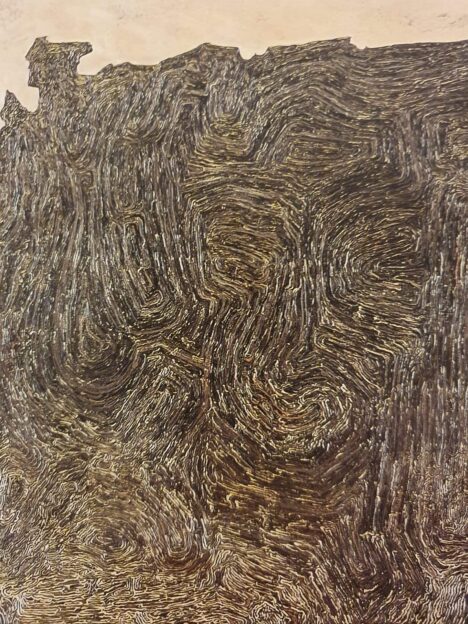
Patrick Huse, Merging Points, 190 x 180 cm
JKG: Your intricate drawings of these places and spaces up north near Jotunheimen largely pass unobserved as “land”, and challenge the idea of ownership in art where a painting becomes a kind of conquest of real estate. There is a kind of neutrality in your treatment of the textures, structure, and space you draw that challenges aesthetic and stylistic hierarchies….
PH: Both my paintings and drawings are represented with a large number of details. Some people call it “Mannerism”. If you go close to nature, you will recognize that nature consists of millions of details that are necessary for the whole. So, in my drawings and paintings there is no difference in the execution of the artwork and from corner to corner. They are equally treated. No beginning and no end. You could claim it’s principally a political attitude or decision. Anyway, I know hierarchies exist and I find them oppressive and they often serves underlaying motives. Somehow, my art practice questions the “system”.
JKG: Could you tell more about your ongoing and ambitious Harvesting Wasteland project?
PH: My ongoing Harvesting Wasteland project is a landscape project with a compound content, which could be interpreted in different directions. What is, or does ‘Harvesting Wasteland’ actually mean?
Is it an attitude, a place, a utopian dream, or a social topic?
Is it a border land between reality and abstraction?
Can it be an artistic quest for affiliation?
Is it strategy in an inhospitable environment?
Maybe it’s about survival in a “Wasteland” in the sense of creating a space for a personal or individual expression. Can in its own way be a socially critical project. The project consists of three main modules: Paintings: “Land Works”, drawings: “Emptiness and Source”, woodcuts: “War Zone” and it includes a video: “Revisiting Nature; Fragments of Time”.
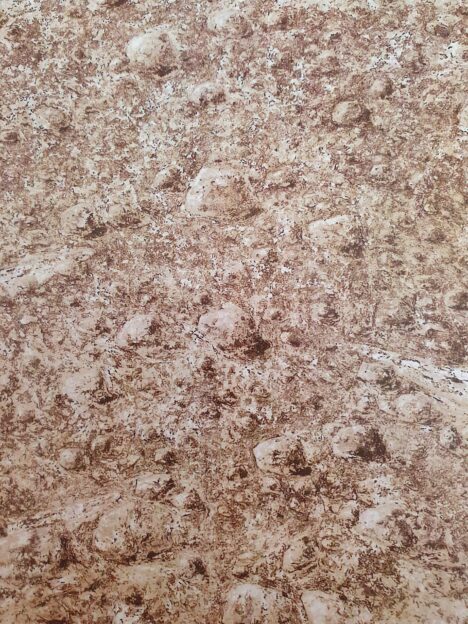
Patrick Huse, Arctic Surface, Oil on canvas 210 x 190 cm
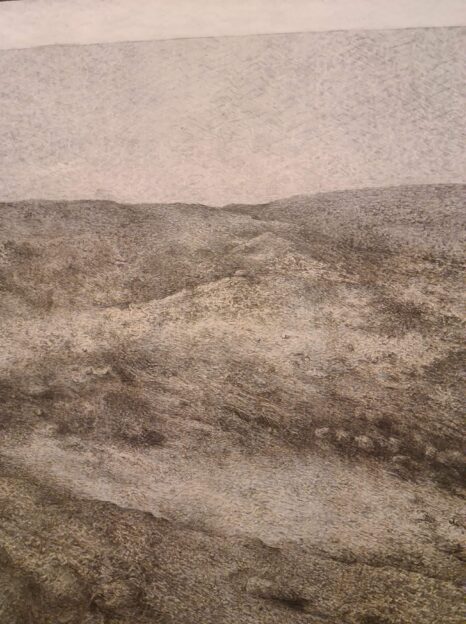
Patrick Huse, Arctic Landscape series III, drawing, 42 x 48 cm
The three environments are in Iceland, Northern Canada and Norway. Iceland is a modern society but with large new, uncultivated areas from recent volcanic activity, especially the area Snæfællsnes and the southern coast from Vik to Jøkulsarlon, areas relevant to my project. In arctic Canada, Devon Island, Nunavut territory, on the north side of the Northwest Passage’s east entrance, there is a crater after a large meteorite impact called The Haughton Crater with no vegetation. There are no inhabitants except for a large NASA Haughton Crater Research Project in the crater. Neighbouring islands have Inuit populations. Furthest south is the mountain range Jotunheimen in Norway reaching 1500-2400 meters above sea level. The area from Steindalen towards Rasletind is a mythical place, but not inhabited. All these landscapes are between the +61 to the +75 northern latitude.
As the Norwegian art historian Holger Koefoed has written: “Few artists have searched towards the extreme North, where Huse has found meaning in different types of “Wastelands”. His art projects are also full of existential questions. In his paintings and drawings, Huse chooses to concentrate on mountains, rocks, and new volcanic stone formations. Harvesting Wasteland has a geological approach at the core of its artistic aims. The artist is not forgetting about the fragile environmental situation and the fact that his projects come at the end of an era. He has travelled far to reach these inhospitable places to find “nothing” and then went to extremes to make some kind of harvest. This text focuses on some possible artistic aims and their theoretical implications. His paintings and drawings are at the core of this investigation”.
JKG: Thanks so much for sharing some of your knowledge and experience Patrick.
…………………………………….
All images copyright and courtesy of Patrick Huse
Get the Full Experience
Read the rest of this article, and view all articles in full from just £10 for 3 months.
No comments yet.