The Boglands are Breathing
Siobhán McDonald is an Irish artist based in Dublin. In a practice that emphasizes field work and collaboration she works with natural materials, withdrawing them from their cycles of generation, growth and decay. Her solo exhibition, ‘The Boglands are Breathing’, presents a new body of work that critically explores the role of boglands as both repositories of our past and guardians of our future. In a multifaceted body of work, Siobhán McDonald blends scientific and creative processes to make sculpture, video, works on paper, paintings and sound pieces.
Siobhán McDonald’s solo exhibition, The Boglands are Breathing, presents a new body of work that explores the role of boglands as both repositories of our past and guardians of our future. Boglands are mythical places where the most important changes of contemporary times are taking place. The artist, Joseph Beuys described them as “the liveliest elements in the European landscape, not just [for] flora, birds and animals, but as storing places of life, mystery and chemical change, preservers of ancient history.” The Boglands are Breathing responds directly to this thinking to encourage awareness of the cultural, historical, biological and climatic significance of bogs.
In a multifaceted body of work, Siobhán blends scientific and creative processes to make sculpture, video, works on paper, paintings and sound pieces. Our shared boglands are positioned as the protagonists of an unseen drama, and this work makes visible the collective memory that is held in the rich repository that exists within the thin layer between the soil and the rocks. The exhibition gathers numerous collaborators, bringing together scientists, conservators, musicians, philosophers, perfumers and celestial phenomena, all of whom collectively take part in the evolution of the work.
Amongst the new work that anchors the exhibition is a an artistic response to the fascinating project ‘Unlocking Nature’s Pharmacy from Bogland Species (UNPBS)’ led by Professor Helen Sheridan, Academic Director of NatPro, Trinity Centre for Natural Products Research. An installation entitled ‘A library of lost smells,’ consisting of plant species, gathered from numerous bog sites across Ireland acts as a slow distillation of deep time created from plants and mineral rich bog waters, that explores links between smell & memory. The installation holds an assortment of hand blown glass bottles containing scent from eight of the most important notes. Some of the vessels contain scent infused remnants that were buried deep in a bog for over 20 years alluding to the low oxygen levels and unusual smells derived from the preservation conditions. The artwork employs the senses to cultivate an intimate, intuitive experience that aims to transport participants through time as a reminder of the medicinal properties in the pharmacy beneath our feet.
Inspired by NatPro’s approach to create connections to the ancient, rich and fertile landscapes and unique biodiversity that has accumulated over many millions of years, Siobhán explores how a number of these plants have historic documented use in ancient Medicine for a variety of cures which she sutured together into a delicate shroud. In particular she alludes to the magical properties of the low oxygen levels in bogs that provide unusual preservation conditions. In addition to low oxygen levels, sphagnum moss, of which the peat bog is composed, produces an antibiotic substance called sphagnan that binds with proteins on the surface of microorganisms, immobilising them. Above all the sphagnum moss causes organic material to undergo chemical changes itself that make it impervious to rot.
Driven by tales of plants and alchemy in Irish folklore, Siobhán created a scent library that aims to invite audiences to experiment with different time scales to imagine forms of preservation – over thousands of years of organic matter swallowed up, from tree stumps, bodies and sacred objects to plant life.
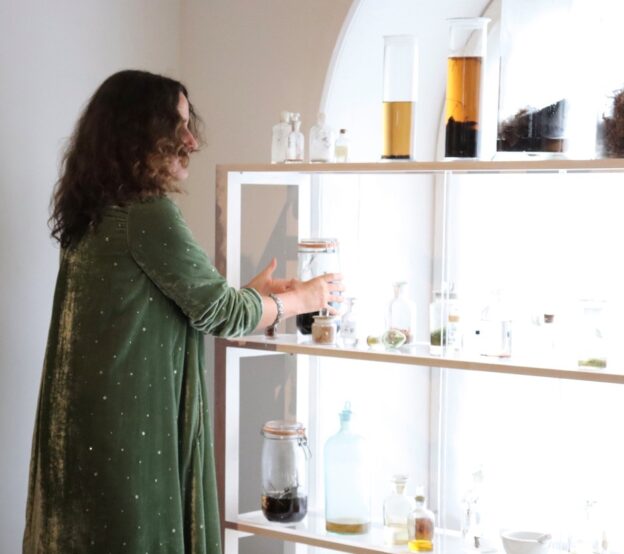
Library of Lost Smells, 2023, is a rich olfactory experience, created from plants and mineral rich bog waters, that enables audiences to explore links between smell & memory and to connect to areas that no longer exist. This work will be activated on certain days throughout the exhibition when audiences will be enabled to smell the distillations.
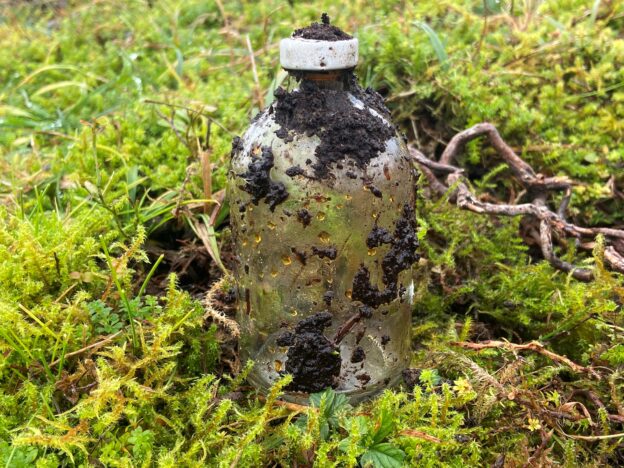
‘Do you think you could understand Bog Myrtle without smelling it?’ (2023)
Siobhán remarks .. “During the lockdown I walked across numerous bogs in acute awareness that the mist hovering over the pools contains molecules, memory and smell of deep time. In creating ‘A Library of lost smells,’ I wanted to create a living sculpture driven by tales of plants and alchemy in Irish folklore. I wanted to create something physical because smell is so difficult to visualise.”
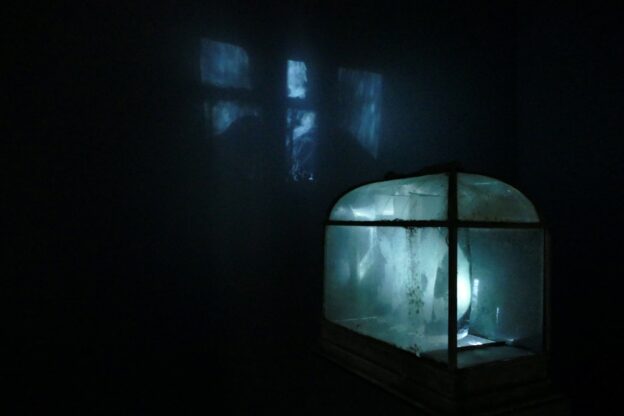
Filtered time (2023).
Inspired by the mystery of the fragmented Faddan More Psalter in which animal gut skin is sutured together with paintings of bog plants in a delicate shroud suspended in a state of transformation lingering between life and death.
Bogs were often used by Irish monks as hiding places for valuables. Skin, as a material was used for many years in the process of communicating and storing stories or histories – in the form of manuscripts. In reimagining this material for the exhibition, Siobhán links to the idea of the intuitive resonances of the natural body and shared cultural histories.
In the end Gallery, a glass house stands alone entitled Filtered Time, inspired by the mystery of the fragmented Faddan More Psalter in which animal gut skin is sutured together with paintings of bog plants in a delicate shroud suspended in a state of transformation lingering between life and death. The glass house that was reclaimed is illuminated by light and sound coming and going in the rhythms of human and plant breath. Siobhán worked with the Dr John Gillis, (chief manuscript conservator at Trinity College Dublin,) for many years in one of the purest conversations she has ever had in the creation of this artwork.
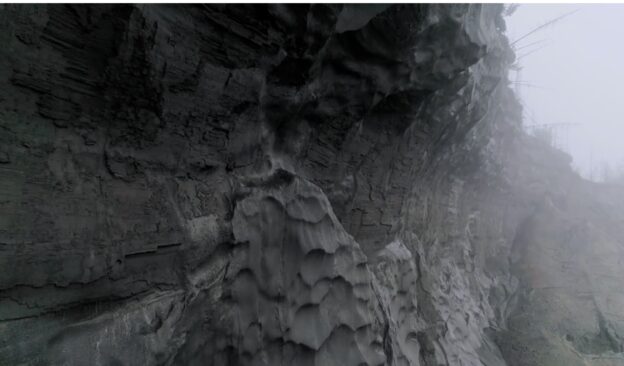
‘Methane Lake’ 2022
‘This video installation depicts ice that formed over bogs. I paint on large blocks of ice from different moments in history that have calved from the Arctic ice. The act of painting with invisible methane gas presents itself as a time capsule of the Earth 20,000 years ago, representing the imagined notion of a time we cannot go back to. I went on an expedition to explore this beautiful and vital Arctic ice which holds a memory that extends for millions of years into the past. The film explores the slow workings of geological processes found deep in permafrost, meditating on the sentience of ice. By painting on ice from different moments in history and letting them melt I am drawing the infinite concept of Ensō.
Ensō is rooted in Japanese calligraphy and closely related to the concept of wabi-sabi — the Japanese idea of the transience of all things. Ensō is a circle that has since ancient times been written with canes or sticks in mid-air.’
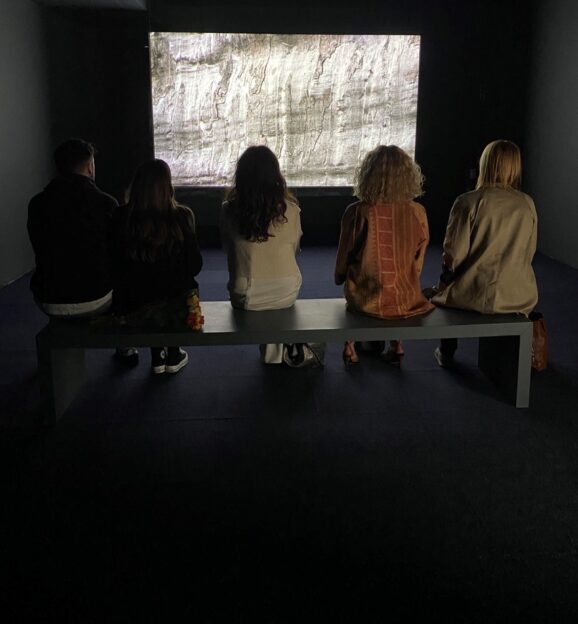
METHANE LAKE, Installation shot, The Model (2023) video installation that explores the slow workings of geological processes found deep in permafrost, meditating on the sentience of ice.
Another body of work responds to the global context of bogs at the poles. As our worlds ice disappears – out boglands are exposed. Theses massive landscapes hold many toxic gasses – like methane. And also many clues to the past in seeds and matter buried deep in the past. Methane Lake brings together themes spanning locations from the Arctic tundra to Irish bogland in an installation that explores the slow workings of geological processes found deep in permafrost, meditating on the sentience of ice. Siobhán began this aspect of the work by spending two years at international cultural institutions including the Palais de Bozar, Brussels and the EU Commission in Ispra to research the power of ‘bogs’ to transform our air. While in tandem, back home she explored numerous bogs such Bragan mountain to consider ideas around time and the preservation of collective memory in that thin layer between peat and plants.
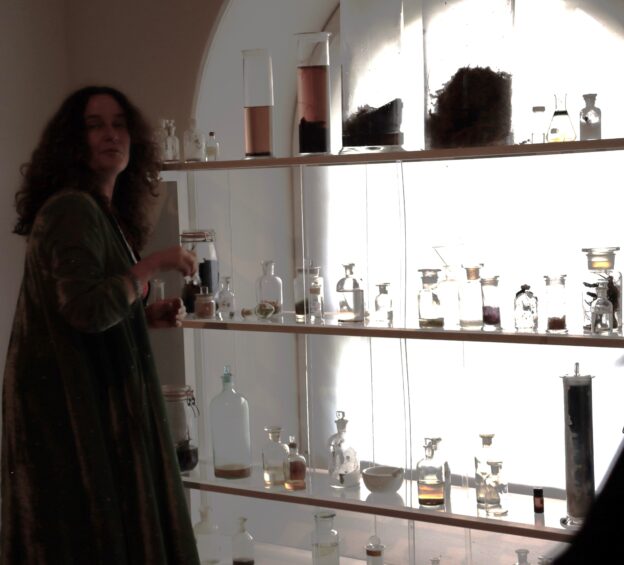
A Library of Lost Smells (2023)
Is a slow distillation of deep time created from plants and mineral rich bog waters, that explores links between smell & memory. The installation holds an assortment of hand blown glass bottles containing scent from eight of the most important notes. Some of the vessels contain scent infused remnants that were buried deep in a bog for over 20 years alluding to the low oxygen levels and unusual smells derived from the preservation conditions. The artwork employs the senses to cultivate an intimate, intuitive experience that aims to transport participants through time as a reminder of the medicinal properties in the pharmacy beneath our feet.
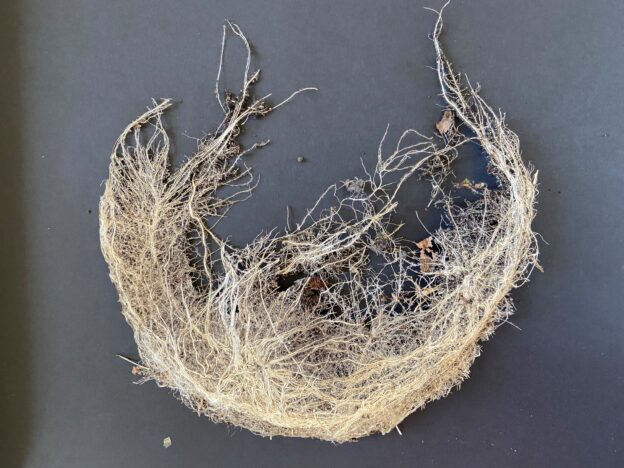
A root looking for the sun (2023). Roots, peat and quartz
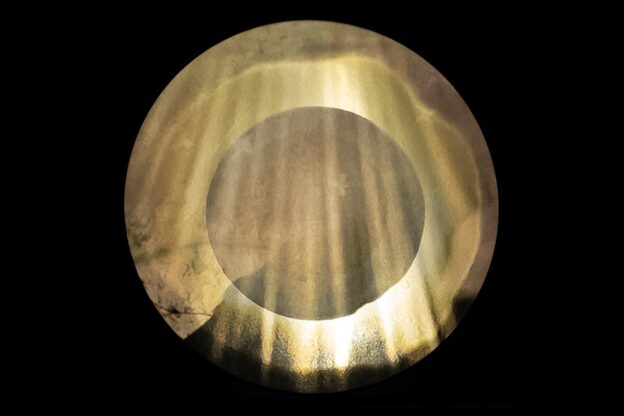
‘The week the sun touched the earth for EMMA’ (2022). Oil painting, film and easel.
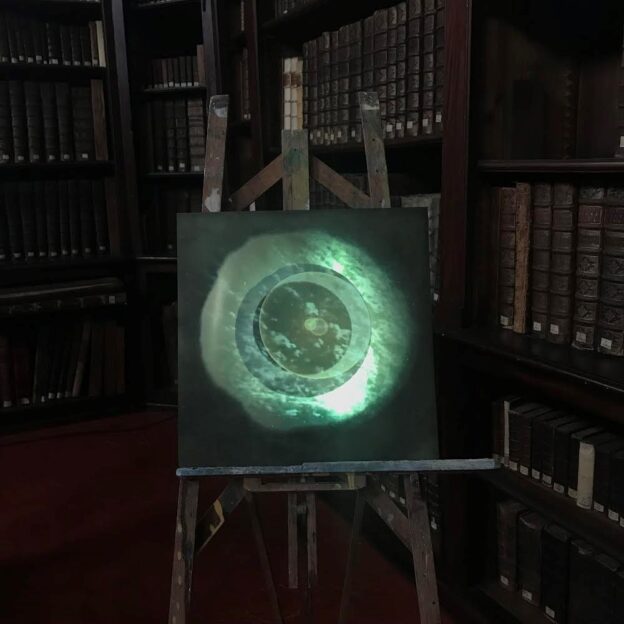
The week the sun touched the earth for EMMA (2022). Oil painting, film and easel.
The week the sun touched the earth for EMMA aims to capture the act of looking at solar storms whose magnetic fields have a direct impact on our bogs. The film employs multiple drawings and images of solar storm eruptions that frame distant images of a dancer walking across the sun. The projection aims to capture the phenomenological act of looking and seeing solar storms which occur on the North and South Poles as a double virtual reflection. The movement is portrayed by my dear friend, the late Emma O’Kane. Her exquisite movements explore the sun through dance and point to places beyond our imagination. She literally embodies the movement of light behind the horizon. The film uses special NASA solar lenses adapted for the project to explore realms and perceptions of reality and conjure up a deep past.
Collaboration with ESA and DIAS for the launch of Solar Orbiter.
Film maker: Christopher Ash
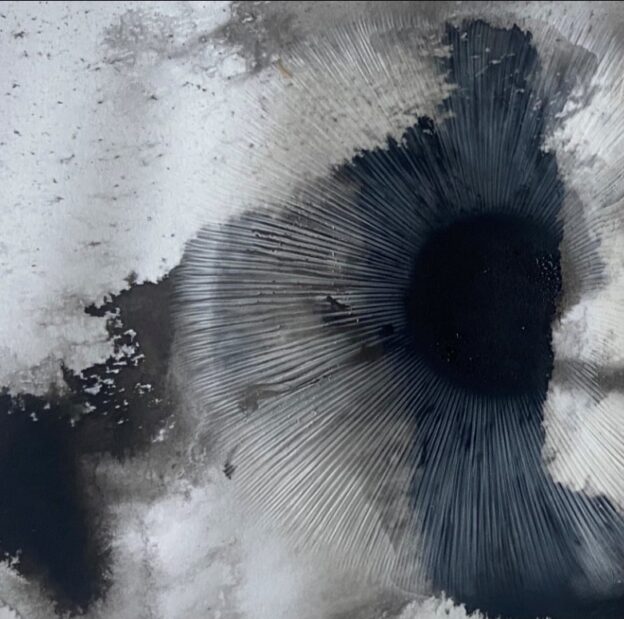
Cosmic Gas I (2022)
Painting and Chine collé on German etching paper: plant fragments collected from bog sites and glaciers. Created through invisible methane gas. The prints painted with an ink of methane pollution extracted from the bogs, reproduce images of solar eclipses from a 1905 Sonnenfinsternis-Expedition.
Cosmic Gas featured in Gallery B fuses materials derived from poisonous invisible methane gas and explores the question: what manages to live in the ruins we have made? Consisting of both drawings, paintings and lithographic prints, they bear the direct imprint of plant fragments collected from bog sites, matter from what used to be living organisms, which over time have become gaseous. The drawings appear delicate and complex, conveying the light and dark histories from which they emerge – recounting stories of life and decay – from remedy/medicine to the poisoning of an ecosystem. The work is rooted in the medieval mythology of boglands as a cultural preserver, offering an insight into ancient pagan times. The strange landscape of boglands with many rare geographical features and occurrences explains the large mythology surrounding it. Tim Robinson, remarked on an Irish bog: ‘Mind is being reabsorbed into matter; humanity’s imposition of languages, order, meaning, is being sucked down and choked off by nature.’ Maybe it is this mysterious timelessness that places the bogs as reminders that we are not mortal. That we are made of the same material.
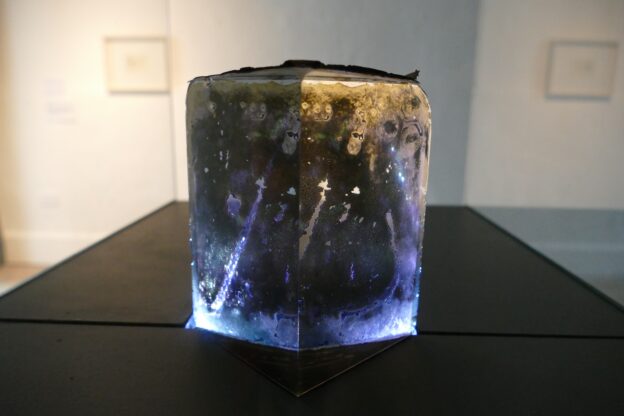
STUDY FOR A VOLCANO (2020)
Study for a volcano’ (2020) Eyjafjallajökull 2010 eruption film through glass prism, 2:20 mins a glass prism embellished with volcanic ash, air particles and 24 karat gold.
The installation is composed of a of glass prism embellished from the repeated application of thin, transparent layers of pigment made from volcanic ash to form an optical quality surface. The prism appears static, but when you look closely the film projections make the reflections on the surfaces distinct. The work focuses on air and how we, as humans, can affect our surroundings
Filmmaker, Christopher Ash.
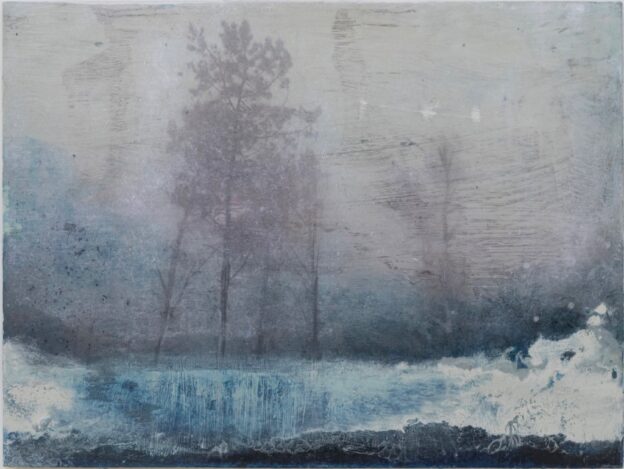
The trees are whispering (2023). Oil paint on board
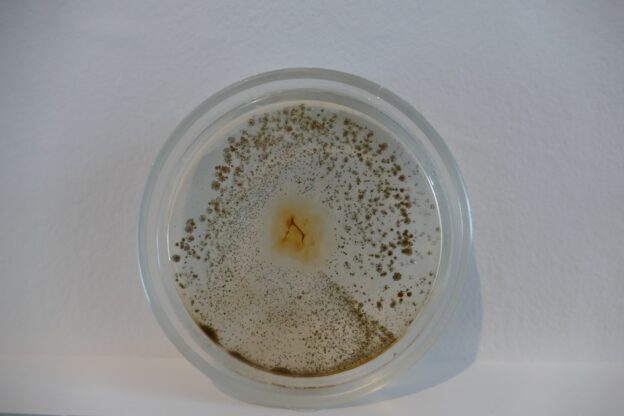
Understory (2023)
Mycelium drawings on glass.
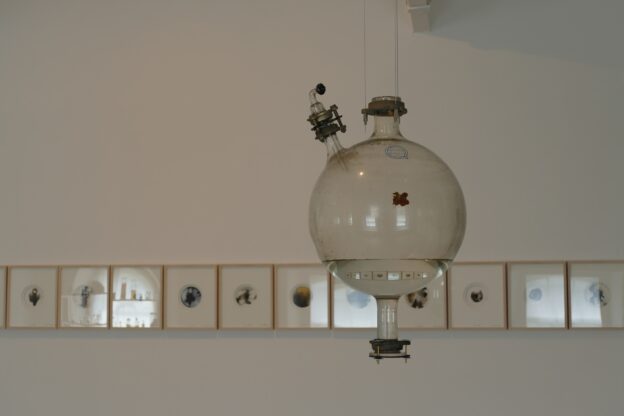
‘Time isn’t deep’ (2023). Greenland water, hand blown glass air vessel
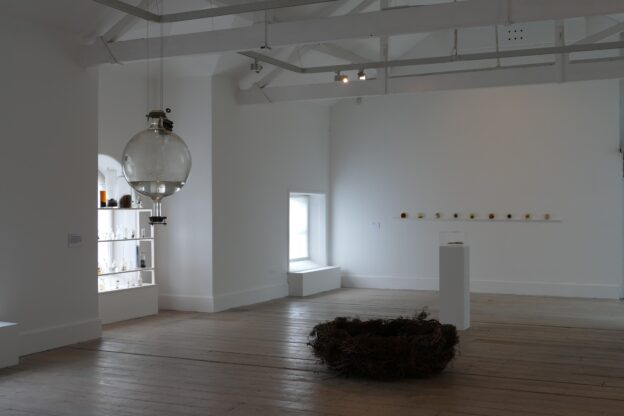
Gallery Installation shot (2023). The Model.
The Boglands are Breathing continues at The Model, The Mall, Sligo, F91 TP20 until Sat. 8 July, 2023.
Commissioned by The Model with funding from an Arts Council Project Award. Supported by NatPro: Trinity College Dublin and Creative Ireland.
Part of the exhibition in Gallery C is primarily an artistic response to the project ‘Unlocking Nature’s Pharmacy from Bogland Species (UNPBS)’ led by Professor Helen Sheridan, Academic Director of NatPro, Trinity Centre for Natural Products Research.
………………………………………..
All images copyright and courtesy of Siobhán McDonald
Get the Full Experience
Read the rest of this article, and view all articles in full from just £10 for 3 months.
No comments yet.