Celebrating our connection to the land
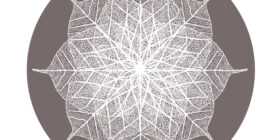
Hillary Waters Fayle combines textiles and printmaking techniques with found botanical and organic material, exploring the symbolism, geometry and patterns found in nature. From simple lines and ribbing to fully rendered botanics, the thread-based embellishments interrupt the fragile matter. The resulting sculptures evidence nature’s durability while juxtaposing the organic material with the fabricated additions.

Needle+Thread – Blooms for Grace, 2021
Richard Bright: Can we begin by you saying something about your background?
Hillary Waters Fayle: I grew up in a small town outside of Buffalo, NY, which at that time felt quite rural and has since been heavily developed. Where now there are endless houses, there were fields and woods. I went to public school and enjoyed the privilege of being able to take art classes, which I loved most of all the other subjects. In the summer I spent a lot of the time outside, gardening with my mom and grandmother, playing in the woods and the creeks, but when I wasn’t doing that, I was usually either reading or making some kind of art. I loved the idea that I could make objects that might add beauty to my life, but at a young age the only accessible materials were needle and thread, and I learned to sew and embroider.
When I was a young teenager, I attended a summer camp that focused on environmental education; it was here that my love for learning about nature, especially plants, was cultivated. With some difficulty I chose to study art over natural sciences at Buffalo State College, where I earned a BFA in Fiber/Textile Design and later a MFA in Craft/Material Studies from Virginia Commonwealth University. Although I chose to formally study art and textile design, my passion for learning about nature and plants has never ebbed.

There All Along 2
RB: What is the underlying focus of your work? In particular, what are the thinking processes and knowledge practices that guide your artistic research and work?
HWF: I’ve found that my perception of what I’m doing shifts over time, and over time more and more about my own motivations and influences becomes clear to me. My underlying focus as I understand it at this moment is bringing together elements of nature and culture and my motivations for doing this are varied in different bodies of work, but ultimately can be distilled into celebrating our connection to the land.
I bring together materials and processes that express the union of humanity and the natural world, most often textile traditions in collaboration with botanical material. These pieces explore our deep historical and lived experience with cloth and the botany that surrounds and supports us– a connection I feel to be both powerful and ever present– grounding us in time and place, binding us to past and future.
Whether stitching, drawing, planting seeds, or harvesting, my hands echo the gestures made by thousands of hands over thousands of years and I feel connected to the lineage of people working with textiles, plants and the land. Stitching, like horticulture, can be functional– a technical solution to join materials/a means of survival– or, both can be done purely in service of the soul, lifting the spirit through beauty and wonder.

Needles+Thread
RB: Have there been any particular influences to your ideas and artwork?
HWF: I was inspired early on by my mother’s mother, who was an avid gardener and who taught me to sew, and my father’s mother, who instilled a love of all things Irish, which is our lineage. There are some interesting connections I can make now about what I was drawn to as a child- for instance, I was fascinated by the intricate patterns I found in the books she gave me, especially the illuminated manuscripts of the Book of Kells. In looking at these images now, I see them as two-dimensional drawings of knots and thread. I also always loved William Morris’s work, which I now see also as a gorgeous and stylized way of combining botanical imagery with the structure of weaving lace and knots. I also loved crocheted doilies, despite their fussy-fuddy, outdated aesthetic in the home, I was fascinated by the elaborate and complex patterns, which I now connect to images of mandalas and geometric patterns which have certainly inspired my work.
I believe all material holds meaning, and this is such an important consideration for me. I work within the discipline of craft, pulling from traditional ways of making- when working within the boundaries of tradition I feel it’s important to acknowledge and embrace the inherent context of the materials and processes I use. The material I choose to work with, mostly botanical, has its own history, both as a species independent of us and also in relation to our interactions. Although I am not indigenous, I find tremendous inspiration in indigenous ways of relating to plants and the land, and this certainly guides aspects of my work. As part of my work involves taking from the land, I always abide by the rules of the honorable harvest, as outlined so beautifully by Robin Wall Kimmerer in her book, Braiding Sweetgrass.
Perhaps above all else, I’m inspired by beauty and wonder- I think both beauty and wonder tend to be trivialised in art, but I believe exposure to beauty and wonder nourish us in ways I have a difficult time putting words to. There is a quote by the poet and mystic John O’Donohue that has always stuck with me, “Beauty is that, in the presence of which, you feel more alive.”

Needles+Thread
RB: Can you say something about your Needle + Thread series and the inspiration behind the work?
HWF: While I was in college, I had the wonderful opportunity to study abroad in the UK. There was an embroidery program at Manchester Metropolitan University, where I fell deeply in love with the complex family of ‘insertion stitches’. These stitches are both functional and elaborate, meant to join two pieces of fabric together but in a most exquisite way. I began using them almost exclusively during this time, and on any material, I could find small bits and bobs, clothing tags, paper, scraps of this and that. Anything I could get a needle through. I finished my term in the UK and came back to the US, where I had a summer job as “camp cook” at the very same summer camp I’d attended as a teenager. I was refocused on environmental education and my passion for nature, and it was here that I by chance looked up at a beautiful old oak tree and noticed the thick, tough leaves. I wondered if I might be able to stitch on them, and when it worked, I felt almost immediately that it was the best thing I’d ever made. I think this was really the first time I’d been able to bring my passion for nature and textile arts together, and in that combination, I felt able to explore the possibility and metaphor of gentle and careful collaboration with nature.

Needles+Thread

Needles+Thread

Needles+Thread

Needles+Thread – Blooms for Better Days (detail)
RB: Your completed works are delicately three-dimensional. Can you say something about your technique and how you have developed it?
HWF: Working with leaves and other botanical material is not like working with fabric or canvas or paper, every leaf is different and reflects the life it’s lived- insect holes, drought, sunburn, blight. I have a reverence for the material I work with and I find leaves, as simple as they may seem, to be incredibly complex and gorgeous, and always stronger than they seem. I have found that certain leaves work better than others, of course, and working with certain species while they are fresh vs dried or vice versa can be advantageous. Over years of working with leaves, I’ve found ways to hold and work with them that don’t tear or destroy them, but essentially, I’m just being very careful and gentle.
Pressing the leaves for preservation is the way leaves have been preserved historically, and there are some herbariums in existence that have intact specimens which are hundreds of years old. My work isn’t pressed as long, nor is it protected from UV light in the same way, but I do suspect that my leaves, preserved in this way will be here longer than I will.
In pressing the leaves, the moisture evaporates at an even rate, so the leaves do not curl up as they might outside. They do relax a bit as I work with them, though and there is a subtle dimensionality to the finished work.

Knife+Leaf – cutcut
RB: What is the role of empty spaces or transparency in your art works, particularly in the Knife + Leaf pieces?
HWF: In these works, which are actually much faster than stitching, I’m removing material instead of adding more, so the process is totally diferrent and the negative space creates the pattern or image. Whether cutting or stitching, adding or subtracting, I’m paying close attention to what the leaf might withstand, and taking that into consideration as I work. I don’t so much think about the idea of transparency as much as I think about the idea of something being revealed. My favorite of these pieces are those which collaborate with the leaf in some way, responding to the patterns and textures already present.

Knife+Leaf

Knife+Leaf – Moving Towards
RB: In many ways our human brains interpret information through pattern recognition and re-arranging pattern, which is an evolving dynamic process. What importance does pattern play in your work?
HWF: Pattern exploration is a through line in all of my work, and I would consider pattern to be one of my most important influences. I look at pattern all the time, in historical textiles from around the world, in geometry, in Islamic art, in nature, the decorative arts-pattern is truly everywhere, and it feels like an endless well of inspiration. Beyond being beautiful and captivating, pattern can hold historic and symbolic meaning, and I’m very interested in this as well. I find the combination of meaningful pattern, process and material to be very powerful.
RB: Can you say something about your Portraits of Place series and its connection with a project for the Grace Farms Foundation?
HWF: Portraits of Place is an ongoing series of site-specific pieces that I’ve been working on for the last four years. I see these pieces as a tribute to the land, and to honoring our relationship with that land. The story of the land is in the plants that grow there, and these pieces tell that story. What grows in any particular place today is a record of not only our interactions, but also an echo of everyone and everything that came before, every drought or storm, every hand that tilled the ground, planted or cut a tree, tended a garden, every deer that grazed, every bird that dropped a seed.
In this series, I’m only using the plants of a specific place, to create an arrangement which reflects that land, or the story of that land made visible. Botanical material is carefully collected and pressed, and then once dried, arranged on and adhered to acrylic. Each leaf is placed with careful consideration into an elaborate, mandala-like pattern, every leaf and petal fitting together, using inscribed circles and squares as an underlying scaffold. I feel the resulting arrangements reference the inherent repeating patterns underlying everything in the natural world- echoed in our own lived and spiritual experiences, and the idea of interconnectivity.

Portaits of Place – Grace Farms Foundation, New Canaan, CT

Portraits of Place -Grace Farms Foundations, New Canaan, CT
Grace Farms sits on 80 acres of natural landscape in New Canaan, CT, and is home to nature trails, restored meadows, and a diverse natural habitat that invites exploration and reflection. Grace Farms Foundation’s interdisciplinary humanitarian mission is to pursue peace through nature, arts, justice, community, faith, and Design for Freedom, a new movement to remove forced labor from the built environment. It was such an honor to work with Grace Farms to create a Portrait of Place that reflects not only the land but pays tribute to all that Grace Farms stands for and works toward.

Portraits of Place – Maymont Park, Richmond, VA

Portraits of Place Chisman Creek Park, Tidewater, Virginia (detail)
RB: How has your artwork evolved from the very first pieces?
HWF: Over the years I’ve grown as an artist and the work I’m capable of making now is more ambitious, more skilled, and shifted in scale, but essentially the same. I certainly have a different perspective now, and I’m able to see and contextualize what I’m doing more clearly. I’ve tried and tested so many different techniques and materials over the years, but there is so much that I’ve thought about and not yet had time to explore, bringing some of these ideas to life is something I look forward to doing in the future.
RB: What future projects are you currently working on?
HWF: I’ve just finished some bigger projects and I have a bit of time to reset and just be less pressured in the studio, which I’m very much looking forward to. I have a lot of collected material specific to different places that is currently being pressed. When the pressing is done and I have time, I’ll begin turning them into Portraits of Place. Certainly, starting some of the projects I’ve dreamed about is next on my list as well.
……………………………………..
All images copyright and courtesy of Hillary Waters Fayle
Get the Full Experience
Read the rest of this article, and view all articles in full from just £10 for 3 months.
No comments yet.