Carolin Antos, University of Konstanz and Balthasar Grabmayr, University of Tübingen
OpenAI recently announced that one of its AI models solved one of the hardest problems in modern mathematics: the Navier–Stokes problem. The equations at the heart of this problem describe the movement of fluids like water and, according to the scientific definition, air.
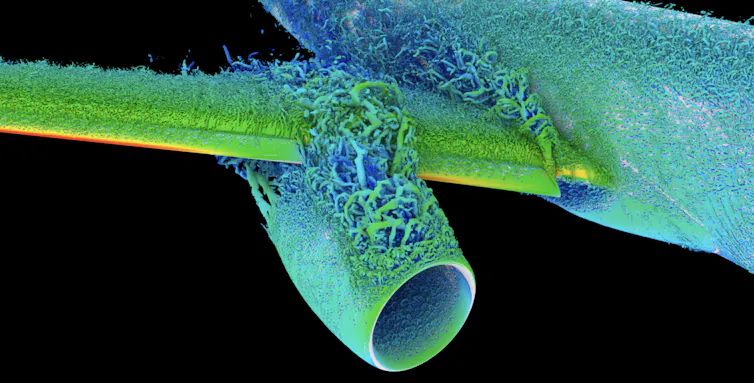
The Navier-Stokes equations are essential to understanding phenomena such as ocean currents, blood circulation, and airflow over airplane wings. Yet, mathematicians have struggled for decades to determine whether coherent solutions to these equations exist.
It was for this reason that the US-based Clay Mathematics Institute, which is dedicated to disseminating mathematical knowledge, chose the Navier-Stokes problem as one of its seven Millennium Prize Problems.
These are the most important and challenging unsolved problems in modern mathematics, with a prize of US$1 million (£746,000; €895,000) offered for the first correct solution to each. A problem that resisted generations of mathematicians thus has apparently been solved by artificial intelligence.
While these advancements sent shock waves through the mathematical world, they seem to be only the tip of the iceberg: On October 6 2026, OpenAI presented its solutions to more than 300 longstanding unsolved problems across most areas of mathematics with their new internal model.
Does this mark the end of mathematics as a human endeavour? Answering this question requires a closer look at mathematical proofs. Broadly speaking, a proof is an argument for a mathematical claim that starts from generally accepted assumptions and proceeds through the different steps of reasoning for the claim.
Before mathematicians accept such an argument as a proof, they need to check that each step is correct. Computers can increasingly help with this task, but for major AI-generated results, human mathematical supervision and expertise remains indispensable.
However, a fully verified proof is not the end of the story. Mathematicians do not only want to know that a theorem is true; they also want to understand why it is true and what can be learned from its proof.
Professor Terence Tao, from Unversity of California, Los Angeles, is one of the world’s leading mathematicians and a prominent supporter of AI’s use in mathematics. He recently coined the term “proof digestion” for the many ways that mathematicians continue to work with a proof after its correctness has been established.
They may reorganise the proof around more natural concepts, streamline a complicated argument, connect it to existing mathematics, or extract methods that can be applied elsewhere. Proof digestion itself can be highly fruitful and produce new mathematics.
Continuing work
Even after a proof has been digested, the mathematical work is rarely done. Major mathematical results often become stepping stones towards new open problems. Important variants of the Navier-Stokes problem, for example, cannot be solved by the methods of the recent proof proposed by OpenAI. This is typical of major breakthroughs: their importance often lies not only in answering a long-standing question, but also in introducing novel mathematical concepts and opening up new lines of research.
Often, one proof simply is not enough. Mathematicians regularly search for new proofs of results that have already been proven. Take, for example, the Pythagorean Theorem: a² +b² = c². This relates to the three lengths of a right-angled triangle.
This result was proved in antiquity, yet a book published in the 1920s collects more than 300 proofs for the Pythagorean Theorem that have been established over the last two millennia. If the only purpose of a proof is to establish that a result is true, all but the earliest of these proofs would be redundant.
Nasa
Instead, the opposite is the case: different proofs may reveal new insights into why the result is true, uncover new connections to concepts from other mathematical areas, or suggest new methods of generalisation. Thus, proofs are not only valued for verifying mathematical results, but also for the explanation and understanding they provide.
What exactly makes a proof explanatory or illuminating is difficult to pin down – and remains an ongoing topic in the philosophy of mathematics. This makes explanation and understanding much less clear goals for AI than simply producing a correct proof.
The recent advancements in AI will likely transform mathematical practice profoundly. But mathematics is not simply the production of correct answers to unsolved problems. Proofs still need to be understood, reorganised, connected to other results and used to generate new questions.
As AI models become ever more effective at producing proofs, these other parts of mathematical research may become increasingly important. In the near future, it may therefore matter less who – or what – can produce a proof, than whether this can be used for mathematical progress.
Carolin Antos, Assistant Professor of Philosophy, University of Konstanz and Balthasar Grabmayr, Assistant Professor of Philosophy, University of Tübingen
This article is republished from The Conversation under a Creative Commons license. Read the original article.


No comments yet.