Ludwika Ogorzelec: Shape in Time
The material of Ludwika Ogorzelec’s sculptures is space itself, and the line of wood, metal or glass is only the contour for the “crystals of space”. Her works are usually created in reference to the context of the cultures and places in which they are presented, most often in situ (in open space, often in architecturally shaped surroundings, in the interiors of exhibition halls of museums and galleries). In this interview with art and ecology author, John K. Grande, she discusses her ideas and work.
When Ludwika Ogorzelec first began to explore the notion of time, space and movement, it was when her professor Leon Podsiadly at the Academy of Fine Arts in Wroclaw, Poland who asked students to make a performance using their body. As she went walking on stilts she could feel how the body always adjusts, shifts to achieve an equilibrium.
Ogorzelec then began the Instruments of Equilibrium cycle project in 1981. Around 1990-1991 in Provincetown, Massachusetts, the Space Crystallization cycle was born. The Instruments of Equilibrium and the Space Crystallization cycles continue to the present in various manifestations.
A major exhibition of Ogorzelec’s art, I’m Looking for a Moment of Equilibrium, held at the Ujazdowski Castle Centre for Contemporary Art in 2021 led to her receiving the prestigious President Lech Kaczyński Award.
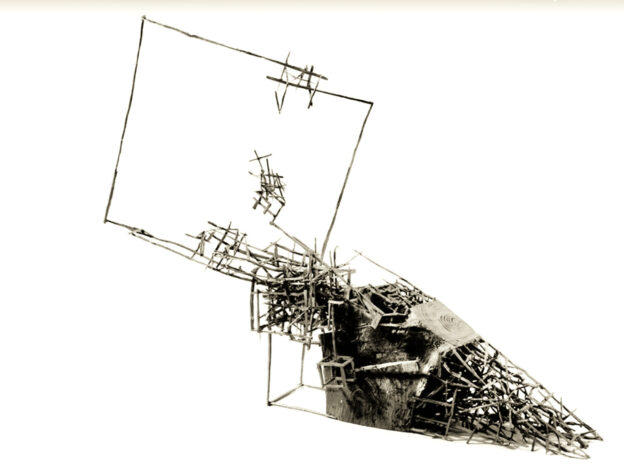
From ‘Instruments of Equlibrium’ cycle , wood , Paris, France, 1988

‘Anti-gravitation’ from ‘Space Crystallization’ cycle (one part of site-specific sculpture created for show at the Ujazdowski Castle Contemporary Art Center, in Warsaw , Poland, wood, 2020
John K. Grande: When did you begin the series of sculptures one saw at the Royal Botanical Gardens in Canada? Did you feel something artificial about the context of nature right next to the industrial steel mills in Hamilton. Nature was manufactured here, completely remade over industrial waste.
Ludwika Ogorzelec: I began this creative way in 1981. I called my first sculptures- mobile objects constructed only by lines” Instrument of Equilibrium” .
For me the most important-thirst medium is air and space. This is my basic material. Next, to make space visible, I introduce lines. The lines come from different kinds of materials. I choose the material I use for these lines in space to help me express my idea.
At the Royal Botanic Gardens the land next to my sculpture Atlantis which floats on water had been an iron mine. The area was industrially ravaged and when the industry finally ended the decision was made to create a natural park.
I have been heavily criticized for my use of plastic saran wrap in this installation.
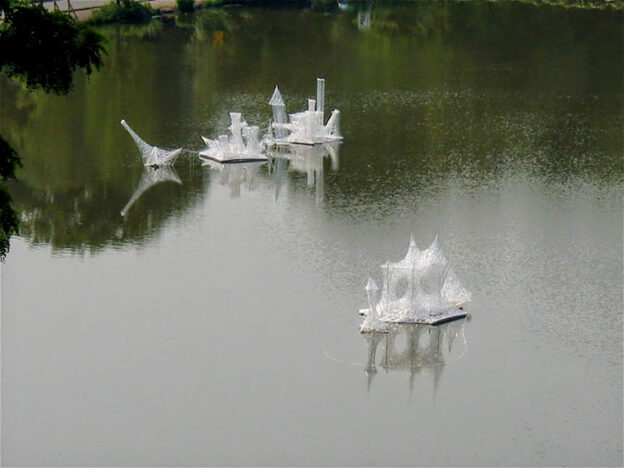
‘Atlantis!’ from the ‘Space Crystallization’ cycle at Royal Botanical Garden in Hamilton Ontario, Canada ( Art and Earth Sculpture Symposium curated by John K. Grande), 2008. Artist : Ludwika Ogorzelec
JKG: Under the nature, then, is this disrupted polluted landscape and so this is a multi-layered landscape. You. called it Atlantis – a fictional civilization that vanished due to human activity.
LO: I called this piece Atlantis 1 and later a second version in Key West, Florida, Atlantis. Again, this nature was superficially not natural, but a natural set up. Islands with bridges. Amid this tropical garden with artificial lakes, turtles, alligators, and other animals populate the site.
JKG: Yet though your sculpture are definitely environmentally attuned they do not always use “pure” natural materials.
LO: To seek a purity in use of “natural materials” misses the broader reality. My sculptures interface between culture and nature outside the gallery complex. People will rediscover this new definition of what art is and can be. Overpopulation, dislocation of environment… what is a true balance between human culture and nature? This is a good question. I create subjective works. I chose wood in the beginning and later adopted plastic and other materials.
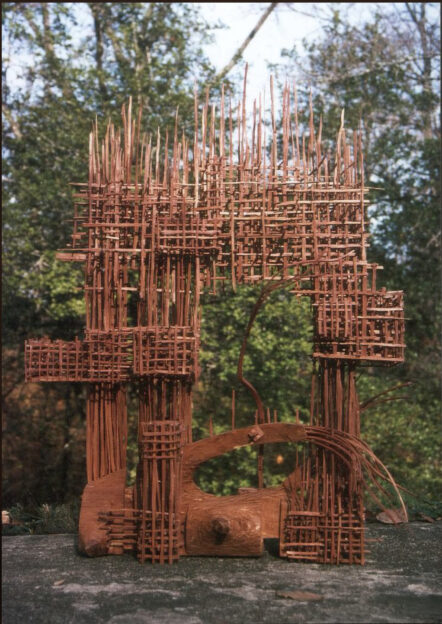
Part of the ‘Instruments of Equilibrium’ cycle, cedar wood, (created during Bernheim Forest Art Symposium, Kentucky, USA, 1999. Artist : Ludwika Ogorzelec
JKG: Sculptors from earlier generations used steel and industrial materials including Alexander Calder, Buckminster Fuller, David Smith…
LO: I seek something pure, with no signification. For example, paper has a lot of signification. Wood is made by nature. I follow the structures of wood – something simple, pure and noble.
I was once asked by a critic years ago “What is your sculpture?” and I replied, “Sculpture is a materialization of my dream delight” Ever since childhood my life was not easy. And this is why I like to escape this heaviness. I need a certain lightness to the sculpture. My work is a kind of materialization of my dream to be light.
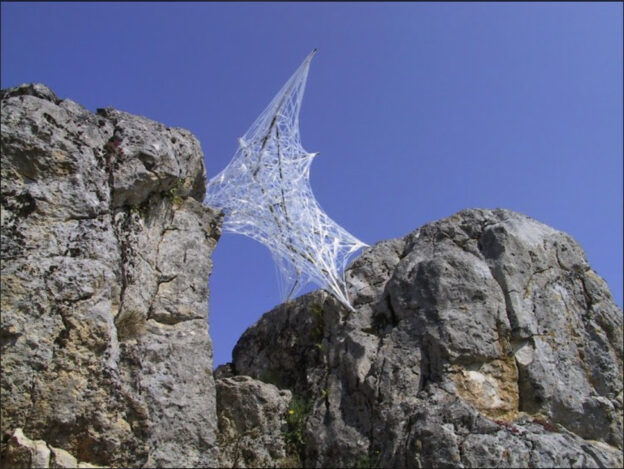
From the ‘Space Crystallization’ cycle, San Cirque Lapopie , South of France, industrial silk, 2002. Artist : Ludwika Ogorzelec.
JKG: Your work has links to earlier artists, like Barbara Hepworth who used strings and space as well.
LO: My work came simply from a line. I refuse to read art theory. I like to arrive at a lightness of being. In Poland I didn’t know of Alexander Calder though people started to say I was like Calder, but I used wood.
JKG: To recognize the impermanence of art, and even civilization is truly something.
LO: Narration is important in the world, building a story is important.
JG: Drawing in space initially with wood and then these more flexible materials
LO: My principle was line in space – because of space our eye cannot perceived because for me it is volume. Space is not empty. It is a conglomerate of many physical phenomena both acoustic and visible and my motivation is to make space visible and so I introduce the line. I started with lines in wood around 1980-1981 as a student in the art academy. I considered abstraction while creating traditional academic studies though studio model’s sculptures in clay were part of the training. Later I understood the human body is universal for understanding the hidden and visible construction
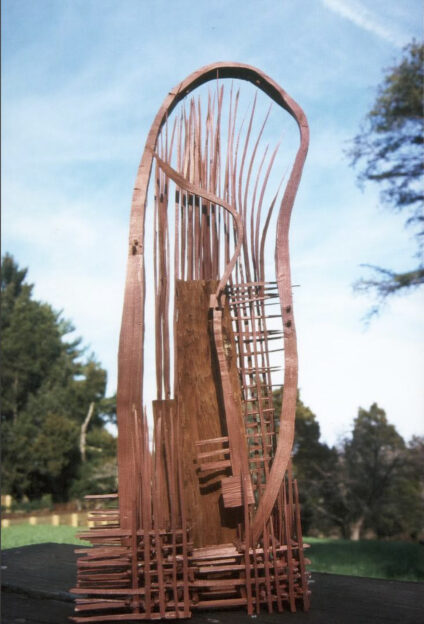
From the ‘Instruments of Equilibrium’ cycle, (created during Bernheim Forest Art Symposium), cedar wood, 1999. Artist : Ludwika Ogorzelec.
JKG: Many artists have a natural facility with abstraction. In a way you think like an engineer. You construct and build always specific to the space of exhibition or installation.
LO: For sure I am like a scientist. The phenomena that I cannot study fascinates and inspires me.
JKG: And you recently made a residence in Philadelphia in 2022 where art and science co-mingle.… What were the origins of this?
LO: I enacted my early performance in Poland walking with stilts. This is an exercise on how to make a performance that will describe your understanding of balance and equilibrium…. Making a performance has to do with balance. I remember from childhood I worked with stilts. While walking on stilts through space, I analysed my ways of perceiving space … Finally, the human body was a mechanism for maintaining balance. This was a revelation for me. It brought me to working with hanging mobile sculptures – the 4th dimension – time and movement as an added dimension. After walking on stilts, I needed to build a sculpture to evolve my research. I decided to build a sculpture to express this phenomenon of space perception. Proportion is very important in achieving this lightness. A lot of mathematics and geometry was involved.
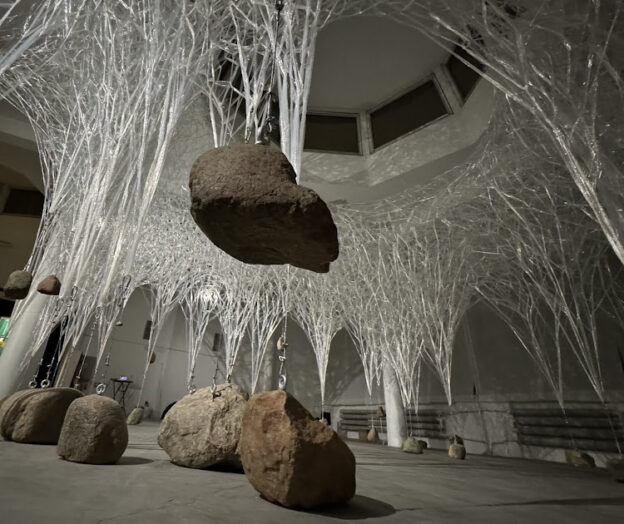
‘New Heaven’ from ‘Space Crystallization’ cycle, at RCPK Minska Praga Warsaw , Poland, industrial silk , stones and steel cables, 2023. Artist : Ludwika Ogorzelec.
JKG Mass, weight and equilibrium…
LO: My sculpture piece was a kind of illustration of this phenomenon on stilts and it stood on one point instead of two. The structure danced on air. The second structure was round and convex so it had a regular weight. And then the vertical wood element had to have a dimension to carry the art. This piece was not on a pedestal but it deranged the public. People needed to do something around formal art.
JKG: The idea of movement in art for me is one of the keys to evolving creativity. It enables you to edit the experience you encounter. This idea of art and movement (as with early performances on stilts) enable us to read reality in a transformative way as a changing phenomenon. which is not possible with static art. Robert Morris in the early 1970s did a lot of challenging installation work involving movement and the body relation to space… When you came to Paris, the nouveau realiste sculptor César invited you to work in his studio.
LO: César was not a real teacher – but he worked by exhibiting.
JKG: And César said you couldn’t be taught because you instinctively know things.
LO: César gave me the possibility to continue what I started in Poland. He was fascinated as my aesthetic contrasted what one found in Paris at the time.
JKG: Did you go to a lot of underground performance events in Poland – Tadeusz Kantor?
LO: Not Kantor but Jerzy Grotowski. People ask me who is your master – a trap-like question. I answer I don’t have a master. So finally, I found an answer but it was not pleasant, and I would answer Grotowski! Most people don’t know Grotowski (theatre). Jerzy Grotowski’s theatrical method influences my creative program. It concerned the answer to the question of what I want to achieve by crystallizing space, and what areas of human/spectator needs I would like to touch/influence with my creative proposal … and here is the commonality with Grotowski’s method which was to touch the first human sensitivity by removing him from the stereotypes of everyday life, and our habits (recorded in the subconscious), in order to prepare him for a new way of being and seeing – as Grotowski proposed. That’s how Grotowski’s method influenced my art program. I experienced this during the paratheatrical activity “The Tree of People” in the late 1970s. The impulse from these activities decided my choices, for my life and art! I realized that there is a subjective and objective world shaped by the conquest of civilization, of culture… the achievements of human thought. For my art I would draw from the objective world which is the cosmos, nature, and science as a tool for studying this objective world. … I would draw on that, not by copying its shapes, images, but by analyzing the mechanisms and quality of this world that keeps it in motion, balance, development/evolution, … I decided to be an artist similar to a scientist heading into unknown, yet undiscovered “aesthetic” areas. My “truth/idea” would be an invisible shape of air right next to me, and not a flashy fashionable aesthetics or a commercial trend … People had to make a link between theatre and art. The shape of space was my preoccupation; the natural cosmos and the human brain.
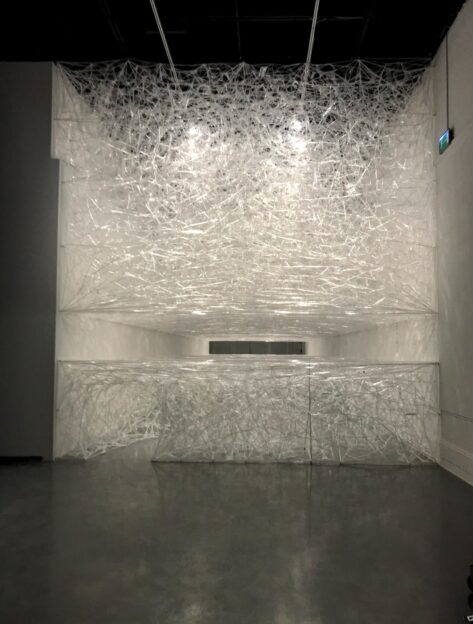
Ludwika Ogorzelec’s exhibition “Looking for the Moment of Balance” at the Ujazdowski Castle Centre for Contemporary Art, 2020 (Photo. Bartosz Górka)
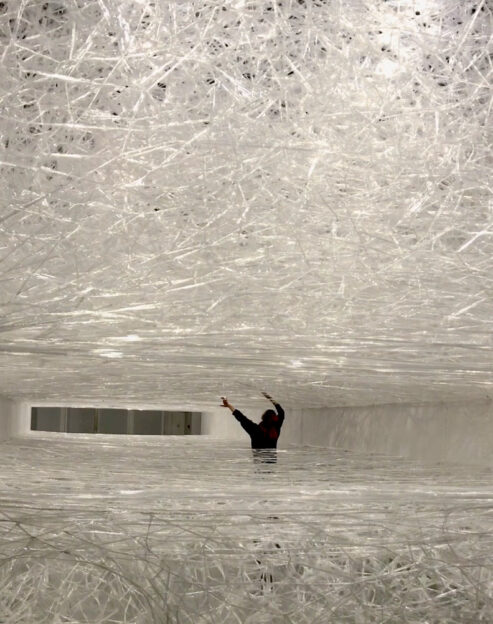
Ludwika Ogorzelec’s exhibition “Looking for the Moment of Balance” at the Ujazdowski Castle Centre for Contemporary Art, 2020 (Photo. Bartosz Górka)
JKG: It is so easy for sculpture to fall into craft. You walk a fine line between craft and high art. You have developed your ideas of space and sculpture as an environmental phenomenon that cannot exist within a craft world where technique is all. Technique can be a limitation on art…
LO: I know what painting is, what sculpture is. I transmit this way of attaching wood in a poetical way. This is not practical but creative. I am precise in my work. In my works, line speaks with the qualities of the material from which the work is made, the picture which it creates (various ordering and geometry, chaos, concentrations, shattering, rhythms, contrasts, similarities, the relationship between filled and not filled space) and the shape of line (simple, wavy, vertical or inclined). This is the extrinsic energy.
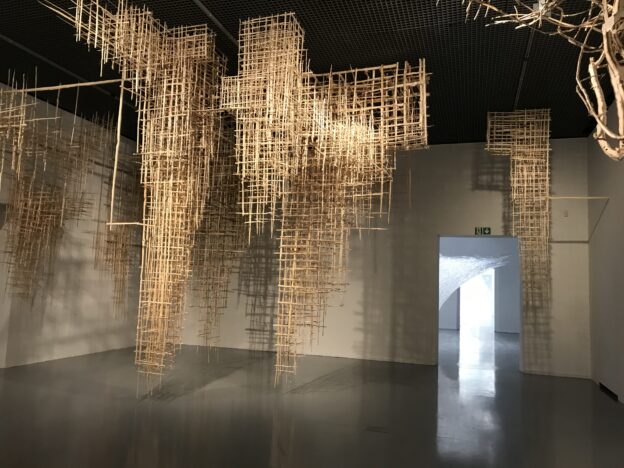
‘Anti-gravitation’ from ‘Space Crystalization’ cycle, at Ujazdowski Castell Contemporary Art Center in Warsaw, Poland. Site-specific sculpture, wood, 5m high, 2020. Artist : Ludwika Ogorzelec.
JKG: And your Space Crystallization series?
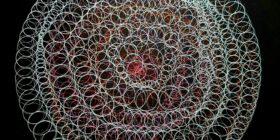
LO: The Space Crystallization is a system of lines intersecting one another with a certain order and modifying the previously determined space, both physically and in its use. In other words, it is a shattering of space into smaller components “crystals”, whose purpose is to achieve a new aesthetic and psychological state that acts on the conscious and the subconscious mind of the viewer.
The Space Crystallization cycle went on for many years. I crystallized specific spaces in a site-specific way. We are humans not part of a big machine…and I hope my installations bring this realization through to the public that sees my work.
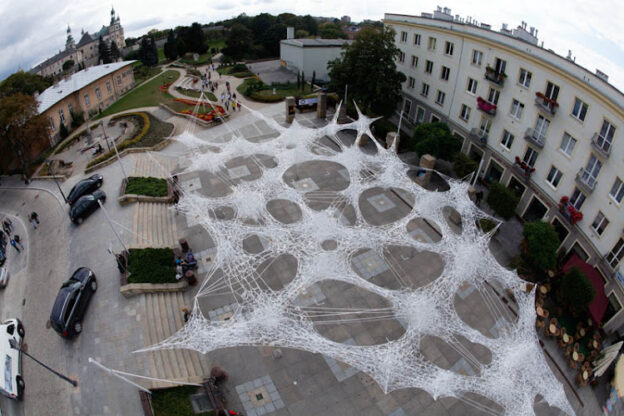
‘Withes Dance’ from ‘Space Crystallization’ cycle, in Kielce, Poland. Site-specific sculpture, 28km lines of industrial silk, 2012. Artist : Ludwika Ogorzelec.
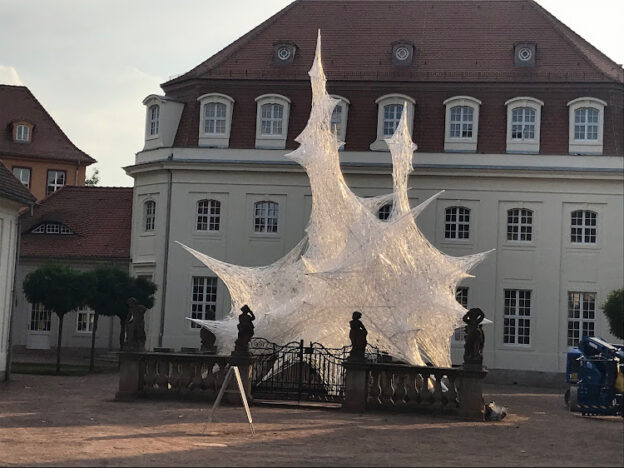
‘Source’ from the ‘Space Crystallization’ cycle in GheteStad-Bad in Germany. Site-specific sculpture , industrial silk artist, 2019. Artist : Ludwika Ogorzelec.
The activity of space is a result of the meeting of the “entrancing energy” and the “extrinsic energy” imparted by the line to the space.
The intrinsic energy is everything that is characteristic of a given space and the architectonic idea behind it, it’s proportion, width, height, length, the materials of which it is composed (concrete, metal, wood, plaster etc.). The space crystallization” proposes an active space and interactive experience whose purpose is to touch the basic universal sensitivities of a person
JKG: This juxtaposition of natural and cultural is one of the keys to the future of design. You give a partial reading of natural form and of geometries that I find interesting. Thank you for this, Ludwika.
……………………………………..
All images copyright and courtesy of Ludwika Ogorzelec.
Brief bio + publications for John K. Grande…
https://www.amazon.com/author/johngrande
Art Space Ecology; Two Views Twenty Interviews, Black Rose Books / U. of Chicago, 2018)
http://press.uchicago.edu/ucp/books/book/distributed/A/bo34137373.html
Get the Full Experience
Read the rest of this article, and view all articles in full from just £10 for 3 months.
No comments yet.