FRACTALS – the sacred geometry of divine oneness
Sabahat Fida is a lecturer in Zoology with the Higher Education Department in Kashmir. With academic training spanning in both the sciences (MSc Zoology) and the humanities (MA Philosophy), her work seeks to bridge the realms of science, metaphysics, religion, and philosophy.
Is God a mathematician? asks astrophysicist Mario Livio.
“There is something very mathematical about our universe, and the more carefully we look, the more math we seem to find “. Mark Tegmark
What if nature is not just intelligent, not just a healer or a source of solace-but also a revelation? A living scripture inscribed with divine logic? perhaps what soothes us in a forest is not only beauty , but recognition – the soul encountering a familiar pattern , the echo of a primordial unity.
The Hidden Architecture of Nature
There seems to be a self-similarity across our existence from the celestial scale to the miniature atoms, from the coastlines and the fans of alluvial rivers to the snowflakes. God has established nothing without a geometric beauty. These self-similar infinitely complex patterns are called fractals coined by mathematician Benoit Mandelbrot, who was the discoverer of infamous Mandelbrot set which is a set of numbers generated by interating a quadratic equation. This intriguing map built onto the numbers withhold beautiful artwork of fractal motifs and parallels of which are seen in the physical world. Isn’t it fascinating that the figures which are created by the numbers in an imaginary world has its mimics in the real world? As if numbers, far from being sterile symbols, are sacred blueprints. Fractals are built on numbers which are transcendental, abstract, conceptual truth having existence outside human mind and thought. Does that uphold a mathematical argument for the existence of God?
A fractal been a rough or fragmented geometric shape that can be split into parts each of which is a reduced size copy of the whole. Fractal geometry assists to demonstrate the physical systems of nature like the rugged mountain terrains or the puffy clouds which aren’t regular, 2D, smooth geometric shapes of Euclidian/classical geometry. It’s the language wherein you can describe the shape of a coastline as precisely as an architect can describe a house.
Fractals are nature’s masterpiece intricately woven into oceanic waves and turbulence, erosion process, lighting bolts and even the rumble of the thunder is in a fractal pattern. The visualization of fractals generates alpha wave production in the frontal lobes simulating relaxed state of mind and it also engages the para hippocampus which participates in regulating emotions. This deciphers the harmony and serenity we identify in nature as if our brain recognizes that kinship to natural world. Fractals have also been incorporated into art and architecture since it elicits strong therapeutic effects.
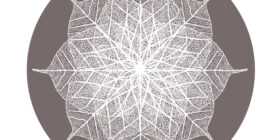
Do you see several pieces of a fern resemble the entire fern only in miniature? A branch of a tree looks like a small replica of a tree itself. Plant structures portray a dance of geometry in the form of fractals as evidences by the Romanesco broccoli, veins of a leaf, pinecones, succulents, flowers etc. Fractals aren’t just alluring and aesthetically pleasing but allow to maximize the efficient nutrient delivery and exposure to sun.
The Biological Symphony of Fractals
This rhyme of fractal is laden into the tapestry of life itself. Humans appear to be a breathing work of art, we can catch the glimpse of fractals in the branching patterns of bronchial tree in lungs or the branching patterns of retinal arterial and venous systems, which resemble the branching of the trees to the bones on a nanoscale. Every cell in the body must be close to a blood vessel in order to receive sustenance and the only way this is possible is through a fractal branching network were blood vessel branch and branch ever smaller, down to the width of capillaries. This mathscape can be also seen in the crystallized tears, where the branching of dendrites creates a unique fractal pattern that reflect the emotions we experience.
The fractals permeate throughout our bodies, these iterations are seen from DNA, heart sounds, neurons, actin cytoskeleton to the extent that scientists believe even the brain, not just in structure but in its process is a fractal. To generate our thoughts, our brains create this amazing lighting storm of connecting patterns, said Jeremy R. Manning, an assistant professor of psychological and brain sciences.
The blueprint of universe is in the language of fractals; this ballet of patterns is seen from micro to macro scale. Galaxies, the vast spiral and elliptical systems are distributed in statistically self-similar patterns. The caricatures of which quite surprisingly are found in the Mandelbrot set.
From Pattern to Pedagogy: How modern education flattens Fractal meaning
Remarkably, the same recursive geometry that shapes a fern leaf or river delta is now etched into the design of our mobile antennas. We have mathematically grasped the fractal nature of things – from the branching of neurons to the cascade of waterfalls- but our technological and scientific applications of this knowledge remain limited and fragmented. While we know that neural dendrites and axons form complex fractal geometries, research hasn’t fully explored how this geometry affects consciousness, learning or cognition. could fractal neural networks be the key to unlocking deeper layers of memory or emotion?
Studies show that viewing natural fractals reduces stress and increases focus, yet this insight hasn’t shaped urban design, education or mental health therapy to the extend it could.
It borders on intellectual dishonesty that Euclidean geometry continues to dominate education, while fractal geometry – the very blueprint of the natural world-remains hidden. we teach children about perfect triangles, circles and lines but the universe has never drawn a straight line. This suppression of fractals is not neutral-it enforces a worldview where nature is simplified, divine complexity is flattened and sacred grammar of creation is ignored.
Modern science has only skimmed the surface of this cosmic signature.
Towards a Fractal Epistemology
“To see a world in a grain of sand and a heaven in a wild flower
Hold infinity in the palm of your hand and eternity in an hour. “ William Blake
Does this omnipresent song of fractals from gluons to glia merely follow a modus operandi.? There was a moment when I stopped looking at fractals as mere patterns, the deeper I went into the spirals, I closer I felt to the Divine singularity, harmony born from repetition and cosmic intellect. It reminded me of how Imam Ali described the universe: every part echoing the whole, every whole anchored in the one. Imam Ali (a.s.), in Nahj al-Balagha, speaks of God as “the First without a before, and the Last without an after”, the Hidden and Manifest, the source of all being. His metaphysical vision is deeply rooted in tawḥīd (divine unity), where all things are signs (āyāt) pointing back to the ineffable Real.
“The beginning of religion is the knowledge of Him, and the perfection of the knowledge of him is to testify to his oneness “. Imam Ali ibn Abi Talib (as)
In the philosophical traditions of Neoplatonism, the core idea of Plotinus is that the universe emanates from the One: a transcendent, ineffable source beyond all multiplicity. From this singular principle flows everything that exists—first Intellect (Nous), then Soul (Psyche), and finally the physical cosmos. To Plotinus, beauty is not surface-level; it is the trace of the divine within form. It is the call of the One echoing through matter, drawing the soul upward. He writes in the Enneads: “The soul is stirred toward the good through the vision of beauty.” While not using the language of fractals, his cosmology describes layers of reality that reflect the unity of the One, just as fractal patterns echo themselves at every scale. In the light of Plotinus, the fractal world ceases to be a coincidence of computation and becomes a metaphysical revelation.
In the branching veins of a leaf, the curling of a fern, or the crystalline edge of a snowflake, there is a harmony that transcends function—an aesthetic whisper that stirs the soul. This, for Ralph Waldo Emerson, was the unmistakable voice of the Divine. To Emerson, nature was not merely a backdrop for human life but the living scripture of spirit, a direct and sacred revelation of the soul of the universe. “Nature always wears the colors of the spirit.” (Nature, 1836). Emerson believed that every form in nature was a symbol—not a vague metaphor, but a real signifier of deeper spiritual truths. To perceive fractals only as mathematical patterns is to see with the eyes but not with the soul. These endlessly recurring forms—leaf and lung, river and root—is a sacred resonance that binds the visible to the invisible. Modern education, in stripping these forms of their metaphysical grandeur, leaves students with formulas but no awe, structure but no spirit. As Ralph Waldo Emerson wrote, “The invariable mark of wisdom is to see the miraculous in the common.” In the branching of trees, the spiral of a galaxy, or the veins of a leaf, the soul recognizes its own architecture. What we call nature is not outside us; it is the living mirror of our innermost truth. To teach fractals rightly is to initiate the self into its cosmic reflection. It is not only geometry—it is gnosis.
…………………………..

Sabahat Fida
Get the Full Experience
Read the rest of this article, and view all articles in full from just £10 for 3 months.
No comments yet.