People-Identities
Alexa Wright is London-based artist working across a range of media including photography, video, interactive installation and book works. She has worked at the intersection of art and medical science since the late-1990s and often works with people with mental and physical differences to make works that address questions of human identity and otherness through qualities like vulnerability and empathy. She has been involved in several long term inter-disciplinary collaborations, for example with Alf Linney, Professor of Medical Physics and computer scientists at UCL (1999-2010) and Hybrid Bodies, a unique international, interdisciplinary project based in Toronto, Canada that brought together medics, visual artists, a philosopher and social scientists to explore the emotional and psychological effects of heart transplantation (2007-19).
Richard Bright: Can we begin by you saying something about your background?
Alexa Wright: My first degree was in painting, but I was never really a painter and I found it almost impossible to work within the confines of a rectangle. I was drawn to making installations and objects, and whilst painting interested me as a process, I was more interested in space and interactivity, although I didn’t quite know how to articulate that in those early years.
In the mid-1980s I did a part time MA at what is now Northumbria University. That was a good time, Newcastle had a very vibrant alternative arts scene with a lot of site-specific projects going on. I was experimenting with materials and spaces, and making site specific and performance works as well as objects. When I look back now, I really like some of the things I made at that time, but I was working quite intuitively, and I don’t think I had a clear sense of direction. Then I remember sitting in my studio one day sometime in the 1980s literally asking myself what I wanted to focus on, and I realised the answer was people – identities, how we define ourselves as human and what is not acceptably human in various contexts. That has been the underlying focus of my work ever since.

Veiled Incisions, 8 steel lightboxes, transformer, table, dimensions variable, 1992
RB: Your interest in challenging ‘norms’ is evident in many of your works. Can you say something about how your work explores and experiments with the defended boundaries of the human/self?
AW: The project to explore the boundaries of ‘humanness’ started in the early 1990s and has preoccupied me in different ways ever since. Works like Donna Haraway’s Cyborg Manifesto were a big influence, but the main driving force was curiosity. The early photographic projects such as Veiled Incisions (1992), which involved photographing cosmetic surgery, and After Image (1997), where I worked with eight people with amputations to visualise their phantom limbs, were based on a fascination with what humans are made of and how we function.
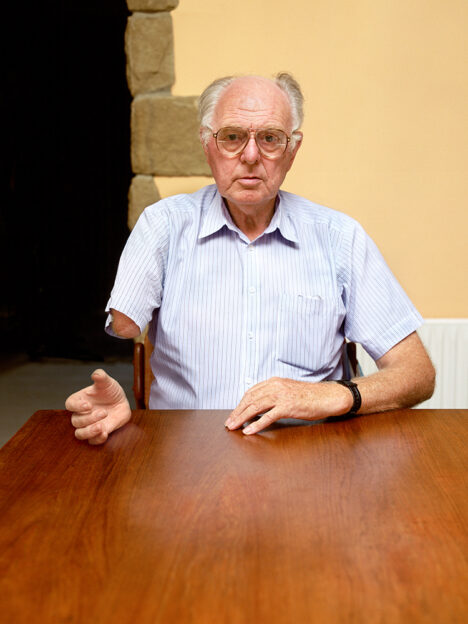
After Image, RD 2, series of 24 digitally manipulated C-type prints, 56x75cm, 1997
After Image was supported by one of the first Wellcome Trust SciArt awards, and this enabled me to initiate a collaboration with neurologist Peter Halligan and neuropsychologist John Kew, and to learn from them about the science behind phantoms before working with the people I photographed. Phantom limbs are particularly interesting because they are completely real for the person experiencing them, and yet imperceptible to anyone else. This raises all sorts of interesting questions about what we mean by self, and where the body begins and ends. This notion of boundary confusion was explored further in the more recent Hybrid Bodies heart project, which I will come back to later. Listening to the people I photographed for After Image talk about their experiences, I felt compelled to try to make work that would address some of the prejudices and preconceptions they were subject to. This led me to make ‘I’, a series of digitally manipulated photos where I superimposed bits of other people’s bodies onto my body in order to confront the viewer with their own responses to physical difference.
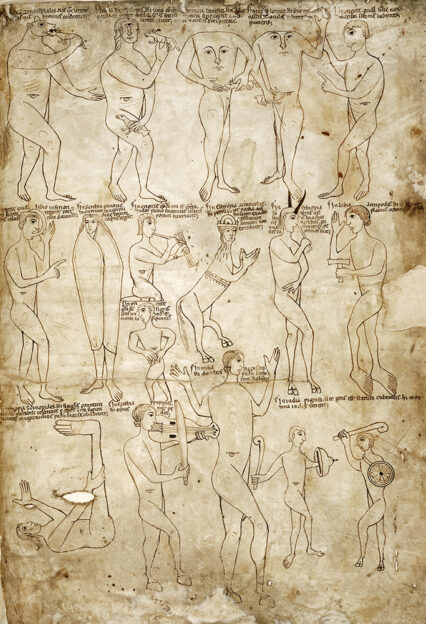
Drawing of the Monstrous Races from the 12th Century Arnstein Bible
RB: Your book, Monstrosity: The Human Monster in Visual Culture, investigates the appearance of the human monster in Western culture. Can you say something about this and the concepts of identity that it explores?
AW: My interest in (“real”, human) monsters also started back in the early 1990s when I came across a reproduction of the Monstrous Races in a library book at the Banff Centre in Canada. As a visual artist making work about human physicality and the expression of identity, I was fascinated by the literal way these strange creatures demonstrate the symbolic power of the human body. Their irregular, transgressive bodies directly and clearly illustrate the main historical purpose of human monsters – that is, to provide a tangible site for exploring the problem of what constitutes acceptable human identity in any particular social and cultural context. I photo-copied the picture and kept returning to it over the next few years. These particular drawings are part of a collection of sketches on the flyleaves at the back of the 12th Century Arnstein Bible, which is now in the British Library, but the Monstrous Races appear in many different contexts from the 5th Century BC or earlier until the Renaissance. They manifest Western suppositions about peoples who lived in other parts of the world, beyond the reach of their direct experience – some are human/animal hybrids, whilst others are clearly mis-interpretations of, for example, people in yoga positions, or wearing tribal masks. The way they so literally manifest the fear and confusion that surrounds difference is fascinating, and, I think, says a lot about how and why ‘otherness’ is constructed. The book starts with the Monstrous Races, and then charts a historical trajectory, from this very visual, physical manifestation of monstrosity that inhabits unknown territories far away, to more proximate and less tangible behavioural monstrosity.
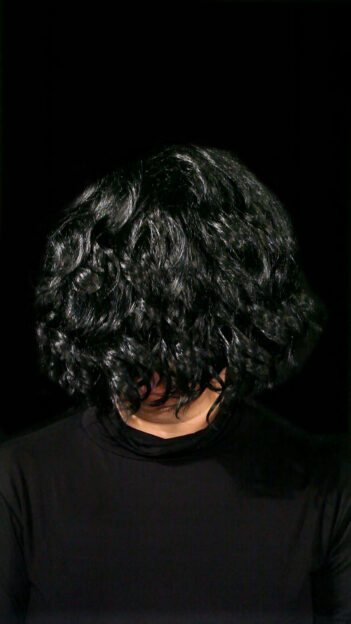
There’s So Much More I Want to Tell You, Single screen video, 5min 32sec, 2016
RB: Can you say something about your work, There’s So Much More I Want To Tell You?
AW: Perhaps in parallel to the thinking behind the monster book, around 2010 my interest in ‘otherness’ shifted from representation of physical difference to mental health. This happened for two reasons – firstly because it seemed to me that attitudes towards people with physical differences or impairments were improving, whilst there remained a lot of prejudice and fear around people with serious mental health issues. Also, because on a more philosophical level, I am very interested in psychosis and what it can tell us about reality.
My first mental health-related project was A View From Inside, which involved working for nearly a year with ten people who experience episodes of psychosis to create a series of photographic portraits. I met with each person several times to try to understand what their world is like during a psychotic episode, and we worked together visually to find a way of representing this. In the resulting photos, the grand eighteenth Century settings have been altered, both digitally and physically to form ‘stage sets’ for the internal experience of each person when he or she is not in consensual reality. These highly constructed settings, each incorporating a view through a window and an array of significant objects, give some clue to the individual’s private world. Whilst I set up the photographs and did all the digital manipulation, the images were arrived at discursively with the people represented, and this was important to me, especially because most of the participants really took ownership of the way their experiences were represented. The photos feel quite intimate, and yet the visual narratives are ambiguous, making people’s sometimes bizarre experiences public, but in a way that is not too revealing.
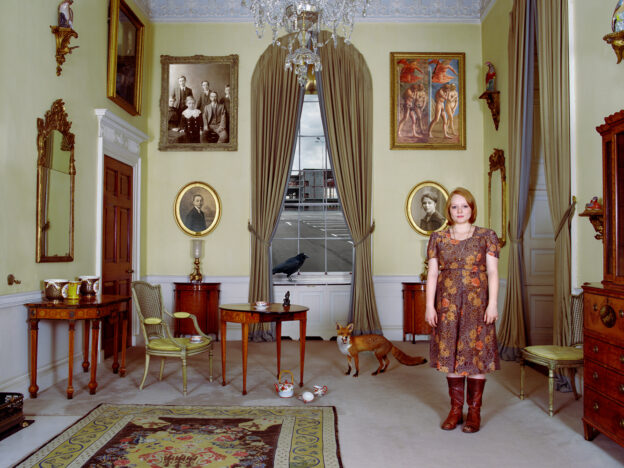
A View From Inside 1, series of 10 digitally manipulated C-type prints, 76x 00cm, 2012
All the people photographed for A View From Inside were well at the time I worked with them and they were able to reflect back on their psychotic experiences with some distance. This was great, but I also felt that I wanted to get closer in to understand more about the texture of psychosis at or close to the time it was happening. So, after more than a year of negotiation with the NHS I was able to set up an artist residency across two mental health recovery centres in North London to run the project Piecing It Together. I led weekly workshops at each centre introducing participants to photo-collage (from magazines) as a direct, visual means to communicate their recent experiences of mental ill health. Some people continued to work with me individually to create small photo-text books. Several participants also agreed to recorded interviews with me, and these provided inspiration for an ongoing series of video works, the first of which was There Is So Much More I Want To Tell You. Based on the real life experiences narrated by a participant from the Piecing it Together project (with permission, performed by actress, Isabel Carr), There Is So Much More I Want To Tell You takes the viewer on a journey of self-reflection as our relationship to the unidentified narrator changes through the course of her narrative. The black wig over the narrator’s face is playing with the ethics of concealed identity, and also the black on black is a nod to Samuel Beckett, whose work I love and continuously return to.

A Real Life Drama, Synched 3-screen video installation for one monitor and two projections. 17min, 7 sec, 2020
RB: Can you say something about your video work, A Real Life Drama?
AW: A Real Life Drama was made in response to an another interview with a Piecing it Together participant, a young woman who described her psychotic experience as ‘like a Shakespearean drama with everything happening all at once’.
The resulting three-screen video installation, shot in a black box studio, is configured to emphasize the materiality of the imagery. In the installation, two larger freestanding screens invite viewers into the Main Character (MC)’s psychological space, physically as well as visually. These are inhabited by three characters that represent different dimensions of MC’s own psyche: Cordelia and King Lear from the Shakespearean drama, and The Director, a commanding inner voice that could be the result of psychotic delusion, or could refer to the internal narratives we all construct. To the left of the two larger screens is a smaller screen or large monitor where a head and shoulders shot of the actress who plays MC intermittently appears. She comments on the action, both in character (on black) and as herself (on white). In the installation the deliberately theatrical non-space of the projected imagery is reflected in the space inhabited by visitors to create an interplay between reality and fiction, ‘real’ and imagined incidents. Narratives are set up and then broken, time is compressed and historical events collide with contemporary ones. The physical presence of the projected imagery is intended to make the work more immersive, inviting the viewer to play an active part in piecing together the fractured narrative which takes place across and between the different screens.
A Real Life Drama, Synched 3-screen video installation for one monitor and two projections. 17min, 7 sec, 2020
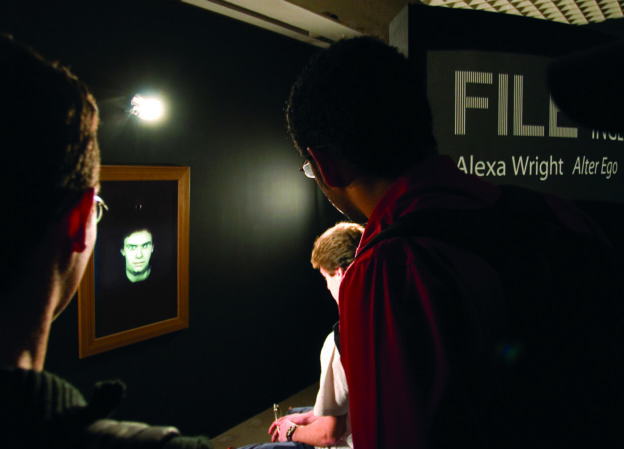
Alter Ego, Interactive computer installation, dimensions variable (2005)
RB: One important aspect of your work is that it invites active participation of the audience on some level. Why is this important to you?
AW: I am interested in affect; creating a situation where audience members can reflect on their own position in relation to the subjects in the work, but on a somatic level as much as an intellectual one. In a brilliant essay on ‘I’ published in Portfolio Magazine 30 (Dec, 1999), the cultural theorist Mark Cousins wrote that the work: ‘judges the spectator and finds him or her lacking’. I loved Cousins’ essay for several reasons, not least because what he says here shows that he completely understood what I was trying to do with these photos.
Installations such as Alter Ego (2005), a virtual mirror where individual users interact with their own avatar, and Conversation Piece (2009), where visitors can enter into dialogue with a disembodied virtual character, literally involve active input from audience members in order to function. These works also have a secondary audience, the people watching the interaction, and I am interested in this dynamic where the viewer becomes a performer, and, by implication, a part of the work. I suppose I see audience interaction as an extension of the process of making the work, because each new interaction brings a new dimension to it and in that sense the making process is never finished.

Conversation Piece, Interactive audio installation, dimensions variable, 2009
RB: Collaboration with scientists and working with people with mental and physical differences is an important aspect of developing your artwork. What have you personally learnt from working in collaboration and has this approach thrown up any surprises for you, in regards to your previously held beliefs or intuitions?
AW: I think the main benefit of working with scientists is that this gives direct and discursive access to knowledge as it evolves. But my collaborations with scientists have all been very different. Working with Alf Linney at UCL was a true collaboration from the outset, we worked very closely together and the boundary between our different practices became quite blurred. By contrast, at the start of the Hybrid Bodies project some of the scientists were uneasy about having artists on the team and were worried about sharing their research with us. However, that did change over time, and they began to trust us – to the extent that most of them flew to London from Toronto to participate in an exhibition and event that I had organised in relation to the project.
The main benefit of working with participants, such as people with mental and physical differences is that it gives me an intimate insight into those people’s unique, individual experiences. The discrepancy between someone’s subjective experience and external perception of them is central to a lot of the works I make, and so the human process of interacting with subjects, or participants, feels crucial to my working process. I can’t say that my thinking has been radically changed or challenged at any particular moment by working collaboratively. I think it’s a more subtle process whereby each interaction brings new insights that feed into the thought processes behind that and future works, and this often happens on an unconscious level.
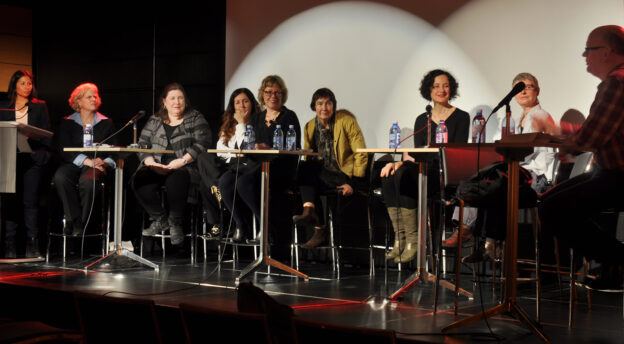
Hybrid Bodies team, 2014
RB: You were involved in the multidisciplinary project, Hybrid Bodies. Can you say something about this project and the artwork you created for it?
AW: Hybrid Bodies was a unique and long-term international project based in Toronto, Canada. Between 2007-2019, the collaboration brought together artists, theorists, and an interdisciplinary medical research team to examine the often-unacknowledged emotional and psychological effects of heart transplant on recipients. Based on the premise that whilst heart transplant is now almost a routine operation, the nature and prevalence of the psychological and emotional disruptions that confront heart transplant patients are less well understood. Along with three other artists, Catherine Richards (CA), Andrew Carnie (UK), and Ingrid Bachmann (CA), I was invited to make work that responds to the transdisciplinary research of the team led by Heather Ross, chief transplant cardiologist at the Toronto General Hospital and also involving health researcher Pat McKeever; transplant psychiatrist, Susan Abbey; social worker Jennifer Poole; and British philosopher, Margrit Shildrick.
The Hybrid Bodies study first looked at heart recipient experience, and then, in a second phase, at donor family experience. In both cases the study centred around video-taped interviews conducted by a specialist nurse in patient’s homes. From the point of view of an artist, these were fascinating as they often revealed a mismatch between what people were saying in words and what their body language was saying.
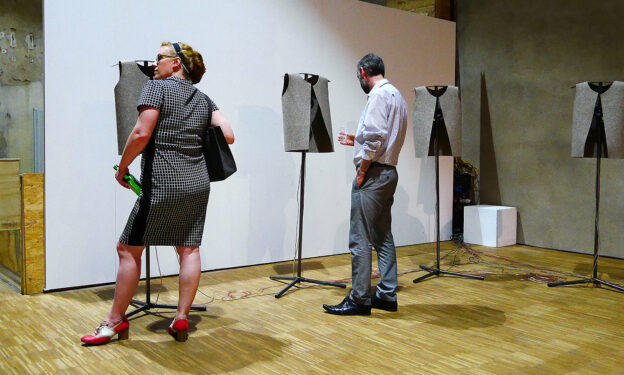
Heart of the Matter, 8 channel audio installation with felt jackets on steel stands, KKW, Leipzig Germany, dimensions variable, 2017
Heart of the Matter, first shown as part of Hybrid Bodies at PHI centre, Montreal in January 2014, was the first work I made in response to the research into recipient experience. Drawing attention to the impact that heart transplant can have on a recipient’s sense of self as a bounded and unique individual, Heart of the Matter also explores the correlation between a physical and an emotional exchange of hearts. In this eight-channel interactive audio installation, monologues compiled from individual accounts of the experience of heart transplant are juxtaposed with personal narratives of intimate relationships. The stories, which emerge from a series of felt jackets, are activated as visitors approach. As more people enter the space, the eight individual stories are overlaid to form a cacophony of interconnected testimonies about the effects of a physical or emotional change of heart – it is sometimes difficult to distinguish between the two.
As mentioned above, it is important that I am the one who conducts the research for my work, talking with people directly to understand their personal experiences, or witnessing actual events first-hand. It is out of this process that the work emerges. In the case of Heart of The Matter, though, I didn’t have access to the participants in the scientific study, so the narratives are derived from a combination of interviews I conducted myself, and transcripts of interviews conducted by the scientific research team. These have been edited together to form eight discrete personal stories, which in the installation are spoken by actors.

Cut, series of 7 digital prints enlarged from small collages, 84 x 57cm, 2018
Altogether, I made quite a number of different works for the Hybrid Bodies project. These included the photographic work Cut, and accompanying moving image work, Not Gone Not Forgotten (both 2018). Organ transplant raises many intimate questions about ‘fitting in’, from the question of whether the recipient’s body will accept the new organ to questions donor families have about whether they would like the recipient and how they would feel if they didn’t. Enlarged from small collages made from magazine cuttings, the photos that make up Cut respond to the experience of organ transplantation by literally cutting together or colliding fragments of two domestic scenarios. The grain of the image is deliberately visible in these enlargements, drawing attention to the materiality of the process. In Not Gone Not Forgotten two identical flat screen monitors are hung low (knee to waist height) at right angles to one another in a corner. On the right side we see an individual in her/his living space silently gesticulating. On the left side part of that individual is cut out, appearing randomly in the life of another family. The work is silent. The images are situated in living rooms, the nucleus of the family home, yet the fragmented bodies give a sense of dislocation. We never see anyone’s facial identity, but along with the décor of the living room and clothing, small gestures of hands and feet convey personality. In both Cut and Not Gone Not Forgotten the fragmented whole becomes a kind of Deleuzean “assemblage” where one part of the image simultaneously fits into and intrudes upon the other.
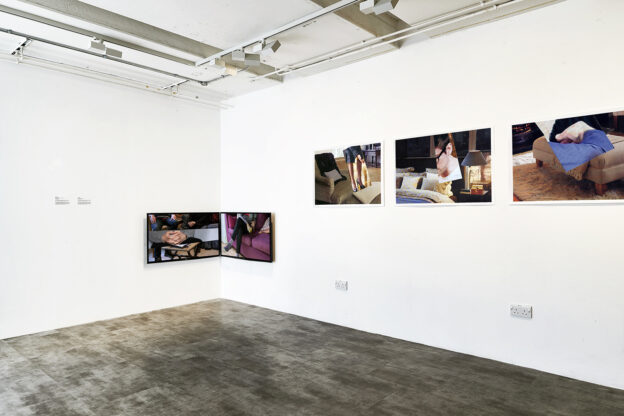
Cut and Not Gone Not Forgotten in Winchester, 2018
The last work I made for the project was Still Live (2019), a series of four still life photos that draw on Vanitas symbolism to explore themes of living and dying. Offering a universal reminder that everything is temporary, they articulate philosophical questions that challenge us to consider the moment and nature of “death,” whether being “alive” is dependent upon being a contained and “bounded” individual, the location of the self within our corporeal bodies and what we mean when we consider ourselves to be “individuals”.

Still Live 1, series of 4 digital colour prints, 59 x 80cm, 2019
RB: What projects are you are currently working on or have coming up?
AW: I recently won a small Arts Council Lottery grant to carry out Inside Stories, a participatory project in two prisons in the North-West. Since September 2021, I have been running workshops for small groups in both prisons. We started by using collage to explore four keywords: power, justice, judgement and freedom, then participants added more words to the list such as responsibility, respect and forgiveness. We started with collage because it’s an accessible medium to get people thinking visually, and one that I am familiar using. Then I brought a camera into the prisons so that participants could take photos to communicate something of their experience of being ‘inside’. But there are strict rules about what we can and can’t photograph, so the available vocabulary is pretty limited. At the same time, I and another lens-based artist, Joe Lee, have been capturing footage outside the prison as directed by participants to represent their memories of the outside world, mainly focusing on images of freedom, power and judgement. Now I have a big editing task ahead of me – to create a meaningful piece of work that responds to direction from the various participants. I have never worked in quite this way before. For the Piecing it Together project, for example, I was quite clear that the work I made should be separate from the work made by participants. But I’m most interested in process and finding out how to do something, so each project builds on the last and brings with it new challenges. Now it’s going to be interesting to find a balance between allowing participants agency and authorship and asserting my own editorial structure so that the work really is co-created. Then it will have to go through a strict approval process by the MOJ before it can be made public.
Early next year I will also be starting work with a scientific team on a project looking at the impact of long-COVID in minority ethnic groups in the UK. I am hoping to co-create either still photo, or short video works with individual participants in the study.
………………………………………
All images copyright and courtesy of Alexa Wright
Get the Full Experience
Read the rest of this article, and view all articles in full from just £10 for 3 months.
No comments yet.