Archive | Interviews RSS feed for this section

The magazine will feature exclusive interviews with artists, scientists, writers and creative thinkers.

Vital Signs

Judith Alder is a British visual artist with a multi-faceted practice, working across a range of media and processes. Central to her work is a fascination with biology, physics and the history of scientific endeavour and science fiction. Alder is interested in how an understanding of life, its origins and evolution can help us think about the future of our rapidly changing world. She sees her work as a means of exploring and communicating complex ideas. In her latest show, ‘Vital Signs’, she assembles a body of interconnected works grounded in research and inspired by accessible science communicators and visionary writers like HG Wells, Primo Levi, Kazuo Ishiguro and Stanislaw Lem.
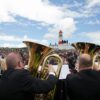

Lise Autogena & Joshua Portway – Foghorn Requiem

Lise Autogena and Joshua Portway have worked together since the early 1990’s, developing large scale performances, multimedia installations and site-specific work, usually in collaboration with organizations and experts across many specialized fields. In 2013 they developed ‘Foghorn Requiem’, a requiem for disappearing sound, performed by the Souter Lighthouse foghorn, three brass bands and fifty ships out in the North Sea. In this interview with art and ecology author, John K. Grande, they discuss this work as well as their other projects.

On a Multispecies Studio

Julie Andreyev is an artist-activist, researcher and educator in Vancouver, located on the unceded, traditional and ancestral territories of the Coast Salish people, including the xʷməθkʷəy̓əm (Musqueam), Sḵwx̱wú7mesh Úxwumixw (Squamish), and səl̓ilw̓ətaʔɬ (Tsleil-Waututh) First Nations, as well as the unceded traditional territories of nonhuman animals and plantlife. Her multispecies studio practice, called Animal Lover, explores more-than-human creativity and ways of knowing.

Aquaforming

Robertina Šebjanič is an artist whose work explores the biological, chemical, political and cultural realities of aquatic environments and the impact of humanity on other organisms. Her projects call for the development of empathetic strategies aimed at recognising the rights of other (non-human) species.

On ‘Perception: First Form of Mind’

In his recent book, ‘Perception: First Form of Mind’, Tyler Burge develops an understanding of the most primitive type of mental representational: perception. Focusing on the functions and capacities of perceptual states, Burge accounts for their representational content and structure, and develops a formal semantics for them. Drawing mainly on vision science, ‘Perception: First Form of Mind’ is a rigorous, agenda-setting work in philosophy of perception and philosophy of science.

On ‘Nature Fast and Nature Slow’

Nicholas P. Money (Nik Money) is a gentleman of letters, mycologist, and professor at Miami University in Oxford, Ohio. He is the author of popular science books that celebrate the diversity of the microbial world. His latest book, ‘Nature Fast and Nature Slow: How Life Works, from Fractions of a Second to Billions of Years’, is a vision of biology set within the entire timescale of the universe. It is about the timing of life, from microsecond movements to evolutionary changes over millions of years.

Collaborating with Living Matter

Darya Warner works at the intersection of art and science by bridging growth/connections with human and non-human actors through the prism of Climate Change. By addressing site-specific history, ecology, and local systems of communication, Darya aims to cultivate a new form of hybrid space for “intermatter” interaction with an emphasis on the interconnectivity of intelligence across species.

Biophilia

Laura Stack is a visual artist, educator, and eco-enthusiast residing in Minneapolis, MN. She creates biological abstract paintings, ink collages & installations informed by science, science fiction, and the natural world. Her work alludes to fictional organisms and plays with the tension between organic and synthetic.

Buster Simpson – Proto-Habitat Design Sculpture

Seattle artist Buster Simpson is a pioneer in the field of urban environmentalism and art in public spaces. Since the late 1960s and early 1970s, Simpson has been dedicated to working in the public realm; his method is grounded in a farsighted contract between the artist and where he lives. His career parallels the rise of public art in the Pacific Northwest and he has played a crucial role in establishing Seattle as a significant center for community-minded artistic practice. In this interview with art and ecology author, John K. Grande, he discusses his ideas and work.

Talking about the Mind

Jack Symes is a public philosopher and writer. He is currently a teacher and researcher at the University of Liverpool and is best known as the producer of ‘The Panpsycast Philosophy Podcast’. The podcast, in which Jack discusses philosophy with the world’s leading thinkers, has over 75,000 regular listeners. He is also the editor of ‘Talking about Philosophy’, a series of introductory philosophy books for the general public. Jack’s first book, ‘Philosophers on Consciousness: Talking about the Mind’, was published by Bloomsbury in February 2022.