Exploring the Intersection of Art and Science: Brainlight
Laura Jade is a contemporary Australian artist exploring how BCI technologies can offer new forms of expression to interface with the mind aesthetically. She is the creator of Brainlight, an artwork that integrates biology, lighting design and BCI (brain-computer interface) technology into an interactive brain sculpture, lasercut from transparent perspex and engraved with neural networks. The installation is controlled with a wireless EMOTIV EPOC+ EEG headset which detects and outputs live neural activity, translating electrical signals from the user’s brain, into a vivid and dynamic light display within the brain sculpture. In real-time Brainlight visualises the brain frequencies of theta (3.5–7.5 Hz) as green light, alpha (7.5–13 Hz), as blue light and beta (16–32 Hz) as red light.
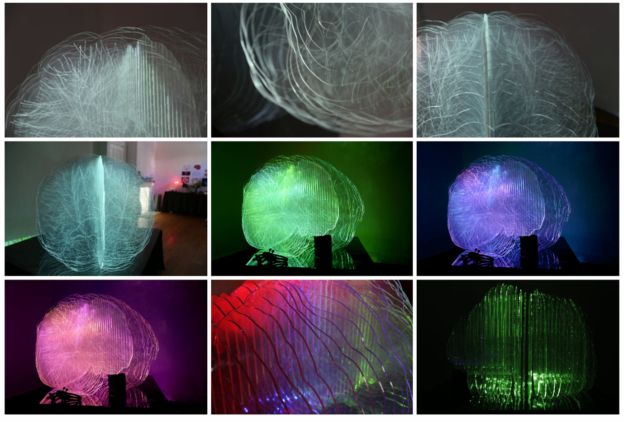
Brainlight collage
A Window into the Mind
As rapidly advancing technologies become more widely available, having access to tools that collect biometric data, particularly BCI technology, provides artists with new ways of exploring our biological selves and creating new modes of audience interaction. Most of us navigate life without awareness of our brain’s intricate processes. Brainlight invites us to observe and engage with our neural rhythms. By experiencing this artwork, viewers embark on a journey of self-discovery—a rare opportunity to interface directly with their inner selves through technology. The work aims to facilitate a curiosity to know and sense oneself more intimately, while at the same time exploring the creative potential of BCI technologies. Brainlight’s interactive BCI connects a viewer’s internal state and their impact on the artwork. By placing the audience amid a live neuro-feedback interaction, this setup not only encourages participants to observe and engage with their emotional and aesthetic reactions but also prompts them to explore their capacity to influence these responses.
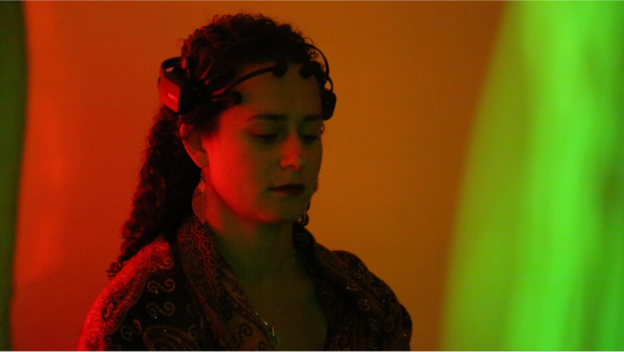
Brainlight. Participant wearing EEG headset.
Communicating with Colour
Since the early experiments with EEG on humans in the 1920s, the use of EEG in the study of the brain has been mainly focused on clinical diagnostics and trying to understand neurological processes and functions in a research laboratory environment. EEG technology in Brainlight represents a departure from its clinical roots. Here, EEG becomes a conduit for unspoken communication—translating subtle brain signals into a visual language of colour. Each hue embodies a facet of our inner reality: red signifies alertness and intensity, blue evokes calm and introspection, while green symbolises natural cognitive processes, daydreaming, and creativity. Jade was curious to see if a simplification of live brain activity, symbolically visualised through colour, could communicate a sense of a person’s inner reality to an audience and generate a meaningful experience. Our innate search for synthesis seeks to reduce complexity into its simplest form to understand it. In the same way, Brainlight simplifies the electrochemical activity of the brain into a colour-coded visual experience. The audience then attempts to make sense of patterns generated by a complex mix of brain activity which includes perceptual responses, memory and emotion. What becomes interesting is how audiences attempt to create a narrative and recognise a pattern that signifies personal meaning for them. Their desire for pattern recognition happens at the same time as their mind, emotions and subjective interpretation continually influence the artwork. Amusingly, audience interaction tends to become most gamified around the calm and meditative blue alpha state, which in a busy gallery, is usually the most difficult to accomplish. To experience this state, users need to contend with the many obstacles within the exhibition environment: eager onlookers, the brightly illuminated sculpture, the novelty of the situation, exposure to other sensory stimuli (such as noise), as well as their state of mind and how comfortable they are being the spectacle in the room. Interestingly, when a participant does manage to attain the blue state, they must master their excitement to prevent the brain from switching immediately to red. This effect is perhaps one of the most interesting manifestations of the feedback loop. Witnessing one’s current state of mind so often changes it.
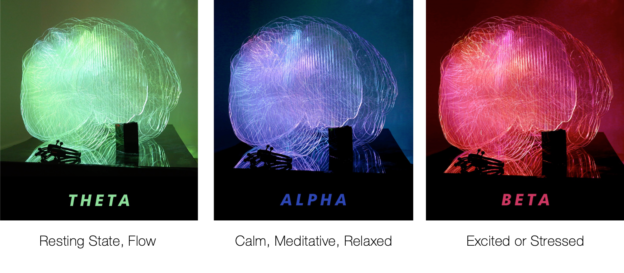
Brainlight Frequencies
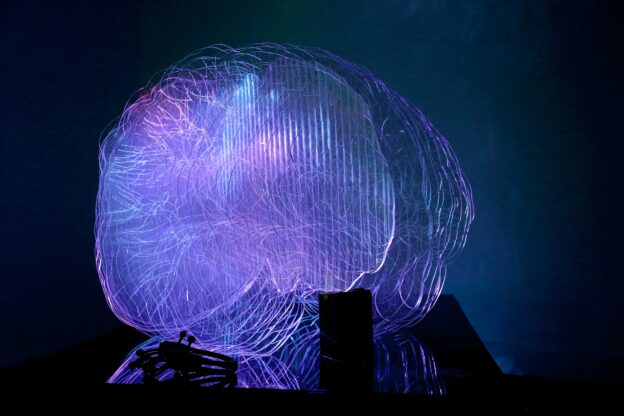
Brainlight Blue
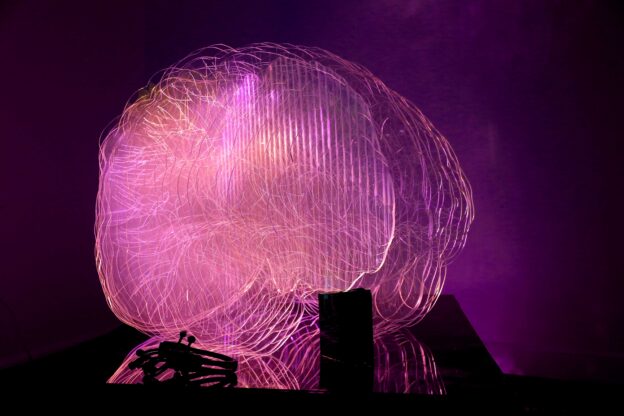
Brainlight Red
The Intricate Dance of Light and the Brain
The relationship between our bodies and light is a captivating one, essential for our well-being and understanding of the world. Light serves critical roles in our bodies, from producing vitamin D and regulating melatonin to syncing our internal clocks. But beyond its biological functions, light also connects us to the vast universe. By harnessing light, we explore distant galaxies and witness the origins of existence. Moreover, there’s a fascinating link between the frequencies of light and those of our brain. Light, essentially photons traveling as electromagnetic waves, comprises the visible spectrum that our eyes interpret as colours. Since colour itself is a creation of our minds rather than an inherent property of nature, our brains collaborate with light to perceive the world around us. Brainlight takes this idea a step further by harnessing BCI interaction to create a neuro-feedback loop of this process of perception. The artwork is activated by your brain’s electrical activity; it transforms these electrical frequencies into light waves, which are then re-translated by your brain into colour. The colour which your brain is now seeing, is a visual representation of this very perceptual process, meaning you as a viewer bear witness to a real-time loop of your brain transforming the image of your brain transforming the image, etc. This is no different from the constant input-output mechanism performed by the visual cortex, with the exception that the input is now also the output. The recursive nature of the feedback demonstrates the potential of artistically devised interactive technologies to bring us closer to the pure process of perception itself.
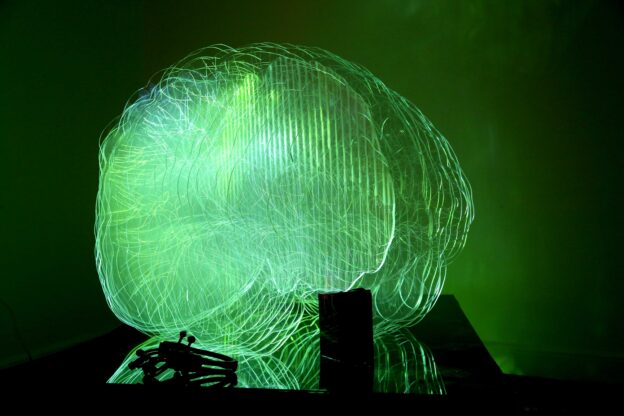
Brainlight Green
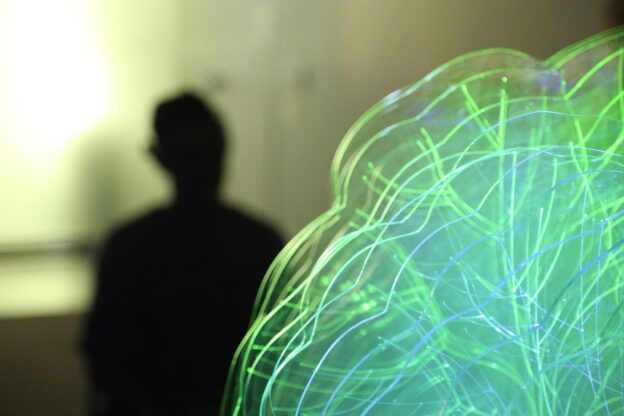
Brainlight (detail)
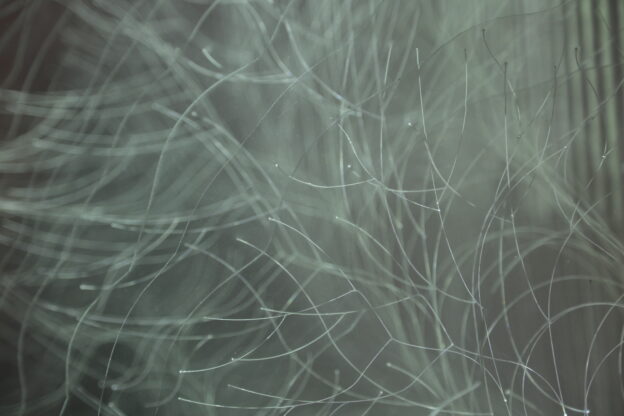
Brainlight (detail)
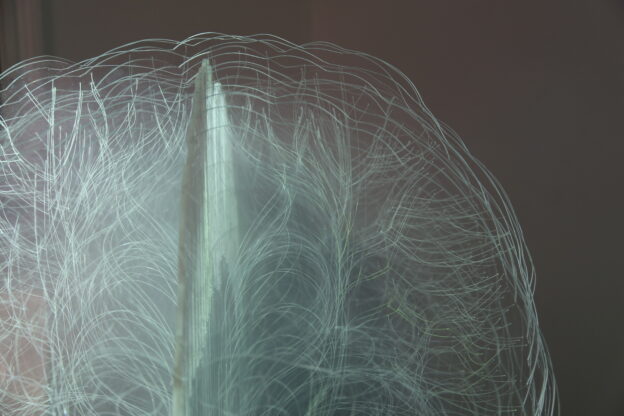
Brainlight (detail)
The Collaborative Process
An interdisciplinary approach was important in the research and development of Brainlight. The team included software engineer Sam Gentle, neuroscience and medical innovation researcher Peter Simpson Young, industrial designer Neill Wainwright, and electronics engineer Sami Sabik. Brainlight was created as a research project for a Master of Design in Lighting at the University of Technology, Sydney (UTS). Alongside UTS, Brainlight was created through Culture at Work’s (CAW) 2015 art + science residency program. CAW is a not-for-profit organisation that connects art and science through artist residencies, educational programs, and exhibitions. During the four-week residency at CAW we developed interactive interfaces that translated the electrical data from the EEG headset into various forms of visual communication, including projections (Cerebral Orb), prototype brain maquettes and the final Brainlight sculpture.

Cerebral Orb, interactive light projection, 2m x 2m, 2014
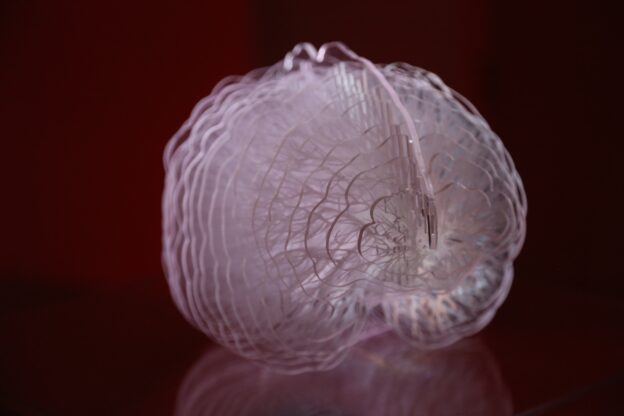
Brainlight maquette

Brainlight maquette
In 2017, Brainlight was invited to perform with the Sydney Art Quartet (SAQ) in a series of three evening concerts titled Light Fantastic: Music + Neuroscience + Light. The role of Brainlight was to visualise the brain activity of the musicians performing to compare it to the brain activity of the audience listening. Across three evenings, Brainlight exposed some remarkable differences between the brain patterns of the musicians and the audience. Lead cellist (and SAQ director) James Beck wore the EEG headset for the first two compositions. His performance was both technically complex and highly emotive, yet rarely did Brainlight flicker into the upper frequencies of beta or alpha (associated with highly analytical and calm states of mind respectively) remaining instead in a dominant state of theta. Similarly, when the headset was placed on violinists Anna Albert and Thibaud Pavlovic-Hobba, their brain activity remained in a steady state of theta throughout their performance with very little dynamic fluctuation. The audience members who subsequently wore the EEG headset displayed a remarkable contrast; exhibiting unstable fluctuations of predominately higher frequencies (alpha and beta) suggesting a larger, more constantly changing range of brain activity and emotions. Visually this contrast was obvious, having remained bright green while worn by the musicians, when the headset was passed to the audience Brainlight began cycling quickly through red and blue, often displaying all three colours simultaneously, visualising the varying emotional and physiological reactions to the music’s fluctuations in mood and rhythm.

Brainlight. Sydney Art Quartet.
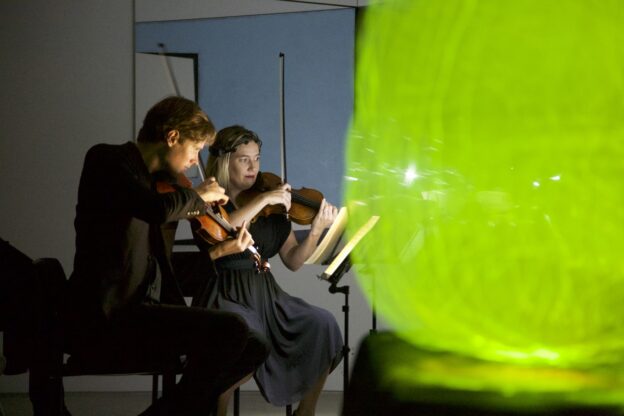
Brainlight. Sydney Art Quartet.
The collaboration between SAQ and Brainlight demonstrated how BCI technologies can visualise underlying neurological phenomena in musical performance, adding a new layer of interest for the audience by revealing the hidden differences between performing and listening to music.
Interactive Brainlight with piano composer Axel Singer (filmed during art-science residency at Culture At Work).
Brainlight and Science Communication
Brainlight has proven to be a captivating medium for science communication and public engagement with neuroscience. ABC’s Catalyst (an Australian national science communication television series) used Brainlight in an episode titled “Brain Stimulation” featuring scientists (including Brainlight collaborator Peter Simpson Young) discussing brain-enhancing devices. In a follow-up episode titled “Sleep Matters,” they used Brainlight’s colour coded light display to communicate brain activity cycling through the stages of sleep.
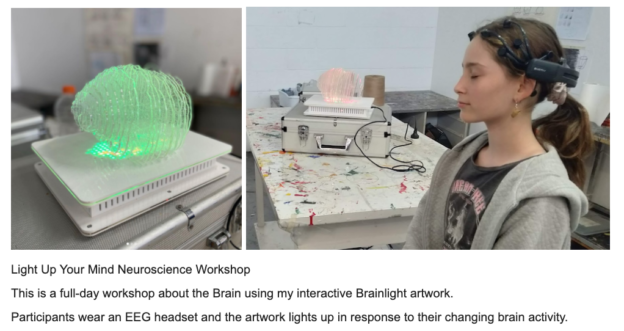
Brainlight, mini_ neuroscience workshop
Laura is a passionate STEM teacher and has developed Brainlight into an interactive educational workshop for primary and secondary students. In the Brainlight workshop, students are invited to interact with the artwork and partake in stimulus activities such as puzzles, maths problems, memory games, and emotive role play to predict and observe the changes in brain activity. In the process, students are introduced to the concepts of neuroscience, brain anatomy, emotional intelligence, mindfulness, data visualisation and BCI technologies. The Brainlight workshop demonstrates how biologically-driven interactive models can offer students tangible, memorable and novel opportunities for self-discovery by stimulating a unique engagement with their bodies and minds.
Brainlight unites art, BCI technology and the audience to realise new ways of exploring our biological selves, as well as creating new modes of audience interaction. The work contributes to an international community of artists, designers and technologists who have been utilising BCI technologies for artistic expression during the last 50 years. These artistic BCI projects are important to both research communities as well as the public because they explore, question and reveal new relationships with technologies and facilitate creative methods of connecting to each other and to ourselves.
…………………………………………….
All images copyright and courtesy of Laura Jade
Get the Full Experience
Read the rest of this article, and view all articles in full from just £10 for 3 months.

No comments yet.