Cosmological Perspectives
Ione Parkin RWA is an abstract painter, co-lead artist on the Creativity and Curiosity project and an Honorary Visiting Fellow of the School of Physics and Astronomy at the University of Leicester. She is the curator of the exhibition ‘Cosmos: the art of observing Space’ currently showing at the Royal West of England Academy in Bristol (24th January-19th April 2026).
The Creativity and Curiosity Art-Astronomy Project
Since 2016 I have been co-leading the art-science project Creativity & Curiosity (C&C) alongside the Scottish artist, Gillian McFarland. We have been engaging with a wide range of astronomers, astrophysicists, cosmologists and planetary scientists from universities and institutions across the UK and further afield. The project has toured through exhibitions and talks, workshops and full-dome planetarium presentations, interdisciplinary conferences and science centres.
The C&C project has at its roots, the building of a sense of connectedness and collaboration, exploring the nature of interdisciplinarity within the practice of visual thinking. As a result of these interactions with space scientists, I have been creating a series of artworks bringing the science fully into the realm of contemporary arts practice.
In December 2024 I was invited to give the John Brown Memorial Lecture at the Royal Astronomical Society, London. Professor John Brown was the 10th Astronomer Royal for Scotland and a keen supporter of art-science collaborations.
See Ione Parkin – John Brown Memorial Lecture, ‘Exploring cosmological phenomena’, Art takes on the cosmos | Astronomy & Geophysics | Oxford Academic ‘Astronomy & Geophysics’, April 2025, Vol 66, Oxford University Press’.
About the artwork
Visions of the expansive universe have fuelled my work for a number of years. Throughout my engagement with space scientists I have been deeply affected by their passion for their specific subject areas and their desire to understand, explore and explain the universe. My work has been informed by the science but driven fundamentally by the primacy of imagination. A critical balance of intention and intuition.
As an artist I am preoccupied with an exploration of material intelligence, of the physical qualities and properties of paint and surface. Space scientists have talked with me about their enquiry into the processes of cosmic and planetary creation; their rigorous and sometimes intuitive approach to experimentation and a shared interest in mistakes, ambiguity and uncertainty. They talk about scale, temperature and how materials interact and the life-cycle of matter itself transitioning from one form to another – aspects of research which I can fundamentally relate to.
Qualities of repeated observation and the value of the sustained gaze are of great interest to me as a painter – visual information digested through looking, perceiving and interpreting – an iterative cycle of engagement that leads to deeper understanding.
I have become fascinated by ideas about the early formation of the universe, supernovae, planetary atmospherics and solar dynamics. Astronomers have talked with me about the overarching meta-narrative of cosmic creation – an enormity of context within which it is difficult to gain a perceptual foothold. During these conversations, the information I receive quickly translates into a visual form and stimulates my tactile sensibility as an artist. In the depths of my imagination I see massive clouds of cosmic dust and gas; the filamentary structure of vast webs of colour and shimmering light; luminous visions of immensity. This feeds creativity and triggers curiosity in equal measure and there is a sense of constant questioning in all these works. I am questioning how to convey extremes of temperature, scale and distance.
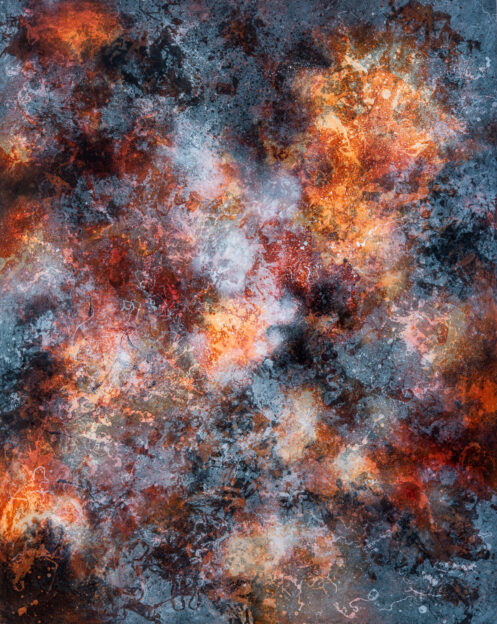
Ione Parkin RWA: Dust – Gas – Light, oil on canvas, 153 x 121cm , 2020
There are a number of strands of on-going enquiry in the current work. In the larger canvases, I want to show a layering of processes which suggest the evidence of past states of matter (Dust-Gas-Light, oil on canvas, 152 x 102cm, 2020). These are images reminiscent of highly star-forming regions. Morgan Fraser (University College Dublin) wrote in response to this painting: “You can see vast clouds of gas and dust and clusters of stars, all thrown together in a great spectacle of cosmic birth and death. The regions of galaxies where star formation happens are violent, tumultuous places. Stars are born, shine brilliantly before dying in supernova explosions. The most massive stars will be tens of thousands of times brighter than our Sun, illuminating the regions in which they live. Winds driven by massive stars slam sheets of gas together, triggering a cascade of new star formation. All this chaos and dynamism is captured in the painting.”
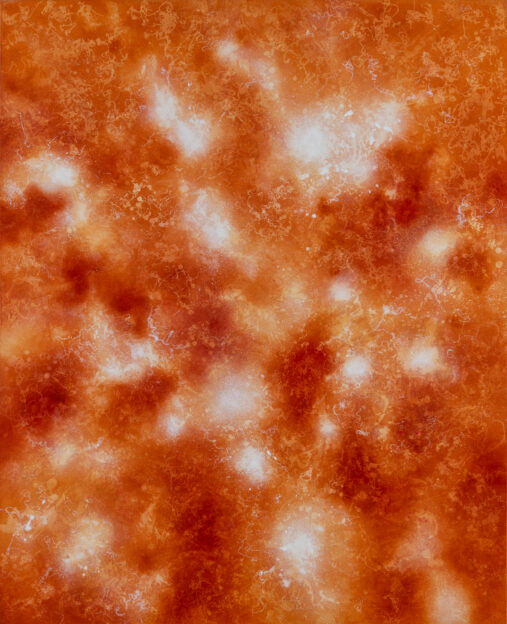
Ione Parkin RWA: Fusion, oil on canvas, 160 x 130cm, 2025
Fusion (oil on canvas, 160 x 130cm, 2025) was stimulated by conversations with solar physicist, Helen Mason (Department of Applied Mathematics and Theoretical Physics, University of Cambridge). The painting seems to radiate the intense heat and turbulence of super-heated plasma. In physics, plasma is described as the ‘fourth state of matter’, not solid, liquid or gas. It is ‘super-energised gas’ which is the fast nuclear burning of hydrogen, producing other elements such as helium. I wanted the sense of physics at work and intense energy being emitted, absorbed and emitted again. The luminosity of the painting is a quality that I value – the impression that it is lit from within. The twisting tendrils of light intertwine and exist in constant motion.
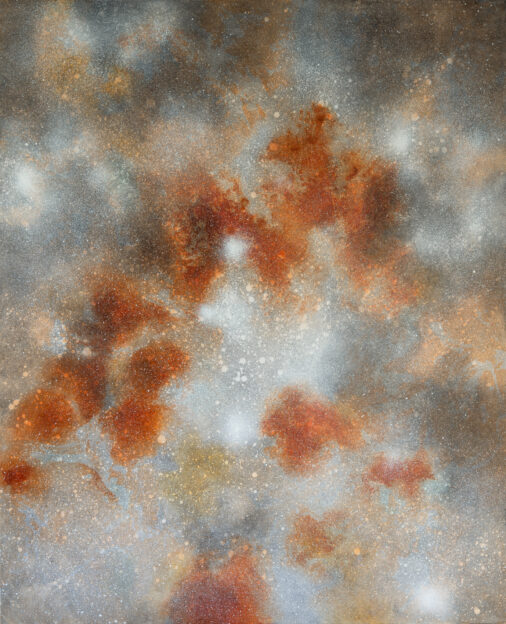
Ione Parkin RWA: Stellar Dispersal, oil and synthetic resin on canvas, 160 x 130cm, 2025
Stellar Dispersal (oil and synthetic resin on canvas, 160 x 130cm, 2025) “evokes images of stellar nurseries, still partially shrouded in dust which would appear red as the dust is heated and emits infrared radiation. Near the centre of the image appears a new cluster of stars, with a few very bright, very massive stars, whose powerful luminosity is responsible for dispersing the dust clouds away”, writes exoplanetologist Professor Amaury Triaud (University of Birmingham). The painting has a mesmeric quality, lit from within and is speckled with deep starfield references.
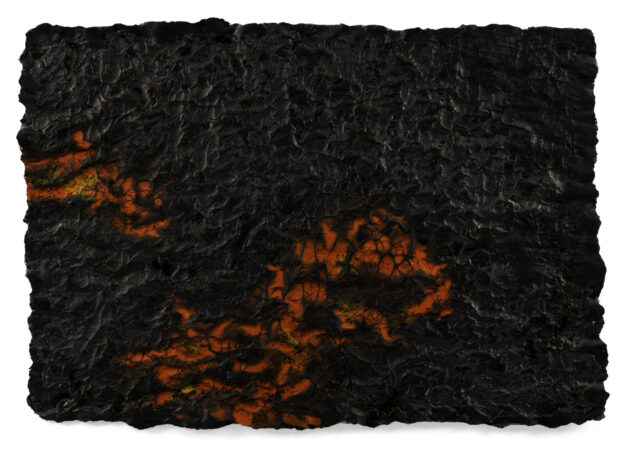
Ione Parkin RWA: Vulcanism, mixed, media, 110 x 90cm, 2025
The series of mixed media works on paper, Speculations on Planetary Surfaces, are richly textured and simulate geological samples of distant and unreachable terrain. We seem to be hovering above these surfaces as if prospecting from orbit. These are surfaces which echo the hyper-cold regions of other planets, known and unknown, in our solar system or beyond. They suggest a cyclical history of freezing and thawing or the charred intensity of fusion crusts or a volcanically active planetary surface (Vulcanism, mixed media on paper, 110 x 90cm, 2025).
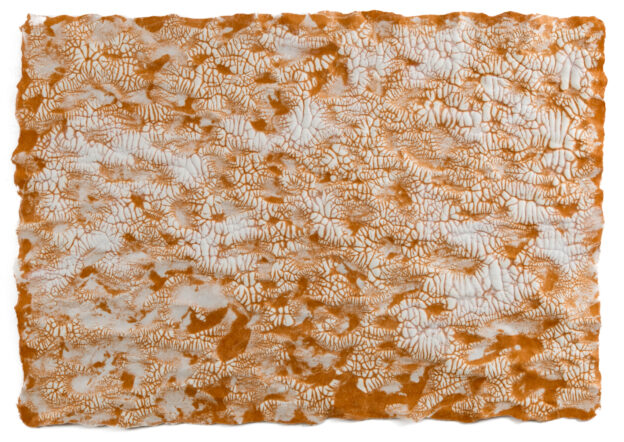
Ione Parkin RWA: Sublimation of Mars Polar Ice, mixed media on paper, 110 x 90cm, 2025
Sublimation of Mars Polar Ice (mixed media on paper, 110 x 90cm, 2025) is one of a series of works inspired by the carbon-dioxide and water ice which covers the polar regions, fracturing and cracking in the Martian summer, revealing the iron-rich earth between the cracks. Sublimation is a chemical process where a substance turns from a solid into a gas without going through a liquid state. The intention behind this series has a clarity of purpose, followed by the instinctual processes of painting.
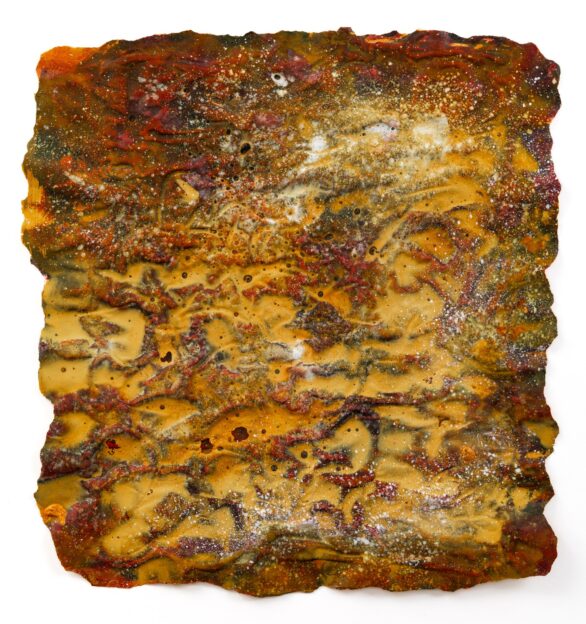
Ione Parkin RWA: Sulphur Crust, acrylic/oil on paper, 40 x 34cm, 2022
The lava lakes and sulphur-rich environment of Jupiter’s moon, Io, was the inspiration behind Sulphur Crust (acrylic/oil on paper, 40 x 34cm, 2022). It appears as a roughly torn section of a hot sulphuric young world – turbulent and violent – a chemical cocktail of different elements blanketed by material ejected from volcanic eruptions.
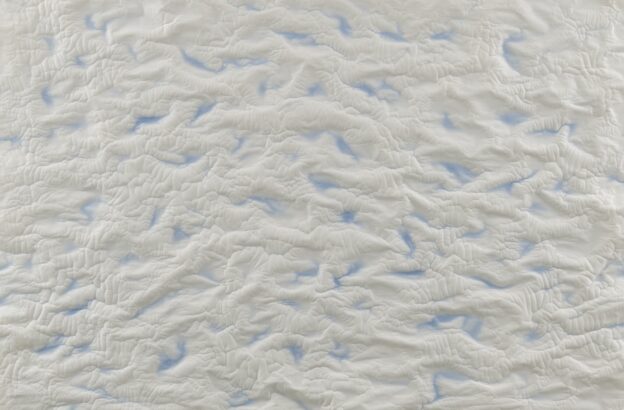
Ione Parkin RWA: Sub-Zero (detail, mixed media on paper, 110 x 90cm, 2025
Sub-Zero (detail, mixed media on paper, 110 x 90cm, 2025) evokes vast hyper-cold regions across a world in the depths of planetary chill. The blue seems to indicate glacial meltwater and perhaps indicates the potential conditions for the presence of life.
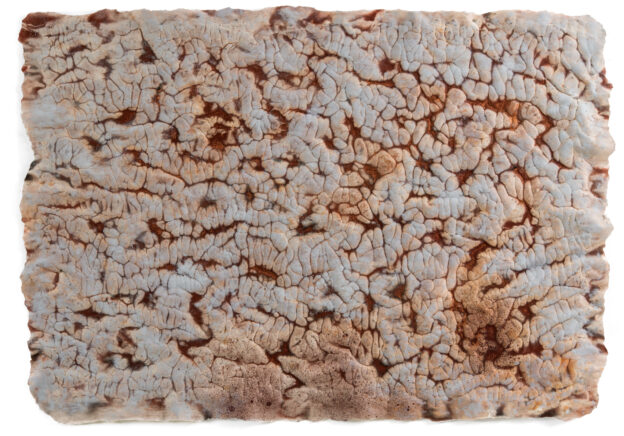
Ione Parkin RWA: Chasmata with Tholins, mixed media on paper, 110 x 90cm, 2025
This mixed media work, Chasmata with Tholins (mixed media on paper, 110 x 90cm, 2025), was inspired by the surface of Pluto in terms of its form and subtle colouring. Tholins are complex organic compounds, created when ultraviolet radiation from the sun breaks down methane and other gases in Pluto’s atmosphere. These tholins fall to the surface giving the planet and its moon, Charon, their reddish-brown colour. Tholins are common throughout the solar system and, on Earth, have been found to contain amino acids that are the building blocks of life.
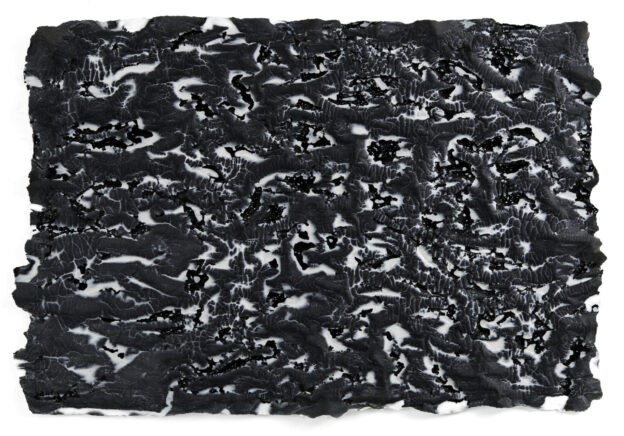
Ione Parkin RWA: Amorphous Ice, mixed media on paper, 110 x 90cm, 2025
Amorphous ice is a solid form of water lacking the regular repeating crystal structure of ordinary ice – instead it has randomly arranged molecules often formed by rapid cooling. It is the most common form of water in the universe and is found in comets and icy moons. I wanted to evoke a barren, inhospitable and frozen world brought within touching distance – closing the gap between what is unreachable and what can be known. (Amorphous Ice, mixed media on paper, 110 x 90cm, 2025)
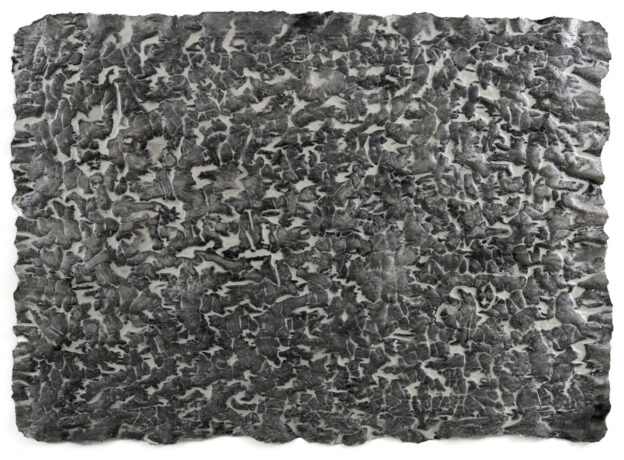
Ione Parkin RWA: Albedo, mixed media on paper, 110 x 90cm, 2025
Albedo (mixed media on paper, 110 x 90cm, 2025) has been coated with a semi-metallic, pearlescent paint to enhance the reflective qualities of the painting’s surface. This can be perceived by moving from side to side in front of the painting. The albedo effect is the measure of how much sunlight a planetary surface reflects and is a property that can be measured by astronomers. The surface structure of this painting seems to be imitating fractal processes with fluid and pigment, exploring the quality of the fracture lines – lines that simultaneously connect and divide across a surface.
Meteorite Matters I-VI is a series of mixed media works on paper in direct response to close study of a sample of the Krasnojarsk Pallasite, held in the collection of the Bath Royal Literary and Scientific Institution. This rare stony-iron meteorite is part of the 630kg Krasnojarsk Pallasite. It is around 4.2 billion years old. Historically significant, it is the first of its kind to have been scientifically recognised as having extra-terrestrial origins. It was first described as a meteorite in 1779 by German physicist Ernst Chladni. It is thought to represent the shattered remains of a large asteroid or planet which collided with another huge mass at a time when the orbits of the planets in our solar system were still stabilising. I became fascinated by this object of cosmic origins and produced multiple works revealing different aspects and qualities.
The Meteorite Matters series combines photography, photopolymer etching, blind embossing, collagraph printing with silver etching ink and other substances. The final multi-faceted work echoes a scientific approach of close study, analysis and gathering information in a collective form. Meteorite Matters I is a deliberately bleached image, hinting at the entry of the meteorite into Earth’s atmosphere, burning up, white hot. The second image (Meteorite Matters II, mixed media on Hahnemuhle paper, 55 x 55cm, 2025) appears to view the arrival of this extra-terrestrial object through a telescopic lens. Meteorite Matters III (mixed media on Hahnemuhle paper, 55 x 55cm, 2025) evokes an atmospheric landscape – the micro-topography of this fascinating object of cosmic origin. Meteorite Matters IV (mixed media on Hahnemuhle paper, 55 x 55cm, 2025) explores the cross-section of the sample – bubbles of olivine and pyroxene crystals which are surrounded by an iron-nickel matrix – and is embossed with silver metallic etching ink.
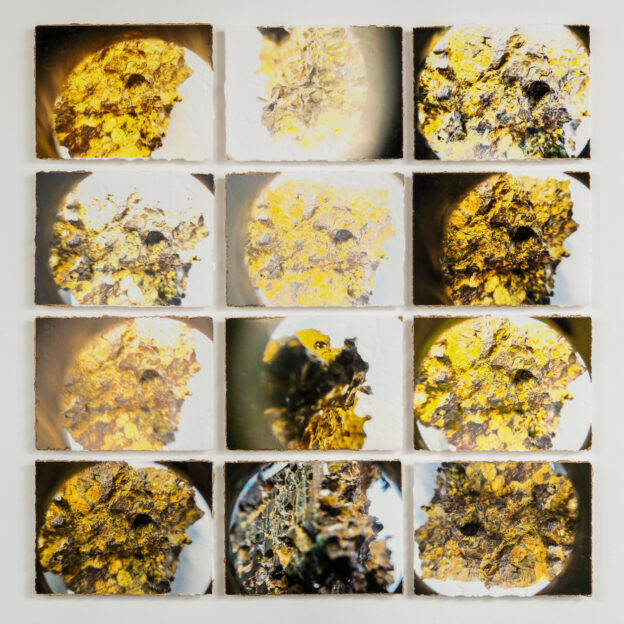
Ione Parkin RWA: Meteorite Matters II, mixed media on Hahnemuhle paper, 55 x 55cm, 2025
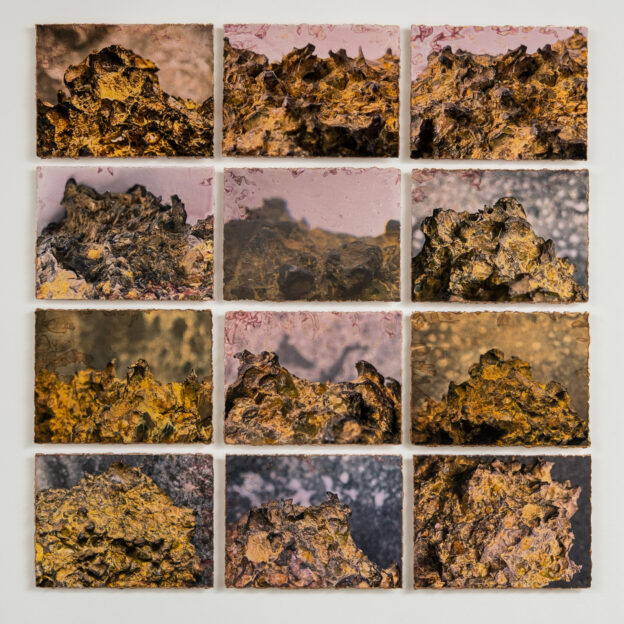
Ione Parkin RWA: Meteorite Matters III, mixed media on Hahnemuhle paper, 55 x 55cm, 2025
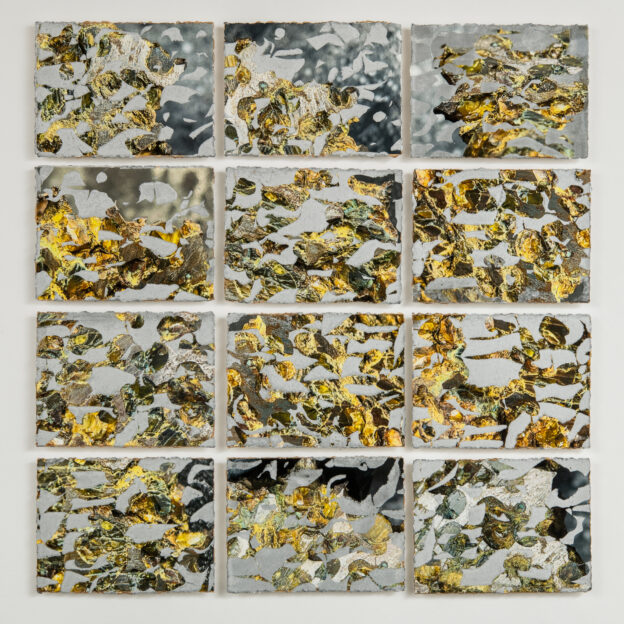
Ione Parkin RWA: Meteorite Matters IV, mixed media on Hahnemuhle paper, 55 x 55cm, 2025
Contemplation of the cosmos brings about a paradigm shift in perspective. The cross-pollination of ideas through interdisciplinary dialogue acts as a catalyst for refreshed visual thinking. These works are contemplations on time and space, meaning and mark-making, materiality and atmospherics.
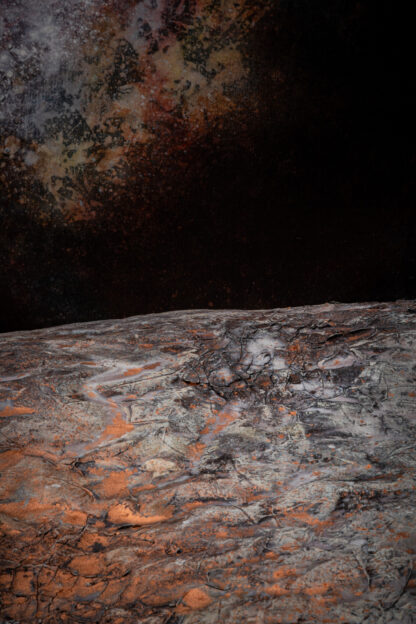
Ione Parkin RWA: Undiscovered Worlds, IV, digital photograph on archival paper, 2024
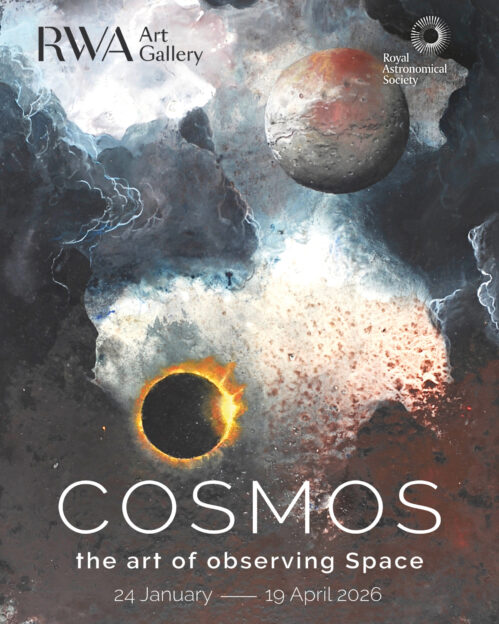
Cosmos poster – image credit: Michael Porter RWA, Impossible Landscapes, 2025
The curation of ‘Cosmos: the art of observing Space’
I have curated a major exhibition of artwork held in the main galleries of The Royal West of England Academy (RWA) in Bristol. Cosmos: the art of observing Space, runs from 24th January until 19th April 2026.
I have worked closely with the Royal Astronomical Society, developing a partnership with the RWA. This exhibition explores humanity’s enduring fascination with the cosmos through a blend of historic artefacts and contemporary artworks. Cosmos brings together works by Royal Academicians and RWA Academicians, alongside compelling pieces by established and emerging artists.
Through the work of over 30 contemporary artists the exhibition explores a range of themes: light waves, rotation, orbiting, solar dynamics, planetary surfaces, time, observation, star fields, asteroids and meteorites, constellation mapping and our closest neighbour, the Moon. I have gathered rare treasures from the archives of the Royal Astronomical Society, National Maritime Museum, the History of Science Museum, the Bath Royal Literary and Scientific Institution and other collections. Highlights include historical drawings of the moon, celestial globes, a historic meteorite, and intricate star maps, showcasing the deep interconnection between art and science in our quest to understand the universe.
Artists and astronomers are trained observers and the intuitive qualities of vision and imagination are valued through the lens of both arts and science disciplines. Cosmos: the art of observing Space offers a unique journey through time, imagination, and inquiry—inviting visitors to experience the awe, wonder, and curiosity that the cosmos continues to inspire.
For more information on Cosmos: the art of observing Space: www.rwa.org.uk
The Cosmos symposium will be held at the Royal Astronomical Society, London, on Saturday 28th February 10-4, in-person and online.
Booking through:
Exhibition catalogue
This richly illustrated publication features a Foreword by Professor Chris Lintott, (astrophysicist, author, and co-presenter of BBC’s Sky at Night). Additional essays by the curator, Ione Parkin RWA, and leading contributors including Dr Sian Prosser (Librarian and Archivist at the Royal Astronomical Society), and Professor Amaury Triaud (University of Birmingham). https://www.rwa.org.uk/collections/rwa-shop/products/pre-order-book-cosmos-the-art-of-observing-space
……………………………………..
All images copyright and courtesy of Ione Parkin
Get the Full Experience
Read the rest of this article, and view all articles in full from just £10 for 3 months.
No comments yet.