Tag Archives: Drawing

What makes a good scientific illustration?

Trevor Weekes is a practicing Artist and Educator. He has been a Lecturer in Natural History Illustration and Fine Art in The School of Design, Communication and Information Technology, University of Newcastle.

Exhibiting regularly, with both solo and group shows throughout Australia, his art practice embraces multi disciplines, specifically Drawing, Painting, Sculpture, Artists Book production and more recently Animation. Music has always played an important role in his life and is an area he has been involved in, producing a sound piece to CD, and incorporating sound in several of his installations. His absolute love of animals has been a major topic of interest, focusing on Birds specifically and Flight.
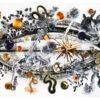
Julie Harrison’s ‘Bodies’

Julie Harrison is a multidisciplinary visual artist and educator who probes methods of science and mechanisms of technology to explore the dualities of nature and artifice. She currently makes drawings using repurposed biological images from various sources. For the past forty-five years she has been an active professional artist in New York City, has garnered awards and exhibited both locally and internationally. Her work resides in public collections at The Getty, the Library of Congress, Harvard University, Columbia University, New York Public Library/Berg Collection, Brown University, and others.

The Art of Science

‘The Art of Science’ explores the work of 40 artists and artist–scientists, from different cultures and eras, uncovering how these innovators have designed futuristic technology centuries ahead of its time, investigated time and space through abstract art, and created sculpture informed by Nasa technology.

‘The Art of Science’ explores topics such as: Climate breakdown and conservation ; Deep space and cosmic archaeology ; How media is used to communicate ideas relating to science ; Exploring being human alongside biotechnology ; and AI and Neural Networks.

Mapping the Remains: a personal journey in drawing anatomy

Lisa Temple-Cox’s work explores interstices: between science and religion, the normal and the pathological, the familiar and the uncanny. Central to her practice is her search for identity and sense of belonging as a mixed-race post-colonial child. She is fascinated by Vanitas as both categorisation and as a symbol of the changing states of life. Her current research interests explore the aesthetics and symbolism of the medical museum with a focus upon the anatomical. It examines our own subjective experiences and perceptions of the body in life and death using a range of media, including drawing, assemblage, and installation.

Brainscapes

Artist and writer, Richard Bright, has addressed the relationship between art, science and consciousness for over 30 years. He has exhibited both nationally and internationally and was the recipient of the ‘Visions of Science’ Award, The Edge, Andrew Brownsward Gallery, University of Bath (Second Prize Winner). In ‘Brainscapes’ he shows some works from his neuroscience inspired Limited Edition Prints.

Projecting desires and fears

Anna Sofie Jespersen is a Danish artist based in London who produces emotive figurative works. Anna’s powerful drawings are laden with feeling. Her large scale works have a particularly strong impact. She trained at the Chelsea College of Art and has won awards for both drawing and painting, including second prize in the 2016 Jerwood Drawing Prize for her work ‘Sid in Bathtub’. She was shortlisted for the 2017 Bloomberg New Contemporaries.

Ritual forms and transformations

Kate Southworth makes paintings, drawings, prints and rituals as a way of understanding the transformative energies and unseen patterns of the psyche. Her work experiments with a ‘scattered form’ in which several visible and invisible fragments co-exist. Recent work maps her journeys into the unconscious mind revealing geometric and net-like forms. She has a particular interested in how processes of transformation emerge in the symbolic sphere: the hexagrams of the i-ching, alchemy, yoga traditions, calendric practices, and myths.

CIRCLINGS

CIRCLINGS shows examples of a new book of drawings by Garry Kennard, which were prompted by the final lines of the last canto of Dante’s Divine Comedy. These words describe the vision that Dante experiences at end of his journey through hell, purgatory and paradise. They tell of his witnessing the creative power at the heart of creation. In this he sees a great circling of reflected spheres and rainbows and, somehow, the human image within it all. The article includes the preface by Paul Broks, clinical neuropsychologist-turned-writer.

Vessels

Artist and writer, Richard Bright, has addressed the relationship between art, science and consciousness for over 30 years. He has exhibited both nationally and internationally and was the recipient of the ‘Visions of Science’ Award, The Edge, Andrew Brownsward Gallery, University of Bath (Second Prize Winner). In ‘Vessels’ he shows some recent work from the series.