The beauty of natural forms
Anna Franklin is a British self-taught visual artist, classically trained pianist, and music teacher. Her art is nature inspired with a focus on climate awareness, where she blends traditional art and craft techniques.
Richard Bright: Can we begin by you saying something about your background?
Anna Franklin: I was born and raised in Soviet Russia but since 2006 the UK has been my permanent home. I am a classically trained pianist and self-taught visual artist with no formal fine art training. For many years I worked as a piano teacher and accompanist, but a few years ago I discovered textile art and got hooked.
I have always been interested in art and fashion. My childhood home was full of books about art. I loved looking through them as well as making beautiful dresses and costumes for my dolls when I wasn’t practicing scales and arpeggios. I was seen as a musically gifted child, my piano teacher and parents encouraged me to pursue a career in music, and so I did.
Years later, when I moved to the UK, I also got my degree from the University of Surrey. Recently, I stopped teaching, and decided to become a full time artist. Playing the piano is still as important to me as it ever was, I love my beautiful Bluthner, but I really enjoy exploring my creative side as a visual artist.
RB: What is the underlying focus of your work? In particular, what are the thinking processes and knowledge practices that guide your artistic research?
AF: The underlying focus of my work is environmental advocacy. My art focuses on pressing environmental causes and consequences of climate change, such as coral bleaching and ocean pollution, which in my view, does not receive enough attention. I find coral ecosystems fascinating. It is painful to learn that this outstanding and fragile beauty is under threat created by us, human beings. It is so sad that marine species and ecosystems are being destroyed before they are discovered and fully understood.
The thinking processes, knowledge practices and my artistic research are guided by inspiration that comes from the beauty of natural forms, especially coral reefs and flowers. I can spend hours looking at images of corals, studying their colours and textures.
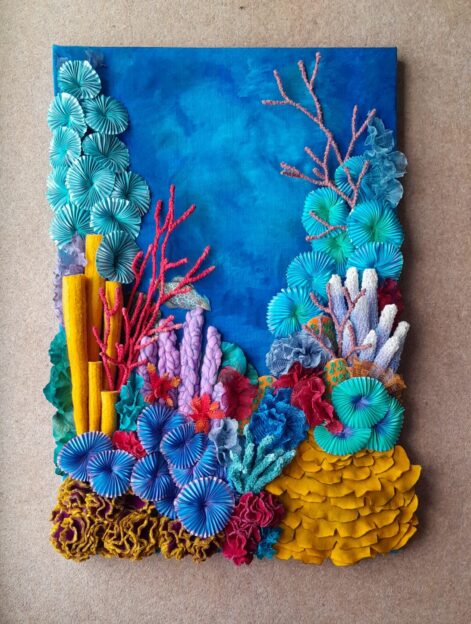
Coral garden
RB: Have there been any particular influences to your ideas and work?
AF: Some of my influences come from visual art, perhaps, mostly Impressionism, Pre-Rafaelites, and masters of the Italian Renaissance. I follow Leonardo da Vinci’s principle of studying life in order to represent it in art. Even when I am creating an artwork that is completely abstract, there is always something from the real world that I try to represent.
It goes without saying that music is a very strong influence on my art. Music and art have a strong connection, they share fundamental principles like rhythm, balance, harmony, contrast, repetitions and unity, which are used to structure and evoke emotions in both mediums.
Among my favourite composers are Bach, Beethoven and Chopin. I feel a strong influence of Bach in particular, some of my white coral artworks remind me of his fugues.
Another major influence is climate change and ocean pollution. Even as a small child I had a fascination with the sea and as I grew up, my interest concentrated on the under-water world of the ocean floor. I always loved watching documentaries about coral reefs. The beauty and fragility of these unique ocean forests still epitomise the interdependence of our living planet to me. The diversity of life which makes its home in these great coral worlds from the smallest creatures to great predator fish, all living side by side and reliant on each other.
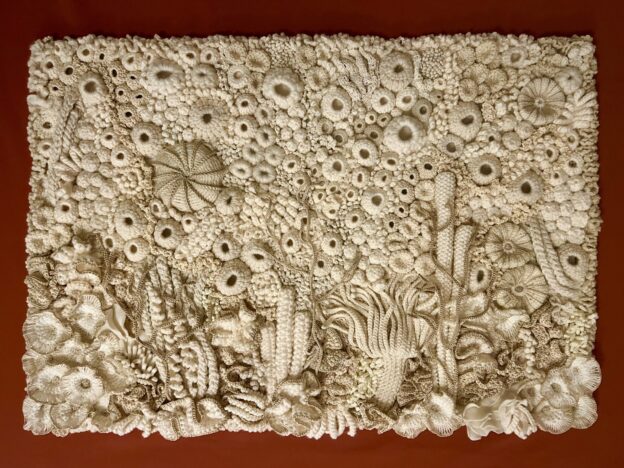
White corals, Series 2, N 3
As a teenager I kept an aquarium at home and studied the lives of the tropical fish I kept. I loved the colours of the reef fish, vivid and striking like living art catching the refracted light from the water, changing tone and accent as they move and continually reacting with the other creatures in their world. Born in March under the sign of Pisces, I think that is why I relate to the sea and feel at home there but perhaps it is just coincidence.
In the last few years I have, like many people, become appalled by the pollution of our planet by single use plastic waste. In less than 60 years we have filled the world with this ubiquitous and virtually indestructible trash. The Actor Jeremy Irons presented Trashed, an excellent series of documentaries highlighting the problem. I felt ashamed, horrified, guilty watching plastic carrier bags eaten by marine mammals, killing them in ever greater numbers. Plastic waste on the deep ocean floor, a region less well known to man than the surface of the moon yet still contaminated by our trash.
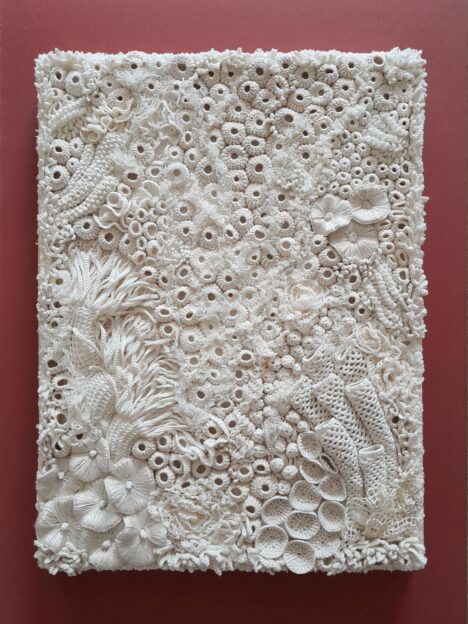
White corals, Series 1, N 5
RB: Can you say something about your working process? What is the starting point?
AF: Usually, I just see it in my mind, like a vision, spark, sometimes with details, sometimes without. Then I think about what is the best way of creating it. Some of my corals might be half-crocheted and half-knitted or embroidered. Sometimes I also paint them. I enjoy traditional fibre and textile art and craft techniques, such as crochet, knitting, embroidery, etc., and I prefer to work with natural fibres, minimizing the use of synthetic ones. I upcycle fabrics and yarns whenever I can.
The classical music training instilled good habits like focus, perseverance, and diligence in me, that now help me in the delicate, intricate, time-consuming process of creating each coral.
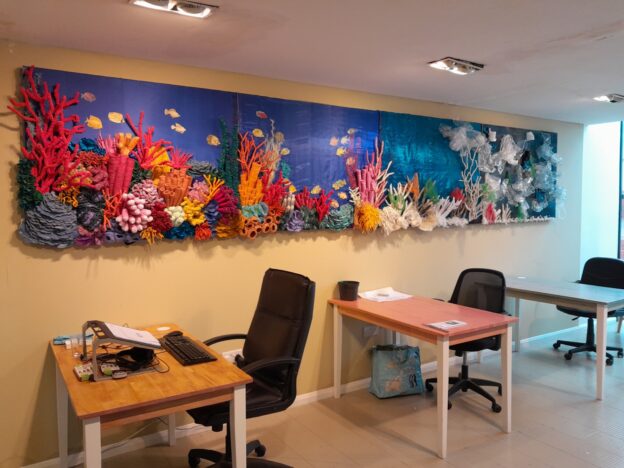
ZERO Carbon Guildford installation
RB: Can you say something about your artwork for ZERO Carbon Guildford?
AF: ZERO is a charity that engages local residents in becoming more aware of their personal impact on the planet and empowers them to make changes that reduce waste, protect nature and improve health.
My artwork focusing on the beauty (and also the bleaching) of coral, was greatly received at ZERO because it brings attention to how precious and fragile some of our ecosystems are and how important it is to look after them. I am particularly grateful to Steph Bleach, Outreach Coordinator at ZERO Carbon Guildford for this opportunity.
I thought of the dying oceans and the destruction of the great reefs when I was making it. I wanted to show the contrast between the vivid life of the reef and the ghostly desert which remains when the coral dies off in large areas. I wanted to show the fragile beauty of coral and hint at a future which we may yet prevent.
The artwork is just under 5m in length, and 92 cm in height. I constructed it in three sections so it would be easily transportable as I knew ZERO would need to change home at some point.
When ZERO moved last year to another venue in central Guildford, I added the fourth panel, to reinforce the message. I must confess it felt a bit strange to use plastic bottles and other rubbish but I wanted to make my message very loud and clear.
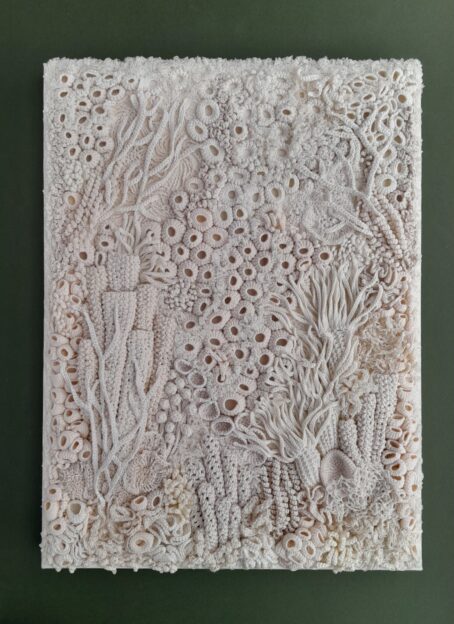
White corals, Series 1, N 4
RB: In many ways our human brains interpret information through pattern recognition and re-arranging pattern, which is an evolving dynamic process. What importance does pattern play in your work?
AF: As a classically trained pianist, it comes naturally to me to recognise and anticipate patterns. Just as music builds through recurring motifs, harmonies, and evolving structures, my artworks rely on repeated stitches, organic forms and variations to create movement and life within each piece.
To me, the process of creating artworks is similar to composing music. Each loop and knot mirrors a note or phrase, and together they form intricate, interwoven structures—much like music builds upon recurring themes. The patterns in my artworks evolve across the canvas, sometimes structured, sometimes in fluid, improvisational waves, reflecting both the order and unpredictability found in nature.
Just as in music harmony may shift to dissonance, some of my coral artworks transition from vibrant, densely textured arrangements to stark, unravelling forms, mirroring coral bleaching. By intertwining different patterns, my art explores how structures can grow, shift, and, in some cases, break down.
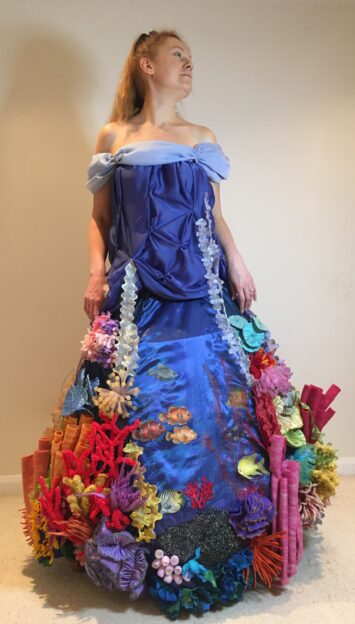
Wearable art Ocean
RB: Your art explores how things form, grow and evolve. How has your artwork evolved from the very first pieces?
AF: When I first started, my pieces were more about simply replicating the beauty of nature through knitting, felting, fabric manipulation, and crochet—focused on texture, colour, and form. But as my work evolved, I became more intentional about storytelling, using my art to highlight the environmental threat corals face and to show the contrast between thriving reefs and the stark reality of coral bleaching.
My art now serves not just as artistic expression but as visual conversation, inviting viewers to reflect on what’s disappearing beneath the ocean’s surface. I’ve moved beyond just creating intricate coral reefs to exploring decay, fragility, and loss—integrating stark whites and delicate, almost skeletal forms to represent dying reefs.
RB: What projects are you currently working on?
AF: I am preparing some artworks for exhibitions both in the UK and internationally, as well as working on several commissions. I have more ideas than time.
…………………………………….
Instagram @annfranklin_art
All images copyright and courtesy of Anna Franklin
Get the Full Experience
Read the rest of this article, and view all articles in full from just £10 for 3 months.
No comments yet.