Emerging Ideas
Hanna Lemmik: Engrammatica / Bodies in trouble
Rumination takes place within the body and is therefore constrained by the body’s material reality, particularly the material reality of memory. We do not know exactly how memory is contained in the body but there are indications that memories are constantly remodelled on the molecular level. That is, they do not stay static. Kierkegaard’s ideas on despair are in line with this idea of constant change. Kierkegaard’s self strives for a consistency which it cannot achieve and therefore it must despair, but it is also transformed through this process, suggesting that unwelcome mental loops are tentative and changeable.
An engram is the material substance of a memory. We still have not localized it despite the deployment of innumerable rodents into mazes—will they ever find their way out? But the mere notion that such a thing as an engram exists is useful for phenomenology, particularly of one’s own. Here, I appeal for use value instead of meaning because a spectre of dualism hangs over attitudes regarding mental states, cognition and emotions. There seems be an informal agreement that psychology and philosophy of the mind exist somehow outside of biology. While it is true that levels of understanding within these disciplines have diverged, the mind remains a natural phenomenon that is constrained by the material context in which it is found. In fact, all ideas and memories have a material basis in the brain as does every verbal tic, intrusive thought and fit of rumination. It is common to assign the context of these impulsive negative thoughts to psychiatric conditions like depression, bipolar disorder or anxiety. Most of us would agree that these conditions have a biological basis, but the content of negative thoughts themselves is seen as somehow immune to biology. To understand basic human emotive processes like rumination, some appreciation of the underlying material context is nonetheless necessary. On the other hand, a solely biological understanding would also leave us at a loss since science tends to limit itself to concepts it can formally test.
Søren Kierkegaard, a 19th century Danish philosopher, certainly did not have this constraint. He was obsessed with the human capacity for despair and was himself so inclined to ruminate, he filled dozens of books with semi-autobiographical contemplation. One event came to hold a mercurial presence in his writings—his engagement to a girl called Regine Olsen which he broke off in 1841 without any obvious reason. This would not be so surprising had he not become possessed by the memory of this affair. He subsequently threw himself into his work, being particularly productive in the years 1843 and 1844 when six and seven texts respectively were published under his various pseudonyms. In fact, most of what we consider Kierkegaardian theory originates from these two years. One text, Repetition (1843), deals exclusively with Regine and the break-up. Today, we might diagnose a person who exhibits periods of impulsive decision making with little regard for consequences (breaking an engagement) and mania (extreme productivity) that accompany periods of depression as suffering from bipolar disorder. At the time, this concept did not exist. Instead, he sought resolution to these afflictions through philosophical investigations. He wrote about anxiety at a time when religious dogma was considered a science and psychology was only beginning to make headway. He saw anxiety necessarily as something innate and hereditary, tracing it back to original sin. Regardless of how quaint this conclusion might sound to us, his approach was rooted in sincere observation and scholarly investigations and therefore holds merit, especially regarding what it feels like to be in despair.
Kierkegaard’s understanding of despair is likewise soused in religious reasoning but offers other fruitful avenues for reflection. His despair is not just any angst. It has an object and a direction, and is inextricably linked with the idea of the self. To him it is the continuous systematization and adjustment of the self that necessarily produces despair. He writes: “self is a relation which relates to itself—a synthesis—but in relating to itself it relates to something external.”[i] Here, Kierkegaard touches on two things that are essential to understanding rumination. Firstly, he states that the self is not stable—it is in flux. Biologically, the stuff in the brain such as synapses and proteins are also constantly moving, remodeling, degrading or rebuilding. Even the DNA in neurons is constantly edited—but more about that later. Nothing stays the same and indeed nothing can. Kierkegaard writes that immediacy really has no self, and therefore cannot recognize itself either. Thought is only possible because of memory. If we were to be only in the present, we would never be able to make sense of, or respond to, our environment other than by reflex.
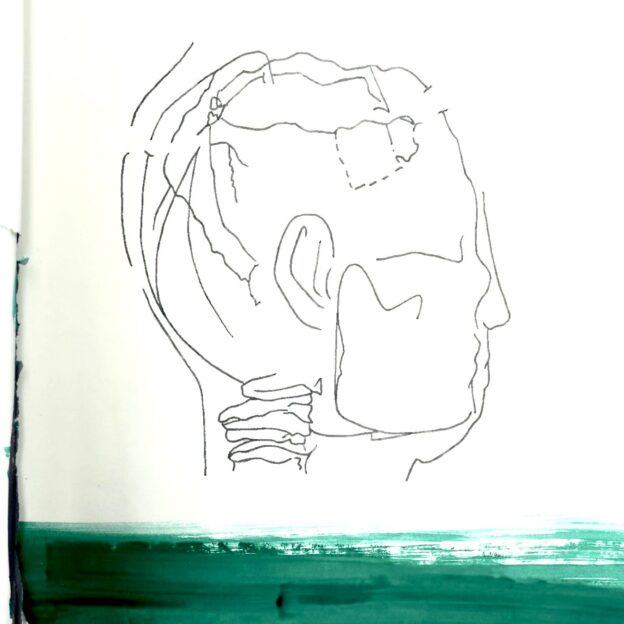
Pencil and gouache on paper. Courtesy of the author, Esther Walters.
Secondly, although we do not know how the self is constructed from these parts, we do know that they are influenced by temporality, or the state of how they were before, and the environment. We can imagine that these two things, temporality and environment, are also what make up Kierkegaard’s external—that to which the self relates. I say that temporality is external because past brain states influence current states but are no longer or only partially existing. To Kierkegaard, the self desires coherence wanting to “consume itself” which it ultimately cannot do since it and the external are always shifting. The consumption or digestion of the self has a natural similitude to rumination. Rumination derives from the Latin noun rūmen, referring to the first of four stomachs in ruminant animals where they temporarily store their partly digested food to return to chewing it later. Similarly, mental rumination entails returning to memories and physically reworking them. We now understand that returning to memories changes them. Ruminating and memory are therefore linked and to understand rumination, we must consider what we know about memory.
Let us first consider the memory network. This is important because memories, or engrams, seem to move from one brain area to another. In mammals, these parts are the amygdala, the hippocampus, and the prefrontal cortex. In a neuroscience textbook you would see a diagram of a brain with lots of arrows coming in and out of these three regions. These diagrams are drawn static but imply movement. They represent neurons with tails that are always branching, thickening, thinning, contracting and expanding. We obtain the direction of these communicating streams by tracing where the tail of a neuron in one brain area ends up. So, we know that specific neurons in the hippocampus connect to specific neurons in the amygdala, and the amygdala in turn sends its own clingy projections back to the hippocampus and so on. The communication between these three areas is surprisingly predictable even across species. It is also possible to see which brain areas have correlated activity, manipulate the organism genetically or with drugs and see how the connectivity changes. This type of experiment, perturbing and recording, is a big favorite among biologists.

Deep-daze is a command line tool for converting text to image using OpenAI’s CLIP and Siren. Talking about memories also converts images to text and then back until they become disjointed and distorted. Image is courtesy of Diarmuid Morgan.
The problem with these diagram explanations is that they represent what is essentially a plumbing issue, and as such they cannot be entirely satisfying. Even so, we can split hairs a while longer and ask if something like rumination is a consequence of a specific network property or so called ‘bad wiring’. For example, there exists a network of brain areas that is active when people are not focused on tasks immediately involving the outside world. This is termed the default mode network and its activity is often associated with such noble follies as mind-wandering and daydreaming in humans, although it is more likely to serve some sort of a more basic housekeeping function. In fact, a similar network can also be detected in anaesthetized rodents. The default mode network is hyperactive in some way in a few psychiatric disorders, particularly depression with rumination.
Depression in rodents—yes, rodents are considered depressed when they display helplessness, anhedonia and behavioural despair (lo these never-ending mazes!)—who have also a hyperactive default mode network can be partially alleviated by reducing the electrical activity of the network.[ii] This type of a network diagram sounds somehow intuitive and compelling, mainly because the default mode network implies movement and self-referential circularity—a mental loop. Beyond a metaphor this sounds like the definition of rumination because something about the loop-like way ruminative thought feels suggests a network. This piece of the puzzle has perhaps captured a dynamic. We can now imagine the swimming of thought, but not what is moving within these circuits, not the thought itself.
“You are really in even far greater despair than you realize, your despair goes much deeper,” writes Kierkegaard in The Sickness unto Death (1849). He refers to the inability of a person aware of their despair to conceive of what it really is. Indeed, how deep does despair go? Perhaps it goes as deep as a single synapse—the gap between the squirming protrusions on neurons through which they communicate. Neurons grow and remodel these protrusions constantly. Over time, the protrusions on different neurons connect to form synapses and grow thicker through activity or wither away. Many researchers believe that memory is contained in those synaptic connections because synapse development has been shown experimentally to often coincide with memory formation. To clarify, they do not mean that memory is contained in the gaps between the neurons. That would be problematic. They mean that memory is contained similarly to a computer’s binary code in the electrical signals that are enabled by an assemblage of neurons forming many synapses, which is only slightly less problematic.
Although most things the brain does involves synaptic change (thought), we know that engram cells have something special about them. They have preferential connectivity with other engram cells, meaning that they ping each other more often than others. We know this because we can now force specific neurons to contain a new memory in rodents. Using one of the more creative experimental frameworks, we can take advantage of the fact that a neuron’s probability to become an engram is associated with a high content of a substance called CREB[iii]. If we genetically alter just some neurons to have more CREB, these neurons will win the competition, imbibe the memory, and strengthen connections with other engram cells. One can then send only these neurons offline and see how the behavior of an animal changes (good old perturb and measure). Doing that, it is possible to narrow down the location of a new memory to a handful of cells and see how these cells are connected to other brain regions. Many engrams can interact with each other quite randomly. It is not at all obvious how we catch a specific train of thought. It is possible that however similar, each is somewhat coincidental and unique. Every time we replay a memory, we might stumble upon or invent something new, changing the synapses. Again, there is something intuitive about the changeable nature of these synapses. It suggests repetition evoked by already existing neuronal associations. But is it that simple?
Surprise! The synaptic theory of memory is not in fact the whole story. It has become clear that memories can be created without synaptic change and that the destruction of synapses does not destroy memories. For example, butterflies change all their synaptic connections and undergo severe brain remodeling during metamorphosis but still avoid smells that they were experimentally taught to fear when they were caterpillars[iv]. Hibernating mammals lose a lot of their synapses but soon after waking their neuronal connectivity is restored and they retain their memory.[v] It is also possible to partially awaken a memory in rodents just by electrically stimulating engram neurons even when, during the engram’s formation, synapse creation had been disrupted[vi]. Alas, blocking synapse growth does not block memory and therefore biologists must conclude that synapses do not contain memory.
The word ‘engram’ comes from the Greek words for ‘in’ (en) and ‘letter’ (gramma), giving a sense that it really is physically (in-letter) inscribed into the soft cells that make up our psyche. There are, appropriately, many things that happen within a neuron when a memory is formed. One of them is a type of a modification on DNA called methylation. Importantly, blocking this modification also disrupts the formation of memories. The normal role of DNA methylation in cells is to mostly to suppress the activity of genes. Some biologists think that methylation is necessary to stop neurons from producing CREB, so they would not be able to compete to become new memory engrams and therefore be forced to preserve old memories. If true, I wonder how long this strategy would hold up? Perhaps learning something new is the only sure way of escaping undesirable mental loops.
Also, firing is stressful to neurons. We know that when cells are stimulated by wounding or an electrical signal, they get stressed and make more of a series of factors called ‘immediate early genes’. These cellular stress sensors drastically alter which molecules are produced in the cell to promote growth and repair. Both electrical stimulation and the formation of memories increase the number of breaks in the DNA of neurons. These breaks occur most often around immediate early genes and increase their activity, and if we were to stop these breaks from happening, we can—again—block memory formation. Each time a break happens in the neuron’s DNA, it gets repaired but mistakes are so common that it is safe to say most neurons in your brain do not have identical DNA within them. Some think that memory is actually contained in this way like carvings in a tree. Therefore, DNA between neurons is not identical in the brain, and this is a prerequisite for having memories in general. Viewed like that, memories are scarring, a long-term cellular change provoked by cataclysmic molecular events, while any activity is remodeling their content all the time.
We must think deeply about the bodies that enable and constrain our minds. If neuronal activity does have the potential to change memories, then it is certainly feasible that bad memory loops can become less taxing over time. Nothing is fixed in the brain. To Kierkegaard, forgiving your own self is robbing that duty from God and therefore blasphemous. The reality can be slightly less bleak as memories are changeable—every time we polish them, a little goes away, particularly if we use our capacity for rumination on learning something new.
………………………….
[i] The Sickness onto Death, first published in Danish in 1949, translated by Alastair Hannay in 1989, re-published by Penguin Classics in 2008, p9
[ii] Clemm von Hohenberg, Christian, Wolfgang Weber-Fahr, Philipp Lebhardt, Namasivayam Ravi, Urs Braun, Natalia Gass, Robert Becker, et al. 2018. “Lateral Habenula Perturbation Reduces Default-Mode Network Connectivity in a Rat Model of Depression.” Translational Psychiatry 2018 8:1 8 (1): 1–9
[iii] Josselyn, Sheena A., and Susumu Tonegawa. 2020. “Memory Engrams: Recalling the Past and Imagining the Future.” Science 367 (6473). https://doi.org/10.1126/science.aaw4325.
[iv] Levine, R. B. 1984. “Changes in Neuronal Circuits during Insect Metamorphosis.” The Journal of Experimental Biology 112 (September): 27–44.
[v] Mihailović, L., B. Petrović-Minić, S. Protić, and I. Divac. 1968. “Effects of Hibernation on Learning and Retention.” Nature 218 (5137): 191–92.
[vi] Ryan, Tomás J., Dheeraj S. Roy, Michele Pignatelli, Autumn Arons, and Susumu Tonegawa. 2015. “Memory. Engram Cells Retain Memory under Retrograde Amnesia.” Science 348 (6238): 1007–13.
……………………………………..
Hanna Lemmik holds degrees in Archaeology, Genetics and Biomedicine. She is currently completing her doctorate in King’s College London, researching how the immune system influences memory and anxiety. https://www.wellcomeneuroimmunephd.co.uk/students
Get the Full Experience
Subscribe today and view all issues in full from just £10 for 3 months.
Comments are closed.