Emerging Ideas
Alain Negre: Contemporary Cosmology and Traditional Representation of the Whole
The contemporary cosmological narrative is linked to a traditional symbolic representation of the whole. The number, in the qualitative sense, allows a link between the physically knowable reality and the imaginary World-Soul. Thus, the quaternary is reflected in four fundamental cosmological events, two of which are of the simple attractor type with the other two characterized by strong emergence. The ternary is revealed through a three-moment dialectic, chiseled into the cosmic becoming by the fundamental forces of physics. The reflections of these two archetypal numbers thus offer another glimpse of the universe and, from a perspective between different orders of reality, may also offer food for thought about certain new relationships between cosmological events.
I. Totality, origin, myth and history
Questions of wholeness and origin lie at the border between science and myth, as well as on that between reason and imagination. Since 1916, the theory of general relativity has provided a scientific representation of the entire universe, first portraying it as a universe that has always existed, one which is eternal and constantly recreating itself. Eventually, history crept into most objects in physics. The universe, as a whole, has become the subject of a story, a thermal story that unfolds along a time axis graduated from 0 to infinity.

The prevailing cosmological model tells the story of matter, arising out of a fluctuation in the quantum vacuum which is the minimum state of energy density. It is the story of a mixture of expanding particles which cools whilst expanding and which, at around the age of 380,000 years, is differentiated between matter and light, and structured into galaxies, stars and planets, to end up on Earth with a biosphere and Homo Sapiens. Furthermore, this model can be extrapolated towards the future, indeed towards the very distant future.
II. Totality and cycles
Cyclical models then emerged. The first of these were based on expansion-contraction sequences. They could not withstand the problem of increasing entropy from cycle to cycle, nor the observation in 1998 of an accelerated expansion preventing any such cyclical evolution. The cyclical idea has nevertheless reappeared within the framework of this expansion which, in the far future of the universe, rarefies matter until its virtual disappearance and thus brings back the initial conditions of a vacuum-like configuration. As this fluctuating vacuum is unstable, it can experience a spontaneous symmetry breaking, which induces a rapid growth of one fluctuation which can create a new universe through a new inflation mechanism. Note that this mechanism is not necessary in Roger Penrose’s conformal cyclic cosmology (CCC) model[i] as the accelerated expansion of a previous phase achieves the same conditions.
Black holes at the centers of galaxies eventually merge and swallow (almost) all matter and then evaporate. This leads to a massless universe (i.e. a clockless one which also means a state devoid of time, as well as space). This state is paradoxically equivalent to the extremely hot state at the very ‘beginning’ when all the masses of the particles were negligible compared with the ambient energy. This equivalence allows for a ‘conformal rescaling’ which transforms the universe of the end into a new origin for a new phase of expansion called ‘aeon’.
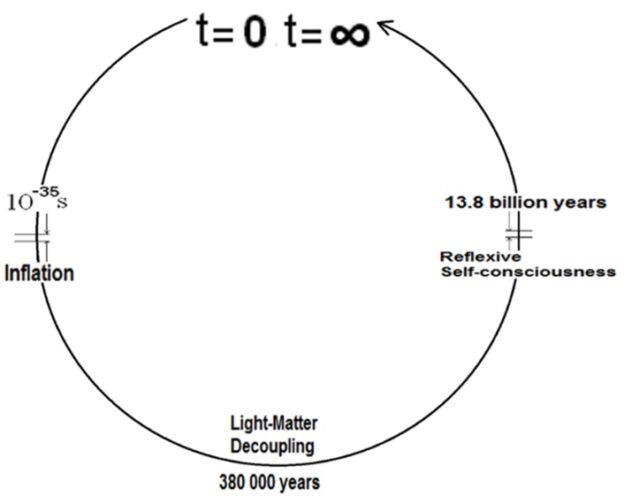
These various types of cyclical evolution may thus be transferred on to the linear time axis, folded back on itself, as in the figure below:

III. Mandalas
This circular representation tends to recall the time of the ‘eternal return’, that of the so-called Great Mother religion. It is also the basic form of the mandala which is a traditional representation of the whole. Its circular shape is often contained in a square enclosure with four gates representing the four cardinal points. More generally, it is a universal archetypal form which harmoniously integrates the qualities of the first integers. The latter, which are prior to quantitative numbers, are also called archetypal numbers[ii]. They represent the foundation on which the entire modern mathematical edifice has been constructed.
The mandala is thus a qualitative numerical model of the totality, which refers to the notion of unus mundus (one world) of medieval philosophers. This is the level of a metaphysical reality where matter and psyche are not separate. It is a potential world in relation to our empirical world which is its manifestation[iii]. It was taken up by psychiatrist Carl Jung and physicist Wolfgang Pauli in their conception of a psychophysical cosmic unconscious. Pauli, in his study of Kepler, showed that great inventions, scientific conceptions, are rooted in a breeding ground governed by the archetypes that are empty forms of the unconscious[iv]. These formal structures are the founding principles of the universe and are in themselves unknowable. They leave imprints in the consciousness, known as archetypal images or symbols.
It is suggested here that traces or reflections of fundamental archetypal numbers emerge in accounts drawn from the interpretation of contemporary cosmological models. There follows a qualitative structure punctuated by the numbers 4 and 3, summarized below (for further details, see[v] and[vi]).
First of all, four major events stand out. These are four events characterized by concepts of qualitative physics (attractor, emergence, phase transition, symmetry breaking):
IV. The quaternary
1) Notice, first of all, the common point of t = 0 / t = infinite) which acts as a double ‘simple’ attractor. It is, in fact, a double attraction: towards maximum disorder, according to the second law of thermodynamics and, in parallel, another attraction towards order, illustrated by the growth of complexity and by the evolution of species.
2) At its diametrical opposite, at the age of t = 380,000 years, the expanding mixture of particles – which cools while expanding – reaches the critical temperature of 3000 K, leading to the decoupling of matter and light. Free electrons disappear and become bound to atomic nuclei. Hydrogen atoms can be formed and light can now pass through these without hindrance. Just before this event, the expanding universe was globally ‘attracted’, in the finest level of its plasma texture, toward disorder and utter cold. But this lethargic state has been avoided in our real universe thanks to the fine-tuning of the constants of physics, which allow for the existence and growth of overdensities of matter. This is because, when the friction electron/photon is stopped due to cooling, the uniform attraction of the matter/radiation mixture is now followed by matter living its independent life by structuring itself into galaxies, stars, planets, etc.
3) The eruption of reflective consciousness is a ‘strong emergent’ event occurring in the stellar epoch at the age of 13.8 billion years. This could be associated with symmetry-breaking mechanisms in the brain or, according to Penrose, with an orchestrated self-collapse process – objective reduction of the wave function triggered by gravity – of quantum-superposed tubulins in the brain[vii].
4) The ‘strong emergence’ also characterizes cosmic inflation which is the event that is supposed to have caused the universe to emerge from vacuum at the age of 10-35s. This mechanism, unnecessary in the CCC model, has been reinterpreted by physicist Paola Zizzi as the ‘Big Wow’ in the context of a quantum-computing universe[viii]. The universe is not energy or matter but information.
V. The ternary
The ternary principle is associated with a dynamic process of development in time. One possible illustration of this is the three-term thesis-antithesis-synthesis dialectic which operates in the form of the work of the fundamental forces of physics: gravity – nuclear – electromagnetism. These forces sculpt and chisel cosmic matter according to 4 times 3 moments:

Thus appears a 4 × 3 numerical figure isomorphic to the Yin-Yang symbol and the zodiac. The 12 signs of The Girdle of Ishtar – admirably re-interpreted by Dane Rudhyar[ix] – surprisingly echo the events of the corresponding 12 cosmological phases.
VI. The 12 phases:
Compared to the objective time of physics, the successive phases are at first very short (inflation lasts 10-32 s) and then become longer and longer. This brings the evolution of the universe closer to that of the human being who experiences subjective time. What matters is the density of events, not the objective time of the clock and the calendar.
The emergence of life and reflective consciousness are usually considered epiphenomena doomed to disappear no later than four billion years from now. More optimistic models have been developed in particular by Freeman Dyson[x] for an expanding universe and by Frank Tipler[xi] for a shrinking universe. These are based on the idea that life and intelligence do not depend on the type of material of the substrate but rather on its structure. The latter could be formed, for example, by electrons and positrons which are the only remaining charged particles of an endlessly expanding universe.
At the very beginning of the universe (I), cosmic inflation causes space to grow exponentially, starting from an infinitesimal space-time bubble. This is one of two ‘strongly emerging’ events that result from a spontaneous symmetry breaking of the quantum vacuum. This first affirmation of ‘being’ (thesis) is confronted (II) by the condensation of material substance (antithesis) which appears with primordial nucleosynthesis. Synthesis (III) takes place in the matter-light ‘friction’ which aims at the formation of the first light atoms, such as hydrogen.
Following light-matter decoupling, attractive gravity gathers matter around local inhomogeneities (IV) (thesis). This increases thermal pressure which triggers nuclear forces (antithesis), creating carbon and other heavy elements (V) which enrich the environment. A local ‘friction’ between matter and light takes place on the Earth (VI), which develops and synthesizes forms that are increasingly better adapted to the environment.
Around the age of 13.8 billion years – in other words, today – the explosive emergence (thesis) of reflexive consciousness (VII) is confronted (antithesis) by the disorganization of material substrates and proton decay (VIII) – as well as black holes that swallow everything, and so on. Speculative models (in reality closer to science fiction than science) show that life and consciousness (IX) could be maintained, encoded on the remaining particles of matter – electrons and positrons – by developing communication networks.
These first three quadrants of the circle seem to complete the cycle. The universe of the ‘end’ returns to the conditions of the ‘beginning’, namely the unstable quantum vacuum that leads to a new period of inflation which creates a new universe. Remember: the CCC model doesn’t even need this period of inflation.
VII. The difficult transition from 3 to 4
So, what about the fourth quadrant of the circle? Physical time is no longer defined, either in the crossovers from aeons to aeons, nor in the rebounds of most bouncing models when Planck conditions prevail. It then becomes difficult to locate the moments of a dialectic there. This complication recalls the traditional difficult passage from 3 to 4 of the alchemists, which corresponded to an obstacle in the flow of thought[xii]. The absence, or lack, of the fourth is the sign of the existence of an endless unknowable totality which is a transcendent reality.
VIII. The fourth
Some lineaments from these three moments may be disentangled from the following remark: at the ‘end’ of the third quadrant, each point of the universe is uniformly subjected to two opposite forces which are gravity and dark energy or ‘cosmological constant’. In the case of the rapidly expanding universe, the latter greatly outweighs the former and vice versa in the case of the shrinking universe. In the fourth quadrant, we can thus see these two forces engaged in a new ternary dialectic. And in the fourth quadrant, they operate in a universe totally devoid of matter and full of information:
(X) Gravity tends to contract the universe into a single point (thesis).
(XI) At every point in the universe, the dark energy or cosmological constant (antithesis) opposes gravity. It is associated with the vacuum of space and is perhaps, as Penrose thinks, a residue of gravitational energy from the previous aeon which accelerates expansion. During the bounce, or the conformal rescaling, there could be creation or variation of fundamental physical constants.
(XII) There is perhaps a synthesis of the action of the two forces within the quantum vacuum, which produces phenomena of friction or erasure. At the Planck scale (1.6 × 10⁻³⁵m), the geometry of space-time is made bumpy due to quantum fluctuations.
IX. Universe of information?
The hypothetical events in this quadrant would probably be easier to describe no longer from a material space-time but from what the space-time would emerge from. According to digital physics, physical laws, particles and fields originate from information encoded in the quantum foam at Planck scale. Physicist Paola Zizzi[xiii] showed that the computational complexity necessary for the emergence of consciousness (VII) was obtained at the end of inflation (I), renamed ‘Big Wow’. At the other end, the hypothetical IXth phase of post-material events, where only electrons and positrons remain, would also be more accessible in terms of information. These particles, separated by considerable distances but linked in hypothetical positronium atoms by the electromagnetic field, could constitute the substrate of consciousness of the distant descendants of the Sapiens survivors of the previous stellar era.
X. Conclusion
A satisfactory treatment of gravitational phenomena and quantum phenomena is struggling to emerge into consciousness. Pending a new and more inclusive information theory, the 4 × 3 qualitative numeric structure, glimpsed in the contemporary cosmological narrative, may bring about a renewal in scientific ideas about time, space, and information. The underlying patterns and symmetries drawn by qualitative angular relations (oppositions, squares) could give rise to new intelligibilities. Furthermore, linking life, consciousness, and matter, they can motivate the search for complementary relationships between physics and depth-psychology. This was Pauli’s dream for the evolution of physics.
Alain Negre, Independent Researcher, France.
……………………..
References:
[i]. Nurowski P. 2021. ‘Poincare–Einstein approach to Penrose’s conformal cyclic cosmology’ Available from: https://iopscience.iop.org/article/10.1088/1361-6382/ac0237
[ii]. MacLennan B. 2018. ‘The Psychodynamics of the Numbers’ Available from: https://www.academia.edu/37542387/The_Psychodynamics_of_the_Numbers
[iii]. Atmanspacher H. 2018. ‘Dual-Aspect Monism according to the Pauli-Jung Conjecture’ Available from: https://www.ibb.unesp.br/Home/ensino/departamentos/educacao/dual-aspect_monism_according.pdf
[iv]. Atmanspacher H. 1996. ‘The hidden side of Wolfgang Pauli’ Available from: http://philsci-archive-dev.library.pitt.edu/940/1/HiddenPauli.pdf
[v]. Negre A. 2018. The Archetype of the Number and its Reflections in Contemporary Cosmology, Asheville: Chiron Publications.
[vi]. Negre A. 2020. ‘Towards An Enantiodromic Approach To The Universe. Jung, Pauli, And Beyond’ Available from: https://archeanweb.com/towards-an-enantiodromic-approach-to-the-universe-jung-pauli-%E2%80%8Band-beyond/
[vii]. Hameroff S. 2020. ‘Orch OR is the most complete, and most easily falsifiable theory of consciousness’
Available from: https://www.tandfonline.com/doi/full/10.1080/17588928.2020.1839037
[viii]. Zizzi P. 2003. ‘ Emergent Consciousness: From the Early Universe to Our Mind’ Available from: https://www.neuroquantology.com/article.php?id=1504
[ix]. Rudhyar D. 1943. The Pulse of Life, Available from: https://khaldea.com/rudhyar/pofl/pofl_p1p1.shtml
[x]. Dyson F. 1979. ‘Time without end: Physics and biology in an open universe’ Available from: https://www.panspermia.org/revmodphys.51.447.pdf
[xi]. Tipler F. 1994. The Physics of Immortality, New York: Doubleday. Available from: http://scilib-physics.narod.ru/Immortality/Tipler.htm
[xii]. Jung C.G. 2004. Four Archetypes, London: Taylor & Francis e-Library. (paras. 425-426). Available from: https://www.universofilosofico.org/wp-content/uploads/2018/02/Four-archetypes-carl-gustav-jung.pdf
[xiii]. Zizzi P. ibid.
……………………………………
Alain Negre was born in 1950. A physicist and electronics engineer, he has worked in the semiconductor industry and taught at the Institut Universitaire de Technologie in Grenoble. At the same time, he has become interested in mind-body issues and the relationship between science and spirituality. He is the author of The Archetype of the Number and its Reflections in Contemporary Cosmology (Chiron Publications) and of the article “ https://archeanweb.com/towards-an-enantiodromic-approach-to-the-universe-jung-pauli-%E2%80%8Band-beyond/#:~:text=It%20denotes%20a%20philosophical%20view,operates%20along%20a%20natural%20continuum.
Get the Full Experience
Subscribe today and view all issues in full from just £10 for 3 months.
Comments are closed.