Emerging Ideas
Sarah Slavick: Elegy to the Underground
“Through its whole life and even after it is dead and decaying, a tree supports the life around it. Through sharing resources and working together in complex and infinite pathways, alliances, and kinship networks, trees reach enormousness and increase their chances of survival and ours as well. These new discoveries of the hidden life of trees suggest new metaphors for our survival and how we should act to protect our home and our species. My ‘Elegy to the Underground’ watercolors and oil paintings are a tribute or memorial to trees whose heartbreaking loss I fear and mourn.”
People aren’t the apex species they think they are. Other creatures-bigger, smaller, slower, faster, older, younger, more powerful-call the shots, make the air, and eat sunlight. Without them, nothing.
-Richard Powers, The Overstory
There is nothing purely human, the vegetal exists in all that is human, and the tree is at the origin of all experience.
– Emanuele Coccia
But down deep, at the molecular heart of life we’re essentially identical to trees.
-Carl Sagan
As we face extinction of life on earth and the climate crisis deepens, possibly to the point of no return, I grieve for our natural world. Climate change is leading to more extreme weather patterns, to climate refugees, and to the destruction of biodiversity and ecosystems. The human species has not only caused massive ecological destruction but we have separated ourselves from nature and have lost our connection with it. The failure to see this wider context lies behind most of our man-made environmental catastrophes. We often fail to understand, value, or even notice the wondrous, vast, slow, interconnected, primordial natural world alongside ours that brings us a panoply of environmental benefits. Most of us, it seems, are barely conscious that we ourselves are of nature and that we depend on nature for survival.
As the world struggles to stave off climate catastrophe, trees, inevitably, have great importance. Yet, mass destruction of trees continues. According to the World Bank, between 1990 and 2016, the world lost 502,000 square miles of forest.
Trees, through figure and metaphor, analysis and allegory, and as record and reflection, have long been a source of inspiration for artists who reveal the beauty and value of these great protagonists of the living world. As one of the most enduring visual metaphors, the tree, with its roots, branches, and foliage, maps hierarchies of knowledge and ideas, and depicts relationships between families, languages, and species.
While trees above ground are critical for human survival in producing oxygen, I am, in my Elegy to the Underground series, particularly drawn to what happens below ground in the recent discoveries about latticed fungi or mycorrhizal networks. I’ve always been interested in making art about things that are unseen, hidden, or imagined. It is fitting that my work here is of what is underground. Much of what goes on in these root systems is still a mystery and these invisible worlds are a rich territory for me to invent and create with wonder, reverence and urgency.
In the book, the Hidden Life of Trees, Peter Wohlleben makes the case that the forest is a social network where trees engage in social behaviors, communicating with one another through a vast network of roots. They are not simply individual entities but part of a much larger, complex system that communicates and responds as an organism. There is a whole ecosystem that lives and thrives at the top, around, and in a tree. Through its whole life and even after it is dead and decaying, a tree supports the life around it. Through sharing resources and working together in complex and infinite pathways, alliances, and kinship networks, trees reach enormousness and increase their chances of survival and ours as well. These new discoveries of the hidden life of trees suggest new metaphors for our survival and how we should act to protect our home and our species. My Elegy to the Underground watercolors and oil paintings are a tribute or memorial to trees whose heartbreaking loss I fear and mourn.
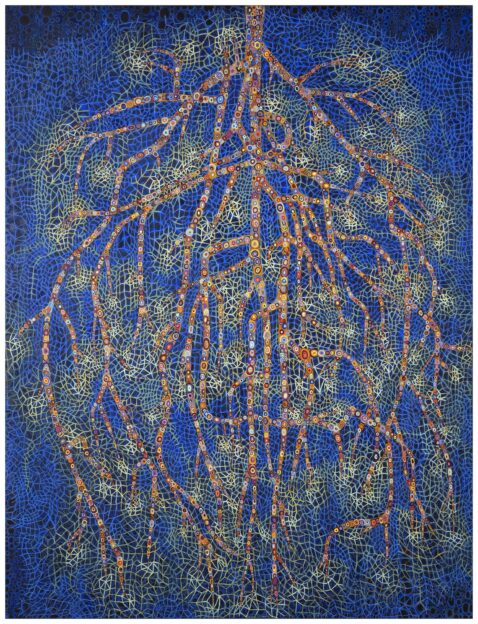
Elegy to the Underground 2020 oil/canvas 56” X 43″

Elegy to the Underground 4 2021 oil/canvas 72” X 48″

Elegy to the Underground 14, 2020 watercolor/arches paper
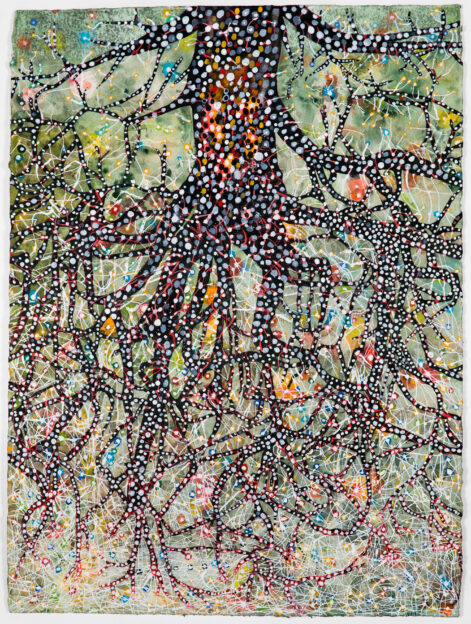
Elegy to the Underground 6, 2019 watercolor/ink/arches paper 30” X 22.5”
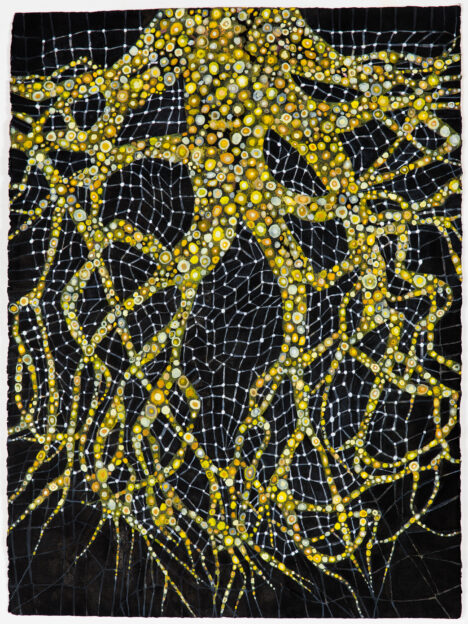
Elegy to the Underground 8, 2019 watercolor/ink/arches paper 30” X 22.5”

Elegy to the Underground 2, 2019 watercolor/ink/arches paper 30” X 22.5”
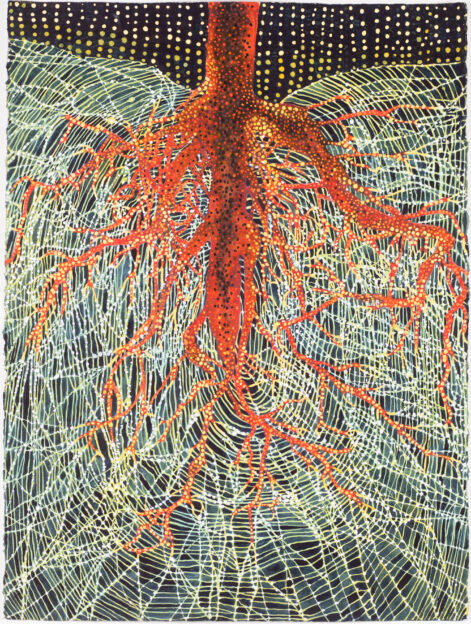
Elegy to the Underground 10, 2020 watercolor/ink/arches paper 30” X 22.5”
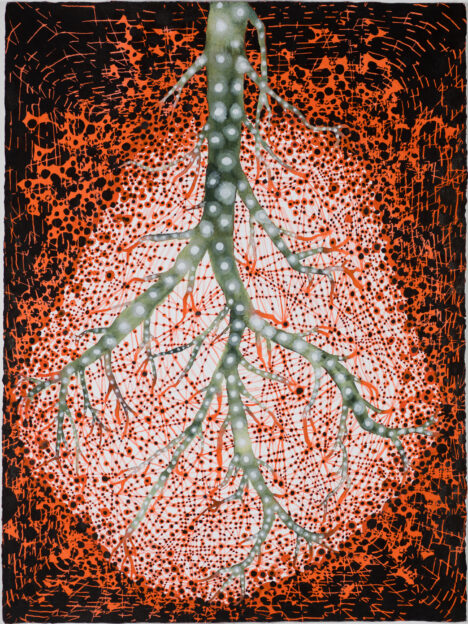
Elegy to the Underground 15, 2020 watercolor/ink/arches paper 30” X 22.5”
……………………………………..
Sarah Slavick is a visual artist, political activist, union leader, and professor in the Fine Arts Department at Lesley University’s College of Art and Design in Cambridge, Massachusetts. Slavick’s work was described in the Boston Globe as “a kind of abstract portrait of the psyche in all its dense, unknowable layers.” While her work is abstract, she references cell biology, accretion of geological formations, botanical structure, and the taxonomy of the natural world. Much of her work is inspired from literature, women’s studies, the sciences, philosophy, and the political arena. Slavick holds an MFA from Pratt Institute and a BA from Wesleyan University.
A member of a large family, she has five siblings, three of whom are also professional artists. The current exhibition, Family Tree Whakapapa, brings together the work of four sisters to ‘talk about trees.’ As curators, painters, photographers and writers, we portray trees in conditions in and outside of human care and conflict. In December 2020, the exhibit opened at the Aratoi Museum of Art and History in Masterton, New Zealand, followed at the Wallace Arts Trust Pah Homestead in Auckland and will be exhibited at the Erie Art Museum, Erie, PA USA in January 2023.
Get the Full Experience
Subscribe today and view all issues in full from just £10 for 3 months.
Comments are closed.