Matter and Time
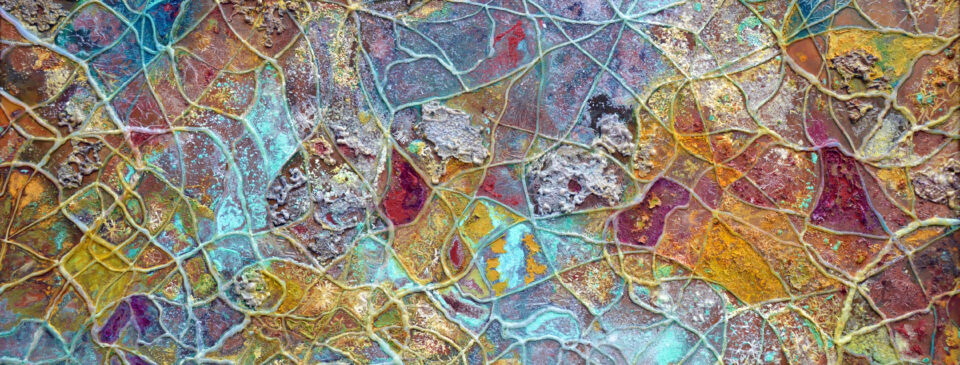
Cheryl Safren, a New York-based artist, employs chemical reactions in the creation of her artworks. Changing colour through reaction, crystallization, fusing, and solidification are a few of the ways chemistry informs her art. Her science art has appeared in National Geographic Science, Hyle, Chemical & Engineering News, Seisma, ArttheScience, etc. She was guest speaker at an American Chemical Society convention held in Puerto Rico and was the keynote speaker at Junior Science Symposium held at Adelphi University.

The Silent Reverberation of Materiality
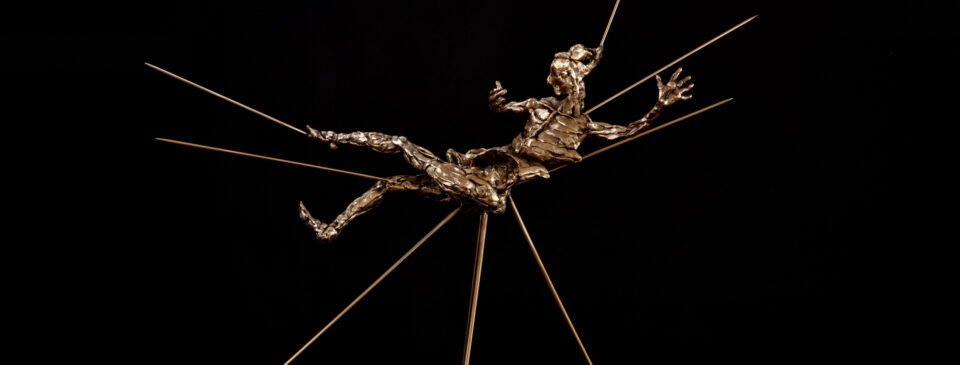
Sculptor Dr Gindi is an artist of the elemental, a material thinker who pursues philosophical inquiry through a deep engagement with extra-human sensibility. Attuned to the resonation of material things, she is also a sculptor of words, deploying a distinctive, poetic idiom to elicit the conditions through which something new can be sensed. For Dr Gindi, the artist is a conduit through which the art forces of nature reveal a world in the process of becoming, rendering tangible a thought or sentiment in the process of finding form. Beyond the allure of the enchanting surface she hearkens to the ‘silent reverberation of materiality’ and in sentiments reminiscent of Whitman, speaks in this interview of its utterance. She discusses her ideas and work with Jill Marsden, Professor of Literature and Philosophy, The University of Bolton, UK. She is the author of ‘After Nietzsche: Notes Towards a Philosophy of Ecstasy’ (Palgrave 2002) and assorted essays on Nietzsche, aesthetics, modernism and literary thinking.
The Matter of Time
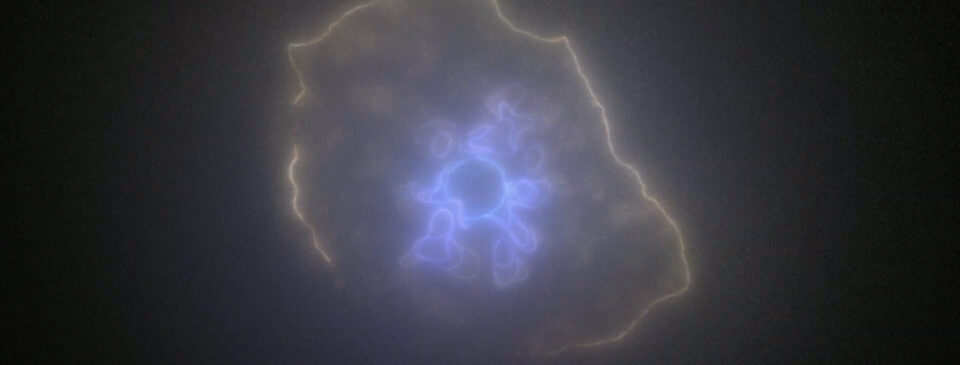
Ariane Koek is a British independent producer, curator and writer recognised internationally for her transdisciplinary work in arts, science, technology and in the creation of new residency programmes. She was the initiator and founder of Arts at CERN (2009 – 2015) – the first officially organised international arts programme by CERN – the world’s leading particle physics laboratory, Geneva, Switzerland. In this article she discusses the work of Montreal-based interdisciplinary artist François Quévillon, who explores the interactions among environmental changes, societal issues, and technological developments.

Sonic Temporality
Mara Sacof is a music producer, runner, and creative studying Zoology at Queen Mary University of London. Her growing fascination with electronic composition, as well as her interests in philosophy, consciousness, and the natural world, led her to write an essay titled ‘Sonic Temporality’. This piece of text explores the relationship between perception and sound, drawing insights into how the concept of time can be manipulated in a digital world of music. The influence of artistic movements such as surrealism and futurism are also touched upon, offering a reflection into how this led producers to make philosophical enquiries into temporality.
Poems
Meg Freer teaches piano and writes in Ontario. She holds music degrees from Carleton College in Minnesota and Princeton University, as well as a Graduate Certificate in Creative Writing, and has published two poetry chapbooks: Serve the Sorrowing World with Joy, with Chantel Lavoie (Woodpecker Lane Press, 2020), A Man of Integrity (Alien Buddha Press, 2022) and Still Life Waiting: Notes on a Ghost Town (Wild Dog Press, 2024). Her photos, poems and short prose have been published in journals such as The Madrigal, Vallum Contemporary Poetry, Eastern Iowa Review, Burningword Literary Review, Arc Poetry, Borrowed Solace, Phoebe, and Sequestrum.

I’m an artist using scientific data as an artistic medium − here’s how I make meaning
Sarah Nance is an interdisciplinary artist based in installation and fiber. She explores the entanglements of geologic processes and human experience in archived, constructed, and speculative terrains. Her current project, “shroud for an ancient sea”, draws on a diverse terrain of subsurface meteor craters, fossilized reefs, and exhumed mountain ranges. These ‘archived’ landscapes are often observable only through fossil records, artifacts, or recorded data. Still, they are inextricably layered within contemporary landscapes, creating entangled strata of geologic and human histories. The site-responsive works in “shroud for an ancient sea” vary from expansive textiles to experimental vocal performances, becoming surface layers that point to complex records of deep time within the geo-anthropic landscape.
She is currently Assistant Professor of Integrated Practice in the Harpur College of Arts and Sciences at SUNY-Binghamton in New York. Nance has previously held professorships in Interdisciplinary Art at SMU (Dallas, TX), Fibres & Material Practices at Concordia University (Montréal, QC), and Fiber at Virginia Commonwealth University (Richmond, VA). Her work has been performed and exhibited widely, including venues in China, France, Canada, Iceland, South Korea, Germany, and Italy, as well as across the U.S.

Stephen Hawking and I created his final theory of the cosmos – here’s what it reveals about the origins of time and life
Thomas Hertog is Professor of Physics, KU Leuven.
“I am a cosmologist and was for many years a close collaborator of the late Stephen Hawking. I received my doctorate from the University of Cambridge and am currently professor of theoretical physics at the University of Leuven, where I study the quantum nature of the Big Bang.”
Author of ‘On The Origin of Time’, Torva (6 April 2023)

Life: modern physics can’t explain it – but our new theory, which says time is fundamental, might
Sara Imari Walker is Professor of Physics, School of Earth and Space Exploration, Arizona State University.
She is an astrobiologist and theoretical physicist interested in the origin of life and how to find life on other worlds.
She is most interested in whether or not there are “laws of life’ related to how information structures the physical world that could universally describe life here on Earth and on other planets.
Deputy Director of the pioneering Beyond Center for Fundamental Concepts in Science, which is devoted to confronting the big questions of science and philosophy. She also co-founded the astrobiology-themed social website SAGANet.org, and is a member of the board of directors of Blue Marble Space.
Sarah is active in public engagement in science, with appearances at the World Science Festival and on “Through the Wormhole” and NPR’s Science Friday.

Why the future might not be where you think it is
Ruth Ogden is Professor of the Psychology of Time, Liverpool John Moores University.
“I have been an academic at Liverpool John Moores University since 2009. My research explores all aspects of how people experience the passage of time. I am particularly interested in understanding why time passes more quickly during some activities and more slowly during others, and how significant changes in life and society affect temporality.”

Ancient Egyptians measured the first hour, and changed how we related to time
Dr Robert Cockcroft is an assistant professor in the Department of Physics and Astronomy at McMaster University. Dr Cockcroft became a faculty member at McMaster in 2020. He completed his undergraduate degree in astrophysics at University College London (UK) and earned his Masters and PhD also in astrophysics at McMaster. He held postdoctoral positions in ancient Eygptian astronomy working with Dr Sarah Symons, and pedagogical research at the MacPherson Institute (then MIIETL). In 2016, he was hired by Western University as an assistant professor in the Department of Physics and Astronomy and as one of the two core faculty members in the then-new Western’s Integrated Science Program (WISc), before ultimately returning to McMaster. Dr Cockcroft’s current work focuses on science education, literacy, and communicating science to the general public.
Dr. Sarah Symons is a Professor in the School of Interdisciplinary Science, McMaster University in Hamilton, Ontario. Her research in history of astronomy concentrates on interpreting astronomical texts and instruments from ancient Egypt and investigating how the night sky was perceived, explained, and depicted. She is the editor of the ancient Egyptian astronomy database, an online resource for scholars, and co-edited Down to the Hour: Short Time in the Ancient Mediterranean with Kassandra Jackson Miller in 2019.

Antimatter: we cracked how gravity affects it – here’s what it means for our understanding of the universe
William Bertsche is a Reader with the Accelerator Physics group of the University of Manchester Department of Physics and Astronomy and the Cockcroft Institute.
“I work on plasma physics and accelerator topics, as well as measuring fundamental properties of antimatter through atomic physics experiments using Antihydrogen atoms. I am a Deputy Spokesperson for the ALPHA experiment.
The ALPHA experiment at CERN routinely synthesizes and traps antihydrogen atoms. With this unique source of pure antimatter systems, we are able to perform precise measurements of its properties, from its spectral signature in various energies ranges to its behaviour in a gravitational field. This research aims to address the question of observed baryon asymmetry in the universe today: why is antimatter so much more rare than matter.”