Buster Simpson – Proto-Habitat Design Sculpture
Seattle artist Buster Simpson is a pioneer in the field of urban environmentalism and art in public spaces. Since the late 1960s and early 1970s, Simpson has been dedicated to working in the public realm; his method is grounded in a farsighted contract between the artist and where he lives. His career parallels the rise of public art in the Pacific Northwest and he has played a crucial role in establishing Seattle as a significant center for community-minded artistic practice. In this interview with art and ecology author, John K. Grande, he discusses his ideas and work.
Seattle artist Buster Simpson, is a pioneer in the field of urban environmentalism and art in public spaces. Early on, Simpson caught the attention of glass artist Dale Chihuly in 1971 who invited him to join the new Pilchuck Glass School in Washington. For more than four 40 years since he moved to Seattle, Simpson has been the ecological and social conscience for neighborhoods and cities in constant states of transition and renewal. His site-specific, agitprop, and process-driven art has surveyed the problems, scrutinized the context, and presented new frames of reference to provide local solutions for global issues.
Since the late 1960s and early 1970s, Simpson has been dedicated to working in the public realm; his method is grounded in a farsighted contract between the artist and where he lives. His career parallels the rise of public art in the Pacific Northwest and he has played a crucial role in establishing Seattle as a significant center for community-minded artistic practice. By acting locally while thinking globally, Simpson has contributed greatly to the national and international debate on what constitutes responsible public art programs.
At a time when Seattle is reimagining its waterfront and its identity, BUSTER SIMPSON // SURVEYOR reframes Buster Simpson’s vision of the city and presents his groundbreaking contribution to dialogues about the health of communities and the societal obligations of the artist striving to affect real change in public life. The exhibition documents and articulates for the first time the breadth, depth, and influence of Simpson’s body of work, staking a claim for his artistic legacy and defining how his methodology and regional aesthetic applies to global systems and ideologies.
…………………………………
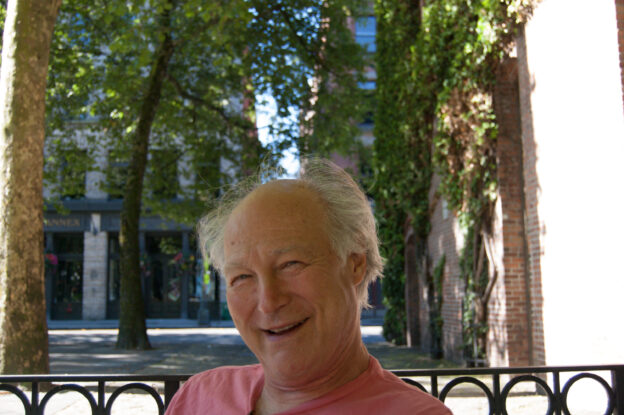
Buster Simpson (photo credit: John K Grande)
JKG: Buster I am interested how you made your debut as a sculptor.
BCS: It was a process of was accretion, I am sure is start as a early age, for me, I grew up in a floodplain along the Cass River in Michigan, and each spring the banks overflowed, reminding us, that this little town had been poorly sited and prone to flooding. Flooding is good, it brings new nutrients to the bottomland. For me, the flood waters provided a form of redistribution of” wealth”, as lumber, ladders and anything that floated new no boundaries and if unclaimed, was liberated. Many of my treehouses and shacks were built from appropriated this flotsam and jetsam.
JKG: So, you already had this awareness of the inter-relation of culture and nature as a kid. This sensitization to nature informed the language you would later use as a sculptor.
BCS: Never thought of it as art then, fish die-off in the Cass River when effluents were disposed into the river… I was up close, seeing the results of our impact on nature. But also experiencing a integrated economy of a small town, with a working flower mill, woolen mill two breweries, lumber mill, quite self-reliant, and productive.
JKG: Were they spraying chemicals then?
BCS: Living in a small town it was easy to walk to the countryside and hedge rows that propagated along fence lines, listening to and watching birds. Surrounded by small farms, undoubtedly some chemicals were use. The Cass River is in the Saginaw River watershed, which includes the Pine River where the Velsicol Chemical Corporation is located. Velsicol produced DDT and PPB and shit in their nests creating a superfund site. Downriver is the Tittabawassee River and Midland, Michigan, home to Dow Chemical, the makers of Agent Orange. Rachel Carlson’s Book came out when I was in high school and realizing the loss of birds was just the tip of the iceberg (a little climate change reference there). Velsicol tried to sue the publishers of Silent Spring, all in the watershed we shared.
JKG: And how was art school?
BCS: I did not start out as an art student, though I had always made things, it was more for the process than the result. At Flint Junior College (yes, another water story), I studied geology, sociology, biology… the usual liberal arts, but I also had art classes. Eventually I gravitated to the art school in my final year at Flint, realizing there were less boundaries, anything could be art, even business law, which I took and liked at the time. I transferred to the University of Michigan School of Art and Design. There was a very interesting collaborative group called the ONCE group; an assembly of mixed media, multi-discipline and avant-garde people. They taught me the poetry of conceptual collaborative actions, without the trappings of art. My first paying job out of art school was creating environmental art in an agrarian context, with a team of other artist at the Woodstock Music and Art Festival in 1969.

Water Table/Water Glass. 2001. Ellington Condominiums, Seattle, WA
Stainless steel, glass, granite, water, and equisetaceae. Glass: 8′ x 4′ dia. Table: 3′ x 4′ x 4′.
JKG: The river plates you produced in polluted environments were brilliant!
BCS: “Tides Out // Table Set”, were first developed at Art Park in Lewiston, NY, in 1978, at a large industrial landfill, a midden of our making. Later, an ideal opportunity came when I was invited to the Kohler Company Factory in Wisconsin as part of their “Arts and Industry” program. Artists work alongside workers making porcelain toilets. I was creating porcelain dinner plates, which seemed an appropriate acknowledgment of what they call in the sanitary engineering world “the process train”. The plates were low-fire and destined for various river effluent outfalls to wick up contaminates, and later were high-fired resulting in the contaminants creating a unique perverse, and telling, glaze embellishment. So how much of my early living along the Cass River impacted this work,
JKG: And you made the plates there?
BCS: Yes, and eventually most of the plates were sited in outfalls on what was once Salish First Nations tidal lands and estuaries in Seattle. The Salish and Kwagiutl saying, “When the tide is out, the table is set”, has new meaning post 1855 colonization. These plates no signify the collecting of oysters, crabs, mussels, and clams, but the effluence of our affluence.
JKG: Cause and effect?
BCS: Ant, the tricksters “Potluck-latch,” dining on these plates including a banquet during my retrospective in 2013 at the Frye Art Museum.
JKG: Where did you put the plates for impacting from pollution in waterways?
BCS: At various outfall and superfund sites: the Duwamish River, Puget Sound, a raw sewage site under the Brooklyn Bridge, Pearl Harbor; the Cuyahoga River. Each has its own embellishment and historical consequence. Although the plates suggest faces reminiscent of Salish Coast masks, they are patterned after the disposable picnic plate, which I saw being used at a potlatch in Alert Bay B.C. in the early 1980’s. The plates serve as eating utensil as well as gargoyles expressing water and as masks.
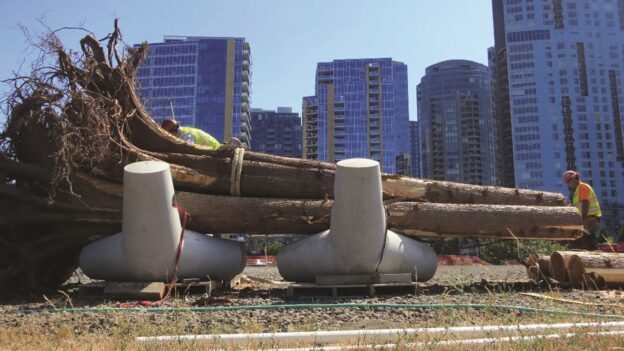
Secured Embrace, 2011-present. Cast concrete, tree roots, and stainless steel cable, 52 x 168 x 52 in.
JKG: Working in the public domain allows you a lot of room for innovation but there are constraints as well…
BCS: Only if you look it that way. Artists can be as agile in public as they are in the studio, it only required different skills. Public funded art is always under scrutiny, it requires the artist to defend their actions. In some way, it is more restrictive in other ways, the commission provides a site, funding and permeant post-production placement and often because there is a site-specific relationship with the placement that includes social engagement.
JKG: Sustainability is built into your vision of public art, and your process and approach can be elaborating?
BCS: For me, working in public is process intensive and often is protracted out over a number of years. As long as the system allows the artist to continue to improve/modify the work, there are advantages. Getting in at the beginning and impacting infrastructure enables more possibilities, and is often more efficient, that is if everyone is engaged and comes with an open mind. Tempe Town Bridge public transit, Carbon Vale parking structure helical ramp, Brightwater Treatment Plant Bio Boulevard, are a few examples of complex collaborative process with the design team.
On a more grass roots level, Growing Vine Street has been a 20-year work in progress, as laboratory. This effort has led to a community effort to save a 7-block tunnel that the State Highway Department wants to fill in. The tunnel happens to be in one of Seattle’s densest neighborhoods where a civic Utilidor could support a host of progressive sustainable actions. So why fill it in when we need new infrastructure technologies that close the loop on water consumption, a place that foster civic cohesion and provides resilient strategies for the coming climate disruption?
JKG: It seems you feel sculpture can have a practical as well as aesthetic dimension… a poetic utility as you say. Art and design can work together… can we go beyond prototypes to mass innovation and production in public design …
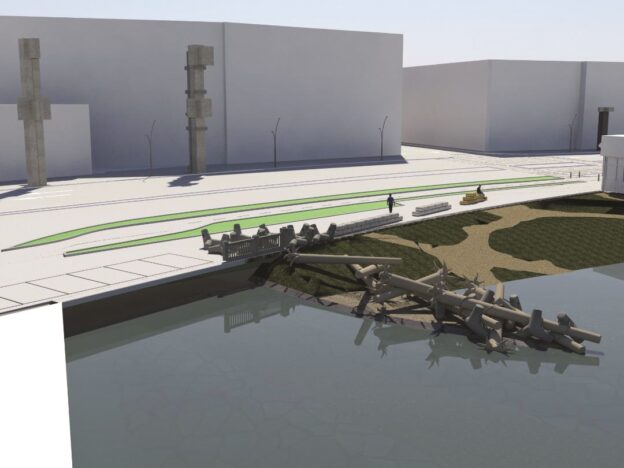
Anthropocene Beach, commissioned 2014 installed (projected) 2020
Rendering of Anthropomorphic Dolos and Improvised Seawall for a new Seattle Seawall
Project. Dolos are intended to be repurposed as conditions merit as root wad habitat and
eventually shoreline armor. Artist commissioned rendering.
BCS: Two elements that I’ve been working with come to mind in response to this; the repeated used of figurative dolos or sometimes called tetrapods, and sandbags to function, peak curiosity and spur conversations.
Anthropocene Beach is a habitat enhancement artwork to compliment a new seawall in Seattle and serves as an amenity and metaphor. Two elements comprise this project: Anthropomorphic Dolos and Stacked Sacks. The intent of these two works is to offer multiple uses and intent.
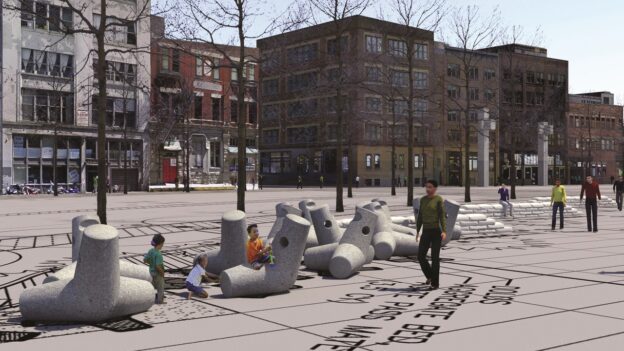
Anthropocene Beach // Zone One Elliott Bay Seawall Habitat Project, Schematic Design: Integral Public Art 1.17.2014
Rendering: Todd Metten of: Anthropocene Anthropomorphic Dolos (concept rendering) 2016 Seattle Seawall Project
The one ton concrete Anthropomorphic Dolos rest on the promenade for seating and creative play objects while awaiting future deployment for their intended purpose as shoreline armor and habitat enhancement anchors. This strategy of intentional pre-siting makes room for issues that come up in public work; allowing artists time to sort things out such as permitting delays, political flare ups or timeline shifts.
Stacked Sacks, sandbags cast in concrete, suggest products offloaded by stevedores, a handmade civic effort in response to climate change. Some sacks will be embellished with names of world port cities and draw common connections and concerns with all ports with rising waters. The Stacked Sack walls suggest a west coast version of the Jersey Barrier. in this case Seattle has the Sea Barrier. I’ve worked with sandbags stenciled with poetic promptings often over the years to highlight rising waters.
I have also pre-deployed a small team of Anthropomorphic Dolos on the South Waterfront Greenway, in Portland, OR. That project, called Cradle, was installed in 2015. There 3 dolos hugging cedar root wads are stationed near the 100-year flood line, ready for action as biomass and bank armoring if the river rises.

Downspout Planter System, 1978
Part of the Growing Vine Street project in Belltown, Post Alley, Seattle, Washington. Photo: Buster Simpson
On another commission, for the Army Corps of Engineers Headquarters in Seattle, along the Duwamish River, I proposed a sculpture called Recovery using dolos, which wasn’t built but I still feel is an idea worth pursuing. Recovery was a transformative approach to building an artwork that would have the potential to evolve from sculptural object to be a functional environmental mitigation. Recovery is, in essence, a “poetic utility.” In other words, a tool designed to perform a particular function that is, in itself, a work of art as exemplified in the approach that dates back to indigenous peoples’ integrating of art into life. The artwork elements communicate the potential to repurpose landscape elements to the riverside at a later date in order to continue the efforts of the US Army Corps of Engineers and community to enhance the Duwamish River estuarine reach habitat.
Recovery was to consist of sixteen figurative sentinels of cast concrete, the dolos, arranged within a 32-foot grid. They were to be coupled with uniquely shaped tree forms, each one anchoring and cradling woody mass, poised to aid marine habitat enhancement. The formation of the installation was to align with the east-west centerline of the building and the west boundary of the project site along the Duwamish River. The sculptural figures faced the river with their concrete back to the east. The pods rested at grade, some partially submerged at times within the seasonal waters of the detention pond and some on high ground. As a metaphor of healing past practices, the tree forms would evolve into nursing log habitats for meadow birds and later, perhaps, habitat for salmon restoration. Recovery exemplifies a new paradigm for contemporary public art, applying conceptual ideas to actual environmental problems, an aesthetic that identifies an active role for art in the environment.
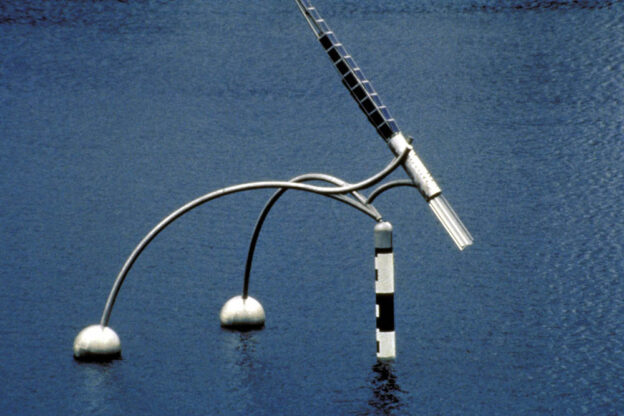
Brush with illumination (1998)
City of Vancouver Public Art Collection
Photo is Courtesy of the artist
JKG: You are right. Many social and aesthetic approaches to public art aren’t being explored. I really enjoyed your playful Vancouver piece, Brush with Illumination (1998). You are using solar panels, microprocessors, strobe batteries, and environmental sensors. It floats, and responds to local conditions… Can you tell me about the conception of Brush with Illumination?
BCS: Brush with Illumination is an interactive sculpture that also functions as a data-gathering apparatus, drawing ideograms and sounds generated from real time environmental conditions. The sculpture suggests a calligraphy brush, responding kinetically to real time tidal and weather conditions, in False Creek, Vancouver B.C., Canada. The sculpture was commissioned by the Vancouver Public Art Program in 1994, installed in 1998, and upgraded in 2009.
The sculpture has an armature of stainless-steel pipe that rests on a gimbal, atop a pile post installed in False Creek. The gimbal enables the sculpture to rotate and rock unrestricted to tidal, wave and wind conditions. The armature connects two four-foot spheres with a three-point “finger cradle” connection at the brush ferrule. The spheres provide both buoyancy and counterweight to the “brush” as it cantilevers on top of the piling, responding to environmental changes.
The brush, approximately 11 meters in length, consists of a handle, a ferrule and a cursor. The handle is an array of solar panels that powers batteries in the ferrule. Within the ferrule, the batteries power data-accessing sensors, processors, and transmitters sending data. Transmitters send ASCII data and video to a land-based receiver and from there onto the Internet. At night, the cursor flashes the code of the ASCII data, as if a beacon, streaming environmental conditions from False Creek. The brush appears as a technical apparatus gathering an “inkwell of data.” A plaque at the viewing station onshore offers the web site address for accessing this data and the resulting visual and audio abstractions via the internet, either by mobile phone or computer. The data is transformed into a live visual and sound logic score based on the lunar calendar. The web site provides a dynamic and enjoyable audio and visual screen saver or wallpaper.
Now in 2018 I am faced with an artwork that relies on some antiquated processing and occasional servicing. An iPhone can do the job of the existing 45 lbs. of data accessing equipment and requires less transmission issues and power consumption. Add to this, the sculpture has become a habitat for the Cormorant and I am fascinated by the prospects that a work of art can evolve into habitat.
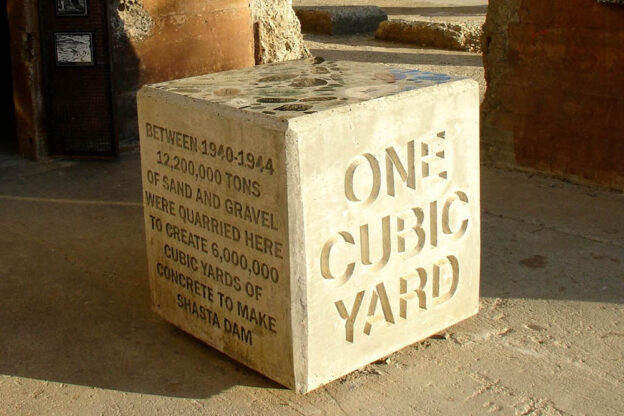
The Monolith, 2005. Turtle Bay Discovery Park, Redding, California, installed location of disused Aggregate Plant whose structure is referred to as the Monolith
JKG: Often it seems idea of what public sculpture is or can be is not flexible. Public sculpture can respond to site and history, use local resources and embody the context of a place. Sculpture can include environment, and elements of landscaping as Recovery (2011) does. Public sculpture can be interactive in more interesting ways and go beyond being a mere art object…
BCS: definitely, I think the Cormorants would agree
JKG: The term wickiup refers to a simple domed structure associated with Native Americans of the Southwest, a kind of shelter long vanished tribes from San Antonio made. The Kickapoo who are recent refugee to Texas, south along the Rio Grande River still build the Wickiup for ceremonial purposes. Would you consider your recent Midden Mound Wickiups in Texas as sculpture, structure, or a contextual link to eco-sensitive built structures?
BCS: All the above, Wickiup Encampment is perched at the top of a manmade mound of a repurposed landfill site, now Pearsall Park in San Antonio. The Wickiups feature “blankets” that present an indigenous approach through colored patterns using woven and twisted wire mesh. Also, a Serpentine Bench, made from Texas limestone, provides seating and is a recreational play object. The bench allegorically references Manetoa, the great water serpent of the Kickapoo. The internal illumination of the wickiup structure at night suggests the light omitted from an intimate campfire.
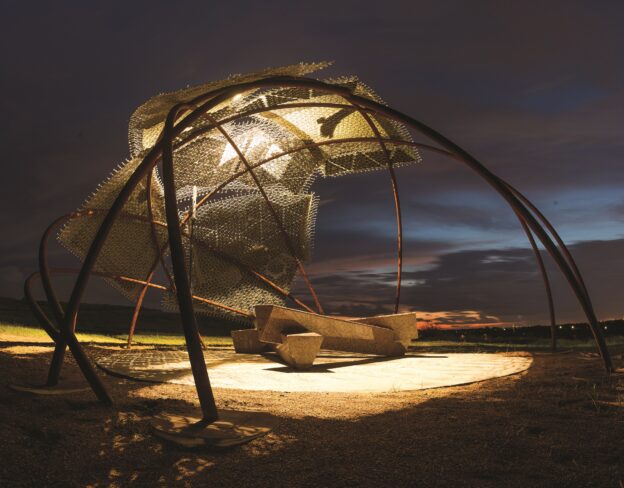
Wickiup Encampment & Serpentine Bench, 2016
Medium: Steel, woven wire mesh, solar, LEDs Dimensions: 14’ x 28 x 60’ Commissioned by the Department for Culture and Creative Development. Pearsall Park, San Antonio, TX.
Photo: Joe Freeman
JKG: These seats and the wickiup structures build a dialogue with place, and eco-habitats that are integrated and work with the ecology of place… Important and topical, even a prototype for builders to consider in new developments….
BCS: I produced two sets of wickiups located on the saddle between two of the landfill midden mounds to take in an interesting 360 degree view of San Antonio. The wickiup structures suggest an overlay to the history of this site: a large decomissioned city landfill repurposed into a contemporary City Park. The wickiups represent the modest shade structures often used by the indigenous peoples of the area. The landfill is our cultural midden; the artwork appropriates the site as a social and ecological comment on consumption. At Pearsall Park, both Wickiup Overlook and Wickiup Encampment have substituted the typical wickiup construction of bent or gathered branches with bent steel pipe. The blankets, which traditionally cover wickiups to protect against the elements, have been replaced with colorful woven wire mesh and geometric hexcell material. Solar panels supply power for nighttime lighting. The wickiups provide shaded gathering places, seating, and viewing experiences looking out over Lackland Air Force Base and the natural landscape along the meandering Leon Creek. Wickiup Overlook responds to the technology of the large cargo planes, using blankets made from a hexagonal structural material often used in aircraft skin construction. During the day, this material creates a sun-reflecting presence, while at night solar lighting transforms the materials into illuminated lanterns creating shadow play on the surfaces below. The Trilateral Bench is comprised of three interlocking ten-foot prism-shaped pieces of polished Texas red granite, forming triangular interconnected seating.
BCS: The reward for all of us who make art in any context public or private, is to witness the engagement by others, and that they find it worthy of their curiosity and study.
………………………………………..
Get the Full Experience
Read the rest of this article, and view all articles in full from just £10 for 3 months.
No comments yet.