Tag Archives: Space

This Land, Marginalia, and Chronicles of Fallacy.

Stephen Nowlin is Los Angeles-based artist, curator, and writer whose practice is inspired by science, the histories of science and art, and theories of knowledge. His work employs the use of digital tools, photography, and scanning technology, resulting in small and large-scale limited edition archival pigment prints. In this article he discusses his work of the last few years which has developed along three ongoing series: ‘This Land’, ‘Marginalia’, and ‘Chronicles of Fallacy’.

What is quantum entanglement? A physicist explains the science of Einstein’s ‘spooky action at a distance’

Andreas Muller is Associate Professor of Physics, University of South Florida.

“My lab’s research focuses on quantum optical phenomena in micro and nanostructures that are potentially useful for new optoelectronic devices. Future generations of optical components are expected to rely on quantum, rather than on classical physics, which could lead to significant improvements in communication speed and security, to improved sensors, as well as to quantum computation. Our main focus is on cavity quantum electrodynamics, that is, the use of optical cavities to tailor the electromagnetic environment of single quantum emitters and enhance light matter interactions at resonant frequencies. Major challenges include the fabrication of micromirrors with high reflectivity and small mode volume, and the coupling of single quantum emitters such as single atoms or single semiconductor quantum dots to a tunable microcavity. We also study quantum optical interactions in gases.”

From the mystery and majesty of the universe and beyond

Shanthi Chandrasekar is a multimedia and multidisciplinary artist from Maryland, USA, who has an academic background in physics and psychology, and has been trained in the traditional Indian art forms of Kolam and Tanjore-style painting. While many of her works are influenced by her Indian heritage, her true inspiration comes from the mystery and majesty of the world around her; her muse lives where the scientific overlaps with the spiritual.

Visualizations of Energy

Carter Hodgkin fuses art, science and technology to explore a new language of abstraction through paintings, animations and large-scale mosaics. Approaching the modification of code as a drawing tool, she generates atomic particle collisions to create animated forms, which visualize energy. Her working process is an interplay between digital means woven into traditional media with an emphasis on the hand. She utilizes a range of media from animation and programming to drawings, paintings and large-scale mosaics.

Exploring Oneness

Sandra Lerner’s work celebrates the creative process of life in a universe that is constantly in flux. She explores the similarities between cosmology and Eastern philosophy, as well as the intersection of art and science.

“My most recent Cosmic paintings interweave the latest theories in astrophysics with the intuitive mysticism of Taoist philosophy, where the universe is seen as an inseparable reality, and in which there is an interrelationship of all things. My exploration of the fabric of the universe, its ever-changing patterns, give rise to and parallels my own creative development. I conceive my art as a spiritual, psychological, and philosophical journey.”

From the Quantum to the Infinite

Jody Rasch is a New York City area-based artist whose work is based on themes from astronomy, biology, physics and spectra. The artist has been exhibiting his work nationally for over 25 years. Duality–abstraction and representation, the literal and the metaphorical, science and mysticism, the unseen and the seen–is a predominant theme in Rasch’s work.

“These pieces, based on electron microscopy, particle accelerators, and radio astronomy are an expression of both the patterns of the natural world and the metaphors underlying modern science. They allow us to see the beauty in the repulsive, to find knowledge in the unknown, to observe the unseen to more clearly see our world.”

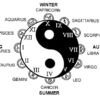
The Cosmos and the Zodiac: Contemporary Cosmology and a Traditional Representation of the Whole.

Alain Negre examines the thesis that the history of the universe, derived from contemporary cosmology, reveals the symbolic structure of the zodiac. While the 12 signs of the zodiac have retained the names of the constellations that stretch around the ecliptic circle, in reality, their essential nature is based on archetypal or qualitative numbers structured according to the four quadrants of a circle, each divided into three parts. This 4×3 numerical structure is a particular vibration of the world’s soul around an unknowable ordering center, about which a circle of archetypes forms. Signs are not archetypes but archetypal figures or symbols. Clothed in a rich symbolic fabric, they enable a new interpretation of the contemporary cosmological narrative. Naturally, the search for reflections and/or structural homologies between scientific and mythical discourse can only be understood by first distinguishing the various levels of reality.

Stephen Hawking and I created his final theory of the cosmos – here’s what it reveals about the origins of time and life

Thomas Hertog is Professor of Physics, KU Leuven.
“I am a cosmologist and was for many years a close collaborator of the late Stephen Hawking. I received my doctorate from the University of Cambridge and am currently professor of theoretical physics at the University of Leuven, where I study the quantum nature of the Big Bang.”

Author of ‘On The Origin of Time’, Torva (6 April 2023)