Meeting Points Redefined
Angela McQuillan is an artist, curator and designer, whose passion lies in connecting people and showcasing creative talent and new ideas. She has ten years of experience working in scientific research and pharmaceuticals, eight years working as a graphic designer, as well as an art school degree. With this unique background, Angela loves to curate multidisciplinary events that convene people with diverse knowledge and skill sets.
One of the most exciting aspects of my job as Curator and Experience Designer is that I spend a lot of my time creating connections between people from different disciplines. Most prominently by pairing artists and scientists, but also engaging with designers, entrepreneurs, educators and community activists. This type of interdisciplinary collaboration is essential for creative innovation; generating new and exciting perspectives that open up unique opportunities for growth that wouldn’t be possible from one single field of study.
Collaboration is not always easy, in fact it involves great communication skills, patience and the ability to be open-minded. I have been managing the University City Science Center’s BioArt Residency Program for almost 5 years, and have facilitated the connection of artists with scientists from the biotechnology company Integral Molecular, which develops tools for antibody research for diseases and viruses. We select artists with an interest in biology to spend three months in a laboratory setting, researching creative projects that culminate into a physical exhibition. These artists spend time working in the laboratory shadowing scientists while they perform their daily experiments and data analysis.
After COVID-19 hit the United States, most of these workspaces were either shut down completely, or only open to essential personnel. The possibility of artists getting access to a scientific laboratory during this time was non-existent. In 2020, we had a few artists lined up to begin their residencies, so we needed to figure out a new way to facilitate their collaboration with scientists who were working from home. Our only option was through virtual meetings, which made the residency much more challenging. Not only did artists have the steep learning curve of discovering a completely new environment in a matter of months, but they were forced to form these connections over the internet. The projects that were created during these periods of quarantine were very thought provoking and demonstrated that even though our modes of communication have changed, collaboration is still entirely possible.
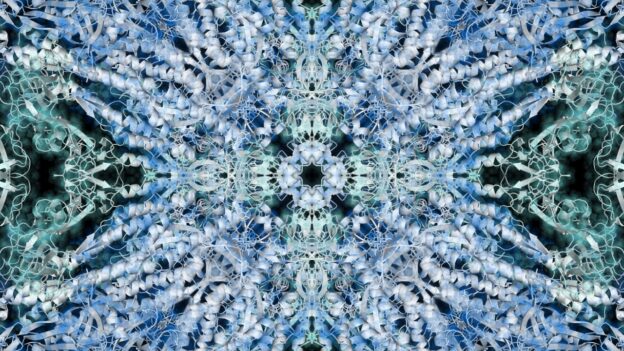
Laura Splan: Unraveling
Unraveling (Marine/Aquamarine/Skyblue) from Laura Splan on Vimeo.
Laura Splan (2020)
https://www.laurasplan.com/unraveling
In 2020, much of Integral Molecular’s research became focused on SARS-CoV-2, the virus that causes COVID-19. One of their innovative lab technologies, Reporter Virus Particles (RVPs), simulate how viral spike proteins enter and infect cells by binding to cell membrane receptors, and are a tool to learn how protective antibodies can bind to these spike proteins and neutralize the virus. Brooklyn-based artist Laura Splan spent three months in 2020 collaborating with Integral Molecular scientists Dr. Benjamin Doranz and Dr. Edgar Davidson over Zoom to produce her series “Unraveling” and “Renatured”. This work was created using Pymol to visualize intricate molecular models of SARS-CoV-2. Splan explains that “by using the specialized features of the software in unconventional ways, I unravel and distort the folded structure of the coronavirus spike protein. I playfully manipulate the folded forms, known as “conformations”, which determine biological function including infectivity.” This collaborative research project culminated in a series of animations that were first exhibited at the 15,000 square foot BioBAT Art Space at the Brooklyn Army Terminal in an exhibition titled Unraveling and Disrupted Domains at the University City Science Center, both in 2020.
These exhibitions also included a sound component in a collaboration with musician Frank Masciocchi, who works as a Lab Instrumentation Engineer at Integral Molecular. Viewers were invited to scan a QR code leading them to Termination Sequence (Into the Void), a Zoom recording of a live improvised electric guitar performance that involved Frank playing “A” notes and chords 33 times – the number of adenine nucleotides at the end of the mRNA termination sequence of SAR-CoV-2. Integral Molecular scientist and guitarist Dr. Joseph Rucker also created his own rendition on acoustic guitar entitled Termination Sequence (Awkward Goodbye).
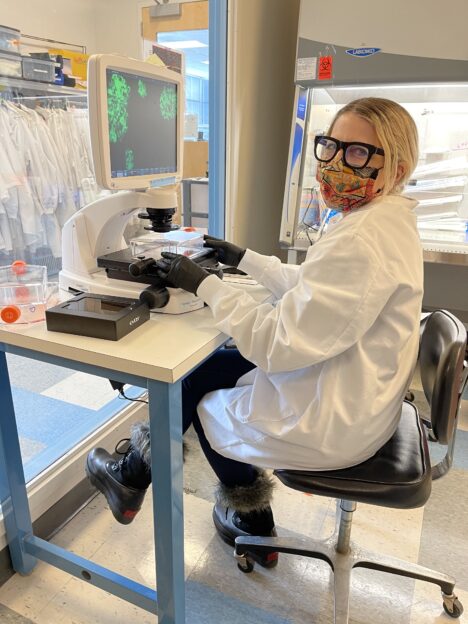
Rebecca Rutstein (photo credit Hayley Crawford)
Another artist who completed her residency at Integral Molecular in a hybrid format during a period of quarantine was Philadelphia-based Rebecca Rutstein. Rebecca’s research focused on microscopic views of cellular networks used for Sars-CoV-2 research, as well as public COVID-19 datasets from Philadelphia, documenting vaccine efficacy and racial inequities in access to health care. Integral Molecular scientists engineer spike proteins of different coronavirus variants and insert them into the outer membrane of each Reporter Virus Particle. The RVP looks like the virus on the surface but does not carry the viral genome inside – instead it carries Green Fluorescent Protein (GFP) derived from jellyfish, which causes living cells in the lab to fluoresce with GFP when the particle enters the cells.
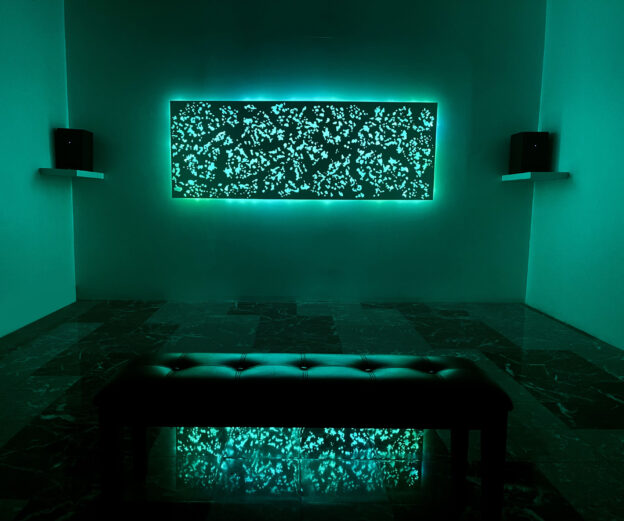
Rebecca Rutstein: Sub Suficiem (photo credit Jaime Alvarez Photography)
Rebecca interpreted this process in her solo-exhibition Socius featured at the Esther Klein Gallery in August 2021, through colorful paintings and a light and sound installation titled Sub Surficiem. The installation was inspired by a 60-hour time lapse video taken by scientist Tabb Sullivan of living cells fluorescing as they become infected with SARS-CoV-2 through Integral’s innovative Reporter Virus Particle technology. LED lights were installed on a powder coated steel, backlit sculptural installation to simulate the beginning of the pandemic, when only a few cases of infection were documented. It shows more and more cells light up – representing the spread of the virus, and then when it is almost fully saturated the lights start to dim in certain areas, representing the effectiveness of the vaccine, until finally most of the lights go out, leaving the room in darkness for a moment before the cycle begins again. This piece is accompanied by the song Confluence produced by Mexican composer Mauricio Rodriguez, that was composed from the vaccination data, with added instrumentals by Frank Masciocchi of Integral Molecular. Additionally, at the closing reception for Socius, a string quartet from the Pennsylvania Philharmonic played Confluence to a live audience memorialize those who we have lost due to COVID-19 .
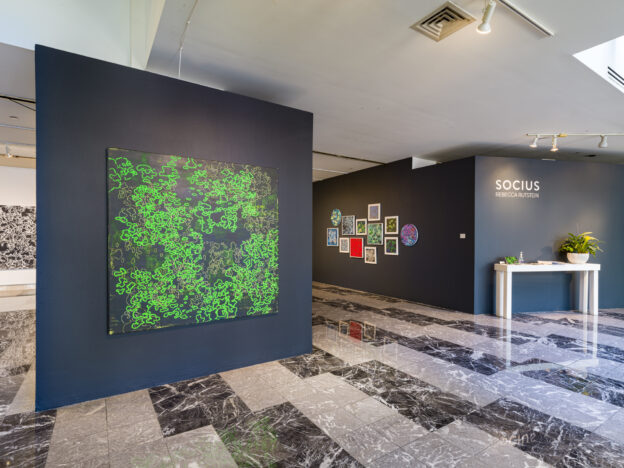
Rebecca Rutstein – installation shot
The COVID-19 pandemic has demonstrated that there are many opportunities for the world to harness science and technology to resolve global challenges for the greater good. Connections can be established on a global scale and people can be reached at the click of a button. However, with reduced opportunities to spend time together in person come new challenges to remain socially connected. What does this mean for interdisciplinary collaboration? Before the pandemic, artists participating in this residency program in-person were afforded more space for process-based art making and experimentation. They could enter the laboratory with a vague idea of what they were interested in learning and pick up new ideas and skills along the way. During a remote collaboration on the other hand, the onus was put on the artists to solidify their area of focus in advance, and then seek out the experts on that topic and come up with relevant questions to inform their research.
People are more likely to share personal stories with colleagues during an impromptu discussion or through small talk. These stories create trust and empathy towards each other, which eventually leads to friendships and mutual understanding. If you have never met someone in-person, can you still collaborate in the same way? This new world of virtual meetings and working from home is redefining the way that people interact with one another. While remote collaboration has many advantages, I wonder what the long-term effects will be. Will networks become more static and siloed? And how do we ensure that we are addressing issues of equity when it comes to access to information?
As we continue our journey through the COVID-19 pandemic, we find new ways to adapt and survive. Embracing digital and virtual life has allowed us to move forward despite the obstacles to holding in-person meetings and gatherings. I hope these new and redefined meeting points allow us to grow and innovate without losing our sense of comradery in the process. Only time will tell.
……………………………………
Artist Statement
Despite the massive amounts of information readily available to us, humans are still surrounded by mystery. Our perception of the world is quite limited as there is much that remains undiscovered. I am drawn to the lure of the unknown, and the quest for more knowledge. I am interested in the processes that happen inside of a living entity that are invisible to the eye yet essential to life. Through my scientific background I have gained a deep appreciation for biological forms, anatomical subjects and bodily functions. I am fascinated by the way that nature evolves and adapts, and the way that humans can manipulate the outcome. I believe in the interconnectedness of all things, and that nothing ever occurs as an isolated event. I am interested in the ability of science to solve problems while ultimately creating new ones, and I think that art is important in this equation because it allows us to reflect on the power of our own knowledge and take a closer look at the implications of how it can alter our society and our environment. Science and art are both tools of exploration, allowing us to gain more insight into ourselves and the world around us. We will never see everything there is to see, but catching tiny glimpses here and there make the quest worthwhile.
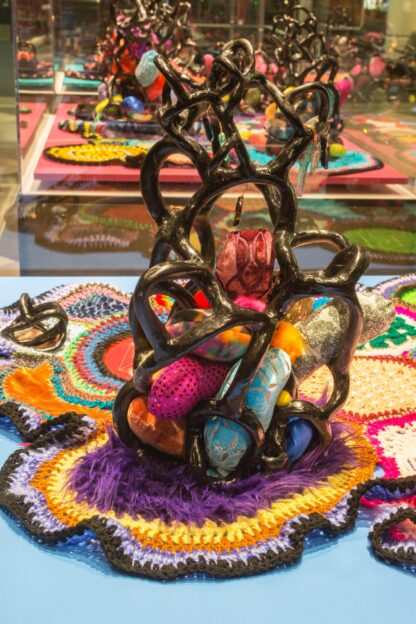
Angela McQuillan: Chimera
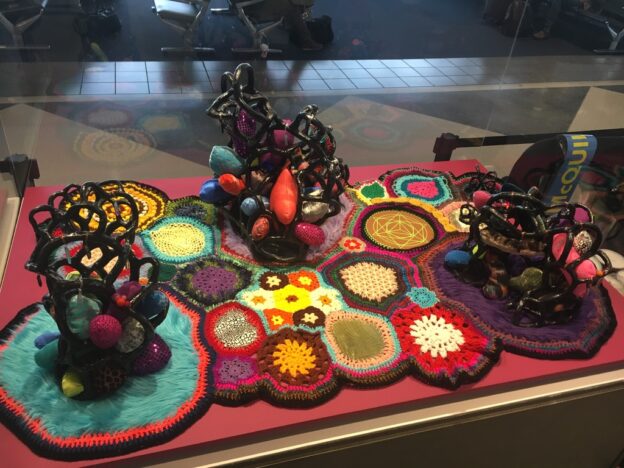
Angela McQuillan: Chimera
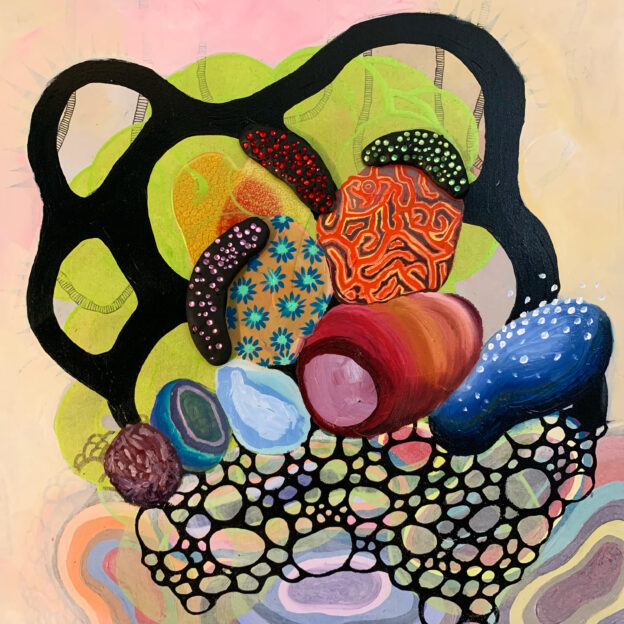
Angela McQuillan: Cluster
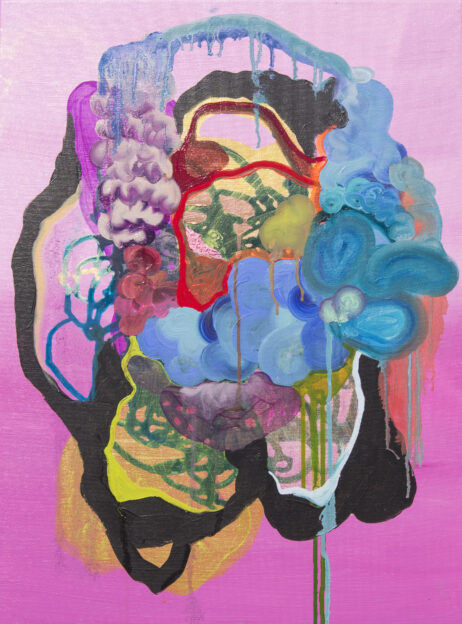
Angela McQuillan: Internal Parts #1, 18″ x 24″, oil and acrylic on panel.
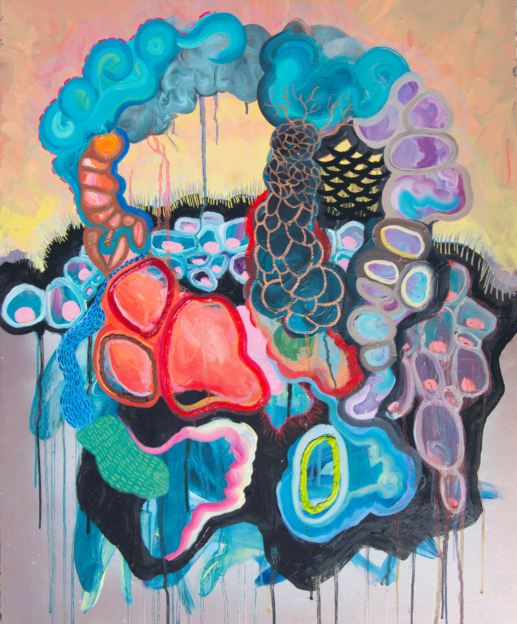
Angela McQuillan: Internal Parts #2, 24″ x 36″ oil and acrylic on panel
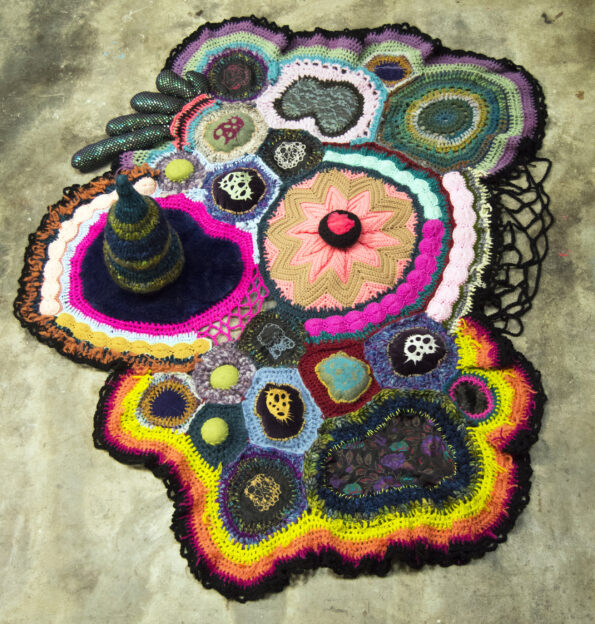
Angela McQuillan: Lifeblood
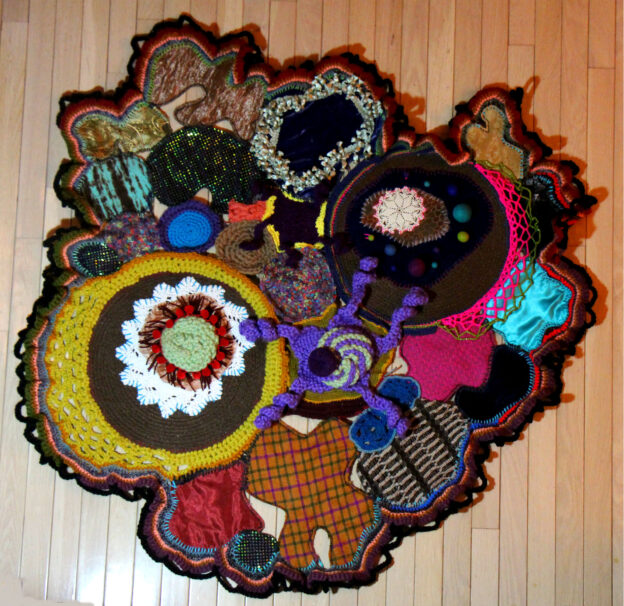
Angela McQuillan: Lilypad
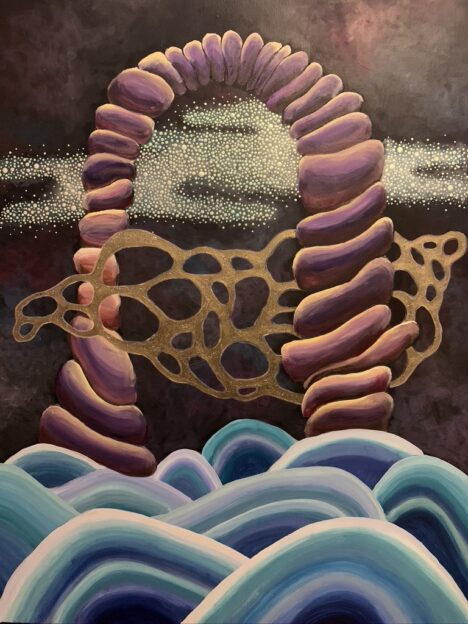
Angela McQuillan: This is just temporary
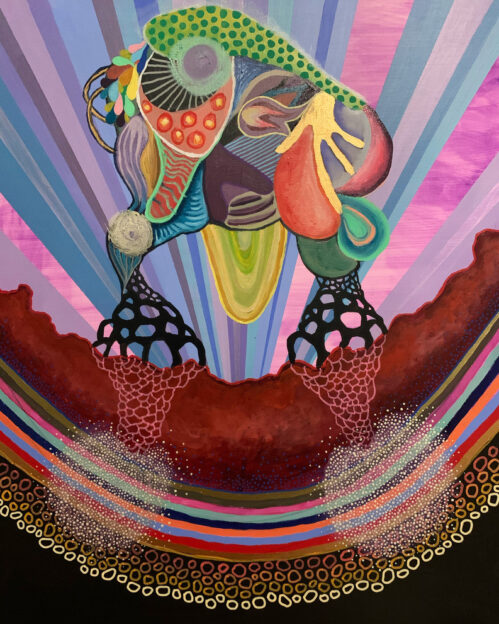
Angela McQuillan: Rise From the Ruins
………………………………
Get the Full Experience
Read the rest of this article, and view all articles in full from just £10 for 3 months.
No comments yet.