Tag Archives: Sculpture

Reimagining Joya: Bringing Joya Residency experiences to the Thames-Side Studios Gallery

‘Reimagining Joya’ is an exhibition inspired by the experiences and artistic responses of a group of artists who have all participated in Joya: Art + Ecology / AiR residency. The artists involved, alumni from the MA Art & Science, from Central Saint Martins, University of the Arts London, invite us to connect with the ecosystems we inhabit.
World Lines

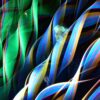
Paul Friedlander is an artist who first trained as a physicist. He became fascinated by art involving the use of movement and light in the late 1960s. In 1983 he made an important discovery of the chaotic properties of spinning string and invented chromastrobic light – “light that changes colour faster than the human eye can see”. Many of his works make use of persistence of vision, a property of how light is perceived combined with movement to create a three-dimensional kinetic body of light in sculptural form. Friedlander applies his scientific knowledge to his art and is heavily influenced by chaos theory, string theory and cosmology. He continues to show his light sculptures around the world in art and science museums and festivals.

Buster Simpson – Proto-Habitat Design Sculpture

Seattle artist Buster Simpson is a pioneer in the field of urban environmentalism and art in public spaces. Since the late 1960s and early 1970s, Simpson has been dedicated to working in the public realm; his method is grounded in a farsighted contract between the artist and where he lives. His career parallels the rise of public art in the Pacific Northwest and he has played a crucial role in establishing Seattle as a significant center for community-minded artistic practice. In this interview with art and ecology author, John K. Grande, he discusses his ideas and work.

Segmentation series

“The segmentation series is inspired by my fascination with science of cell, its division and the journey of growth that starts from a single cell and goes through a million divisions to become a life. I work with glass that has transparency and translucency, two qualities that serve as perfect metaphors for what is known and unknown about life science. The segmented, geometrical forms of my work represent cells, embryos, biological and molecular structures—each symbolizing the building blocks of life as well as the starting point of life.”

Jiyong Lee is a studio artist and educator who lives and works in Carbondale, Illinois, the United States. A professor of art at Southern Illinois University, Lee has headed the glass program there since 2005.

Molly Macleod: We Are All Carbon

Molly Macleod is a multidisciplinary artist exploring scientific concepts through collaborative projects with researchers and scientists. Through poetic interpretation and distilling meaning via her use of unconventional, signifying materials, her artwork invites intimate and philosophical engagement combined with accessible simplicity and a minimalist aesthetic. Locating her practice within the liminal space between art and science she employs the scientific method to examine and question cultural phenomena.

Art4Heart

“My personal life experience led me to realize that health is not self-evident. I had the opportunity to learn how powerful the combination of materials science, medical science and medical art is today.”

Gunther Lill is a mixed media artist. His series ‘Art4Heart‘ aims to inform and make people aware of the outstanding importance of modern technology for human health.

Sun Catcher

Jessica Lloyd-Jones is a visual artist whose work explores concepts of energy and natural phenomena through the experimental use of materials and light. In her work, ‘Sun Catcher’, she has created a vivid light installation at Rowan View Hospital, a Mental Health facility in Maghull, Merseyside, sensitively employing the use of light and colour to create a relaxing environment for staff, visitors and service users.

On Groundswell

Dr Pamela Whitaker is an art therapist living in Ireland who practices under the name of Groundswell, a social enterprise working in the areas of art therapy, art and participation, environmental arts, and arts and health. She has written ‘Groundswell: The Nature and Landscape of Art Therapy in Materials and Media in Art Therapy’ (edited by Catherine Hyland Moon) and ‘The Art Therapy Assemblage in Art Therapy and Postmodernism’ (edited by Helene Burt).

Habitats of Composition: The Nature of the Commons

This is an article about land art that constructs habitats of refuge or survival shelters. The art of constructing forest sanctuaries, as a form of social media, is a resourcing of found materials transformed into personal and social places of significance. Amidst COVID-19 restrictions, nature became everyone’s place to be and public parks were an essential commonplace for combining and finding a place apart to come together. What emerged in the forests of Phoenix Park, Dublin was the construction of landmarks for protection and solace. As bushcraft and public artforms, these dens act as declarations of personal security and social constructions, occupying both a boundary and an invitation. They are landmarks for solitary pursuits and social encounters—transformative locations for introspection and the communal sharing of a forest.