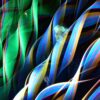
Paul Friedlander is a light artist who first trained as a physicist. He became fascinated by art involving the use of movement and light in the late 1960s. In 1983 he made an important discovery of the chaotic properties of spinning string and invented chromastrobic light – “light that changes colour faster than the human eye can see”. Many of his works make use of persistence of vision, a property of how light is perceived combined with movement to create a three-dimensional kinetic body of light in sculptural form. Friedlander applies his scientific knowledge to his art and is heavily influenced by chaos theory, string theory and cosmology.
One of his most notable one-man exhibitions ‘Timeless Universe’ (2006) shown in Valencia at Sala Parpalló gallery, was inspired by the theory of English cosmologist, Julian Barbour that time does not exist. It was composed of 30 pieces varying in shape and size in a darkened tunnel like space illuminated by a combination of chromastrobic lights, stage lights and video. Friedlander’s Projections were generated by computers in real time. For the imagery projected on his sculptures he used written records ranging from ancient scripts, signs, codes and modern mathematical formula that were fragmented using his own software, creating imagery that was in constant flux and never repeated to correspond with Barbour’s ideas that the universe is timeless.
Group shows include SoulsandMachines (2008), at Reina Sofia Museum of Modern Art, Madrid curated by ArtFutura directors Montxo Algora and Jose Luis de Vicente.
He continues to show his light sculptures around the world in art and science museums and festivals.