Nothingness
Issue 66 July 2021
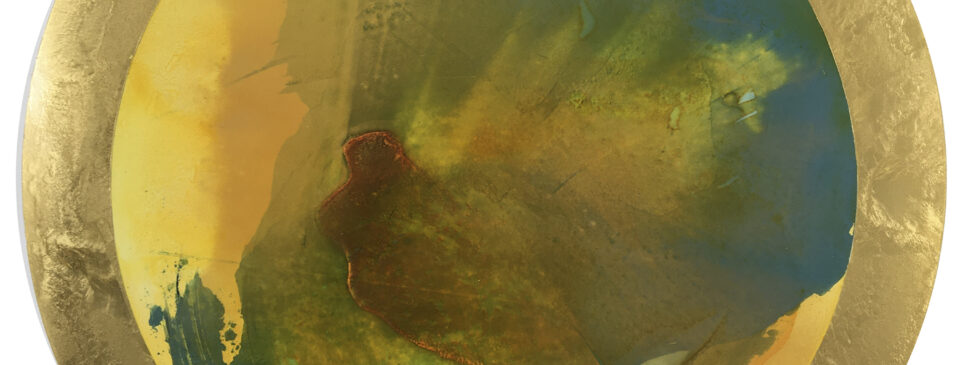
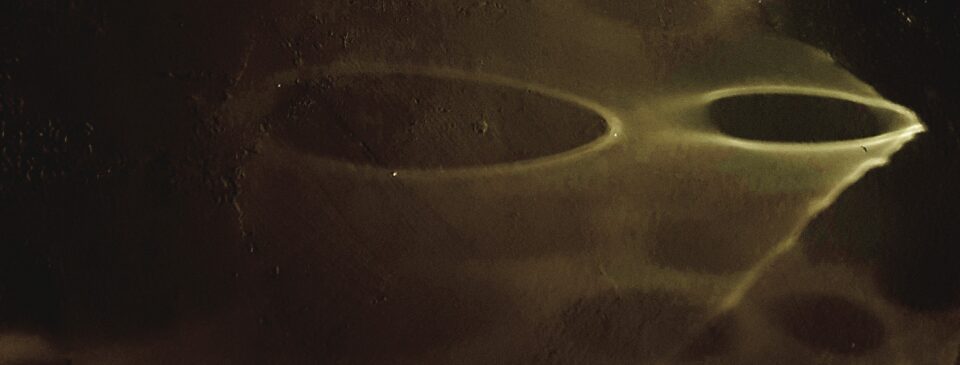
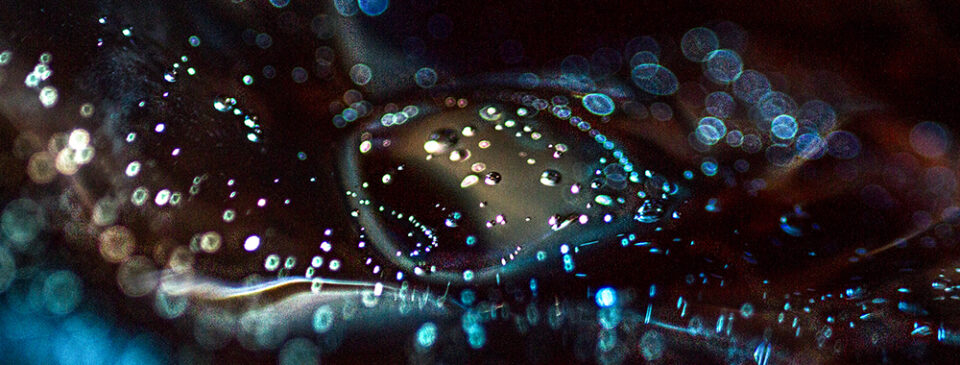
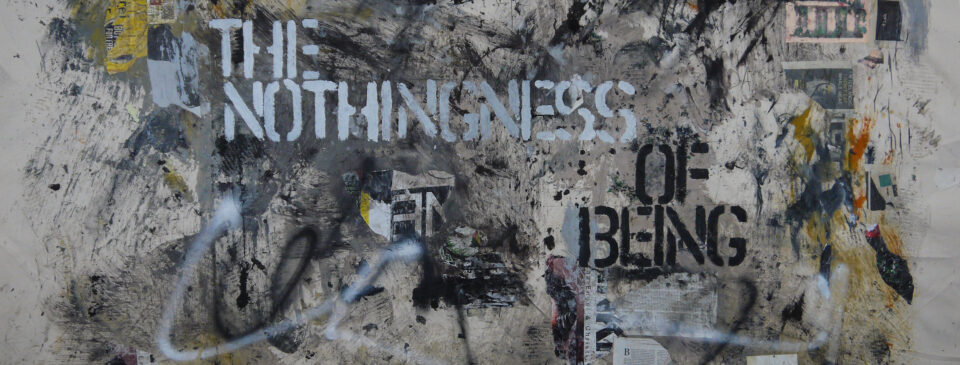
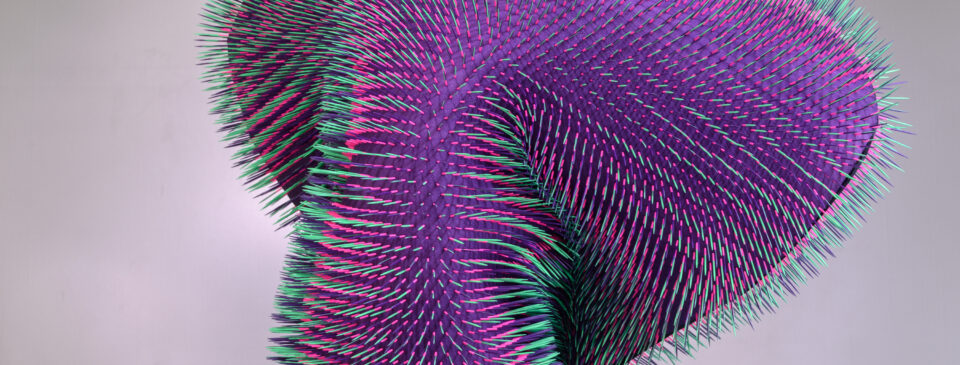

Rendering the invisible visible
“There is something, un-named, that rises up within me when I have an ‘experience of beauty’. This upwelling forms a basic urge; to communicate, to describe as deeply as possible this experience of energy. On all levels. To take another by the hand and say, here, let me show you.”
Karen Fitzgerald’s artwork is focused on the energy that suffuses our world, as well as the Universe: her work explores energy in its myriad manifestations.

Absence in Cinema
Justin Remes is an associate professor of film studies at Iowa State University. He is the author of ‘Absence in Cinema: The Art of Showing Nothing’ (Columbia UP, 2020) and ‘Motion(less) Pictures: The Cinema of Stasis’ (Columbia UP, 2015). He has also written articles for JCMS: The Journal of Cinema and Media Studies, Cinema Journal, and Screen. His current book project is entitled ‘Found Footage Films: A Work of Experimental Scholarship’.
An Encounter with Mystery
Nila Onda is a New York City-based cross-disciplinary artist, producing a multi-faceted body of work ranging from photography and experimental film to painting and printmaking. She is inspired by nature, ideas in quantum physics, eastern philosophy, Zen aesthetics and the complex symbolic language of geometric patterns in Islamic art. Her images originate from a deep sense of mystery within.

A dialogue with the environment
Adam Crowley makes paintings in the landscape and still life genre. His work explores concepts of beauty, fear, sadness, hope, frustration, deep-time, and tradition. Originally beginning his photo based work with the idea of removal of the self and monastic transcription of imagery, he has recently come to realize the necessity of beauty and the importance of dialogue between artist and environment.
Nothing is Beautiful
Niki Hare is a diverse visual artist whose work revolves around ideas of existence and vision. The work dissects and explores the world she has suddenly found herself in. There is a focus on detailing and observation. “The world is paused, broken down into layers, shuffled, pushed back together and sent on its way. Nothing is static, there is a sense of the temporary, imbalance, discomfort.”.
Searching a moment of Doing Nothing
With his art practice, Emanuel Gollob bridges aesthetic research, human-A.I. interaction, neuroscience and robotics. The spectator’s emotions when perceiving his works are most important to him. With his works he explores different techniques of creating a moment of doing nothing, confronting people with machines whose aim it is to make them become inactive.
Yves Klein: Leaping into the Void
Adrian Holme is a teacher, writer and artist. He is an Associate Lecturer on the MA Art and Science, Central Saint Martins, and his cross-disciplinary background encompasses biology, fine art and information science. He is also a Lecturer on the BA Hons. Illustration course at Camberwell College of Arts, UAL, where he coordinates and delivers a humanities / critical theory element. His art practice extends across drawing, installation and performance, and he also works as a commercial copy writer and editor.

Answering the biggest question of all: why is there something rather than nothing?
Lloyd Strickland is Professor of Philosophy and Intellectual History at Manchester Metropolitan University (UK). His principal research interests are Early Modern Philosophy (particularly Leibniz), and Philosophy of Religion. He has published numerous articles on both fields, as well as eight books: Leibniz Reinterpreted (2006), Shorter Leibniz Texts (2006), Leibniz and the Two Sophies (2011), Leibniz’s Monadology (2014), Leibniz on God and Religion (2016), Tercentenary Essays on the Philosophy and Science of Leibniz (2017, with Erik Vynckier and Julia Weckend), The Philosophical Writings of Prémontval (2018), and Proofs of God in Early Modern Europe (2018). He also runs a website which contains many of his translations of Leibniz’s writings: www.leibniz-translations.com
Nothing matters: how the invention of zero helped create modern mathematics
Ittay Weiss is a Senior Lecturer in Mathematics at the University of Portsmouth where he has been working since 2016. His research interests are in topology, homotopy theory, metric geometry, and category theory. He is particularly drawn to practical abstractions with an algebraic flavour, as he is working on solving problems by employing categorical techniques and point-of-view. Other than these research topics, he is interested in broad aspects of mathematics, its interactions with society, and the history of mathematics.

Max Richter’s Sleep, a filmed antidote to modern life with music to dream by
Frederic Kiernan is an early career Research Fellow at the University of Melbourne whose work examines the relationship between music, creativity, emotion and wellbeing, both presently and in the past. He is a specialist on the music of Bohemian composer Jan Dismas Zelenka (1679–1745) and his PhD thesis (2019), titled ‘The Figure of Jan Dismas Zelenka (1679–1745) in the History of Emotions’ won the University of Melbourne’s Chancellor’s Prize for Excellence in the PhD Thesis (2020). He has examined Zelenka’s music from different theoretical perspectives in historical musicology, reception study, music psychology and the history and sociology of emotion. He has also focused on the area of creativity and wellbeing, and is currently a Research Fellow and Academic Convenor of the Creativity and Wellbeing Hallmark Research Initiative (CAWRI) at the University of Melbourne. He recently co-edited a special issue of the International Journal of Wellbeing on the theme of ‘creativity and wellbeing’, as well as a special issue of Musicology Australia titled ‘Zelenka, Bach and the Eighteenth-century German Baroque: Essays in Honour of Janice B. Stockigt’. He is currently the National Secretary of the Musicological Society of Australia.

What is nothing? Martin Rees Q&A
Lord Martin Rees is the UK’s Astronomer Royal. He is based at Cambridge University where he is a Fellow (and Former Master) of Trinity College. He is a member of the House of Lords, and a former President of the Royal Society. His research interests include space exploration, black holes, galaxy formation, the multiverse and prospects for extraterrestrial life. He is co-founder of the Centre for the Study of Existential Risks at Cambridge University (CSER). In addition to academic publications, research papers he has written many general articles and ten books, most recently ‘On the Future: Prospects for Humanity’.