Rendering the invisible visible
“There is something, un-named, that rises up within me when I have an ‘experience of beauty’. This upwelling forms a basic urge; to communicate, to describe as deeply as possible this experience of energy. On all levels. To take another by the hand and say, here, let me show you.”
Karen Fitzgerald’s artwork is focused on the energy that suffuses our world, as well as the Universe: her work explores energy in its myriad manifestations.
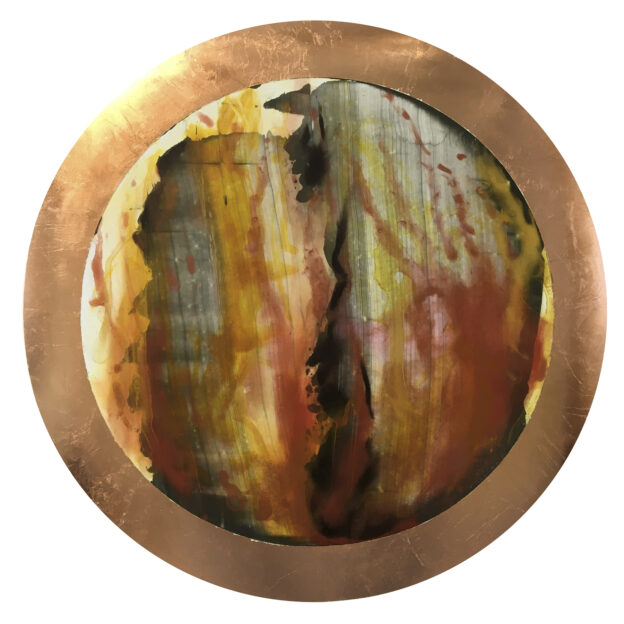
Fire, 15″ diameter, mica, Venetian plaster with copper on yupo, mounted on panel, $800.
Richard Bright: Can we begin by you saying something about your background?
Karen Fitzgerald: I was born and raised rural: on a dairy farm in central Wisconsin. The youngest of 4, I was pretty much left on my own. I preferred the out of doors – there was always something that needed attention. Finding a new calf in the back swamp and bringing mama and baby up to the barn; suckling a runt pig that wouldn’t survive on its own. Weeding in the late afternoon garden while a mama skunk paraded her young ones up and down the driveway. This seminal attachment to the natural world is what formed me as an artist.
RB: Have there been any particular influences to your art practice?
KF: Once I began formal studies, there were a number of key influences. As a young artist, I loved Georgia O’Keefe’s work, as well as Mark Rothko. Larry Rathsack was an important teacher in my early studies. Poets were also important influences; Czeslaw Milosz, Wendell Berry, Mary Oliver, Theodore Roethke. Each of these voices spoke clearly for my development.

Air, 15″ diameter, mica, Venetian plaster with silver on yupo, mounted on panel, $800.
RB: What is the underlying focus of your work?
KF: There is something, un-named, that rises up within me when I have an ‘experience of beauty’. This upwelling forms a basic urge; to communicate, to describe as deeply as possible this experience of energy. On all levels. To take another by the hand and say, here, let me show you.

Earth, 15″ diameter, mica, Venetian plaster with 23k gold on yupo, mounted on panel, $800.
RB: Your work is exclusively done in the tondo form. Can you say more about this and why this form is significant to you?
KF: Roundness has a distinctive presence: it suggests interconnection, wholeness. It is itself, inhabiting its own form in a natural way and reminding us of where we are. (On a round, blue planet, spinning with others around a round, glowing sun.) Whereas the rectangle insists we remember windows and the experience of looking out at the world, a tondo is presentational. This is a powerful distinction.

Light, 41″ diameter, oil, mica, Venetian plaster with 23k gold on yupo, mounted on panel, $4,200.
RB: There is a strong sense of energy in your work, both material and spiritual, which are both interconnected, interchangeable and often invisible. Would you describe your work as a metaphor of energies and of rendering the invisible visible?
KF: Yes, of course, that’s a lovely way to describe my work. Thank you!
The language of visual abstraction is presentational; it does not re-present something. It is the something. The language of metaphor is rich and complex. One must enter it in order to decipher it, and that is also a good describer of what my work does. Metaphor often unifies several disparate phenomenon, and treading one, we create a new interconnection between this and that. The energies that comprise us, and within which we are embedded are often invisible. Emotional energy is subtle, wildly dynamic, and often completely invisible. This felt world can profoundly affect us. Unlike a gathering cumulo-nimbus cloud system, we cannot “see” the collection of energetic eddies that creates an emotional exchange with someone else. We cannot “see” wind. The list is long regarding all the energetic things we cannot see.
There is also the presence of energy within my work that is not a metaphor. It is itself a particular kind of invention: form given its full voice. Taney Roniger has written eloquently about this fact, that form is its own language. We may not always understand what form means or is saying. In that way it takes its place in the world with so many other expressions. We can be present to these even when our verbal-language-based brains cannot adequately translate their “meanings”.

Soul of Fire, 15″ diameter, mica, Venetian plaster with 23k gold on yupo, mounted on panel, $800.
RB: Can you say something about your working process?
KF: Early on I learned to respect craftsmanship, and I still do. About 2 years ago I began working with yupo, a paper-like product that contains zero natural fibre. Yupo does not interact with materials; unlike watercolor papers, it will not buckle. I’m hesitant to use the word “steps” to describe my working process, yet in essence it is appropriate. I work with Venetian plaster, which needs to be applied and sealed. The various layers of paint need to be sealed between each layer, or the subtleties of pluming, and pigment settling are lost when a new layer is applied. When the painting is finished, gilding also needs to mind a careful process in order to allow the gold to be as beautiful as it can be. In earlier gilded work, I would prepare the panels and gild them completely before any paint was applied. This is an intensive process that involves sealing the panel, applying a base layer, and sanding the surface extensively. Gilding demands proper care – it must be cleaned a day after application, then sealed. There’s a lot of problem solving embedded in my process, I’m always mindful of how various pigments, sealants and media are interacting with each other.

Field of Light, oil, with Venetian plaster on yupo, 23k gold, 31.75″x31.75″, $2,500.
RB: Your works often incorporate gilding. Can you say more about this and the meaning it has in your work?
KF: I learned gilding processes in 2006 after several frustrating years of grasping for a more dynamic quality in the surface and luminosity of my work. While I arrived at gilding through its dynamic physicality, I’ve come to depend on its cultural baggage. In older cultures, gold was always used to signify something as sacred. I hue to this reading of gold. I want that transference of meaning. Essentially, I am suggesting that energy is sacred: the gold bands around the edges of the new paintings “halo” the form within. Christian iconography signalled sacredness through the golden halos that encircled the heads of many figures. This tradition spans hundreds of years. Gold is such an outrageously extravagant material, as are other leafing metals such as copper, palladium, and the lighter golds. Their shimmer mimics so many things in the natural world: the surface of water, the dance of light within clouds. That shimmer is at once metaphorical and profoundly physical.
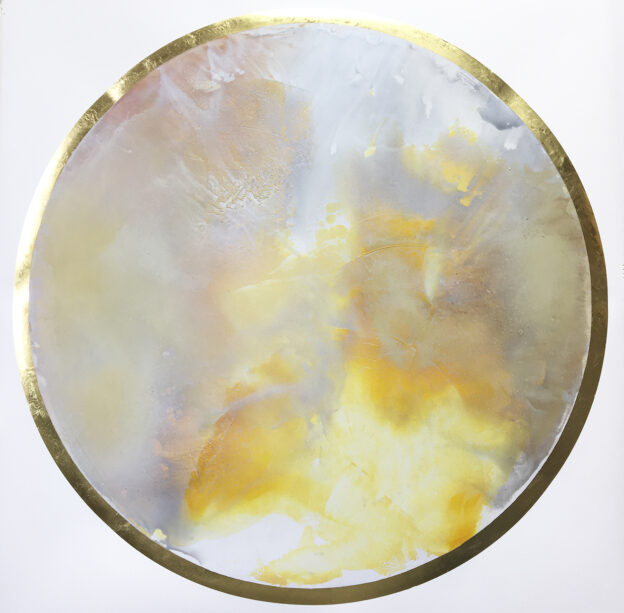
What The Light Saw, 40″ diameter, oil, mica, Venetian plaster on yupo with 23k gold, mounted on panel, $4,200.
RB: Can you say something about the suite of paintings, What The Light Saw, and the inclusion of poetry in the body of work? What, for you, is the relationship between poetry and the visual art?
KF: I’ve loved poetry since I was a teenager. In many ways, poetry is the most abstract application of verbal language. It says things succinctly, and can, within a few words move one from a purely physical experience to a whole-body, immersive transformation. Poetry’s ability to “say” something about our deepest human experiences is profound. It shares this capacity with the visual language. Both poetry and visual art are not only perfect forms for expressive communication. They are wise teachers as well. I often return to either a painting or a poem and find new understandings in ways that were opaque to me in previous encounters with the same work. A poem by Czeslaw Milosz, The Bird Kingdom, was a favourite for years. When I finally read his Harvard / Nobel lecture, I realized there was another meaning in this poem. It was written for all the inhabitants of the death camps in WWII. I was stunned. A number of paintings were made from this poem – all around 1990.
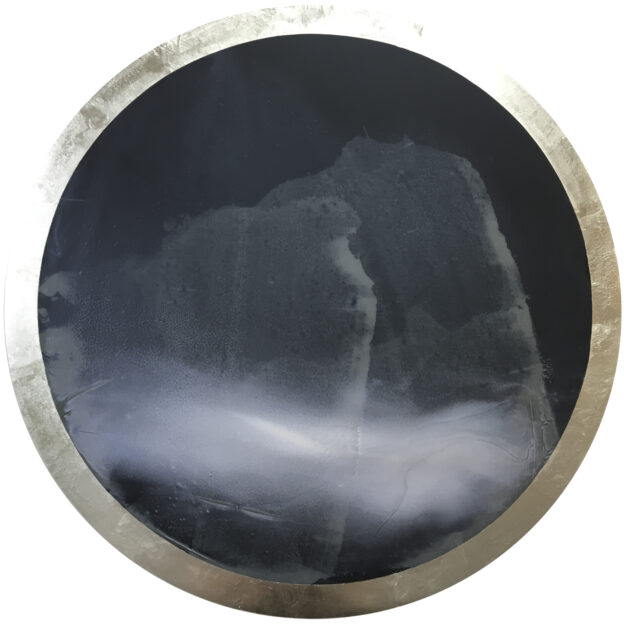
Fog Light, Remembering Gay, 16″ diameter, mica, Venetian plaster with 12k gold on yupo, mounted on panel, nfs.
What the Light Saw is a suite of work that began with a poetry-based inspiration. Rainer Maria Rilke’s poem, Sonnets to Orpheus I, 4 (quoted in full below) speaks to a lightness of energy that suggests an ease of passage through many denser energies. I imagined a consciousness of light; light possessing its own imagination that was unfettered – it could interact with our own imaginations. From there other poems were brought into the mix, each sparking one or more ideas for the paintings. While I can cite these sources, parsing the particularities of these rich interrelationships is more challenging.
When I take in a poem, or any artwork, the experience is complex: it ranges across the full spectrum of my physical and associational sensory networks. It resonates emotionally, intellectually. It seems to set up some sort of vibrating pattern of energy that imprints itself on my interior. Sometimes there are goose-bumps, other times chills up and down the spine. Tracking this, or trying to make it visible is like tracing the route of nutrients climbing from the mychorzial roots up to the leaf tips. It’s a myriad complexity, a schmear of experiential happening.

Earth of Wonder, oil, with Venetian plaster on yupo, 12k gold, 31.75″x31.75″, $2,500.
Allowing myself to be fully open to a poem functions as a stimulus to my own inner inspiration. A related field of ideas grows from a singular connection. When that happens, I know to run with it. It’s not something I can take notes on and return to later to expand into a fuller something. I have yet to uncover any sort of storage system for these fields of ideas. The only choice is to work, to take each idea and give it form. And similar to poetry, some ideas have a broad frame, with fine, discernable features. Others, are slimmer, they are sly, or they remain stubbornly shy, even mute. Some are fecund, others, singular.

All The Light We Cannot Hold, 26″ diameter, oil, mica, Venetian plaster on yupo mounted on panel, $2,275.
RB: Can you say something about the Sparrow’s Eye suite, which you describe as a meditation on the spiritual?
KF: This suite of paintings was done as a collaboration with composer, Carl MaultsBy. We worked with Civilla Martin’s beautiful spiritual, His Eye is on the Sparrow, as a source text.
While I find the lyrics lovely, encountering the music of the text is another matter: it is a profound experience of comfort, faith, determination, and optimism. As we worked together, I imagined what a sparrow might see out of its eyes. The world is wide, and full of mystery: do birds experience the profound, humbling feelings we do when we look to the sky, or consider time?
My definition of spirit and spiritual do not include organized religion as a requirement for anyone to be spiritual. My sense is that when we are grounded in our own imaginings, we are connecting with divine energy. We are embedded in this energy, it is embedded in us; we are woven with it, through it, and for it.
A handful of poems inspired some of the Sparrow’s Eye suite, including W. S. Merwin’s, Wendell Berry’s, and Mary Oliver’s work. For example, Sparrow’s Eye, Day Blind Stars is a line from Wendell Berry’s The Peace of Wild Things.

When Spring Emerges, 15″ diameter, mica, Venetian plaster with 12k gold on yupo, mounted on panel, $800.
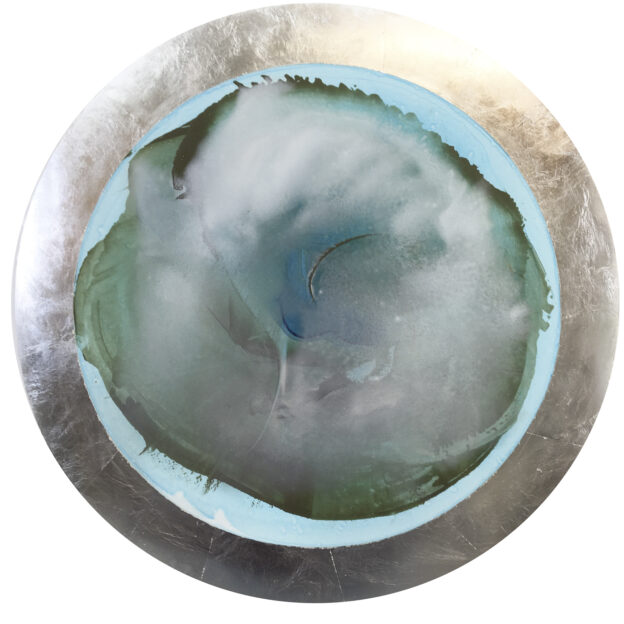
The Gathering Wave, 15″ diameter, mica, Venetian plaster with 12k gold on yupo, mounted on panel, $800.
RB: What projects are you currently working on or have coming up in the future?
KF: I have a solo exhibit with Arthelix gallery on line through July 29th. https://www.artsy.net/show/shim-art-network-arthelix-karen-fitzgerald-energies?sort=partner_show_position
From September 11 – October 11, 2021, I will present work in a 2-person show with Jaynie Gillman Crimmins at the JVS Project Space, 108th Street at Third Avenue, Manhattan, NYC.

Energy of Green, 15″ diameter, mica, Venetian plaster with 12k gold on yupo, mounted on panel, $800.
…………………………
What You Cannot Hold
You who let yourselves feel: enter the breathing
that is more than your own.
Let it brush your cheeks
as it divides and rejoins behind you.
Blessed ones, whole ones,
you where the heart begins:
You are the bow that shoots the arrows
and you are the target.
Fear not the pain. Let its weight fall back
into the earth;
for heavy are the mountains, heavy the seas.
The trees you planted in childhood have grown
too heavy. You cannot bring them along.
Give yourselves to the air, to what you cannot hold.
– Sonnets to Orpheus I, 4
Rainer Maria Rilke
……………………………………
All images copyright and courtesy of Karen Fitzgerald
Get the Full Experience
Read the rest of this article, and view all articles in full from just £10 for 3 months.
No comments yet.