A Sense of Place
Issue 59 July 2020


The queer uses of colour
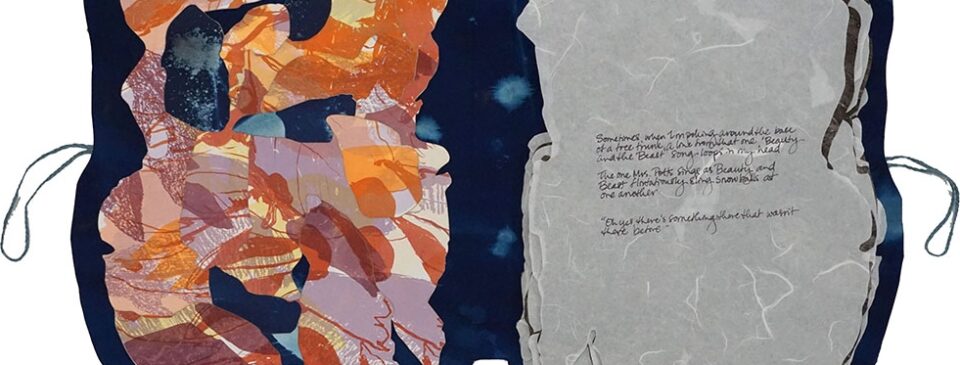
This text looks to undo assumptions of creative individuals existing apart from dynamic material relations. Following a material ecocriticism ethos, it describes many simultaneous instances of materials affecting the narrative or meaning-making potential within human art practice, specifically in recounted moments from an artist residency taking place within collective gardens where plants were made into paints. In developing Sara Ahmed’s refrain of ‘use’ coming before, during or after relations, the creative tendency to find potential in pre-existing materials, using them differently, is proposed as a life-sustaining mode, like that of Margulis’ Serial Endosymbiosis Theory.

Returning the artist to the field: Utilizing printmaking’s multiplicity, mediation and materiality for enhanced science communication.
Visual art as a parallel practice to science research offers opportunities for communicating the complexities of many ecological systems to non-experts. Immersive and interactive artworks provide a means to complexity, perceived distance, and opaqueness of language surrounding ecological systems. This paper describes the use of printmaking and print installations as analogues that engage audiences in complex soil systems. The three projects discussed here trace the journey of artist observer to field collaborator and examine printmaking’s capacity to facilitate the communication of both explicit and experiential knowledge of soil systems.
Keywords: field research, practices of arts and sciences, soil science, tacit knowledge, fine arts, printmaking

Ancient Ritual in Contemporary Mark-Making
“The power of the natural world, its intrinsic energy and fundamental properties, is dependent upon a fine balance. The balance of positive and negative forces resides from the smallest particles that make up our universe to concepts we live with every day: night/day and dark/light; finite/infinite and one/zero; quiet/loud and soft/hard; organic/manmade and the natural environment as opposed to the constructed cities. My work has been centered on concepts of this balance of opposites, as well as methods of numerical systems and patterning we use to construct an order to our world.”
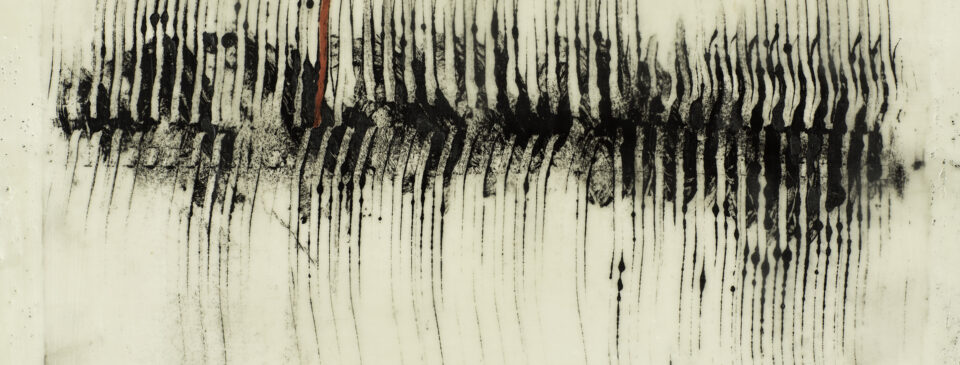
Catherine Eaton Skinner’s works incorporate painting and encaustic, sculpture, printmaking, and photography. The figure, both human and animal, is an important element in her work and acts as a source of inspiration and exploration of identity, spirit and the paradoxes of human existence. She discusses her life and work in ‘Ancient Ritual in Contemporary Mark-Making’.

The Grand Challenge for Science
While mainstream physics continues its detailed Hadron Collider investigations of the smallest particles and astrophysics investigates the origin of the universe, the most important problem of who and what we conscious human beings actually are has been eliminated from physics and thereby from the foundations of science. This has led to a world view of humans as pointless creations of probability whose lives are without purpose beyond immediate material gratification. That the foundations of science has eliminated the subjective experience is its greatest failure and rectifying this situation is its greatest challenge. This paper illuminates this challenge.

Sky
SKY is an exhibition, curated by Stephen Nowlin, that invites visitors to ponder both the provincial and universal elements of space above and around the Earth’s surface. This group exhibition demonstrates how the unfolding realities exposed by new science are affecting change in the understanding of ourselves, our planet and beyond. The SKY exhibition features works of contemporary art, science artifacts and historical objects displayed equally and side-by-side, blurring boundaries and distinctions between domains usually separated by convention and differing periods of history.

Handspan, handspun: navigational lines in the work of artists Inge Thomson and Deirdre Nelson
This essay considers projects by two multimedia artists working in Scotland to propose that culture and local ecology are inseparable and mutually-determining aspects of our understanding of and care for place. The work of Inge Thomson and Deirdre Nelson encompasses material cultures and oral traditions, with an emphasis on marine environments, creating new narratives of passage as works of advocacy for ‘vernacular, community-based ecology’.
Poems
Lynne Goldsmith’s first book, ‘Secondary Cicatrices’, won the 2018 Halcyon Poetry Prize and was a 2019 Finalist in the American Book Fest Awards and a 2020 Human Relations Indie Book Award Gold Winner. Her poetry has been published in Backchannels Journal, Spillway, Thimble Literary Magazine, Environmental Magazine, Red Planet Magazine, among others, with upcoming poems in Tiny Seed Literary Journal and Scotland’s 2020 Geopoetry Conference program.

Coronavirus has changed our sense of place, so together we must re-imagine our cities
Dr Tony Matthews is an award-winning Urban and Environmental Planner, with portfolios in academia, practice and the media. He is a faculty member at Griffith University, where he is a Senior Lecturer in the School of Environment & Science and the Cities Research Institute.
His research and practice interests include adapting cities to climate change impacts; the role and function of green infrastructure; sustainable and low carbon design; the interplay between built environments and human health; and achieving high quality urban design outcomes. He is also an active public writer and commentator with hundreds of national and international print, radio and television media appearances. He founded the Urban Broadcast Collective (@urbanpodcasts), a curated network of podcasts dedicated to cities and urban life. Tony also co-developed and co-presented ‘The Urban Squeeze’ radio program on ABC Radio, which ran for two seasons and won three Awards for Excellence from the Planning Institute of Australia.

It’s not easy to make landscape a place: you have to feel it
Fiona Stafford is Professor of English Language and Literature at the University of Oxford and tutorial fellow at Somerville College. She is a Fellow of the British Academy and a Fellow of the Royal Society of Edinburgh. She works on literature of the Romantic period, especially Austen, Burns, Clare, Keats, Wordsworth and Coleridge, and on their literary influences on modern poetry. Her research interests also include late eighteenth and early nineteenth-century culture; Irish and Scottish literature (post 1700); Archipelagic literature and art; Place and Nature Writing (old and new); Trees, Flowers and their cultural history; Environmental Humanities; literature and the visual arts.
Her most recent book is ‘The Brief Life of Flowers’ (2018). Like her acclaimed book, ‘The Long, Long Life of Trees’ (2016), it draws on first hand observation, literature, art, folklore, mythology, cultural history, natural science, botany, history of medicine.

Time alone (chosen or not) can be a chance to hit the reset button
Thuy-vy Nguyen is an Assistant Professor in Psychology at Durham University in the UK. Her research mainly focuses on observing people’s experiences when spending time alone and understanding personality and contextual factors that predict the quality of their solitude.

Humanity and nature are not separate – we must see them as one to fix the climate crisis
Heather Alberro is Associate Lecturer/PhD Candidate in Political Ecology, Nottingham Trent University.
“My work revolves around all things relating to the human-animal-nature relationship and its radical reconfiguration along harmonious/anti-anthropocentric lines. Specific disciplines of focus include radical environmental politics, environmental sociology, green utopian studies, environmental ethics, posthumanist studies, and sustainability.”