The Beauty and Fragility of Nature
Meredith Woolnough is an internationally acclaimed, award winning artist from Newcastle, Australia. Her elegant, embroidered drawings capture the beauty and fragility of nature in knotted threads. Vibrant coloured structures of organic shapes hover effortlessly above the surface, elegant and enchanting.
“The more I work with natural forms, the more I find myself drawn into the science of nature. I am fascinated by the way things are built, the way they grow and function. I often find myself marvelling at the perfection of a single leaf or the phenomenal beauty of a coral reef and it can be quite overwhelming at times, almost spiritual.”
Richard Bright: Can we begin by you saying something about your background?
Meredith Woolnough: I grew up in the suburbs of Sydney Australia. I was always an arty kid who loved making things, so I followed my passion and studied Fine Arts at university fresh out of high school. It was there that I discovered and fell in love with the weird and wonderful embroidery technique that I use to create my artworks. I have been working full time as an artist for over a decade now, creating and selling works and also teaching this style of embroidery. I am also a mum of two little girls, so I am constantly trying to find that sweet spot between juggling family life and my art business.
RB: What is the underlying focus of your work? In particular, what are the thinking processes and knowledge practices that guide your artistic research?
MW: I simply see my work as embroidery art for nature lovers. I aim to depict the beauty and wonder of nature by presenting it in a new and unfamiliar way. I hope that when others see my work they are intrigued and it encourages them to look closer, to ask questions and to discover something new.
My practice begins with field work, finding and documenting plants or animals in the natural world that interest me. I am often drawn to particular subjects because they have an interesting or beautiful structure. The way things grow and function has always been fascinating to me and I am especially drawn to the veining networks that you see in so many organisms on this planet. Coral fans have been a favourite subject of mine, I have stitched dozens of coral studies over the years. I also love to study and depict the tiny veining systems in leaves. I am likely drawn to these veining structures because they translate well into my medium. My embroidery designs need to be well connected otherwise they will simple fall apart when I remove the temporary base fabric I stitch onto. Branching structures are not only beautiful, they are also well connected so work well with this specific form of sculptural embroidery.

Meredith Woolnough working in the studio
RB: Have there been any particular influences to your ideas and work?
MW: I am largely influenced by the embroidery technique itself and its sculptural capabilities. I see this as a really unique way to draw and I am always looking for new ways to push the process further and use it in interesting ways. I am also inspired by the natural forms that I depict in my stitched studies; I am fascinated by the biology and science behind the various plants and animals I work with.
RB: Can you say something about The New Neighbours and the inspiration behind the work?
MW: The New Neighbours was created for the prestigious art exhibition The Third Tamworth Textile Triennial. This exhibition was a wonderful opportunity for me to make a new work that was bigger and better that I had made in the past. Prior to this, the vast majority of my works were made to be framed (and sold), so they had to be made within certain size and depth limitations. But as this was a travelling exhibition to be shown in amazing large gallery spaces so I knew I could work outside the frame (so to speak).
The New Neighbours is made up of 412 individually stitched and moulded embroideries carefully pinned to the wall in a large circular mass. It is the largest piece I have created to date.

‘The New Neighbours’ by Meredith Woolnough

‘The New Neighbours’ (detail) by Meredith Woolnough
The New Neighbours explored the idea of our changing oceans and the loss of coral reefs due to rising sea temperatures. It has been predicted that 90% of the world’s coral will be dead by 2050. In the face of this devastating statistic I cant help but wonder what the world will be like without coral reefs. What will these beautiful, fascinating and important ecosystems look like after climate change has destroyed the majority of them? Will they become barren wastelands or will the reefs evolve into a new kind of ecosystem, with new dominant species? While many species will perish under the impending harsh conditions there will always be those that are able to adapt, survive and even thrive in the face of change.

‘The New Neighbours’ (in situ) by Meredith Woolnough
The New Neighbours explores a possibility of what the transformed reefs could look like after secondary colonisers have moved in. The embroidered forms that make up the installation are inspired by a red Discosoma species, from the order Corallimorpharia. Colonies of Corallimorphs have been known to rapidly cover empty spaces in a reef, like a living carpet over coral rubble. Species from this order are hardy, fast-growing organisms that are resistant to pollution, water acidity and temperature changes, making them potential survivors of the impending reef destruction.
I like to think that life will find a way and this is some small comfort in the face of the changes our planet is facing.
RB: Your completed works are delicately three-dimensional. Can you say something about your freehand technique and how you have developed it?
MW: When I started working with this embroidery technique I knew very little about it. I barely knew how to thread a sewing machine. I was initially drawn to the freehand machine embroidery technique because I thought it was a really interesting way to do a drawing, I loved the idea of a stitched sketch. Then when I discovered water soluble fabric and realised that I could do a stitched drawing then completely remove the base cloth I was hooked. I decided to dedicate the honours year of my Fine Arts degree to the exploration of that specific combination of embroidery technique and base material. I made all the mistakes in that initial year, but learnt from each one and developed very specific ways that I liked to work, many of which I still use in my practice today. One of my most exciting discoveries of that year was that if I didn’t wash out all of the water-soluble fabric it would re-harden like glue when it dried. This process allowed me to shape the embroidered drawings into specific shapes and create delicate three-dimensional works. It’s such a simple way of working but it has so many creative possibilities. I think have really only explored the tip of the iceberg in terms of its potential.
RB: Can you say something about your Coral Atoll Series?
MW: The Coral Atoll Series consists of three ‘donut’ shaped studies of various coral structures. An atoll is a ring-shaped coral reef, hence the shape. These pieces were a fun study as I didn’t stick to realistic colours and played with some beautiful thread blends which is something I love to include in my work wherever possible. These three stitched structures depicted in this series are some of my most popular and iconic designs. The first is based on the branching forms of coral fans. The second is inspired by the cell-like shapes of corallites (the skeletal cup, formed by an individual stony coral polyp, in which the polyp sits and into which it can retract). The third and final piece is a design that referenced the interconnected nature of coral polyps in a coral colony.

Corallite Atoll by Meredith Woolnough
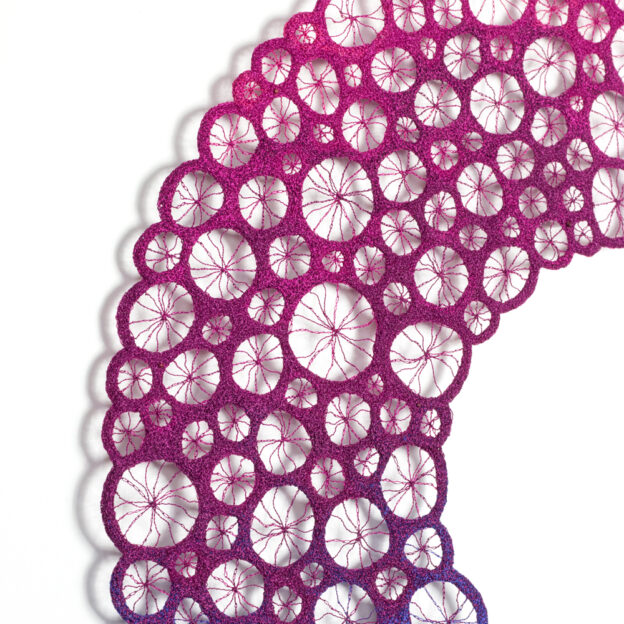
Corallite Atoll (detail) by Meredith Woolnough
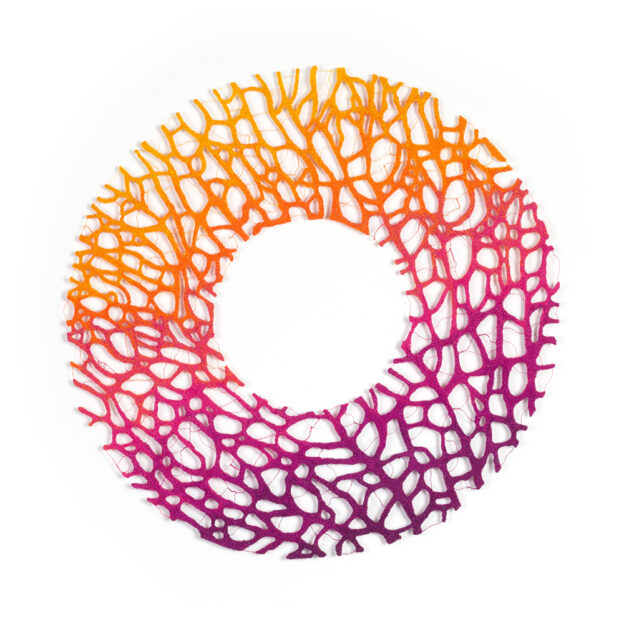
Coral Fan Atoll by Meredith Woolnough

‘Coral Fan Atoll’ (detail) by Meredith Woolnough
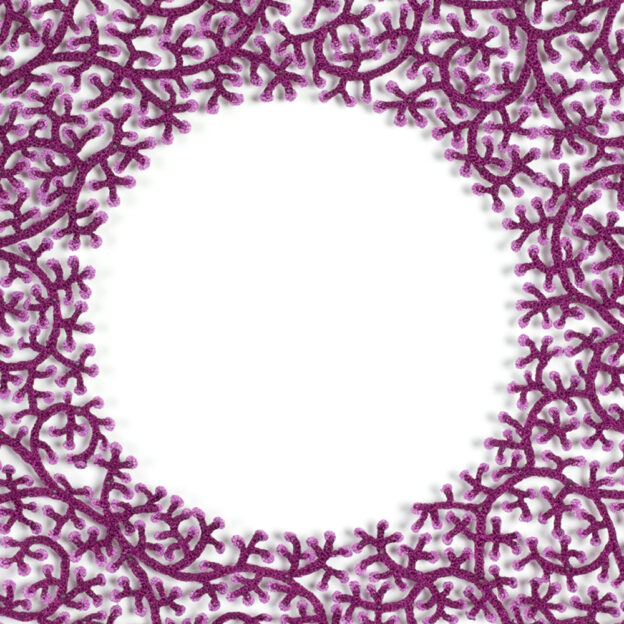
Coral Polyp Atoll (detail) by Meredith Woolnough
RB: Can you say something about The Art of Cells project, your involvement in it and the work you created, Precious Possibilities?
The Art of Cells project was equally exciting and challenging. It was explained to me as a project that brought art and science together in a beautiful way. Naturally, I was intrigued. The project was developed by Gibco (Thermo Fisher Scientific) and its aim was to explore the connection between scientists and cells and see the amazing beauty of cell research like you have never seen it before.
Cell scientists from around the world were each paired with an artist to interpret their science through artistic expression, portraying the amazing beauty of cell research and demonstrating how they love their cells. I was paired with Dr Marietta Hartl who works with early embryonic cell cultures in her research.
I went into this project with no idea what I would be making or what kind of imagery I would have as inspiration. Which was really quite scary for me. But I was pleasantly surprised to see how incredibly beautiful cells could be. The microscopic images that Marietta had captured in her research were like something from an alien world. Glowing and pulsing with life. It was amazing to think that these clusters of embryonic cells were the starting points of life.
I was so inspired by Marietta’s passion for her work and the cells themselves. From there the concept for my own artistic interpretation of her science was born. The final artwork Precious Possibilities was made up of hundreds on small cup shaped embroideries, representing the early embryonic cells from one of the scientists microscopic images. These stitched cells were arranged in a tight circle atop an orange scribble background, representing the extra-cellular matrix.

‘Precious Possibilities’, embroidered artwork by Meredith Woolnough

‘Precious Possibilities’ (detail), embroidered artwork by Meredith Woolnough
RB: In many ways our human brains interpret information through pattern recognition and re-arranging pattern, which is an evolving dynamic process. What importance does pattern play in your work? And what is the role of empty spaces or transparency in your art works?
MW: Pattern plays an enormous role in my work. I am essentially exploring Natures patterns in my stitched drawings and once you start exploring the patterns in nature you can easily fall down a wonderfully beautiful, fascinating and occasionally mathematical rabbit hole. One thing that I love to do is watch people reactions to my work for the first time and hear their interpretations of my stitched drawings. Because the medium is unfamiliar to so many people, they have never seen embroidery like this before, and because many of my studies are purely focused on structure without the normal colour or shape cues, it is easy to misinterpret what my artwork is inspired by. In the same artwork I have overhear viewers recognise anything from leaf veins, neurons in the brain, arteries in the human heart and patterns from lightning strikes. It just goes to show that when it comes to patterns from nature, we all recognise different things, we all have our own connections and associations. There is great beauty in that, I think.
The negative space in my work is, I believe, just as important as the stitched areas. These empty spaces add a lightness and delicacy to the artwork and they are also what sets this form of embroidery apart for others. Most embroideries have a base cloth, a foundation that the design is stitched onto. My work is essentially embroidery that is liberated for its base cloth, the cloth I use is only a temporary surface, it is eventually taken away to revel the beauty and delicacy of the embroidery on its own. The spaces in the final artwork also add to the sculptural nature of the artworks, providing the ability to overlap, interweave and layer pieces to create new forms and structures.
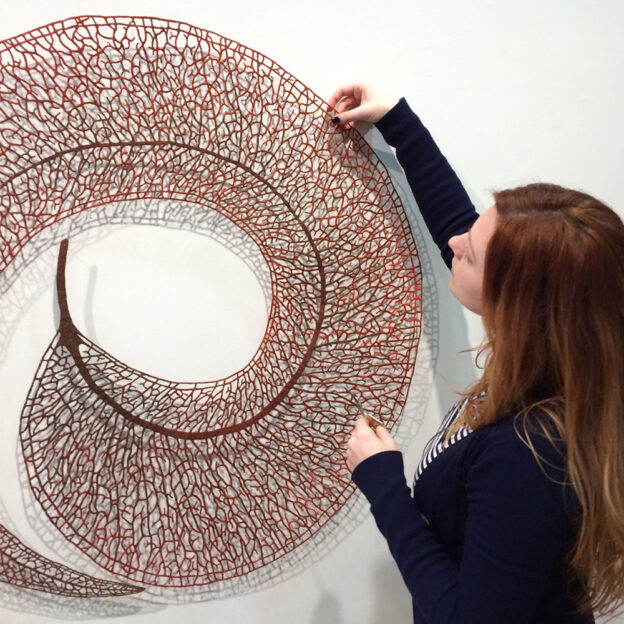
Meredith Woolnough installing Scribbly Gum Leaf
RB: Your art explores how things form, grow and evolve. How has your artwork evolved from the very first pieces?
MW: My very first embroidery pieces were quite different from the type of work I create today. My early works were large hanging sculptures depicting historical embroidery motifs, covered in thousands of loose threads. I made the shift towards nature inspired structures in 2009, about three years after I started working with these techniques. My first coral series set me off on this new path and I never looked back. At first, I was simply interested in depicting the beauty of coral but as I researched further and learnt more about these hugely important and fragile animals I feel my work went deeper and I started to depict very particular elements regarding the colours and structures of specific species. I hoped to portray the most interesting and important elements of the organisms I study in my stitched interpretations. After a few years of exclusively stitching coral I branched out (no pun intended) into plants, exploring the patterns in leaf veins and recreating the veining systems of whole leaf specimens at a large scale. Today, while the majority of my work is still based in studies of organisms from the natural world, I am also not afraid to try different things and explore stitched designs that I think will be interesting sculptures. In 2020 I stitched a series of mini embroideries for my ‘100 Embroideries Project’ and many of those were purely fun, playful pieces.
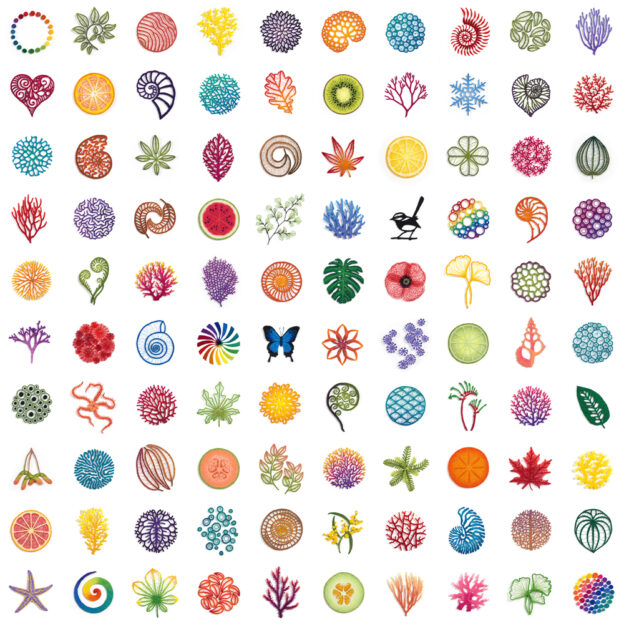
100 Embroideries project by Meredith Woolnough
RB: What future projects are you currently working on?
MW: I am currently working on a series of works for my upcoming solo exhibition in October this year. The focus of the exhibition is patterns and structures found in our oceans. The series is largely dominated by coral structures, which should come as no surprise, but I expect I will branch out into other areas as well as the exhibition evolves. It is early days yet.
…………………………………..
https://meredithwoolnough.com.au/
All images copyright and courtesy of Meredith Woolnough
Get the Full Experience
Read the rest of this article, and view all articles in full from just £10 for 3 months.
No comments yet.