On ‘PRESENCE: The science and true stories of the unseen other’
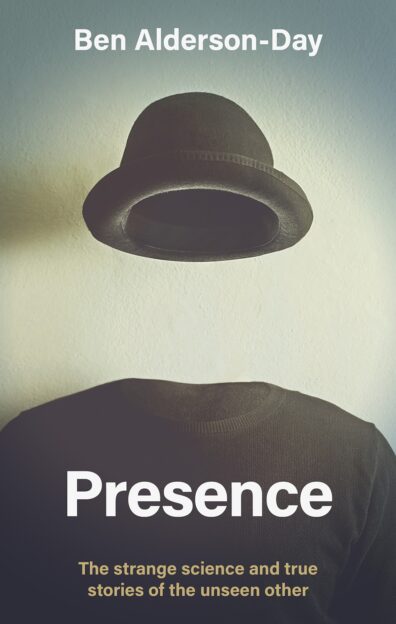
Ben Alderson-Day is an Associate Professor at Durham University and member of the Developmental Science research group at Durham. He is the co-founder and co-chair of the Early Career Hallucinations Research (ECHR) group, a network of over 250 ECRs in 24 countries conducting research on hallucinations and related topics. His most recent research has concerned “felt presence”: the sensation that someone is present without any sensory cues. In this interview, he discusses his latest book ‘PRESENCE: The strange and true stories of the unseen other’ (Manchester University Press, March 2023).
Richard Bright: Can we begin by you saying something about your background?
Ben Alderson-Day: I first started getting interested in psychology when choosing my A-levels (I was actually warned off taking it by some teachers at my school who didn’t see it as a “proper” subject!). At the same time, I’d been aware for a few years that I really wanted to learn more about philosophy and try to study it properly – so I ended up studying Philosophy and Psychology at Edinburgh University from 2003. I didn’t know at the time, but that set me up well for my first post-doctoral position, working as a psychologist on an ambitious interdisciplinary project called Hearing the Voice. Fast forward 10 years later, and I was still on that project! (With a lot happening in between).
RB: What is the focus of your research?
BA-D: As part of that project, my research has mainly focused on hallucinations or unusual perceptual experiences, and usually in the context of people experiencing psychosis. I use both of those terms here because the first tends to get more recognition from the average reader – but it can also be a problematic term, depending on who you speak to. For people who regularly have experiences like hearing voices in the absence of a speaker, calling that a “hallucination” can serve to undermine their own meanings and interpretations. And it was those meanings that we were particularly focused on at Hearing the Voice – trying to look past some of the standard thinking and shibboleths about psychosis and hallucinations, to see what else there might be to explore and understand.
RB: Can you say something about your recent book, Presence, which explores the universal, disturbing feeling that someone or something is there when we are alone? What is the central thesis and structure of the book?
BA-D: This book really came about from conversations with voice-hearers (i.e. people who regularly hear voices). Sometimes they would say that we’re missing the point if we focus on the hearing bit: some voices could just be “there” without speaking. I wanted to know what “there” really meant, because it presents a puzzle. How do you feel that someone or something is there without sensory evidence (like hearing a voice, or seeing a face)? I started to read around the topic and research it more, and came across this phenomenon – known as “felt presence” – in a vast array of contexts, including survival situations, Parkinson’s disease, sleep, bereavement, imaginary friends, and spiritual experience.
The book is really an account of me learning about presence by travelling through those contexts, trying to either talk to people who have had the experience, or experts who have studied the phenomenon. And that can be challenging to do, because people really struggle to describe this experience – it’s like we don’t possess, or we have forgotten, the language to talk about a feeling that is both very basic but also uncanny. If there is a central thesis to the book, it is that you have to approach this experience in the round, drawing on all the varieties of presence that you can, to understand what is really happening for people.
RB: The distinction between delusions and hallucinations is prominent in psychosis and schizophrenia. Does felt presence involve a delusion or a hallucination, or is it more than that?
BA-D: Therein lies a question! This distinction is central to a lot of thinking about psychosis; that things are either of the mind, or of the senses; the stuff of thoughts or in the realm of perception. But presences seem to be sensations without clear sensory content. They get described as feelings, but are firmly not about the five ordinary senses. That means that historically some people have assumed that they can’t really be hallucinations, and must reflect delusions: things like paranoia, for example.
I talk about this debate in the book, but in the end I come back to two things. First, for the people I have spoken to, presences in psychosis can overlap with paranoia, but they often emphasise body and space. There’s a sense that this is a very visceral, embodied phenomenon. That might not be the case for everyone, but at the very least calling it a delusion doesn’t seem to capture that feeling. Second, when you look beyond psychosis, there’s plenty of evidence to show that presences occur without any strong beliefs or ideas that we might call delusions – and if anything, presences seem to instead associate more closely with changes to the sensory world (Parkinson’s disease is a good example of this).
RB: You begin Chapter 2 with the sentence – “If you go looking for presence, the first stories you come across almost always involve snow”. Can you say more about this and give some examples?
BA-D: Sparse and extreme sensory environments are renowned for giving people hallucinations: polar environments, snow-capped mountains, vast oceans and deserts provide a kind of canvas that a dehydrated, hungry (and sometimes oxygen-starved) mind can paint masterpieces upon. But the stories I am interested in go a little beyond that in focusing on the sense of being visited by a kind of entity and companion, and some of the most famous have been on polar expeditions or in high altitude climbing. Perhaps the most famous is Ernest Shackleton’s “Third” man – the sense of a companion that he had when crossing the interior of South Georgia Island at the end of the Endurance expedition in 1916. Another famous case is Frank Smythe, who climbed Everest without oxygen in 1933. He said “All the time I was climbing alone I had a strong feeling that I was accompanied by a second person. That feeling was so strong that it completely eliminated all loneliness I might otherwise have felt” – and he turned to share his Kendal Mint Cake with the phantom companion at one point.
RB: How does felt presence relate to contemporary research and understanding in neuroscience?
BA-D: We can now draw on a range of evidence to understand more about how and why felt presence can occur. In neurology, case studies of people with epilepsy or brain tumours have involved many different descriptions of presence; changes to the brain involving the temporal lobes or the insula, for example, often seem to produce presences (sometimes of a spiritual or ecstatic nature). Researchers have also shown that you can stimulate the brain in specific areas like the left temporoparietal junction (TPJ) – a kind of hub area that seems to be important in integrating lots of different kinds of sensory signals – and this can produce the sense of a shadow figure that mirrors your posture and position. Finally, in the past few years it’s been claimed that we can combine all this information to identify a “presence network” in the brain – but I think more research is still needed there before we can be confident about that.
The key thing all this evidence tells us is that presence itself can be this standalone phenomenon: we don’t need the five senses, or the idea of delusions, for it to occur. And if that’s the case, we need to keep working to understand how such an uncanny experience can arise.
RB: Is the body, or a sense of a body, a significant part of a felt presence experience?
BA-D: Absolutely. The first half of the book places a heavy emphasis on the relevance of our bodily sense to understanding presence. What a lot of the neuroscientific and experimental evidence points to is that presence often occurs when you disrupt the brain’s usual processes for mapping out where our bodies are in space. We have an inherent sense of that via proprioception, but it’s not something people are always fully aware of, or are used to talking about. When those processes get disrupted though, you can get a range of very unusual phenomena: people might see doppelgangers, or feel that their body has been duplicated, or just have a vague sense that someone is close by. So, one answer to that puzzle about presence might lie in the body; we feel presences not via the five ordinary senses, but by changes to our natural sense of our own bodies.
RB: The term ‘tulpa’ was first used in the works of Alexandra David-Néel to describe the concept of ‘emanations’ of the mind through deep meditation within Tibetan Buddhism. As you mention in your book, in recent years a subculture has formed online whose members (tulpamancers) advocate the creation of hallucinations or imaginary friends. Can you say more about tulpamancers and whether their claims can be tested?
BA-D: Tulpamancy is this new phenomenon that draws upon some old ideas. It started with Brony communities online – people who share a love of My Little Pony – who sought to create their own “Tulpas”, or beings who could talk back to them and behave in a sentient way, all the while being part of their own minds. It’s sometimes likened to having an imaginary friend, but Tulpamancers absolutely reject the idea that the outcome is something they are purely imagining, even if the road to that involves lot of training and practice in mental imagery and concentration. When researchers have explored this phenomenon, they liken it to practices like mediation or mindfulness, but the analogy that came up for me was writers. At Durham we conducted some research with professional writers in collaboration with the Edinburgh International Book Festival where we asked them about how they engage with the characters that they create. Some writers were adamant that they were always in control, but other writers described a gradual process in which characters began to speak for themselves, even to the point of dictating new lines!
Clearly, something is going on where our minds have the capacity for the imagination to change our sense of agency, where we feel like we are handing over control to something “other” than us. And when that happens, people begin to talk about these others having their own sense of presence. One Tulpamancer described it as being like two people looking out through the same set of eyes.
RB: Following on from this, can you say something about felt presence in regards to religious/spiritual experiences?
BA-D: It can be really challenging to talk about presence in the context of religious experience. There, the power of belief, symbolism and interpretation to shape what happens – both in advance of an experience, and afterwards – makes it very hard to tease apart different threads. I am also wary of doubting or debunking matters of faith; that’s not my business! But there has been good, careful work on this phenomenon, and in the book I talk to Tanya Luhrmann, a Stanford anthropologist who has written extensively on how voices and presences are experienced and cultivated in religious and spiritual communities. A process she emphasises is absorption – the capacity to turn inwardly and focus one’s attention away from the outside world – and the interesting thing about that is that it really overlaps with practices in writing, Tulpamancy, and elsewhere.
RB: Finally, is there a pattern that runs through felt presence experiences?
BA-D: The basic feeling of the “other” runs through all experiences of felt presence, but things like emotion, personification, and significance vary considerably. The book doesn’t claim a central essence to presence; instead it presents at least two overlapping models or routes towards the experience – bodily and intersubjective. The former involves changes to the bodily self, and we can see it happen again and again in neurological case studies, Parkinson’s disease, sleep paralysis, and probably several survival situations. The latter, on the other hand, is about how we relate to and imagine others – and I speculate that it’s that capacity that we draw upon and allow to flourish in the examples of presences that come about through creative practice, or Tulpamancy. In a way it’s two kinds of presence: of bodies, and of minds. I would venture that the presences of psychosis involve both; but we’re really only at the start of understanding this phenomenon.
…………………………………………
Get the Full Experience
Read the rest of this article, and view all articles in full from just £10 for 3 months.
No comments yet.