The Unsettled Sense
The eye is a sense organ and an affective organ. It receives and is moved. We see and we cry. This essay focuses primarily on the eye which sees and, in particular, on seeing as a presence to our experience of the world and others. It considers how there is an inherent unsettledness and instability in the phenomenology of seeing. Drawing on the phenomenological investigations of Maurice Merleau-Ponty, it explores how the phenomenal richness of seeing is, by its nature, in flux and susceptible to disequilibrium; how seeing is therefore also a steadying and bound up with our experience of spatiality and openness.
For the philosopher Maurice Merleau-Ponty, the thinking of both ‘empiricism’ and ‘intellectualism,’ his recurring characterisations in Phenomenology of Perception (1962) of all thought ‘that presents itself with the world readymade’ (1962: 207), ignores the body as the site and subject of perception. Rather, for Merleau-Ponty, our senses become a way of co-existence or communion as we delve into the world through perceptual experience, ‘a certain way of being in the world suggested to us from some point in space, and seized and acted upon by our body’ (ibid: 212). Thus, in gazing upon the blue of the sky, we do not possess it in thought, but rather we are abandoned to it.
For Merleau-Ponty each sensation of seeing begins and ends with itself and is the first and last of its kind. Seeing belongs to ‘a certain field’ that we have access to and an opening upon, with no special effort required, which at the same time is always limited, in that around what is being looked at spreads a ‘prepersonal horizon’ of what is not seen, or what is invisible. Thus, whilst space may be said to belong primarily to sight as the setting for our existence and co-existence, all our senses are spatial in giving us access to some form of experience, and with each ‘a particular manner of being in space and, in a sense, of making space’, where ‘the power of going to it is inseparable from that of cutting oneself off from it by the sequestration of a sense’ (ibid: 221-222). Whilst we might at any moment feel absorbed into a sense of sight and become even saturated by it, at other times another sense may bring another dimension surging through.
Although we can, as Merleau-Ponty puts it, shut ourselves up in one of our senses, projecting ourselves into our eyes and the blue of the sky, this requires a highly particularised attention and separation through the fixing of the gaze. It involves a turning towards the gaze itself and an interruption of the total spectacle; breaking the link between vision and the world and between the subject and their vision. This experience of the separate senses is, moreover, always unstable. The ‘natural attitude’ of vision involves, rather, surrender to the spectacle and a making of common cause with the gaze, surrendering also the barriers assumed between the senses (for example, in the phenomena of synaesthesia).
For Merleau-Ponty there is a unity of the senses which interact in perception as the eyes anticipate and collaborate in the ‘prospective’ act of seeing. This is always experienced from a familiarity with the world in the body and the senses born of a person’s habitation of the world. Nevertheless, this remains a perceptual field that in our sensory exploration we have a capacity to suspend and limit.
The eye as animator
Thus, for Merleau-Ponty, thinking that ‘looks on from above’ and treats everything as if it were an object, must return to the ‘there-is’ of the body. In Eye and Mind (1961), the last work Merleau-Ponty saw published, he continues his phenomenological investigation into what it means to see and experience seeing and his forceful critique of a Cartesian conception in relation to sight and space. Vision, for Merleau-Ponty, essentially offers an opening to the world. In a body that both sees and is seen, it is deployed in movement and caught up in things and in the world. In looking at things we can also look at ourselves and see ourselves seeing, but this can never be a decision made by the mind setting up some picture or representation of the world.
In Eye and Mind, Merleau-Ponty seeks to enter the sensibility of the painter, who by welcoming light, colour and depth into their body, changes the world into a painting. In this action, the eye is an animator: ‘The eye is an instrument that moves itself, a means which invents its own ends; it is that which has been moved by some impact of the world’ (1961: 166). Merleau-Ponty recognises that, as objects of painterly investigation, light, shadow, reflection and colour have a visual existence ‘like ghosts’ and require a voracity of seeing that reaches beyond the visual givens. In looking at what painters, such as Cezanne and Klee, themselves have to say about their experience of being merged in a subject and of things seeming “to look at them”, where it can become impossible to distinguish between what sees and what is seen, Merleau-Ponty describes phenomenologically, and for everyone, the possibilities of seeing as a way of mixing with the world and others and for the world and others to mix and meld with us.
Merleau-Ponty identifies Descartes’ conception of vision polarised as the action of light upon the eyes and a construction — a making of resemblance — belonging to thought. Descartes, taking his inspiration from perspectival Renaissance drawing, where depth is a third dimension derived from the other two, turns space into something outside of any viewpoint, whereas, Merleau-Ponty argues, every point of space is ‘the evidence of the “where”. Orientation, polarity, envelopment are, in space, derived phenomena inextricably bound to my presence’ (ibid: 173). Merleau-Ponty asserts that there is no view from nowhere, ‘from no point of view,’ but rather that we live in space ‘from the inside’. He asks how space and light speak to us, confronting the Cartesian view that the only light is the light of the mind: ‘Vision encounters, as at a crossroads, all the aspects of Being’ (ibid: 188) and nothing less.
Sight unsettled
The ophthalmologist and psychotherapist John Heaton (1968) has identified how ophthalmology is particularly responsible within modern medicine for its focus on only what can be measured and observed directly, through developing an anatomical model of the eye as a camera. For Heaton, this derives directly from the ‘splitting’ of the person from their world and the body from subjectivity. There is a ‘body-for-others’ experience of the ophthalmologist’s investigations that leave the patient feeling alienated. Under the ophthalmologists gaze, the eye is an object and the eye which “speaks” invariably remains unheard (1968: 5)
Drawing on the work of J. J. Gibson (1950), Heaton seeks to show how deeply we are involved in the visual world. He describes from an alternative ophthalmological perspective the remarkable contrast between the unstable form of the retinal image and our normal experience of the visual world. Thus:
Owing to the structure of the eye, to its continuous motion even during vigorous attempts at fixation, and to its continually changing state of accommodation, the retinal image is tiny, upside down, variably blurred, wiggling and jerking — in fact there is never really an image on the retina at all, but a continuous pattern or ever-changing image. Yet our experience of vision has a peculiarly static quality; the eye is an agent for stabilisation; it gives us the structure of the world. (ibid: 49)
Heaton identifies, as Merleau-Ponty has explored, how the eyes are oriented to the perception of space and, specifically, of distance, in giving us a sense of cohesion and stability in the world. In accounting for the stability and spatiality of the visual world, it is not necessary, Heaton argues, to invoke mental processes, such as memory or association, to supplement the retinal image, rather ‘these qualities may be traced to the structure of the array of light converging on the eye at any moment. The texture and transitions of this structure form a global stimulus on the retina’ (ibid). The retinal image is not a copy or replica of the visual world transmitted to the brain but, in Gibson’s terms, a correlate of it.
Thus, an important distinction can be made between the visual field, which shifts and has boundaries and blurs at its peripheries, and the visual world that we perceive ordinarily in everyday life, which remains largely stable and unbounded. The visual field will normally require a special effort on the observer’s part to experience it, paying attention to the whole range of what can be seen without moving the eyes, and Heaton comments on its slightly illusory quality, with a feeling that one can bring back the visual world whenever one wishes.
As Merleau-Ponty observes: ‘A blending of some sort takes place — when the spark is lit between sensing and sensible, lighting the fire that will not stop burning until some accident of the body will undo’ (1961: 163). There is, as David Michael Levin explores, an elemental trust of vision, insofar that our everyday manner of experiencing seeing, where ‘the persons and things we behold are gifts to our eyes’ (1988: 126), normally remains unthreatened. Heaton has further described the delicate perceptual balance between the person who sees and objects seen in the world and how, in experiencing visual disturbance, attention is drawn to the instabilities of the visual field (ophthalmologically defined) at the expense, so to speak, of the more stable, more solid visual world. Merleau-Ponty points towards this “getting stuck” as a potentiality of seeing existing for all of us, albeit also with the possibility of return. Yet, seeing thus seen brings sharply into question the essential relationship of seeing to being, where seeing, and its disturbance, may place being itself at risk and in jeopardy.
The palpating eye
When through the water’s thickness I see the tiling at the bottom of a pool, I do not see it despite the water and the reflections there; I see it through them and because of them. If there were no distortions, no ripples of sunlight, if it were without this flesh that I saw the geometry of the tiles, then I would cease to see it as it is and where it is…I cannot say that the water itself — the aqueous power, the syrupy and shimmering element — is in space; all this is not somewhere else either, but it is not in the pool. It inhabits it, it materializes itself there, yet it is not contained there. (1961: 182)
In exploring the works of modern painters Merleau-Ponty identifies an enigmatic instability ‘in what is between’ their colours, forms and lines: ‘The enigma consists in the fact that I see things, each one in its place, precisely because they eclipse one another, and that they are rivals before my sight’ (ibid: 180). Thus a line, or a border of colour or form, is not visible in itself but appears ‘always on the near or the far side of what we look at’. This animation or ‘radiation of the visible’ is what the painter seeks as ‘a movement without displacement’ (ibid: 183-184). However, for Merleau-Ponty, this disequilibrium of vision has far wider significance, for it literally teaches us how through vision we come in contact with the flux of being:
Every visual something, as individual as it is, functions also as a dimension, because it gives itself as the result of a dehiscence of Being. What this ultimately means is that the proper essence [le proper] of the visible is to have a layer [doublure] of invisibility in the strict sense, which it makes present as a certain absence. (ibid: 187)
Merleau-Ponty develops his understanding of this complex dimensionality and coherence in vision in his last incomplete manuscript and notes, which were together posthumously published under the title The Visible and the Invisible (1968). In this work, and particularly in one remarkable chapter ‘The Intertwining – The Chiasm,’ Merleau-Ponty unfolds further his phenomenological project to show how this ‘visual something’ catches the invisible in the visible, as he has described operating in the eye of painters. For Merleau-Ponty, the visible, more than a correlative of vision, becomes ‘a flesh of things’ of which we are also a part:
For the visible present is not in time and space, nor, of course, outside of them…To put it precisely, it stops up my view, that is, time and space extend beyond the visible present, and at the same time they are behind it, in depth, in hiding. The visible can thus fill me and occupy me only because I who see it do not see it from the depths of nothingness, but from the midst of itself; I the seer am also visible. (1968a: 113)
Merleau-Ponty presents an alternative understanding of ‘openness through flesh’: ‘What there is then are not things first identical with themselves, which would then offer themselves to the seer, nor is there a seer who is first empty and who, afterward, would open himself to them — but something to which we could not be closer than by palpating it with our look’ (ibid: 131). Moreover, this is a “flesh” that holds ‘the thickness of the look and of the body’. We are, for Merleau-Ponty, at one and the same time separated from “things themselves” and at the heart of them through this ‘thickness’ of the body.
Here Merleau-Ponty presents his final dismissal of thinking that renders things ‘flat’ and inaccessible to the subject by viewing them ‘from above’: ‘He who sees cannot possess the visible unless he is possessed by it, unless he is of it’ (ibid: 135). For Merleau-Ponty there is an essential ‘double reference’. The body is a ‘thing among things’ and of them, but conversely, for the body that sees and touches, the contents of the visible world do not sit before it as objects, rather they ‘enter into its enclosure, they are within it, they line its looks and its hands inside and outside’. This ‘reciprocal insertion’ of one in the other — ‘this strange adhesion of the seer and the visible’ — as exhibited in his tantalising description of the flesh, is what Merleau-Ponty names as the intertwining: ‘Fundamentally it is neither thing seen only nor seer only, it is Visibility sometimes wandering and sometimes reassembled’ (ibid: 137-138). Starting from the body and ‘how it makes itself a seer,’ Merleau-Ponty thus points to the articulations of the aesthesiological body, the sensory body, which, so to speak, slips between the contours of sensible things.
‘That little verb “to see”’
Now perhaps we have a better sense of what is meant by that little verb “to see”. Vision is not a certain mode of thought or presence to itself; it is the means given me for being absent from myself, for being present at the fission of Being from the inside — the fission at whose termination, and not before, I come back to myself. (1961: 186)
As a reader of Merleau-Ponty we are faced, it has to be acknowledged, with a complexity of expression that can sometimes feel obscure and challenging, yet in doing so I think we begin to share with him his particular struggle to find a language that would adequately capture his radical understanding and purpose. A quest that remained unfinished for Merleau-Ponty. Moreover, in reading him, we cannot help but also experience a certain beauty in his prose.
In The Visible and the Invisible, Merleau-Ponty develops and configures his understanding of the shifting and uncertain boundaries in the artistic practice of painters to articulate his conception of a thickness of seeing, where there is a kind of bursting (‘dehiscence’) of the seeing into the visible and the visible into the seeing. In this final expression of his thought, Merleau-Ponty describes the flesh as akin to ‘an “element” of being,’ as we might speak of water or fire, ‘a sort of incarnate principle…yet adherent to location and to the now’ (1968a: 139). Merleau-Ponty fully recognises the strangeness of this domain, where ‘I slip on these “elements” and here I am in the world, I slip from the “subjective” to Being’ (1968b: 218). Crucially, however, this strange domain inseparably transverses and animates other bodies as well. The colours and forms experienced by myself and another are not inaccessible or a mystery to one another, ‘it suffices that I look at a landscape, that I speak of it with someone…because an anonymous visibility inhabits both of us, a vision in general’ (1968a: 142).
For Merleau-Ponty, from the first pages of Phenomenology of Perception, our human existence is inseparably intersubjective in the world and to be celebrated as such. He thus speaks of ‘a field of presence’ that is also an intersubjective field, and concludes that, as incarnate subjects, we make ourselves free through and by means of our involvement in the world and with others. The eye — that touches and is touched with a look — pre-eminently among our senses gives us admission to this field of presence. This is, nevertheless, an unsettled and unsettling realm, where the eye, as an organ, is a fragile agent of stabilisation, and where the visible, for Merleau-Ponty, also opens to the invisible, ‘as a certain absence’. Visibility both coheres and disassembles. Merleau-Ponty thus offers an understanding of vision that embraces disequilibrium and fission in ‘the thickness of the look’. Disturbances of the visual field (in Heaton’s description) in turn may bring a separation from the world and from others. However, following Merleau-Ponty, this can be seen in terms of a complex ‘thickness’ of seeing that we all may inhabit in some degree (by will or by accident) and make a return.
We can, I believe, speak of many forms of lived experience where our world becomes distorted, our horizons appear to narrow (although it is the task of the eyes to widen them), we lose freedom and openness, and can no longer take our space. Whilst, as Merleau-Ponty observes, this is never complete, we may, nevertheless, feel severely separated from others whenever, or wherever, our perceived world becomes suddenly, perhaps fearfully, changed. Where the ‘flesh of things’ may at any moment reveal its elemental dimension of instability, and jeopardy, in relation to our communication and our shared being in the world. The dimensionality of this space is diverse and indeterminate, yet belongs to a specific present and specific place, and an encounter with others. In being present to this encounter, we are engaged in an aesthetic utilising and animating our eyes and the full range of our senses, our own unique ‘openness to flesh’. Moreover, in steadying ourselves here, we are, by grace of our eyes, also involved in steadying others.
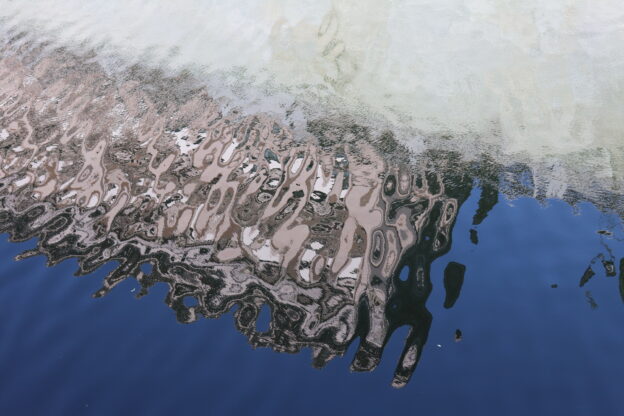
An enigmatic instability… (Photo © Derek Bean)
………………………..
References
Gibson, J. J. (1950) The Perception of the Visual World. Boston: Houghton Mifflin
Heaton, J. M. (1968) The Eye: Phenomenology and Psychology of Function and Disorder. London: Tavistock
Levin, D. M. (1988) ‘The Opening of Vision: Seeing Through the Veil of Tears’. In Hoeller, K. (Ed). (1988) Heidegger and Psychology. Review of Existential Psychology & Psychiatry
Merleau-Ponty, M. (1961) ‘Eye and Mind’. Trans. Dallery, C. In Edie, J. M. (Ed). (1964) The Primacy of Perception and Other Essays. Evanston: Northwestern University Press
Merleau-Ponty, M. (1962) Phenomenology of Perception. Trans. Smith, C. London: Routledge & Kegan Paul
Merleau-Ponty, M. (1968a) ‘The Visible and the Invisible: Philosophical Interrogation’. Trans. Lingis, A. In Lefort, C. (Ed). (1968) The Visible and the Invisible. Evanston: Northwestern University Press
Merleau-Ponty, M. (1968b) ‘Working Notes’. Trans. Lingis, A. In Lefort, C. (Ed). (1968) The Visible and the Invisible. Evanston: Northwestern University Press
………………………….
This paper is a revised and edited version of an article that first appeared in the journal Existential Analysis (24.1).
Get the Full Experience
Read the rest of this article, and view all articles in full from just £10 for 3 months.
No comments yet.