Light of the Flourishing Age
LYU, SHAOFAN is a contemporary artist and Professor at The Fine Arts Academy of Guangzhou, Guangdong, China. His recent monumental public sculpture, ‘Light of the Flourishing Age’, is an excellent example of the current mode of collaborative thinking, development and experimentation combining art, science and technology which is taking place all over China today. His project was the first landscape sculpture directly associated with high-speed trains, known as ‘Gaotie’, in China. In this article, professor and sculptor Billy Lee, discusses the development and creation of this public sculpture.
I am a professor and sculptor who has been working intermittently in China over the past twelve years. The current climate of art in China is not unlike what happened in Europe at the turn of the 20th century, which gave birth to abstraction forever and changing the course of art, design, education and the way we live today. Of course, contemporary technology, speed and communication have since advanced and evolved, but what influenced change, out of necessity, is as evident now as it was then. The development of the industrial revolution gave rise to mass production, new materials, processes, transportation, communications and photography, all of which produced innovative thinking and avant-garde movements, changing architecture, art, design and education. The Bauhaus school, in its ideology of combining art and craft not only elevated the status of art and design principles, but also the way people lived. That was also true with Constructivism, which added engineering, giving art a higher status.
This atmosphere, excitement and energy are now happening again in the 21st century in China. It is one of the few countries which continue to encourage and invest in large-scale constructions of villages, complexes and institutions, emphasizing the importance of art and culture, irrespective of the function of the facilities. Much of this is due to the changing roles of public art. The concepts and technology, under the umbrella of the Metaverse, together with active public interaction through social media, have not only changed the role of art, but also the landscape of public art. Topics are about everyday concerns such as climate and social changes.
Chinese artists are very much aware of and engaged in the milieu of the 21st century change. They explore different fields and avenues using the various concepts and tools of Metaverse, socioeconomic, and technological platforms. LYU, SHAOFAN is a contemporary artist and Professor at The Fine Arts Academy of Guangzhou, Guangdong, China. He received his PhD in Public art and has created unique courses, which have caught the attention not only of the university but also government officials and was rewarded the “Excellence Course” for this master program. What I find interesting about his work is that he not only bridges art and education, but also contemporary issues with traditional Chinese culture. He comes from the strict discipline of Chinese traditional art training, which is an asset, as he explores with great enthusiasm western abstraction and its ideology, guided by his own experience of making art.
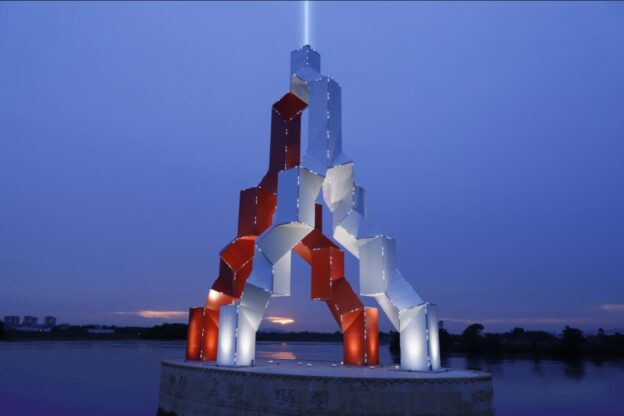
LIGHT OF THE FLOURISHING AGE, Lyu, Shaofan, Height 38m, Night View

Lighting Experiment
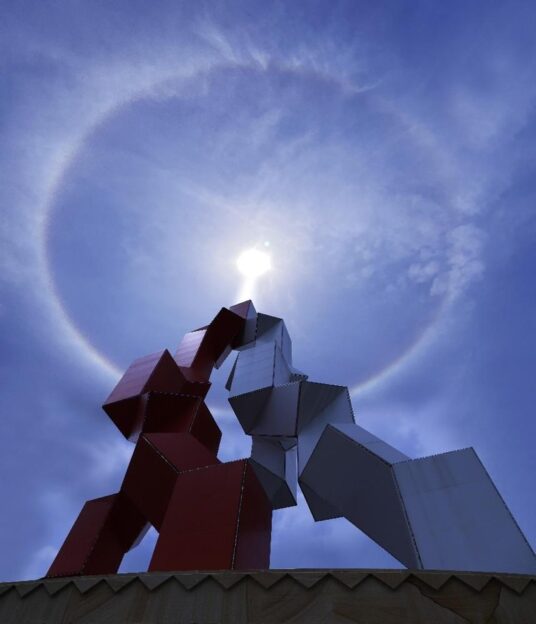
Day-light View with Solar Halo, 30th of April 2021
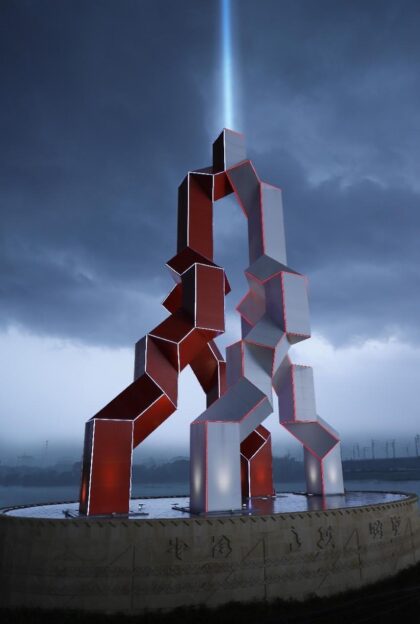
Rain View
His recent monumental public sculpture, Light of the Flourishing Age, is an excellent example of the current mode of collaborative thinking, development and experimentation combining art, science and technology which is taking place all over China today. His project was the first landscape sculpture directly associated with high-speed trains, known as ‘Gaotie’, in China. Lyu invited scientists and engineers to carry out a series of scientific investigations and experiments to determine the best location and scale.
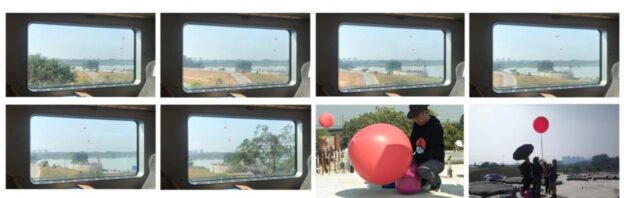
Visual Experiment Series: Route Scenery, High-Speed Training Riding Experiences, Train Speed, Distance Measurements, Time Measurements
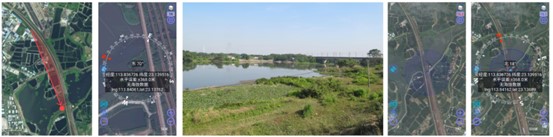
Site Analysis
According to railway regulations, objects are only allowed to be placed no less than 50 meters from the track for safety reasons. Many geological tests were performed excavating 20 meters below ground level in appropriate locations to study the density and compression for load baring. Once approvals for the selected specific sites were given, Lyu’s team began to estimate the scale in relation to time and the surrounding environment. Balloons were used to determine the relationship of height and scale. The parameter of balloon height was set per 25~50 meters, and the visual presentations were then recorded in the train during regular services. From the set of experiments, the best visual presentation was 38-meter, which was used as the final height of the sculpture. Similar tests were performed to estimate the width, using the regular train speed of 300km/h. The optimum of 32-meter maintained at 5 seconds given the window at the passenger’s seat was the most effective. He also used wind tunnels simulations and experiments to assess the vibration and airflow.
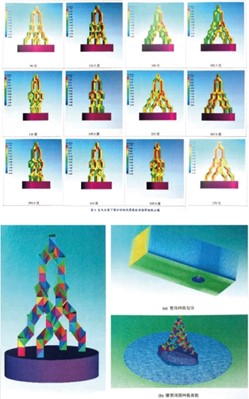
Wind Tunnels Simulations and Experiments
With the prior geological examinations, the sculpture was able to resist category 13 typhoon in a life time of one hundred years. Government departments also organize regular tests and maintenances, i.e., welding, pile foundation inspections, and the lighting system.
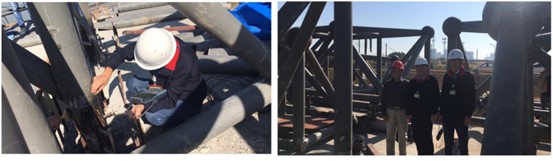
Government Experts Regular Testing and Maintenance
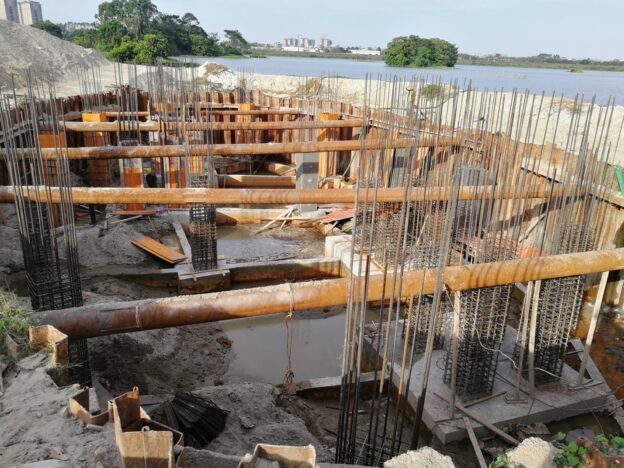
Building of Base during Construction
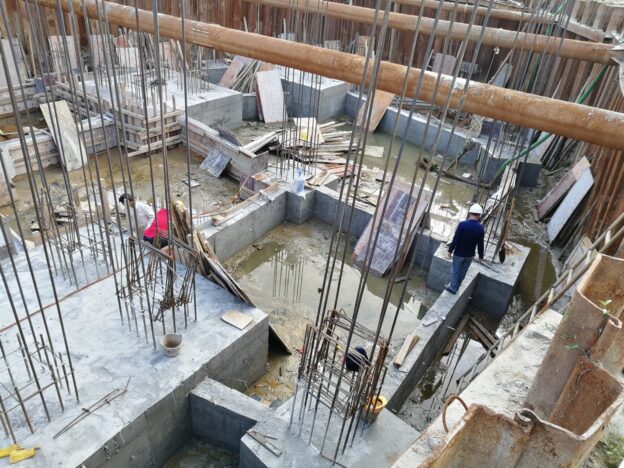
Cushion Cap during Construction
The results of his research had to be presented to relevant government departments, ranging from artistic concept, construction scale, engineering materials, project cost and other aspects of the work. In China, all public art must be approved by the government, supplemented by relevant seminars, repeatedly and rigorously demonstrating scientific, logistical, pragmatic and aesthetic perspectives. Lyu also encouraged his student to participate in all the experiments and dialogues. All the students who participated in this project gained interdisciplinary experiences as well as interaction with technicians and management as they were directly involved throughout the process. The monumental expanse of this project generated individual self-interest, motivation and passion which culminated in extensive in-depth research by the students. This gave them the insight and experience to understand what it takes to make a sculpture of this stature and scale.
Lyu’s work and teaching are very much in line with China’s national development strategy. The sculpture not only reflects contemporary collaboration of art, science and technology, but also with industry and social concerns. This landmark sculpture represents a beacon of light for the people from afar, as well as a local community meeting place, which is an important aspect of Chinese culture. LIGHT OF THE FLOURISHING AGE is a monumental iconic landmark, sited specifically from the distance as a gateway from West Kowloon of Hong Kong to Guangzhou, where the first direct train began its service on the 9th of January 2023. This is much the same way Deng Shao Ping cited Shenzhen in the 70’s as a model city for China’s future.
His sculpture reminds me of the Italian artist Umberto Boccioni, a key figure in the revolutionary aesthetic of the Futurist movement in the early 20th century. The movement embraced the age of technology. Unique Forms of Continuity in Space of 1913, expresses that idea; a figure with the dynamism of speed and the future. Lyu, Shao Fan’s sculpture reflects his vision in this 21st-century. His sculpture is a result of lengthy research, and experimentation, where everything is carefully considered and documented since his client is the Guangshen Railway Company[1] and relevant government departments. Beyond the pragmatic and aesthetic concerns is the bigger picture, the role and purpose of art today. All public art must seek government approval and there are many meetings and justifications that take place over several months.
Like Brancusi’s Endless Column, Lyu understands the concept of scale. When standing under the sculpture, there is a sense of intimacy, such as personal or private space, which is quite different from a distance where the sculpture is seen as a whole within the environment. The space underneath this enormous structure invites people to gathering there, which is an extremely important part of Chinese culture regarding public space. Lyu has calculated the facets of geometric configurations derived from numerous mathematical permutations, to suggest a technological construction of a figure. They appear to have a solid stance, reminiscent of the fundamental immoveable position in Tai Chi, and at the same time fluid and graceful gestures of movement. Your eye moves up and across the varied facets of twisting shapes and proportions of the geometric progressions. He created a wonderful transition from a stable solid position to a playful form of lively movements as the kinetic surface flickers as light and color pass over facets. Most of Lyu Shao Fan’s works use contemporary ideas and technology infused with Chinese culture.
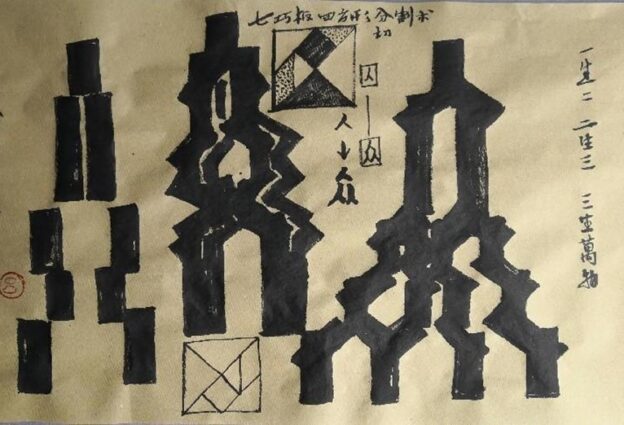
Preliminary Drafting Inspirited from Chinese Culture, the Jigsaw Puzzle Fractal
This was the first landscape project associated with the high speed train in China. The sculpture is very thoughtful and specifically calculated in scale, materials, and concept to pass rigorous scrutiny by the government. What is interesting is that the scale of these projects are continually being built and supported in China. The role of art played this project has shown its potential to public services, and evolved into a new form of paradigm in the society. The concept of these trains are considered to be innovative designs spearheading railway services of high speed trains to another level. The “Gaotie” as it is known is globally recognized and has created a huge export market.
Professor Billy Lee
[1] Guangshen Railway Company: https://www.gsrc.com/
………………………………….
Billy Lee website –
Get the Full Experience
Read the rest of this article, and view all articles in full from just £10 for 3 months.
No comments yet.