From the Quantum to the Infinite
Issue 84 June 2024

Duchamp and Infinity
The art of Marcel Duchamp is notable for its thematic repetition, notably that of Eros. The infinity symbol, ∞, is a more specific throughline, appearing in works by or associated with Duchamp from 1921 onwards. The concept of infinity has three primary applications: the mathematical, the physical, and the metaphysical. With respect to Duchamp, the authors analyse mathematical applications via the Möbius strip and Klein bottle. They investigate physical manifestations of infinity via Duchamp’s La Bagarre d’Austerlitz (1921) and Anémic Cinéma (1926). The infinity symbols in a diagram representing Adam and Eve developed with Georges Bataille, published in Duchamp’s satirical journal ‘Mémento Universel Da Costa’ (1949), serve to clarify metaphysical aspects. For Marcel Duchamp, creativity was Erotism, a psychological and spiritual quest for continuity, infinity.

From the Quantum to the Infinite
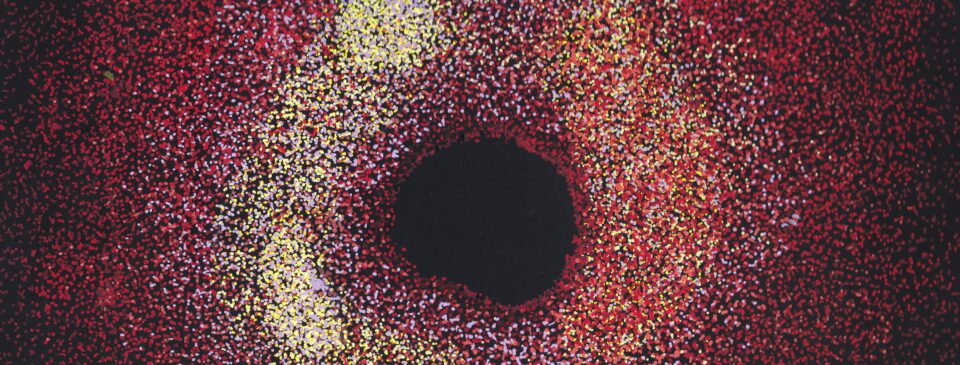
Jody Rasch is a New York City area-based artist whose work is based on themes from astronomy, biology, physics and spectra. The artist has been exhibiting his work nationally for over 25 years. Duality–abstraction and representation, the literal and the metaphorical, science and mysticism, the unseen and the seen–is a predominant theme in Rasch’s work.
“These pieces, based on electron microscopy, particle accelerators, and radio astronomy are an expression of both the patterns of the natural world and the metaphors underlying modern science. They allow us to see the beauty in the repulsive, to find knowledge in the unknown, to observe the unseen to more clearly see our world.”

Exploring Oneness
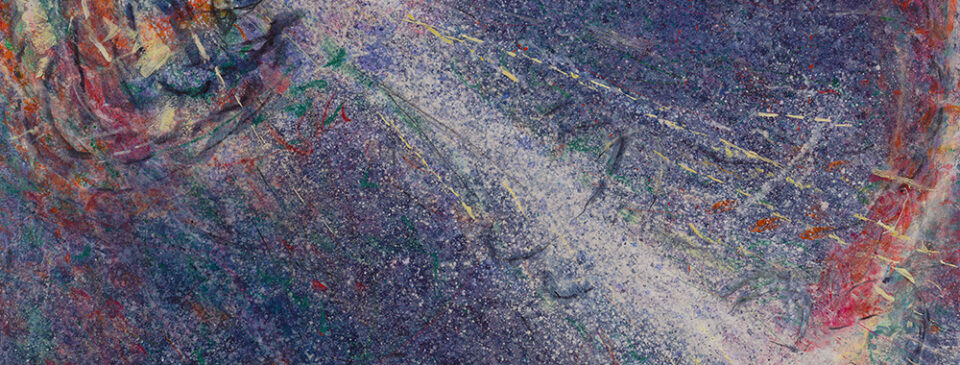
Sandra Lerner’s work celebrates the creative process of life in a universe that is constantly in flux. She explores the similarities between cosmology and Eastern philosophy, as well as the intersection of art and science.
“My most recent Cosmic paintings interweave the latest theories in astrophysics with the intuitive mysticism of Taoist philosophy, where the universe is seen as an inseparable reality, and in which there is an interrelationship of all things. My exploration of the fabric of the universe, its ever-changing patterns, give rise to and parallels my own creative development. I conceive my art as a spiritual, psychological, and philosophical journey.”

Visualizations of Energy
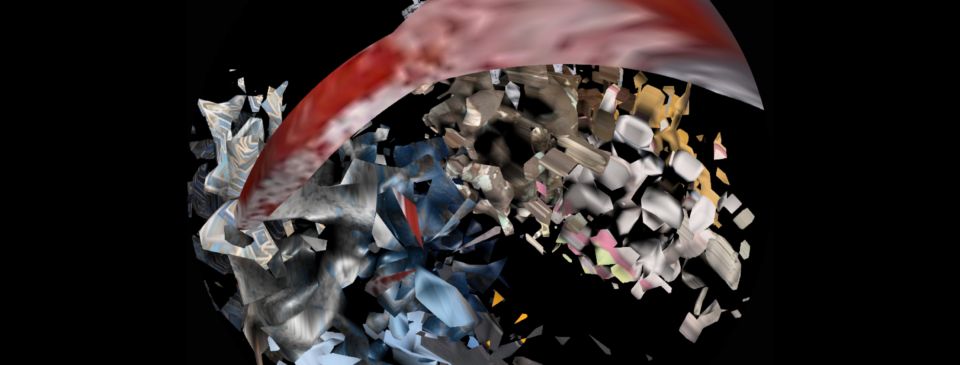
Carter Hodgkin fuses art, science and technology to explore a new language of abstraction through paintings, animations and large-scale mosaics. Approaching the modification of code as a drawing tool, she generates atomic particle collisions to create animated forms, which visualize energy. Her working process is an interplay between digital means woven into traditional media with an emphasis on the hand. She utilizes a range of media from animation and programming to drawings, paintings and large-scale mosaics.

From the mystery and majesty of the universe and beyond
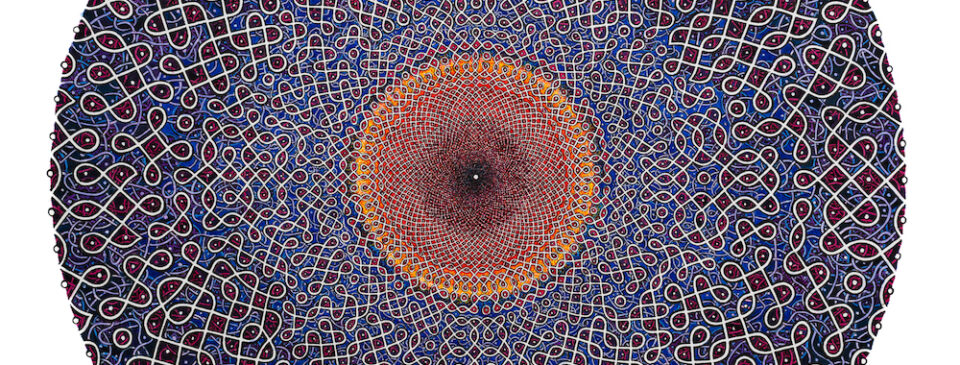
Shanthi Chandrasekar is a multimedia and multidisciplinary artist from Maryland, USA, who has an academic background in physics and psychology, and has been trained in the traditional Indian art forms of Kolam and Tanjore-style painting. While many of her works are influenced by her Indian heritage, her true inspiration comes from the mystery and majesty of the world around her; her muse lives where the scientific overlaps with the spiritual.
Making the invisible visible
Paul Thomas is an Honorary Professor in Fine Art at UNSW Art and Design. He is a pioneer of transdisciplinary art practice. His practice-led research takes not only inspiration from nanoscience and quantum theory but actually operates there.
“This article discusses my research-led artwork, which visually expresses the atomistic world aiming to demonstrate the complexity of making the invisible visible.”

Exploring the Intersection of Art and Science: Brainlight
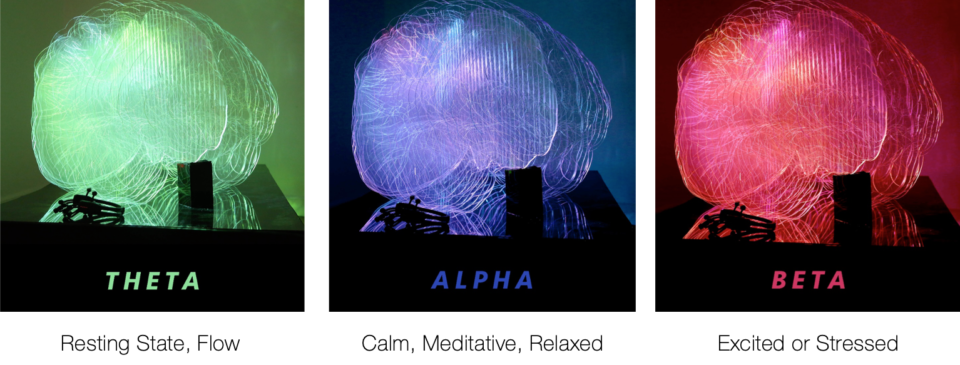
Laura Jade is a contemporary Australian artist exploring how BCI technologies can offer new forms of expression to interface with the mind aesthetically. She is the creator of Brainlight, an artwork that integrates biology, lighting design and BCI (brain-computer interface) technology into an interactive brain sculpture, lasercut from transparent perspex and engraved with neural networks. The installation is controlled with a wireless EMOTIV EPOC+ EEG headset which detects and outputs live neural activity, translating electrical signals from the user’s brain, into a vivid and dynamic light display within the brain sculpture. In real-time Brainlight visualises the brain frequencies of theta (3.5–7.5 Hz) as green light, alpha (7.5–13 Hz), as blue light and beta (16–32 Hz) as red light.

Pathways
Artist and writer, Richard Bright, has addressed the relationship between art, science and consciousness for over 40 years. He studied Fine Art and Physics before founding The Interalia Centre in 1990. Since then, he has lectured extensively on art and science and written articles on James Turrell, Andy Goldsworthy and Susan Derges, among others. He has exhibited both nationally and internationally and was the recipient of the ‘Visions of Science’ Award, The Edge, Andrew Brownsward Gallery, University of Bath (Second Prize Winner). Co-author of ‘The Art of Science’ (Welbeck Publishers, 2021).

We mapped a massive explosion in space, showing how galaxies ‘pollute’ the cosmos
Adam B. Watts is a Research Associate at the International Centre for Radio Astronomy Research (ICRAR), working from the University of Western Australia node. His research uses observations from the world’s largest telescopes, which span the entire electromagnetic spectrum, to understand the star formation process in galaxies.

Could you move from your biological body to a computer? An expert explains ‘mind uploading’
Clas Weber is a Senior Lecturer in Philosophy at the University of Western Australia. He currently holds a 3-year fellowship for Early Career Researcher (DECRA) from the Australian Research Council. He works in the philosophy of language, philosophy of mind, and metaphysics.
Peter Higgs’ famous particle discovery is now at the heart of strategies to unlock the secrets of the universe
Martin Bauer is Associate Professor of Physics, Durham University.
“My research is in theoretical particle physics with a focus on phenomenology. I have worked on Higgs physics, dark matter, flavour physics and on the detection of new light particles with colliders and quantum sensors.”

Quantum dots are part of a revolution in engineering atoms in useful ways – Nobel Prize for chemistry recognizes the power of nanotechnology
Andrew Maynard is a scientist, author, Professor of Advanced Technology Transitions, and Director of the Future of Being Human initiative at Arizona State University. His most recent books include Films from the Future: The Technology and Morality of Sci-Fi Movies, and Future Rising: A Journey from the Past to the Edge of Tomorrow.
Dr. Maynard is an elected Fellow of the American Association for the Advancement of Science, serves as co-chair of the Institute for the Advancement of Nutrition and Food Science (IAFNS) Board of Trustees, is a member of the Canadian Institute for Advanced Research President’s Research Council, has served on a number of National Academies of Sciences committees, and has testified before congressional committees on several occasions. Trained as a physicist, his work cuts across disciplinary boundaries as it focuses on the ethical and socially responsible development and use of new technologies.