Emerging Ideas
Molly Macleod: We Are All Carbon
Molly Macleod is a multidisciplinary artist exploring scientific concepts through collaborative projects with researchers and scientists. Through poetic interpretation and distilling meaning via her use of unconventional, signifying materials, her artwork invites intimate and philosophical engagement combined with accessible simplicity and a minimalist aesthetic. Locating her practice within the liminal space between art and science she employs the scientific method to examine and question cultural phenomena.
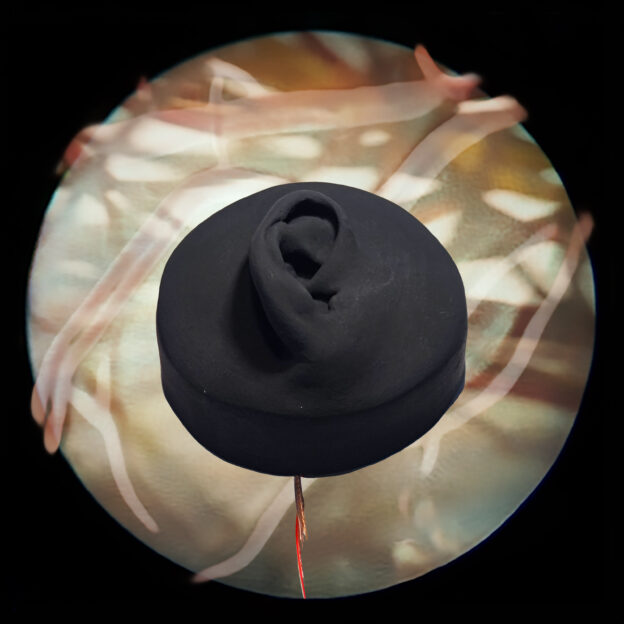
Can the waste materials we shed from our bodies become a part of our technological future?
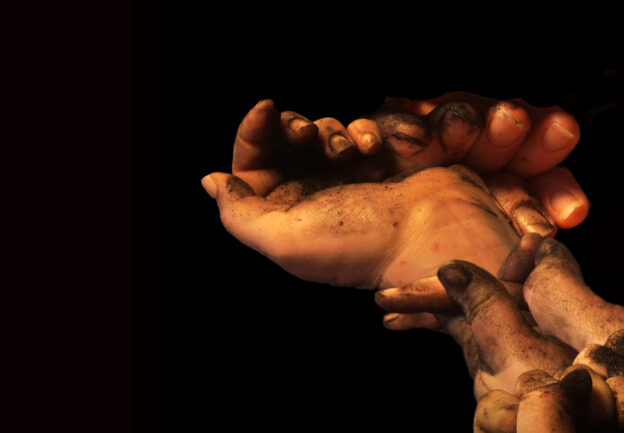
For We Are All Carbon, my own biological matter is repurposed to amplify sound. One year’s worth of hair and nails, shed and collected, are cremated to form carbon granules. Vibrations passing through these granules create a transducer that converts electrical signals into sound. Through the past year of restricted access my focus has turned inward, unable to collaborate tangibly with others my own body became my site of practice, amplifying my voice through my own recycled biomaterial. Exploring the significance of connecting our physicality to the intangible nature of recorded sound. Can technology derived from our own organic matter blur the lines between us and machines? Do these materials reveal our individuality or similarities?
We Are All Carbon is presented as an evolving sonic intervention, as transient as the shifting organic matter that forms our individual anatomies. Exhibited recently at Asylum Chapel and Safehouses 1&2 in Peckham, London as a durational performance, I developed an amplification system that attaches to my body as an extension of myself to broadcast my voice throughout the exhibition, showcasing the texture and tone achieved from the carbon microphone I have developed, blurring the lines between a live scientific demonstration and an improvised performance.
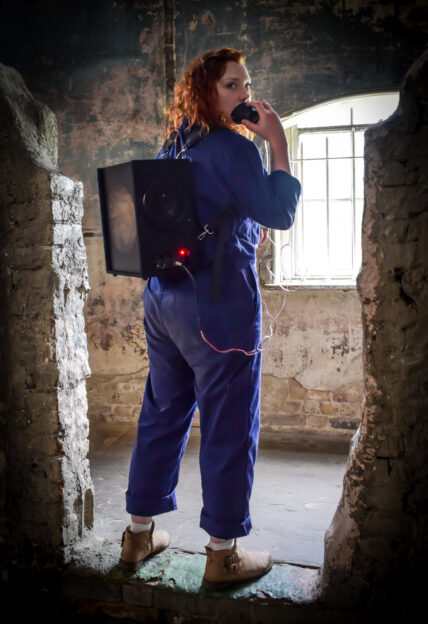
I’m curious about how we interact with personal technology, that has become almost constantly attached and chained to our physical selves through phones and laptops. I wanted to consider the idea that technology could be physically linked to us and ask does materiality play any role in our treatment of these objects? If you knew your technology was once a literal part of you, would you be comfortable upgrading it and throwing the old one away, or do our bodily materials lose all connection to us and meaning once the leave our bodies?
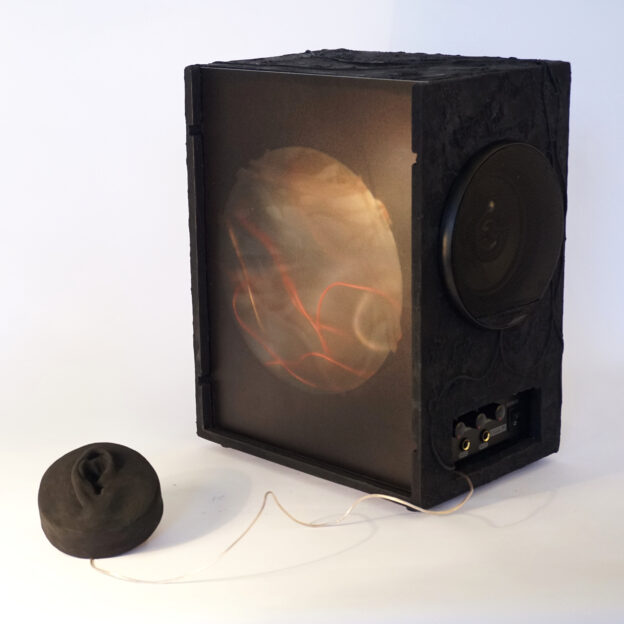
I wanted to examine the evolution of technology, my research into the inception of sound amplification and recording led me to the concept of the carbon microphone, which is the first ever type of microphone invented, and I wanted to take sound technology right back to the beginning, examining the cultural and societal concepts of the time that might have influenced the design and continuing evolutionary path of this technology. Early microphones were designed to pick up mostly male voices and their inability to accurately reproduce female voices was seen at the time as a biological flaw of the female voice, not as an issue with the design of the technology and this left me wondering; what if I could take that technology right back to the beginning and try again, where would it evolve to from there? What other types of technology have been initially designed to be so un-inclusive and how has this effected their evolution too?
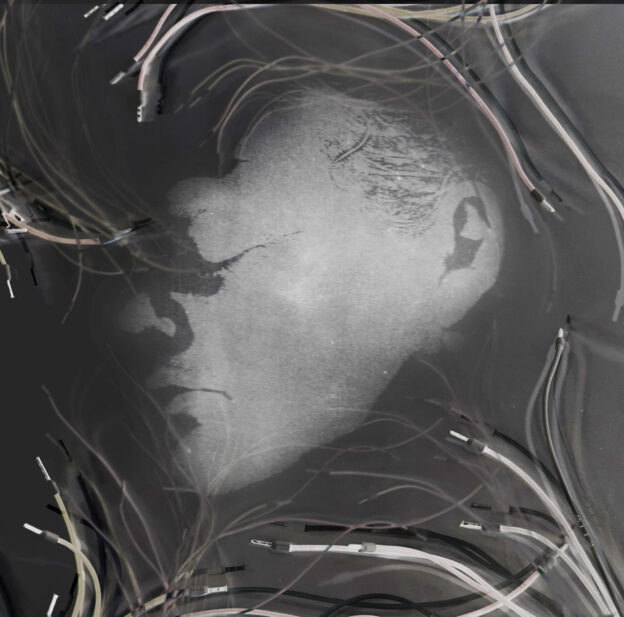
Through choosing a symbolic material such as Carbon, a word that is now used as a measuring stick for morality by what it symbolises in relation to climate change and our personal responsibility with regards to our carbon emissions or ‘footprint’, I wanted to address the futility of vilifying an element in this way. Is this vilification a convenient way of disconnecting ourselves from the source of the problem, every type of matter or chemical is dangerous if we as humans choose to do something dangerous with it, or is the simplicity of ‘good v’s evil’ required to engage such a large and varied number of people with a complicated and multifaceted global issue. We are all fundamentally carbon lifeforms and perhaps there is more power in connecting complicated environmental issues to the visceral physicality of the human body, we all inhabit a body, it’s an experience that unifies us but conversely it is also represents the vast range of individual human experiences and this duality could act as a vehicle for global empathy and compassion.
…………………………………………
Artist Bio/Statement –
Molly Macleod is a multidisciplinary artist exploring scientific concepts through collaborative projects with researchers and scientists. Through poetic interpretation and distilling meaning via her use of unconventional, signifying materials, her artwork invites intimate and philosophical engagement combined with accessible simplicity and a minimalist aesthetic. Locating her practice within the liminal space between art and science she employs the scientific method to examine and question cultural phenomena.
Molly has grown crystals that hear sounds, cultured the microbial imprint of TATE Modern visitors, formed pigment from her own skin, created a microphone out of carbon from her own body, revealed the sonic world from within trees and walked new paths formed by the patterns of her own veins.
She is currently collaborating with researchers at UCL’s WEISS centre and was recently included as the featured artist in I.science magazine published by London Imperial college. Having just completed an MA in Art & Science at Central Saint Martins university her project We Are All Carbon has been shortlisted for the MullenLowe NOVA award.
Website www.mollymacleod.com
Instagram @mollymacleodstudio
Get the Full Experience
Subscribe today and view all issues in full from just £10 for 3 months.
Comments are closed.