Tag Archives: Photography

People-Identities

Alexa Wright is London-based artist working across a range of media including photography, video, interactive installation and book works. She has worked at the intersection of art and medical science since the late-1990s and often works with people with mental and physical differences to make works that address questions of human identity and otherness through qualities like vulnerability and empathy. She has been involved in several long term inter-disciplinary collaborations, for example with Alf Linney, Professor of Medical Physics and computer scientists at UCL (1999-2010) and Hybrid Bodies, a unique international, interdisciplinary project based in Toronto, Canada that brought together medics, visual artists, a philosopher and social scientists to explore the emotional and psychological effects of heart transplantation (2007-19).

A quantum hack for microscopes can reveal the undiscovered details of life

Warwick Bowen is Professor of Quantum and Precision Technologies, The University of Queensland. He earned a PhD in experimental physics from the Australian National University in 2004 for his work on quantum information technologies. He is currently a professor of physics at the University of Queensland. His research interests center on the development of precise measurement techniques based on quantum science, and their application in areas such as biological imaging, precision metrology, and advanced sensing. Prof Bowen leads the University of Queensland Quantum Optics Laboratory, is Director of the University Precision Sensing Initiative, and is a Theme Leader of the ARC Centre of Excellence for Engineered Quantum Systems. He is also a founder and Director of Elemental Instruments, a company that develops, manufacturers and sells precision scientific instrumentation.

A thread of the cosmic web: astronomers spot a 50 million light-year galactic filament

Ray Norris is a British/Australian astronomer in the School of Science at Western Sydney University, and with CSIRO Astronomy & Space Science. He researches how galaxies formed and evolved after the Big Bang, and the process of astronomical discovery with large data volumes. He also researches the astronomy of Australian Aboriginal people.
Ray was educated at Cambridge University, UK, and moved to Australia in 1983 to join CSIRO, where he became Head of Astrophysics in 1994, and then Australia Telescope Deputy Director, and Director of the Australian Astronomy MNRF, before returning in 2005 to active research.
He currently leads an international project – the Evolutionary Map of the Universe – to image the faintest radio galaxies in the Universe, using the new ASKAP radio telescope recently completed in Western Australia. He also leads the WTF project which is exploring machine learning techniques to discover the unexpected.
He frequently appears on radio and TV, and has published a novel, Graven Images.

Martha Gray: BioCyan

Martha Gray is a London based artist and curator, who has worked with alternative processes for the past seven years. Gray’s practice explores personal relationships to the ‘natural’ through experimental photographic processes, with ongoing research into the use of cyanotype as a contemporary method.

The Art of Science

‘The Art of Science’ explores the work of 40 artists and artist–scientists, from different cultures and eras, uncovering how these innovators have designed futuristic technology centuries ahead of its time, investigated time and space through abstract art, and created sculpture informed by Nasa technology.

‘The Art of Science’ explores topics such as: Climate breakdown and conservation ; Deep space and cosmic archaeology ; How media is used to communicate ideas relating to science ; Exploring being human alongside biotechnology ; and AI and Neural Networks.

How photography evolved from science to art

Nancy Locke is Associate Professor of Art History, Penn State. Dr. Locke teaches courses in European art, ca. 1780–1940, and the history of photography from its inception to the present. She is the author of Manet and the Family Romance (Princeton University Press, 2001), as well as articles in such journals as Art Bulletin, Burlington Magazine, and Nineteenth-Century Art Worldwide; furthermore, she has published chapters in edited volumes on such topics as fascism and art in France and Italy, and the representation of childhood in the nineteenth century. Recent essays on Manet, “The Social Character of Manet’s Art,” in the exhibition catalogue Manet, l’inventeur du moderne (Musée d’Orsay, Paris, 2011), and “Manet and the Ethics of Realism,” in Perspectives on Manet (ed. Therese Dolan, Ashgate, 2012), propose that Manet was above all an artist concerned with giving form to the social questions and ethical dilemmas of modern life.
Brain Terrains

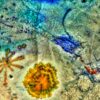
Hanif Janmohamed is an artist based in Vancouver, Canada. His practice is focused on the Geographies of the Mind. ‘Brain Terrains’ is an ongoing body of work. A wandering, quixotic expedition through the common visual lexicons of our human and planetary bodies – a reframe of our inhabitation across scale through recombined medical and satellite imaging.

Neuroscience in pictures: the best images of the year

Wei Luan is a Postdoctoral Researcher, The University of Queensland. His current research studies how the dopamine neuronal system is affected in schizophrenia from the beginning of embryonic brain development.

Merja Joensuu is a Postdoctoral Research Fellow at The Single Molecule Neuroscience Lab, The University of Queensland, lead by Prof Frederic A Meunier. The overall aim of research is to study how neurons communicate in health and disease by using super-resolution microscopy techniques.

Ravi Kiran Kasula is a PhD Student, The University of Queensland.

Our obsession with taking photos is changing how we remember the past

“Human memory represents my main research interest, and more specifically I study how personal memories are remembered in normal people and in those whose ability to remember is exceptional. I believe in disseminating the results of research to the larger public. My work on memory has been featured in newspapers and magazines in the UK (among many, The Sunday Times) and around the world (among many,The Washington Post). I enjoy collaborations with artists (see the False Memory Archive; The Not Knowns theatre project, both funded by the Wellcome Trust).”

Giuliana Mazzoni is Professor of Psychology, University of Hull.