Tag Archives: Mathematics

Why does nature create patterns? A physicist explains the processes behind crystals, stripes and basalt columns

Maxim Lavrentovich is Assistant Professor of Theoretical Biophysics, University of Tennessee, working on theoretical problems in biophysics and soft condensed matter physics.

“Before moving to UT, I worked for three years as a postdoctoral researcher at the University of Pennsylvania in the Soft Condensed Matter Theory group. I was a graduate student at Harvard University from 2008 to 2014, working under the supervision of David R. Nelson. I received a B. A. in Physics and Mathematics from Kenyon College in 2008.”

Fractal patterns in nature and art are aesthetically pleasing and stress-reducing

Richard Taylor is an expert in chaos theory, fractals, and the relationship between art and science. At the University of Oregon, he is a professor of physics, psychology and art, and the director of the Materials Science Institute. Richard’s research focuses on “bioinspiration” in which artificial systems benefit from using nature’s patterns (fractals and chaos). His two biggest projects are 1) using bio-inspired retinal implants to restore vision to victims of retinal diseases and 2) using bio-inspired fractal images to reduce people’s stress levels. He also uses computer analysis to study and authenticate art works. Richard is considered the leading expert on the artist Jackson Pollock.

Nothing matters: how the invention of zero helped create modern mathematics

Ittay Weiss is a Senior Lecturer in Mathematics at the University of Portsmouth where he has been working since 2016. His research interests are in topology, homotopy theory, metric geometry, and category theory. He is particularly drawn to practical abstractions with an algebraic flavour, as he is working on solving problems by employing categorical techniques and point-of-view. Other than these research topics, he is interested in broad aspects of mathematics, its interactions with society, and the history of mathematics.

The art and beauty of general relativity

Margaret Wertheim is Vice-Chancellor’s Fellow in Science Communication, The University of Melbourne. She is an internationally noted writer and exhibition curator whose work focuses on relations between science and the wider cultural landscape. The author of six books, including ‘The Pearly Gates of Cyberspace,’ a groundbreaking exploration of the history of Western concepts of space from Dante to the Internet.

Wertheim is the founder and director of the Institute For Figuring, a Los Angeles-based organization devoted to the aesthetic and poetic dimensions of mathematics and science. (www.theiff.org) Through the IFF, she has designed exhibitions for galleries and museums in a dozen countries, including the Hayward Gallery in London and the Smithsonian’s National Museum of Natural History in Washington D.C. The IFF’s “Crochet Coral Reef” project – spearheaded by Margaret and twin sister Christine – is the largest participatory science-and-art endeavor in the world, and has been shown at the Andy Warhol Museum (Pittsburgh), the Science Gallery (Dublin), New York University Abu Dhabi, and elsewhere. Through an unlikely conjunction of handicraft and geometry, the Crochet Coral Reef offers a window into mathematics while addressing the issue of reef degradation due to global warming. Wertheim’s TED talk on the topic has been viewed more than a million times, and translated into 20 languages, including Arabic.
Topology and the Visualization of Space

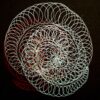
Artist and author, Tony Robbin, works with painting, sculpture and computer visualizations. He is a pioneer in the computer visualization of four-dimensional geometry. With his paintings and innovative computer visualizations of hyperspace, he continues to investigate different models of the fourth dimension and how these are applied in art and physics.

We may just have solved the great mystery of why drops splash

“I am interested in the flow of liquids and gases at very small scales (so-called microfluidics) where experimental analysis is often impossible. Using mathematical modelling and computational simulation can then provides unique insight into such flows.
Much of my research has concerned the dynamics of liquid drops – how they merge, form and interact with solid surfaces (do they splash?).”

James Sprittles is Assistant Professor in Mathematics, University of Warwick.

The Maths of Life and Death

Dr Kit Yates is a Senior Lecturer in mathematical biology at the University of Bath. His job consists of taking real-world phenomena and uncovering the mathematical truths that lie behind them. He extracts the common patterns that underlie these processes and communicates them. He works in applications as diverse as embryonic disease, the patterns on eggshells and the devastating swarming of locust plagues – teasing out the mathematical connections in the process.

On Dark Matter and Dark Energy

Brian Clegg is an English science writer. He is the author of popular science books on topics including light, infinity, quantum entanglement and surviving the impact of climate change, and biographies of Roger Bacon and Eadweard Muybridge. In this exclusive interview he discusses ideas relating to his latest book, ‘Dark Matter & Dark Energy: The Hidden 95% of the Universe’.