Landscapes of the Mind
Issue 75 February 2023
Vital Signs
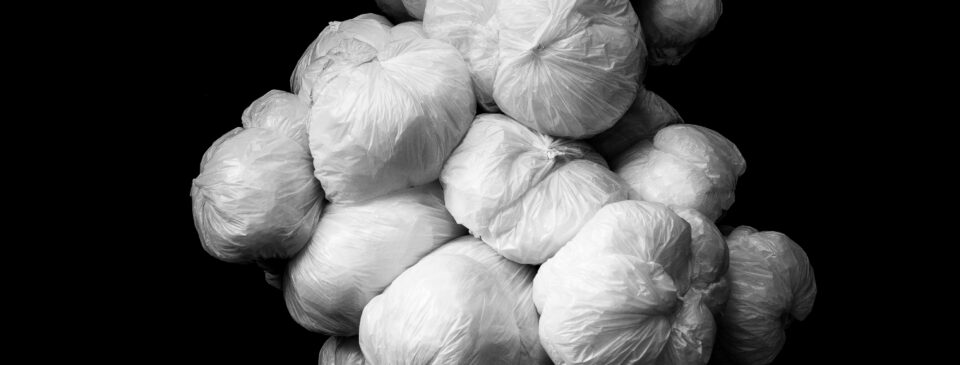
Judith Alder is a British visual artist with a multi-faceted practice, working across a range of media and processes. Central to her work is a fascination with biology, physics and the history of scientific endeavour and science fiction. Alder is interested in how an understanding of life, its origins and evolution can help us think about the future of our rapidly changing world. She sees her work as a means of exploring and communicating complex ideas. In her latest show, ‘Vital Signs’, she assembles a body of interconnected works grounded in research and inspired by accessible science communicators and visionary writers like HG Wells, Primo Levi, Kazuo Ishiguro and Stanislaw Lem.

Unlocking a shift in perspective: The secret is hidden deep within the folds of our brains
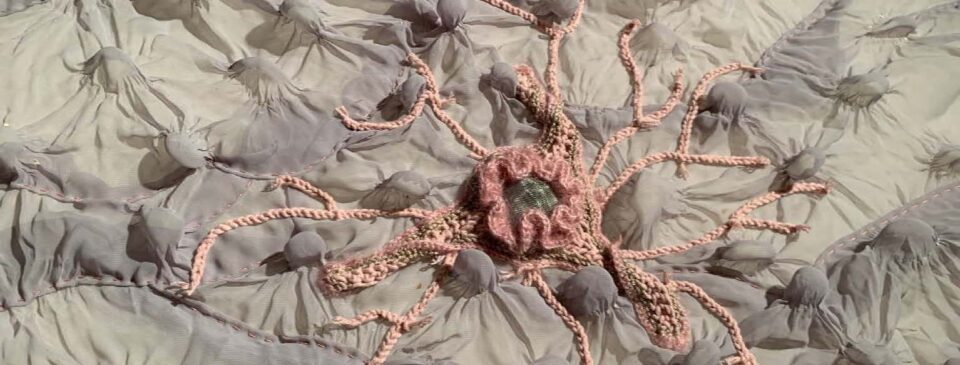
‘Hidden in the Folds’ is an interactive, textile exhibition by Chrys Zantis that explores the mystery and complexity of our brains and different perspectives of (un)conscious experiences. The works extend on current neuroscience research–conveying the internal workings of our brains.
Cutting edge brain scanning technology inspired many of the works, such as two elaborate headdresses using electro-encephalography (EEG) caps, and large textile sculptures where thoughts flutter like birds among silky folds of grey matter.
The topology of landscapes tells of the lifelong journey we undertake toward self-awareness, while an expansive murmuration of Australian Budgerigars becomes a metaphor for consciousness.

Lise Autogena & Joshua Portway – Foghorn Requiem
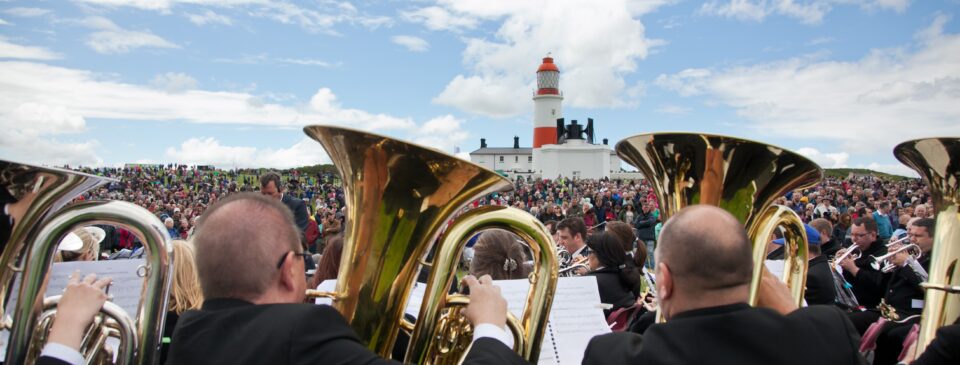
Lise Autogena and Joshua Portway have worked together since the early 1990’s, developing large scale performances, multimedia installations and site-specific work, usually in collaboration with organizations and experts across many specialized fields. In 2013 they developed ‘Foghorn Requiem’, a requiem for disappearing sound, performed by the Souter Lighthouse foghorn, three brass bands and fifty ships out in the North Sea. In this interview with art and ecology author, John K. Grande, they discuss this work as well as their other projects.

Planet of Dreams
Cecelia Chapman is a San Francisco-born artist living in Portugal. Her work revolves around video, essay, storytelling, and works on paper and merges the documentary and experimental. ‘Planet of Dreams 2022’, follows a personal dream journey across continent and through time, observing how dream guides us. Planet of Dreams asks ‘in what ways can the dream state guide us?’
Visual Art and the Veracity of Touch
Taney Roniger is a visual artist, writer, and educator based in New York. Since the late 90s she has been exploring the relationship between art, science, and the spirituality of immanence in both her work as an artist and in numerous essays and symposia.
Landscapes of the Mind
An artist with a deep sense of working with the ‘poetic imagination’, Helen Garrett discusses her work and the ‘dialogue’ she has with her work during its creation. Her interest lies in the multi-dimensional nature of consciousness, with paintings evolving and developing as different images emerge. Helen’s career has spanned many areas of study and experience including working with Somatic intelligence and leadership embodiment practitioners, mental health service providers, Art therapists, university students, schools, and museums, with diverse groups of people and within a variety of community settings. She delivers workshops for the public working with diverse groups of people and bringing an original approach, using Art, Music and often Poetry to focus attention and open dialogue.
Light of the Flourishing Age
LYU, SHAOFAN is a contemporary artist and Professor at The Fine Arts Academy of Guangzhou, Guangdong, China. His recent monumental public sculpture, ‘Light of the Flourishing Age’, is an excellent example of the current mode of collaborative thinking, development and experimentation combining art, science and technology which is taking place all over China today. His project was the first landscape sculpture directly associated with high-speed trains, known as ‘Gaotie’, in China. In this article, professor and sculptor Billy Lee, discusses the development and creation of this public sculpture.
Poems
Lynne Goldsmith’s first poetry collection, ‘Secondary Cicatrices’, won seven honors. ‘By Light and Hidden Matter’ is her latest poetry collection. Two of her children’s picture books each won an honor and two of her photos in the 2022 Nature Conservancy International Photography Contest of over 100,000 entries were picked as judges’ “Favorites” (nonwinning) in the climate and plants/fungi categories. Lynne also has another photo published with Tiny Seed Literary Journal that’s soon to be published in their upcoming book anthology.
Reading Two Books
Florian Coulmas is Professor of Japanese Society and Sociolinguistics at the IN-EAST Institute of East Asian Studies at Duisburg-Essen University. He has published numerous books, including ‘An Introduction to Multilingualism’ (OUP, 2017) and ‘Writing and Society: A Introduction’ (Cambridge University Press, 2013). In 2016, he was awarded the Meyer-Struckmann-Prize for Research in Arts and Social Sciences. For the past three decades he has served as Associate Editor of the ‘International Journal of the Sociology of Languages’, during which time he has observed the steadily increasing use of the concept of identity in both general and scholarly publications. His latest publication, ‘Identity: A Very Short Introduction’, was published in February 2019.

Where are memories stored in the brain? New research suggests they may be in the connections between your brain cells
Don Arnold is Professor of Biological Sciences and Biomedical Engineering, USC Dornsife College of Letters, Arts and Sciences. He studies how information is encoded in synapses. Modifying the network of synaptic connections between neurons is thought to be the main mechanism for storing information in the brain.
“The Arnold laboratory has developed novel recombinant probes known as FingRs that allow us to visualize and ablate synaptic connections in living organisms. We are using this technology to study how synapses change when a memory is formed in a behaving animal. We are also adapting this technology to enable the modification or erasure of memories in vivo through the ablation of synapses in a light-dependent manner. We are particularly interested in the mechanisms by which maladaptive memories, such as associative memories that can lead to PTSD or addiction, are formed. Ultimately, our goal is to use our technology to erase or modify such memories.”

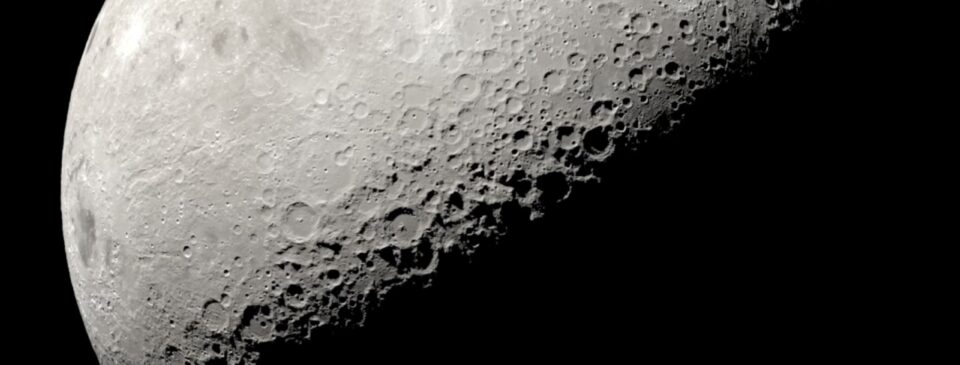
Looking back from beyond the Moon: how views from space have changed the way we see Earth
Dr Alice Gorman is an internationally recognised leader in the field of space archaeology. She is an Associate Professor in the College of Humanities, Arts and Social Sciences at Flinders University, where she teaches the Archaeology of Modern Society.
Her research focuses on the archaeology and heritage of space exploration, including space junk, planetary landing sites, off-earth mining, rocket launch pads and antennas.
She is a member of the American Institute of Aeronautics and Astronautics, the Advisory Council of the Space Industry Association of Australia and the Australian Institute of Aboriginal and Torres Strait Islander Studies.
Her book ‘Dr Space Junk vs the Universe: Archaeology and the Future’ (2019) won the Mark and Evette Moran NIB People’s Choice Award for Non-Fiction and the John Mulvaney Book Prize, awarded by the Australian Archaeological Association. It was also shortlisted for the Queensland Premier’s Literary Awards, the NSW Premier’s Literary Awards, and the Adelaide Festival Literary Awards.

Eye movement science is helping us learn about how we think
Szonya Durant is a Senior Lecturer of Psychology, Royal Holloway University of London and Director of the Virtual Reality Lab, joint between Psychology, Computer Science and Electronic Engineering at Royal Holloway University of London.
“My research is focused on human visual perception and attention, using eye tracking, fMRI, EEG, virtual reality and computational modelling. My background is interdisciplinary training in Mathematics in areas of Biology for my PhD, which resulted in my work on empirical and computational investigations of space and time representation in humans. My recent work is concerned mainly with spatial exploration and representation in 3D space. This has included projects on attention guidance in 360 degrees with tech production companies. I have recently received funding for a project using eye tracking combined with agents to guide attention in multi-tasking situations. I have recently supervised PhD projects on the use of depth if field to guide attention, using eye tracking data from social media to predict personality and situation awareness in remote operators. I am also working on the biological mechanisms involved in combining eye and head movements in 360 degree visual search.”

Les Murray said his autism shaped his poetry – his late poems offer insights into his creative process
Amanda Tink is a PhD candidate at Western Sydney University’s Writing and Society Research Centre, researching Australian disabled authors. Her chapter, “‘If You’re Different Are You the Same?’: The Nazi Genocide of Disabled People and Les Murray’s Fredy Neptune”, in Genocide Perspectives VI, was shortlisted for the nonfiction category of the 2021 Woollahra Digital Literary Award. With Dr Jessica White, she recently co-edited a special issue of Australian Literary Studies titled “Writing Disability in Australia”.