On ‘Liquid Reflections’
In 1958, talented and fearless and eighteen years old, Liliane Lijn left her family home and moved to Paris alone to become an artist. Once there, she found an art world filled with the wild energy of creative revolution – peopled and controlled almost entirely by men. Based on personal diaries from the time, ‘Liquid Reflections’ is her memoir of these years of experiment and adventure. A revelatory account of a singular coming of age: a glittering portrait of the artist as a young woman. In this interview with Richard Bright, she discusses ‘Liquid Reflections’, revealing her experiences in an era when sexism was the norm.
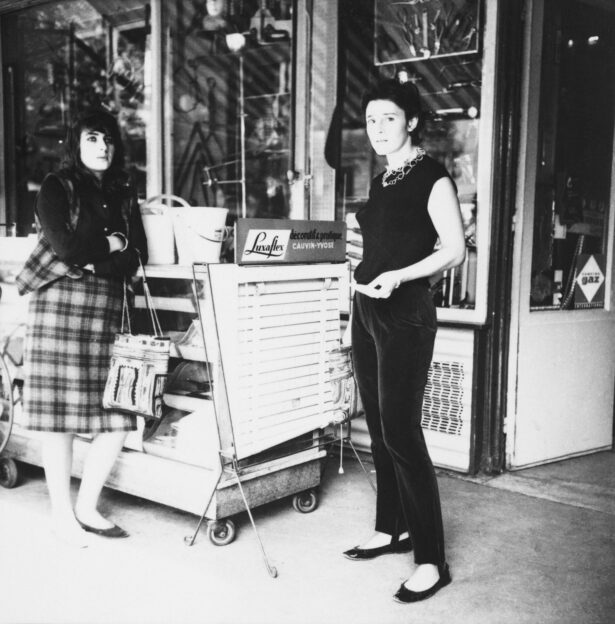
Liliane Lijn (right) with Nazli Nour, Paris 1962 (photo Jean-Loup Charmet)
Richard Bright: A family friend, when asked by your father his advice on your desire to become an artist, remarked “For a woman, this is no career. What does she want to be an artist for?” What was your reaction to this?
Liliane Lijn: The whole scene was at once hilarious and humiliating. My father’s attitude towards me must come across in what I have written in Liquid Reflections: protective, possessive, generous and overwhelming. My reaction was very complex towards my father. He thought I needed to hear the opinion of Mané Katz, whose total male chauvinism and patronising attitude was infuriating but, although sitting there between these two men made me feel like a passive lump of flesh, I couldn’t take his opinion seriously. Mané was always for me the strange little man who visited my family when my brother and I were children. Mané would trick us with obvious sleights of hand. My reaction to his advice was to ignore it.
RB: At 18, you had left Switzerland for Paris to study archaeology at the Sorbonne and art history at the Ecole du Louvre. This lasted six months. Instead of formal training you devised your own programme of learning, immersing yourself in artistic environment of Paris. Why was this move important to you?
LL: I am not sure I understand your question. Do you mean leaving the Liceo before my maturitá, spending the next 4 months studying by myself for 3 A levels and receiving them, moving to Paris? Or leaving the archaeological studies to concentrate on making art? I will try to answer both.
I had stopped attending school in Lugano in the autumn of 1957, after my visit to Venice to see my old schoolfriend Nina Thoeren, who lived there with her mother, the surrealist painter Manina. That summer, I had met Tomeo, a pianist but also the son of luxury hotel owners in Mayorca. I had met this much older, more sophisticated man during a holiday stay at one of his hotels and begun a friendship that later blossomed into a love affair. Nina painted; she was determined to go to Paris to study art. Those few days in October 1958 I spent with her changed the direction of my life.
I realised that I was most myself when making art, drawing, painting, working with clay. I had started an art club in Lugano. Writing was also important to me. I wrote poems. I kept a diary. I wrote a story for children about a child who loses her shadow.
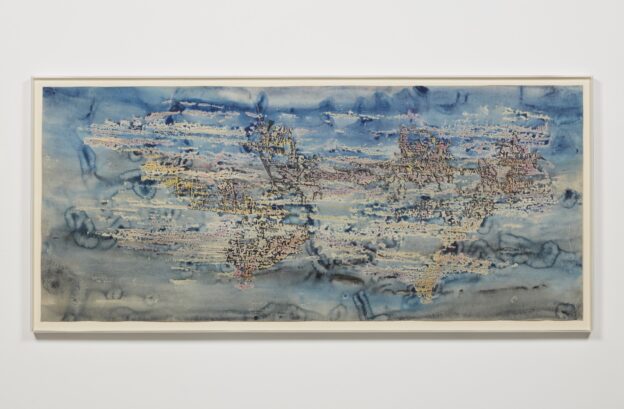
Cloud City, 1959, 70 x 154.7 cm, Crayola wax crayons, gouache, india ink.
Everything seemed different after meeting Nina, and only a few days later the surprise visit from Tomeo, during which we both became deeply, almost magically attached to one another. It was as if my everyday world of study and teenage friendships were suddenly turned upside down. I had to make a break. Perhaps like the break, when I was sent away at nine to boarding school or when my father decided to take my brother and I to Europe the summer I was 14, but we didn’t return. Perhaps discontinuities, interruptions were a pattern in my life, one that would continue.
The move from my studies in Archaeology and History of Art to spending the whole day concentrating on drawing, experimenting, visiting museums and the studios of mature artists was important because I found I couldn’t concentrate or focus on both studying and making art. I think I have explained this in my autobiography. It took a random meeting with another young artist in the same position to trigger the realisation that I could not successfully do both. Naturally, with hindsight, I realise I could have finished my studies, taken a degree in archaeology and then concentrated on becoming an artist – three or four years later. But those years seemed precious. Time – I never felt I had enough time. To concentrate, to focus was most important for me.
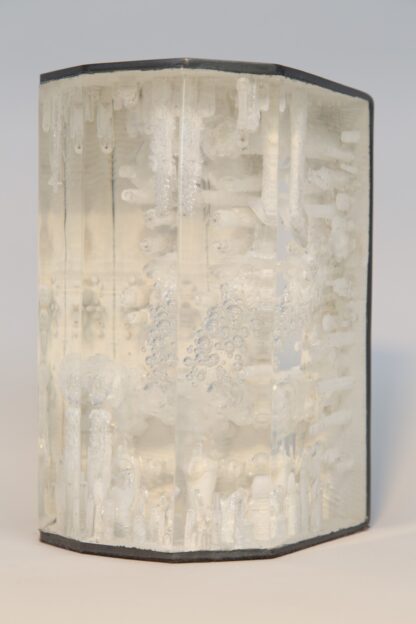
Inner Space, 1961, 22.2 x 11.2 x 11.5 cm.
Drilled, acid etched, painted Perspex (Photo by Richard Wilding 2014)
RB: During this time you encountered members of Surrealist movement, as well as Beat Generation poets. What influences did these groups have on your work? I’m thinking particularly of your experimentation with automatic drawing and ‘Poem Machines’.
LL: I write about these meetings and how they influenced my work. Manina was a surrealist painter and Nina and I were both interested in the fertile imaginative world of surrealism, its acceptance of women, or what we saw as that, and the power, whether sexual or spiritual , the importance that André Breton accorded to the feminine.
My work was just beginning. Automatism, playing with materials and allowing my subconscious to surface, seeing things in random splashes, what I called travelling in the painting, were all gifts to me from surrealism. My Poem Machines were the result of both an interest in the poetic linguistic purpose and meaning of the Beat poets’ cut-ups and experiments in optics, the scientific concepts of interference and the wave particle dual nature of light. William Burroughs and Sinclair Beilus were also interested in science, as was Takis. I took the disruption of the linearity of prose syntax in cut-ups one step further with movement.
RB: Was it difficult cultivating your work in a male dominated environment where only a few women were visibly operating? Did the lack of other female artists disturb you?
LL: It certainly was. I think I made that crystal clear in my book. There were many women artists but they were not exhibited with anything like the frequency of the men. Men patronised women artists. Of course, I was disturbed but I had female artist and poet friends, who were in the same situation that I was. It did depend also on the direction of one’s work. I noticed that women artists who used their body often in ways that could be perceived as masochistic were a success with the male establishment. The artist’s intention of possibly reclaiming the female body was not always appreciated by male critics, who rather appreciated the work for a more voyeuristic pleasure. Female artists interested in science had a more difficult time.
RB: During the time between 1962 and 1964 you began reading about the science of light and matter, as well as becoming interested in the writings of Zen Buddhism. How did this influence your work and what do you see in the relationship between the two disciplines?
LL: In Liquid Reflections I write about how I applied my research into the science of light to the continuous development of my work. I became interested in Buddhist thought when I was nineteen. The question of ‘who was I’, their writings relating to consciousness, awareness and compassion were important both for me as a young developing woman and for the art I wished to create. Later, on reading the biography and 100,000 Songs of Rechung Milarepa, the Buddhist concept of the illusory nature of reality struck me as being like the findings of physics. I was aware however, that even in Buddhism, and especially in Zen, women were thought unable to achieve enlightenment. I realised that spiritual power had been denied to women.
Looking into the life of the materials I worked with, observing while I made something or at the world around me was the path I chose. Science interested me because it asked questions and didn’t take reality for granted. Questioning led to uncovering, lifting off the surface of the real.
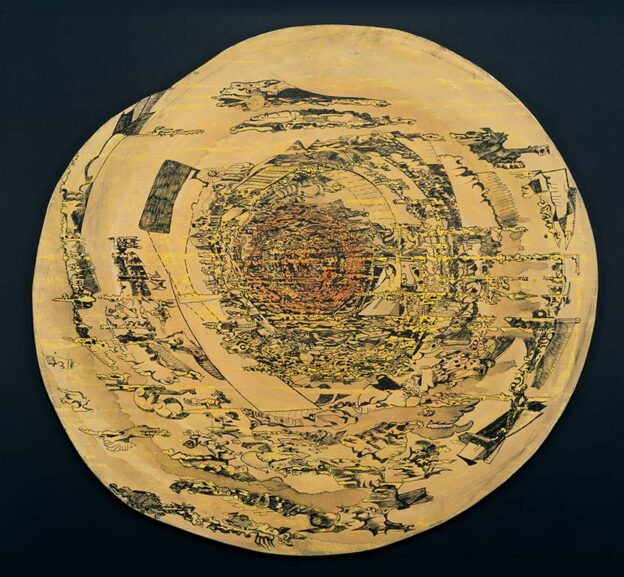
The Beginning
1959
69 x 65 cm
Crayola and india ink on paper cut and mounted on card.
RB: Can you say something about your work, The Beginning?
LL: The Beginning is a recreation of my inner world. It is a drawing in which I travel through the cosmos, in a whirling spiral generated by an intensely red and yellow concentrated central core that slowly cools, landscapes and creatures floating in its outer striations. It is one of the earliest drawings in which I used coloured inks over a wax resist, the forms created by the wax inspiring me to see a world, through which to voyage with my india ink dipped pen. I have kept that work near me through the years. Like a map of my being, it was the beginning of my own path as an artist.
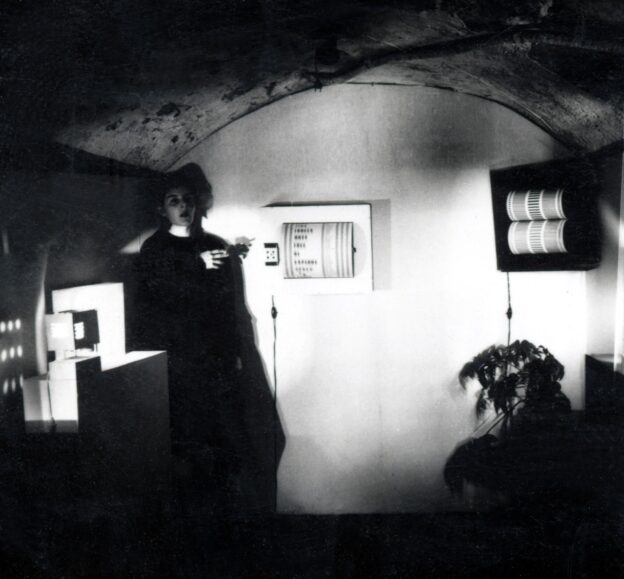
Liliane Lijn: Echolights and Vibrographs, with poems by Nazli Nour, Galerie de la Librairie Anglaise, Paris. 8 November – 2 December 1963.
RB: In 1963, you held your first solo exhibition, Echo-Lights and Vibrographes, at the Galerie de la Librairie Anglaise. What works were in the show and how was it received?
LL: The works I exhibited in my first solo show Echo-Lights and Vibrographes were the Vibrograph, Young Universe Poem Machine, Get Rid of Government Time Poem Machine, which was displayed in the bookshop window, Atom Born Beings Poem Machine, ABC Poem Machine, and four different sized Echolights.
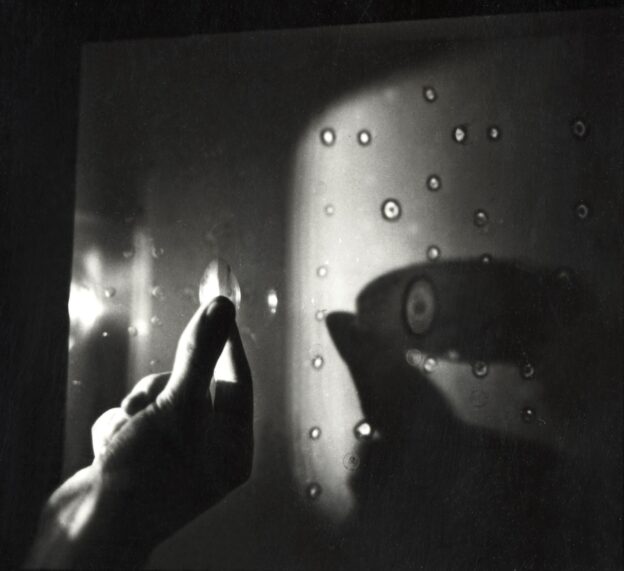
Echolights
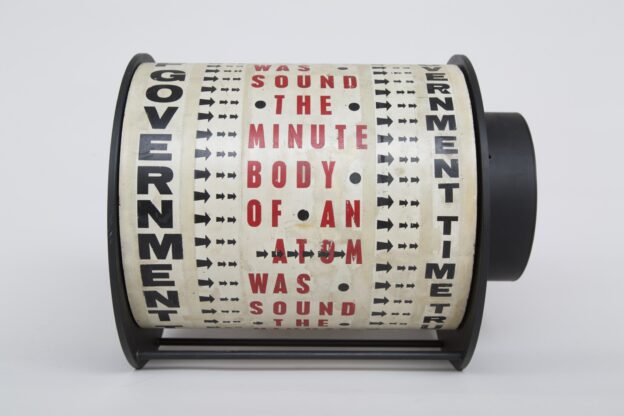
Get Rid of Government Time, 1962, 29.5 x 38 x 30 cm. Letraset on painted metal drum, plastic, painted metal, motor. Words from a poem by Nazli Nour. Frame altered in 1965
It was received very well, loved by artists and poets, reviewed both in French newspapers and in the Herald Tribune by the brilliant American poet John Ashbury. I recall that there were also sales of Echolights. William Burroughs loved the Poem Machines and told me he wanted his text off the page and moving like what I had done with Nazli Nour. It took many years before I could fulfil his wish in Way Out Is Way In (2009). Afterwards, I was invited to participate a Happening, and in several group shows. Most important for me was the feeling the show gave me that I was working on ideas that interested other artists and that I was no longer alone.
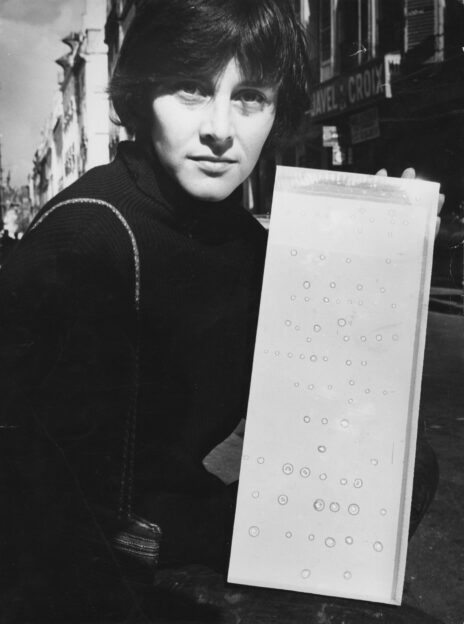
Liliane Lijn with newly completed Echo-Light , 1962 (photo Jean-Loup Charmet)
RB: Can you say something about changes in your surname, what it meant to you and how you arrived at Lijn?
LL: My father’s surname was Segall. I didn’t change my name until I started painting and then I decided to reverse both my names to Nallil Lages. I quite liked the sound of that name but slid back to using my patronym until my first exhibition in the summer of 1961. I describe the changes I went through to arrive at Lijn in Liquid Reflections. I was spending the summer with Takis in Venice during the Biennale and was invited to show my work in a group exhibition in a town near Venice. Our American composer friend suggested that I change my name so as not to be confused with George Segal. I also had a famous cousin, Lasar Segall, whom people called the Picasso of Brazil. Somehow, Line was the chosen name and in Italian the e was not silent and it was pronounced Leené. Arriving in New York a month or two later, I realised Leené was Line and all my work was so linear. That was when I lost the es and added the j so it wouldn’t look Chinese. Only to discover 20 years later on a residency in Holland that Lijn was line in Dutch!
Changing my name was almost like a restart from fresh. It also had negative side effects. The confusion it caused with bureaucracy, passports, bank accounts and such. And worst of all, the loss of recognition. A swathe of former friends and family suddenly couldn’t find me.
There is something about name changing that harks back to a child wanting different parents or wishing to be someone else. Emigrants had their names changed on arrival to the US. My grandmother’s name was shortened from Kustanowiz to Kast because the official on Ellis Island thought that was easier to pronounce. I was refused a US driving licence because the examiner noticed that my forename was spelled Liliane with an e. He asked me: “Isn’t an American name good enough for you?
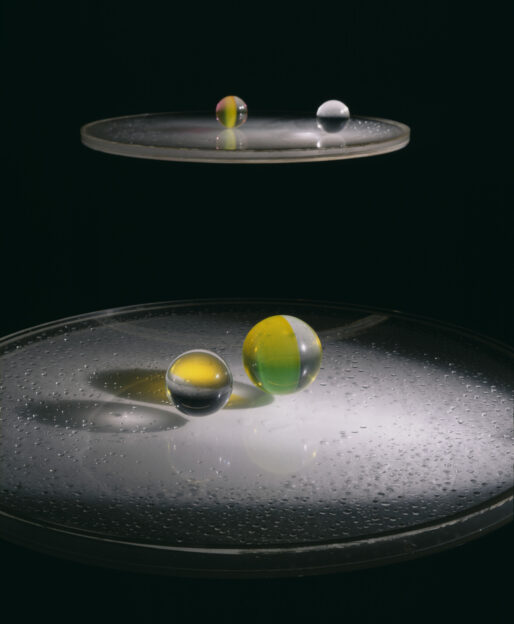
Liquid Reflections 2nd series
RB: Can you say something about Silvana Bismarck Speaks?
LL: I decided to write an autobiography on waking from a nightmare in which I witnessed the loss of everything I held dear. Still half asleep, I realised I had lost everything including my name and decided I would give myself a new name. Sylvana Bismark popped into my mind.
Silvana Bismarck Speaks would be, I thought, the perfect title for the autobiography I was to write.
…………………………………………..
Richard Bright: A personal review of Liquid Reflections
I have known Liliane Lijn for over 30 years, both as a friend and working with her on numerous Interalia events. During this time my conversations with her, on subjects ranging from interactions between art and science, Buddhism, light, poetry, female archetypes, ancient wisdoms and modern technologies, to name but a few, always left me stimulated and inspired. And so, it came as no surprise, reading her recent memoir, Liquid Reflections, left me the same. Based on her diaries at the time, it tells the story of the beginnings of what would become a remarkable career.
It is a beautifully written memoir that covers her formative years, from 1958 to 1966, beginning when, as a creative and fearless 18 year old, she left home and moved to Paris alone to become an artist. With frank and honest intimacy, she reveals her experiences and the challenges she faced cultivating her artistic career in a male dominated environment at the time where only a few women were visibly operating.
Liquid Reflections is a journey with energy and insight, not only through artistic evolution, but also through personal relationships and a testament to imagination, endeavor and resilience.
In Liliane Lijn’s own words –
I wrote LIQUID REFLECTIONS because I wanted to take my readers on the journey I made to become an artist. It’s the story of an idealistic, inspired young woman who refuses to accept the prejudices of her time. Becoming an artist was also a search for my own identity.
……………………………………………
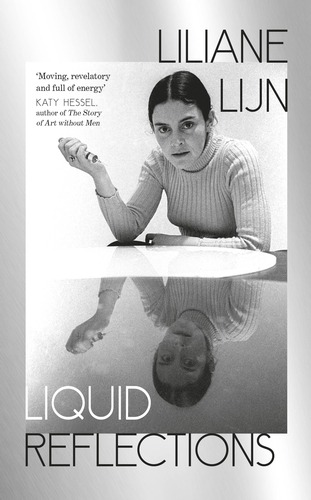
Publisher : Hamish Hamilton, Penguin Random House.
Get the Full Experience
Read the rest of this article, and view all articles in full from just £10 for 3 months.
No comments yet.