Hiroshima is fading
Florian Coulmas is Professor of Japanese Society and Sociolinguistics at the IN-EAST Institute of East Asian Studies at Duisburg-Essen University. His book, ‘Identity: A Very Short Introduction’, was published in February 2019.
Harry Whitaker is a renowned psychologist and neurolinguist, researching in Cognitive Science, Differential Psychology and Neuropsychology.
In this feature they discuss their experience of Hiroshima.
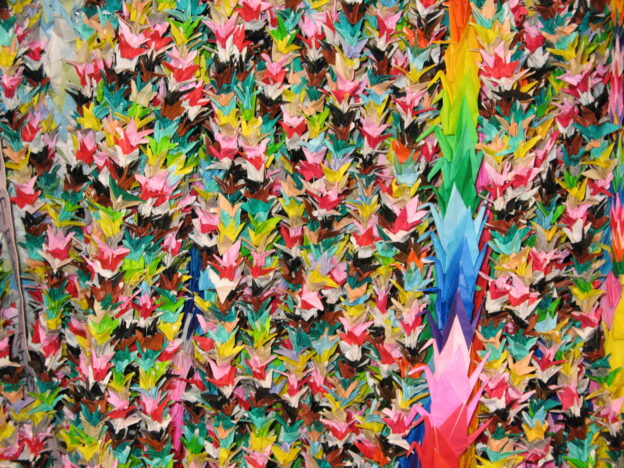
senbai tsuru – depicts a thousand origami cranes, a symbol of peace in Japan.
They were involved in an academic project, Harry Whitaker (Whit) as an author, Florian Coulmas as an editor. Having rather different specializations, they moved in separate circles throughout their careers and never had any professional contact, although it so happened that at one point, more than four decades ago, they had actually met in the unlikely setting of a summer school far away from where they lived. One took part in it as a teacher, the other as a student. When the latter brought this to the attention of the former, the former took it as a prompt for expanding their intercontinental conversation beyond the subject of their scientific project, which had kept them busy for some time, as they were struggling with a mal-designed digital submission system.
Florian Coulmas: Hi again. I went through the attachments you sent me, compiled them into one document and sent it to the copy editor. I trust that everything is fine now.
All the best,
Whit (Harry Whitaker): If I’m ever fortunate enough to meet you in person, I owe you a beer and a meal.
F: Thanks for the invitation! How about Sushi?
This is how it began. And then it continued.
W: You know what? I spent two and a half years in Japan, last half of the 10th grade of high school, then the junior and senior years. My parents trusted me and thus, on weekends and whenever there wasn’t school, I travelled all over the country by train. Spent a week in the Nikko area, spent almost a week around Kanagawa Bay, and climbed Mt. Fuji (absolutely astonished to see a discarded wringer washing machine thrown into the caldera) and watched the sunrise from the top of Mt. Fuji. It was outside a train station on one of my trips, that I saw a beggar on the sidewalk; he was a startling sight, just a small lump with a head and a torso – no arms, no legs. I squatted down beside him to talk, and saw that his skin was a dark, almost shiny burned brown from the fringe of the Hiroshima a-bomb blast. I took out all the money I had in my pocket except what I needed to get home, and then, I apologized to him. I decided then and there that I did not want to go to Hiroshima, nor Nagasaki; it would upset me too much.
I tried all of the Japanese food, everywhere, including the soba carts around all the train stations, the purple-stained rice (forgot what that was called) and sushi. I don’t like sushi, but then, I don’t like fish with the exception of tuna, salmon and shark. So, I buy you sushi and I have something else.
cheers
F: Hey, perhaps we should write something about sushi or sekihan (as the purple-stained rice is called). Everybody likes sushi. When you first travelled there, nobody outside of Japan liked it because it was unknown. When I first came to Japan, in 1970, I never ate sushi out of ignorance and for lack of money. Nowadays, sushi has captured the world and everybody likes it, except you. I hate to say this because I hate the fact that in this day and age everything is ranked and evaluated, but the market size of sushi restaurants is measured as $34.2bn in 2023 in the U.S. alone.
And then there is the subtext. I ate and enjoyed my first sushi in Hiroshima where I had my first job at the university. Long ago as it was, I still remember, and I could tell you a few things about it. How about an epistolary article by two nomads and their stories about sushi and Hiroshima?
Best,
W: What an interesting proposal. First, though, I must demur: I cannot be the only person in the world who knows what sushi is, has tried it and doesn’t like it. The odds of that being true are pretty small. So let’s chat about the options.
Cheers
F: Great! Of course, you can’t be the only person who knows and doesn’t like sushi, but we need a hook to get into the topic. The point is, or rather, the points we could combine to tell a story are three: sushi, Hiroshima, and the flow of time. Your take on sushi differs from mine, as does your take on Hiroshima. And our views on both subjects undoubtedly changed over the years. And not only our views.
What touched me and triggered me to propose this article was your remark about apologizing to a survivor. Apologies, on an individual and political level, are a big topic worth discussing. The high frequency of apologies in Japanese everyday interaction is very conspicuous and indicative of propriety and the social system. Apologies are cultural. In some societies, an apology is tantamount to an admission of wrongdoing. Representing this attitude in its purest form, Charles I, King of England, Scotland, and Ireland, wrote in a letter to Lord Wentworth: “Never make a defence or apology before you be accused.” In sharp contrast, in Japan, people apologize all the time without ever being accused of anything. An apology is an expression of regret about something that happened without necessarily acknowledging guilt. Apologizing in the context of war is a different matter, of course. Generally speaking, victors don’t apologize, the defeated do. It is very difficult to change established narratives and, as you must know, the narrative about Hiroshima and Nagasaki in the U.S. and beyond emerged during the seven years of the post-war occupation of Japan, when nothing about the nuclear annihilation could be published without American consent.
There is a very interesting article about apologizing by Olivia Tasevski in The Diplomat, ‘Hey, Let’s Forget That’: No US Apology for the Atomic Bombings of Hiroshima and Nagasaki’.[i] Have you seen it? The first part of the title is a quote by President George H.W. Bush, who, like all U.S. presidents since Harry Truman justified the bombings of Hiroshima and Nagasaki and framed them as necessary.
President Biden was no exception, which is particularly interesting because in May last year, he came to enjoy raw fish at the 2023 G7 meeting in Hiroshima, bringing the nuclear football[ii] along in his luggage. This was, as I found out, the menu:
Setouchi Acqua Pazza of Japanese Rockfish and Mussels from Hiroshima, with Lemon and Shodoshima Olives, in Light Soup
Higashi Hiroshima Koi-Jidori Chicken Ballotine Stuffed with Akaza-ebi Shrimp Scampi, Braised Thigh and Mushroom Tourte, Roasted Bamboo Shoots and Fava Beans, with Suprême Sauce
Hundreds of activists found this good reason to rally against the Group of Seven meeting there. Ironically, they weren’t allowed to do that in the Peace Park though, which was reserved for the G7 leaders after lunch. What do you make of it? I’m curious.
Best,
W: It never occurred to me at the time that there was a US government injunction against apologizing for the atomic bombs; my apology was, first, as you said, a social expression of regret; however, it was also my attempt to apologize for the US government that had ordered the a-bombs to be dropped. I made it clear to this Hiroshima survivor that I was an American who was apologizing to him, a victim.
The first time I saw a soba cart in the brick area outside Shinjuku train station, I walked up to it, more or less asked the fellow who owned the cart for a bowl (it smelled good; my Japanese was so-so, and I’d never tried soba so I had no idea how to order it). He handed me a bowl and chopsticks and charged me 50 yen. I moved off to a place where I could sit down and tried the soba. Alas, it was fish + noodles and veggies. I do not like fish, as I told you. Back in the sixth grade I had come home (Winter Park, Florida) with a large bluegill that I had caught in a local lake; my mother prepared it for dinner, but did not get all the bones out and a very thin but long bone got stuck in my throat, sideways, and I couldn’t get it out. My father finally plunged his fingers down my throat, grabbed the bone, and pulled it out. That was the last time I ate fish. So, when I tasted fish in the soba, I went over to a trash can and tossed the bowl in. I discussed this with my parents; they had never tried soba from a soba cart. So I talked to some classmates and one of them told me, ‘stupid, you have to choose what you want to go in the noodles, and there are usually a lot of choices’. Next time I went to Shinjuku train station, I went to the soba cart and pointed to each of the veggies I wanted in my soba. The fellow smiled and said “soba te kitsu ne” or something like that. It was delicious, and for the next couple of years that’s what I always ordered, using my best version of the Japanese expression for it.
I don’t remember who explained sushi to me; it might have been the very nice Japanese maid we had, or it might have been one of the teachers at TAHS (Tokyo American High School). But, when I heard that sushi was raw, i.e. uncooked fish, I never tried it and always refused it when offered. Nothing will ever get me to eat sushi.
F: Although I know what you are missing (have missed, actually), I wouldn’t try to persuade you, as long as you live up to your promise to treat me to sushi when we meet up. No point in confronting ingrained habits head on.
W: You’re probably right. A little side story here: I got into a bit of “trouble” a month and a half before graduating from the 12th grade, and the admin of TAHS told my parents that I was being thrown out of school and sent back to the United States by myself for attempting to poison the history teacher. I’d asked the history teacher if he would join me and three friends after class for a celebration of his class which we all thought was the best class at school; he agreed and I served all of us some moonshine I made (I sold it to fellow students in small silver-plated flasks on Fridays so they would have something to drink at school sporting events. At the same time, I had been accepted at the US Naval Academy in Annapolis, Maryland, on the condition of graduating from high school. The admin of TAHS was in a really big quandary because out of all the male graduates in my class of 1956, I was the only one who had been accepted to one of the military academies…after a persuasive chat by my father, they let me stay and graduate.
But of course, I had to give the administration of TAHS “the bird”, i.e., the middle finger of my right hand. I was the salutatorian of my class and, thus, a speaker at commencement. To “prepare” for my speech, I had the local barber cut my hair into what was called a “Mohawk” haircut (as the native American tribe, Mohawks, cut their hair). Well, needless to say, a Mohawk haircut was suddenly declared an illegal hair style (!!) and I was told I could not go to class with it (which could have trashed my graduation, of course) so I went back to the barber and had my head shaved. Thus, I had no haircut at all. I won, I graduated, and I went to the US Naval Academy.
F: Well, well, also on the side, a haircut, Mohawk or otherwise, can change your life. At university I had begun to study Chinese. Like many of my contemporaries, I wore long hair, which the Taiwanese authorities found so offensive that I was refused entry unless I had my hair cut. For me that was unacceptable, and China was not an alternative at the time of the Cultural Revolution. Since I wanted to learn a non-European language, I changed plans and went to Japan. So much for restyling. But let’s return to the plot.
W: My parents were both teachers; my father was a university professor when the Navy didn’t call him to serve, and my mother was a high school teacher. I knew all about the atomic bombs that had been dropped on Hiroshima and Nagasaki (from American newspapers, of course), and it was in my second summer in Tokyo, 1955, when I met the Hiroshima survivor. I had fully intended to visit Hiroshima; however, after meeting the fellow who had been on the fringes of the first A-bomb and was so horribly maimed, I decided that I didn’t want to see Hiroshima after all, nor did I want to see Nagasaki, and so I never went to either one. In retrospect, knowing what we know now about radiation, it was a fortuitous choice. I now believe that dropping those two A-bombs was two acts of attempted genocide.
F: “In retrospect …,” yes, yes, but at the time that was a minority position. Radhabinod Pal, one of the justices of the International Military Tribunal for the Far East, represented it in his dissent judgement. This is what he wrote:
Kaiser Wilhelm II was credited with a letter to the Austrian Kaiser Franz Joseph in the early days of [World War I], wherein he stated as follows: ‘My soul is torn, but everything must be put to fire and sword; men, women and children, and old men must be slaughtered and not a tree or house be left standing …’ This showed his ruthless policy, and this policy of indiscriminate murder to shorten the war was considered to be a crime. … If any indiscriminate destruction of civilian life and property is still illegitimate in warfare, then, in the Pacific war, this decision to use the ATOM BOMB is the only near approach to the directives of the German Emperor during the first world war and of the Nazi leaders during the second world war.[iii]
“Genocide” wasn’t a common notion then, having first been defined in the 1948 United Nations Genocide Convention, largely in response to the Holocaust. Only gradually, after the end of the occupation of Japan did this association evolve and the Holocaust and the atomic bomb were seen “as comparable and interchangeable symbols of the worst that humans can do to other humans”[iv]. When I moved to Hiroshima in 1975, five years after my first stint in Japan and 20 years after your visit there, this link wasn’t a normal part of the discourse on World War II, not in Germany anyway where the focus of teaching about the war in high school was on Fascism in Europe rather than Asia. And no one in Hiroshima would have suggested it to me. In a sense, I wasn’t in Hiroshima. Commuting between my house in the suburbs and the university campus, I lectured on philosophy of language, Wittgenstein and so forth, about which I still knew very little myself and therefore had to do a lot of reading. The rest of my time I spent working on my doctoral thesis about performative speech acts, such as promising, stating, and apologizing. In my mind this was an abstract subject to be studied by investigating the meaning and use of words. That it could have a political dimension, let alone relate to the A-bomb, never crossed my mind. And nobody ever spoke about the bomb anyway or proposed that I visit the Peace Memorial Museum. As I would learn much later, this wasn’t coincidental but part of the story of Hiroshima. The city – what was left of it – was for a long time side-lined by the government in Tokyo, which was eager to become a good ally of the United States, and the surviving victims, hibakusha, were discriminated against for similar reasons.[v] There was a deep silence above them. Colleagues took me to Itsukushima, an island in Hiroshima Bay with its beautiful Torii gate shrine that seems to float on water, to tangerine groves with a stunning view over the Inland Sea, to hikes in the mountains, to a sushi restaurant and to other nice places, but the museum, no. It took me almost a year to work up the courage to go there on my own. It was horrible, raw as if rubble and remnants of the blast had been dumped there the day before. In the meantime, the museum has been sanitized. The display is still terrifying, but it has become a well-curated exhibition about history far away from our present world, whereas then it seemed to engulf me. I had arrived in Hiroshima.
It was not before 1971 that Eisaku Sato became the first Prime Minister to attend the annual peace memorial ceremony on 6 August in Hiroshima. Only gradually after that did the historical turning point marked by the two bombs become part of the history of “the only country to have suffered the wartime use of nuclear weapons”, as it came to be framed, never mind that “the country” didn’t want to know about it for such a long time.
As time went by, citizens’ movements for peace and the abolition of nuclear weapons grew stronger, although a wide gap between the governments of Hiroshima and Nagasaki and the national government remained. Both have always been in the lead of promoting peace. Also worth mentioning in this connection is the Holocaust Education Centre established in Fukuyama City, Hiroshima Prefecture[vi]. It is designed to educate children on the Holocaust; however, as is pointed out on its website, it is located “forty-five minutes from Hiroshima City where the atomic bomb was dropped”, and thus embodies the connection of the two catastrophes.
W: Florian, there is another connection.
Tim Wallberg, GOP congressman from Michigan, evidently made some comments to his constituents last December about bombing Gaza that probably caused you to think, as I did, that ‘Hiroshima’ has become a cultural meme. If so, that in turn, will reduce the shock value of terms like ‘genocide’, etc.
F: Whit, I was about to write to you about Mr. Walberg’s comment when I first saw it last night in the Guardian. Now it’s all over the press. It’s hair-raising and pretty extreme, but fits the general picture of how Hiroshima and Nagasaki are remembered, and will be, as you say, as a cultural meme and a subject for the entertainment industry. “Taken out of context”, yes, of course, of course.
“We shouldn’t be spending a dime on humanitarian aid. It should be like Nagasaki and Hiroshima. Get it over quick.” This is what Mr. Walberg said at a town meeting in Michigan[vii], and when it was taken up in the media, he complained that his remark was “taken out of context” – the usual excuse when politicians discover that what they said wasn’t well received. I don’t want to dwell on that here. In the present context (!) more interesting than whether or not he advocated for the use of nuclear weapons is what his remark tells us about how the obliteration of Nagasaki and Hiroshima is remembered today. If “Nagasaki and Hiroshima”, as Mr. Walberg insisted, was just a metaphor to argue for a quick end to the war, there is obviously not much of a doubt about the legitimacy of the greatest war crime in history.
There is something I meant to ask you, Whit, about memory. You said, if I understood correctly what you wrote in your chapter, that “memory impairment is at the core of aphasia”. I find that utterly convincing. In recent times, however, the notion has gained ground in psychology that forgetting can be good for a healthy brain. Does it make any sense to transfer this idea from psychology – the individual – to sociology – society?
W: Yes, it does. First, let’s restrict the discussion to visual memory. The visual system is one of the largest sensory inputs to the brain; it functions well, albeit differently, in almost every human being. Aphantasia is the inability to store visual images in memory; it’s incidence is very rare, ranging from 1.5% to 8.9% of the population. Aside from aphantasics, common adult long-term memory is heavily influenced by emotions. We tend to remember those events that caused high levels of fear, excitement, arousal, fascination, etc. As an example, when I was 4 or 5 years old and too small to be able to fill a glass with water from the bathroom sink, I climbed into the back of the bathtub because I could reach those faucets. The tub had been used recently and the bottom was wet; the tub was also slanted from back to front (drain and faucets, of course, were at the front). I slipped and slid down to the front of the tub with the glass in my hands. When my head hit one of the faucets, the glass broke, opening up a wound on my forehead that required my parents to take me to the hospital. I carried the scar visibly until I was in my 60’s and it is still visible if I wrinkle my brow. The image of the bathtub, the faucets, blood everywhere, remains in my visual memory to this very day, 80 years later.
F: “High levels of fear”, can hardly be doubted among A-bomb survivors, but among those who dropped them it was probably more “excitement and fascination”, and what is more, they claimed the power to determine the long-term memory of what happened and why. Can this be called an externally induced aphantasia?
Who remembers Joseph Rotblat? Oppenheimer, yes, but Rotblat? One of several European physicists who worked in Los Alamos, but the only one who left after less than a year because he had qualms about deploying nuclear technology in warfare. He was shocked by remarks of the military commander of the Manhattan Project to the effect that the real purpose of building these bombs was to subdue the Soviet Union. Who remembers that Shimon Peres, in 1994 at UN headquarters in New York, referred to Hiroshima as “atomic holocaust”, which for some time after WW II actually was a commonly used expression? It certainly wasn’t used in Christopher Nolan’s epic film ‘Oppenheimer’.
In the U.S., that movie was released in August 2023, simultaneously with one about ‘Barbie’ giving rise to the weird compound word ‘Barbenheimer’ and a media frenzy about which of the two would rake in more money. In Japan, where the movie was released half a year later, it caused much offence, as it conflated an unprecedented human tragedy with a silly toy. In Hiroshima, former mayor and atomic bomb survivor Takashi Hiroaka criticized ‘Oppenheimer’ for not sufficiently depicting the horror of nuclear weapons and paying too little attention to the suffering caused by the bombs. This brings us back once again to apologies. The Warner Brothers Film Group actually has made a public apology about social media activity concerning the ‘Barbenheimer’ hype.[viii] In the neoliberal age, are public apologies offered when actions taken could be damaging to business?
How reliable is our memory, on the individual and on the social level? What did, for example, the members of the G7 meeting in Hiroshima remember of Hiroshima? How does Mr. Putin’s sabre rattling, with which he reintroduced the possibility of nuclear war into the discourse on world order, affect our memory of the atomic bombs? How do comments such as Mr. Walberg’s comparison of Gaza and Nagasaki and Hiroshima? Do they not blur the line we once perceived – I certainly did after having lived in Hiroshima – between a pre-nuclear and a nuclear world, trivializing the historical turning point? Yet, when I lived in Hiroshima, such thoughts never occurred to me.
Is our memory just what we want to remember and what is politically opportune at the time?
…………………..
[i] https://thediplomat.com/2020/08/hey-lets-forget-that-no-us-apology-for-the-atomic-bombings-of-hiroshima-and-nagasaki/
[ii] “Nuclear football” is an informal term for the briefcase that accompanies the US president wherever they go to enable communication about and, if needed, authorization of nuclear attack.
[iii] IMTFE – International Military Tribunal for the Far East. 1999. Dissent Judgment of Justice Pal. Tokyo: Kokusho-Kankokai. http://www.sdh-fact.com/CL02_1/65_S4.pdf.
[iv] Ran Zwigenberg. Nuclear Minds. Cold War Psychological Science and the Bombings of Hiroshima and Nagasaki. Chicago University Press, 2023, p. 4.
[v] https://www.tandfonline.com/doi/full/10.1080/18692729.2024.2348773?src=exp-la
[vi] https://www.hecjpn.org/
[vii] https://www.michiganpublic.org/politics-government/2024-03-30/walberg-on-gaza-it-should-be-like-nagasaki-and-hiroshima-get-it-over-quick
[viii] https://variety.com/2023/film/news/warner-bros-japan-criticizes-barbie-twitter-barbenheimer-posts-1235683885/
Get the Full Experience
Read the rest of this article, and view all articles in full from just £10 for 3 months.



No comments yet.