Chaos and Order as Design Elements in Evolutionary Biology and the Visual Arts: A Case Study of Human–Robot Artistic Collaboration
This paper investigates the interplay of chaos and order in evolutionary biology, cell biology and the visual arts. It argues that creativity in both natural and artistic systems arises from a productive tension between these two principles. The study introduces a collaborative art project in which a robotic drawing machine and a human painter co-created works, embodying order and chaos respectively. By drawing parallels between mutation and repair in biology, dynamic processes in physics, and compositional strategies in art, the paper highlights chaos and order as universal design elements across disciplines.
1. Introduction
Science and technology increasingly intersect with the arts, giving rise to the emerging field of Science Art (6). This paper explores how concepts fundamental to biology — chaos and order — can serve as design principles in the visual arts.
The argument develops in two steps. First, it examines how philosophers, physicists, and biologists have described the tension between chaos and order. Second, it shows how these ideas can be translated into artistic practice. The analysis culminates in a case study of a human–robot collaboration, in which the machine enacts order through precise linear structures, while the human artist intervenes with colorful, irregular gestures that embody chaos.
2. Conceptual Background
2.1 Philosophy: Chaos and Order in Thought
The duality of chaos and order has preoccupied thinkers since antiquity. Hesiod described chaos as the primal void, out of which a structured cosmos eventually emerged. Nietzsche reformulated the tension as the Apollonian and the Dionysian: clarity, measure, and restraint on the one side; excess, ecstasy, and disorder on the other (5). This pairing resonates strongly with the present project, where the robot’s programmed precision corresponds to Apollonian order, and the human artist’s intuitive intervention evokes Dionysian chaos.
2.2 Physics and Mathematics: Chaos, Order, and Randomness
In physics and mathematics, the distinction between chaos and randomness is crucial. Chaos describes deterministic systems whose outcomes are unpredictable because they are highly sensitive to initial conditions. Randomness, by contrast, lacks determinism altogether and is unpredictable by definition. Order stands as the counterpart to both: the presence of symmetry, predictability, and stability. Clarifying these differences prevents the common conflation of chaos with randomness and underscores how each plays a distinct role in the structuring of natural and artistic systems.
2.3 Example: Water as a Dynamic System
The physical behavior of water illustrates how chaos and order coexist. Hydrogen bonds form transient networks that stabilize molecular arrangements, yet these bonds constantly break and reform in rapid succession. The result is a dynamic system in which fleeting order emerges from fundamentally chaotic interactions. This duality makes water an apt metaphor for the way structured patterns and unpredictable fluctuations can generate complex, evolving forms — a principle that translates directly into artistic practice.
2.4 Biology: Mutation, Repair, and Reproduction
Biological systems depend on the constant interplay of chaos and order. DNA replication and protein folding, for instance, require extraordinary precision to maintain life. Yet evolution would be impossible without the “noise” of mutation, most of which disrupts function, but occasionally produces beneficial novelty. The connotation of “noise” is usually negative, but in biology, it is a fundamental design element, even entangled with the design element of order, as seen in DNA and cell replication. The process is stochastic, which explains why genetically identical cells may still behave differently.
Similarly, cell division embodies order, while mechanisms such as DNA repair manage the chaotic disruptions that threaten stability. Biology thus demonstrates that chaos is not simply destructive; it serves as the raw material from which order renews itself and life advances.
A striking example is stochastic gene expression, where genetically identical cells, under identical conditions, nonetheless express different levels of the same protein. This “noise” is not merely error; it allows populations of cells to hedge their bets against environmental uncertainty, ensuring that some are pre-adapted to stress. Too much stochasticity would destabilize development, but too little would make organisms fragile in the face of change. In a similar way, protein folding depends on a careful balance of order and disruption. The polypeptide chain can easily misfold into chaotic tangles, yet specialized chaperone proteins guide it toward a stable three-dimensional conformation. Life, then, is not the triumph of order over chaos, but a dynamic negotiation between them: evolution harnesses randomness, while molecular systems continually filter and constrain it into workable form. These examples highlight how the principles of order and chaos depend on a balance between the two: too much mutation results in the collapse of the species’ development, and conversely, too much order leads to evolutionary stagnation.
The list of examples could, of course, be extended, but a detailed treatment lies beyond the scope of this paper.
3. Artistic Translation: Chaos and Order in Visual Design
3.1 Form
In the visual arts, form makes the tension between chaos and order immediately perceptible. Order is manifest in symmetry, repetition, and geometric clarity, while chaos appears in irregularity, asymmetry, and disruption of pattern. A composition built exclusively on order risks banality or sterility, while pure chaos tends toward confusion and dissolution. Vitality arises when the two are combined. In art history, Mondrian can be read as order-dominant, Pollock as chaos-dominant, and Klee as a balance between the two. More generally, vitality emerges when stable structures are disturbed, or when irregular gestures find themselves framed by a larger coherence.
3.2 Color
The dialectic of order and chaos applies equally to color, which can be described by three parameters: hue, saturation (intensity or dullness), and value (lightness or darkness). Beyond these, color perception is shaped by simultaneous contrast, associative context, and the temporal dimension of perceptual latency. Perception is never static: colors shift in relation, interact, echo, cancel, and sometimes require time to be fully seen (1).
A pure hue resembles a clear, undistorted sound—precise, coherent, and easily identifiable. By contrast, a random aggregation of colors produces visual cacophony, akin to auditory noise. Grey, though often described as a mixture of black and white, in practice arises from blending primary pigments in subtractive mixing. Fully saturated hues, however, yield perceptual clarity, as Kandinsky emphasized in his discussion of yellow, red, and blue (2).
Color harmony depends on order. When hues of similar value and saturation compete—for example, pink and orange, or yellow and orange—perceptual tension emerges. Such combinations show how similarity can reduce distinction, producing controlled disorder. Complementary pairs, such as orange and cyan, remain easily separable and create dynamic harmony through contrast.
Colors are rarely perceived in isolation. Each hue appears within a surround—either inside the artwork or the broader visual field. The order or chaos of this surround shapes the perception of the focal image. Color parameters must therefore always be considered relationally: chromatic elements interact and influence one another, just as mutations and repairs interact to sustain biological order.
The physical processes of additive and subtractive mixing further illustrate this interplay. In additive mixing, white light results from the combination of red, green, and blue primaries, or from the superposition of all wavelengths in the visible spectrum. Adding wavelengths increases brightness and energy. Subtractive mixing, by contrast, occurs with pigments: combining them increases absorption, producing darker tones, and the mixture of all primaries yields black (3) (4).
Saturation defines the “purity” of a color. Spectrally, pure hues occupy narrow wavelength ranges. Adding complementary pigments or browns lowers saturation by increasing absorption and reducing reflection, leading to perceptual dullness or darkness. The acoustic analogue is white noise: the absence of a distinct signal.
The principles of color parallel those of music: order and chaos appear in melody, rhythm, consonance, and amplitude. A clear, saturated hue, like a regular waveform, conveys order. A chaotic blend of colors, like random frequencies, produces perceptual noise. Across biology and the arts alike, the interplay of order and chaos generates complexity, vitality, and expressive depth.
4. Case Study: Human–Robot Collaboration
4.1 Framework
The case study was developed during a residency at the Ludwig Boltzmann Institute for Network Medicine in Vienna, Austria. The project’s performances were conducted together with scientist Christiane Hütter and AI engineer Sebastian Pirch, using a digital robotic printer and AI-assisted image generation. The guiding question was how humans and AI-based machines might collaborate artistically by embodying opposing forces: order and chaos. Whereas Neil Harbisson’s prosthetic art explores the fusion of human perception with technology, this project staged a collaboration between distinct partners — a robot and a human — each enacting one pole of the duality.
This question was explored in the context of biology: the robot, in principle, provides the design and functional elements of order, while the human partner introduces the chaotic element. Both, as elaborated above, are equally essential in biological evolution and development. Both the robot’s precision and the fixed design from which it works introduce the “orderly” element. The chosen image was that of a cell. A correctly calibrated robot functions with high precision and may follow a design plan with far greater accuracy than a person can execute. It is the manifestation of order. The human, on the other hand, with comparative inaccuracy and creativity, introduces the chaotic element.
4.2 Method
The process began with AI-generated motifs, which were vectorized and fed into the robotic printer. The robot executed the motifs as fine line drawings in black ink with a precision of approximately 0.4 mm. Onto this ordered linear framework, the human artist introduced color fields applied with gestural freedom.
The method thus explicitly staged the meeting of programmed control and spontaneous disruption.
4.3 Results
Two artworks were produced in this collaboration (Figures 1 and 2). In both, the robotic linework established a structural skeleton of order, while the human color application destabilized that structure with irregular rhythm and expressive intensity. The result was not a simple layering but a genuine interaction: in some areas, the order resisted chaos, while in others, chaos overwhelmed order, producing hybrid zones of tension.
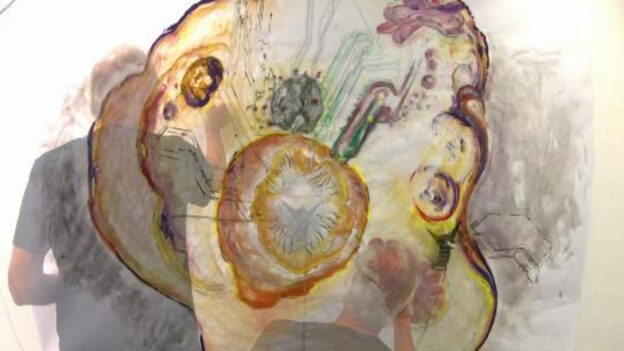
• Figure 1. First work (light, translucent, with earthy yellows and reds): emphasizes integration, transparency, and organic continuity—like a living cell where machine logic has already fused with biological flow.
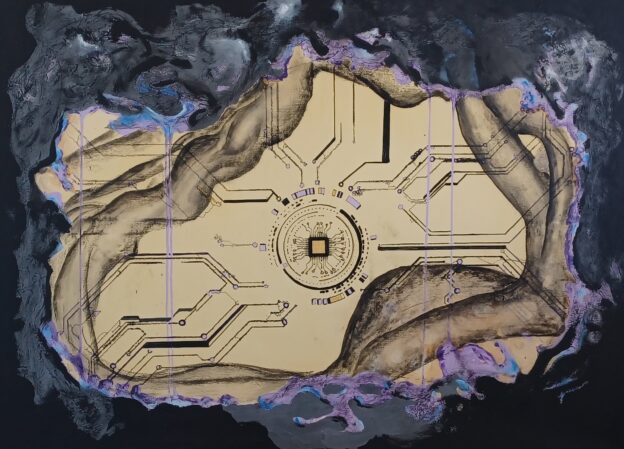
• Figure 2. Second work (black–gold–purple): emphasizes contrast, enclosure, and the tension between order and chaos—like a technological cell embedded in cosmic matter.
Interestingly, the distinction between the robot’s order and the human’s chaos was not always clear. Although the robot produced precise line drawings, these showed imperfections due to variations in ink flow and the support chosen for the work. In some cases, these imperfections were either corrected or reinforced by the human artist. Conversely, some of the human interventions, though intended as spontaneous gestures, settled into rhythmic repetitions or sweeps of paint. Therefore, as in biology, here too the two principles appear entangled with one another. These inconsistencies suggest that chaos and order are not fixed properties of human versus machine, but relational qualities that can shift depending on context.
Audience responses reinforced this point. Viewers often identified vitality not in the purely chaotic or ordered passages, but in the thresholds where one began to invade the other — for example, where a wash of color dissolved the clarity of a mechanical lattice, or where the grid reasserted itself through translucent pigment. Rather than perceiving the work as a simple opposition of man and machine, many interpreted it as a dialogue in which each partner destabilized and redefined the role of the other.
5. Discussion and Conclusion
The exploration of chaos and order across philosophy, physics, biology, and the visual arts reveals a common principle: life and creativity emerge from the interplay of structured stability and disruptive innovation.
The case study of human–robot collaboration demonstrates how this principle can be enacted in contemporary art. By assigning order to the machine and chaos to the human, the project materialized an ancient duality in a new technological setting. The resulting works highlight how balance — not dominance of one force over the other — generates vitality.
The implications extend beyond this project. In biology, the balance between mutation and repair drives evolution; in art, the interplay of harmony and disruption fosters expressiveness; in human-AI collaboration, the productive blend of control and spontaneity could shape the future of creativity itself. This case study thus offers insights for future human-AI partnerships, not just as a metaphor for biology and art, but as a foundational design principle for co-creation systems.
…………………………………..
References:
(1) Schumann, H. (2000). Visualisierung: Grundlagen und allgemeine Methoden. Springer.
(2) Kandinsky, W. (1952). Über das Geistige in der Kunst (pp. 90–100). Benteli.
(3) Albers, J. (1975). Interaction of color. Yale University Press.
(4) Itten, J. (1973). The art of color (2nd English ed., E. van Haagen, Trans.). Van Nostrand Reinhold.
(5) Nietzsche, F. (2003). The birth of tragedy (S. Whiteside & M. Tanner, Trans.). Penguin Classics.
(6) Bliem, R. F. (2024). Do you know what Science Art is? A definition of and introduction to an art genre. In Conference proceedings of the SGEM conference (Vienna). https://doi.org/10.35603/sws.iscah.2024/ks01.01
……………………………………………..
All text and images copyright and courtesy of Rudolf Friedrich Bliem
Get the Full Experience
Read the rest of this article, and view all articles in full from just £10 for 3 months.
No comments yet.