Jack Tait: Master of the Analog Drawing Machine
The authors herein present an introduction to the extraordinary and wide-ranging work of analog drawing machine artist Jack Tait. Now 88 and still active as an artist and theorist, that work has been previously recognized only within a relatively small circle of specialists within his native Britain; but given the current explosion of interest in techno-art, it has seemed appropriate to the authors to employ the communication format to introduce his art to a global audience: a body of work addressing the currently vital questions of the analog versus the digital, and the random versus the deterministic.
1.0 Introduction
In parallel to a long and distinguished career as a photography professional and educator, Jack Tait (Tait 2022) has engaged in a fifty-year exploration of the possibilities of analog drawing machines – almost certainly the most adventurous and fruitful of its kind — and his work thus inviting comparison with that of, for example, Bauhaus photographer and kinetic sculptor László Moholy-Nagy.
The machines are of course of great interest — he has designed and fabricated some fifty of them over the years (Figure 2), and according to several distinct theories of operation; but it is the variety and intensity of the drawings themselves which, in our opinion, mark Tait as one of the early masters of techno-art. Indeed, so striking are these images that it has seemed perfectly appropriate to the authors to allow them to speak first for themselves when being introduced to an international audience, with explication provided within the image captions — hence our choice of the “Communication” format — and as supplemented by separate introductory statements by the various authors
And finally this point: the wonderful drawings shown in the following Section 2 are, without question, the product of curation; i.e., Tait is anticipating a later generation of digital artists in presenting to the public only a tiny selection of the output of his analog machines. With the assumption, however, that the artist is tending to respond to those outputs which best express what might be identified as a creative principle at work within the universe (Nagel 2012), such curation must be seen in a positive light as nudging our entire technological ecosystem in the direction of its continued expression.
1.1 Introductory Statement by Paul Brown (artist, writer, Secretary of the Computer Arts Society, and Honorary Visiting Professor, Sussex University)
Two British pioneers who created electro-mechanical drawing machines emerged in the 1960s, they both lived in Manchester but never met. Desmond Paul Henry bought analogue war-surplus bombsight computers and modified them to make complex drawings. Jack Tait was a photographer who had developed precision engineering skills that he used to make his super wide angle photographic cameras, skills he then applied to the design and creation of sophisticated programmable analogue drawing systems. At that time, he was the founding head of the Dept. of Photography at Manchester College of Art & Design where I was an undergraduate painting student. Our paths crossed occasionally when I used his photo labs. We never got to know each other and more than three decades would pass before we met again via the auspices of the Computer Arts Society (CAS). Alan Sutcliffe, CAS co-founder and editor of their publication PAGE, dedicated an issue to Jack’s machines and drawings (Tait 2007). He was keen to pursue a PhD, documenting and contextualising his work and I invited him to visit Sussex University where I was a visiting professor and artist-in-residence in the Informatics Dept. We met with Phil Husbands, who led the Informatics research programme, and he advised Jack to find an opportunity for a practice-based Ph D, something that Sussex couldn’t offer at that time. Jack returned to Manchester where the Art College had become a faculty of the Manchester Metropolitan University.
In 2011 I was pleased to be invited to be external examiner for his PhD. Jack’s work was exceptional; he described his working methodologies and the works relationship to visual cognition and aesthetics. Like several of his contemporaries who emerged from the constructivist, concrete and systems art traditions that dominated the middle decades of the 20th century, Jack creates his machines to bypass issues like self-expression and focus instead on the more formal aspects of the artwork. His systems are designed to address specific issues like randomness, chance and the relativity of line and shape. Recent work also explores psychophysical aspects like, for example, comparisons of the subjective interpretation of his drawings by different observers. The mechanical constraints together with the programmable, parametric control enables a degree of fine tuning, creation, examination and analysis that would otherwise be difficult if not impossible. His machines now include optical heads for photographic recording that also enable the automatic generation of colour and produce work at a greater scale than was previously possible.
By pursuing this rigorous evolution of his image-making systems Jack has carved out a unique place for himself in the field of the generative and computational arts. In 2013 London’s Science Museum recognised his contribution by acquiring seven of his machines with four programmers for their permanent collection together with videos documenting their maintenance and use as well as many of the drawings they had produced.
1.2 Introductory Statement by Nick Lambert (Chair of the Computer Arts Society and Director of Operations, VISTA Project, Faculty of Computing, Engineering and Science, University of South Wales)
Since the 1950s, Jack Tait has worked as a photographer, designer and educator, with a considerable output of work in each of these fields. Having established the photographic schools at Derby and Manchester Colleges of Art, he was also head of department at Newport College of Art, where he pioneered the use of computers in graphics education during the mid-1980s.
Whilst pursuing his other interests, Tait has maintained a consistent commitment to the development of a mechanical approach to producing and understanding aspects of art, leading to the work for which he was awarded a PhD by Manchester Metropolitan University in 2011. Tait subsequently compiled his extensive art experiments into a single text, Art by Machine (Tait 2013), that details his approach, results and theories on the nature of machine-produced art, and the forms he calls “Taitographs” that emerge from his mechanical devices.
With a background strongly informed by Systems Art and process drawing – Kenneth Martin’s work on chance and order is referenced – Tait is particularly concerned with the way in which chance and order can create aesthetically pleasing drawings. There is some discussion of the way in which aesthetic choices in terms of the construction and setup of the linkages and switches in the Taitograph machines affects the outcomes; and it is clear that Tait’s intimate knowledge of his systems enables him to suggest the general outcomes, but not the specific results, of each system.
This is not to say that he determines the output as such, but rather sets up the conditions by which a particular outcome is made more likely. Obviously certain Taitographs will only produce results within a particular range of outcomes, but Tait insists that his machines transcend the use of “tools” in art, because they are not merely extensions of the artist’s hand and eye; instead, some decision making and therefore control are delegated to them.
For this reason, Tait’s work goes some way beyond the Lissajous-type figures that are found in earlier drawing machine work and moves towards timing mechanisms and ways of stopping and reversing the direction of the pen; and later mechanisms for varying the amplitude and lifting the pen as well. His NSEW machines, which even include rotating pen selectors holding different line weights and colours, produce more “gesture-like” drawings (in Tait’s terminology) that have a calligraphic freedom compared to the tight curves of his earlier systems. This reflects Tait’s insistence that the wider range of variables at work in the NSEW systems, some of which are quite subtle, show how pseudo-randomness can be deployed in making artwork.
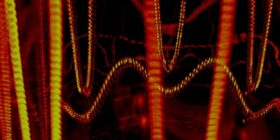
Perhaps the best expression of the incorporation of both deterministic and randomised elements is found in the images produced using a light pen. By substituting this for a physical pen, and using a DSLR camera and photographic enlarger to capture the images (a cunning fusion of old and new photographic technologies), Tait produces what I think are his most compelling images. One can see a suggestion of the Constructivist origins of his thinking on process in art: the light drawings seem to pick up where Moholy-Nagy and Man Ray left off with their “photograms”. Tait has arrived at this form from a very different direction to these pioneers, but the idea of a non-objective photograph produced using purely mechanical means has a very interesting heritage of which he is fully aware.
1.3 Introductory Statement by Frederic Fol Leymarie and Glenn Smith (Department of Computing, Goldsmiths, University of London / Space Machines Corporation)
Our two colleagues having already provided a comprehensive picture of Tait’s career as an artist, we shall have the luxury of a more theoretically-oriented approach, and one which places his work and the devices he has created within the history of drawing machines and drawing machine art.

Figure 1. Some examples of drawing machines: a) The Writer by Pierre Jaquet-Droz, 1774, Musée d’Art et d’Histoire, Neuchâtel; b) a wooden, dual-pendulum harmonograph not unlike those exhibited in the early 1800s; c) Méta-Matic No. 10 by Jean Tinguely, 1959, Museum Tinguely, Basel; d) The “Baxter” robot writing its own name in a graffiti tag style, by D. Berio, S. Calinon & F. Fol Leymarie (2016).
That history (Figure 1) is surprisingly rich and varied, and with the early Jaquet-Droz Writer of 1774 and the harmonograph, invented early in the succeeding century, conveniently illustrating two of its distinct theoretical axes: 1) the deterministic vs. the random; and 2) the digital vs. the analog.
The Writer, an assembly of about 6,000 pieces is, at this stage in technological evolution, still unquestionably analog. Activated by forty carefully engineered cam wheels, the rotation of their smoothly-varying perimeters is precisely translated into a courtly script — the ability to move the pen in both the X, Y and Z directions across and above a flat surface. It also represents an early example of a re-programmable machine: each cam wheel embodying the instructions to produce a particular letter, the automaton can be re-set to write different successive characters and words in a beatuiful calligraphic style. Within fifty years, however, those cam wheels would be transformed, first into carefully punched cards, for the Jacquard loom, and later evolved further by Charles Babbage into the gears of a discrete state machine, i.e., a mechanical digital computer; and although the computer is, in some sense, the essence of a deterministic device, it has also become capable, as it has gained a billion-fold in the number of its working elements, of producing random-seeming, art-like outputs that are quite compelling.
The dual-pendulum harmonograph, on the other hand, is the very definition of analog: two pendulums harmonically oscillating at right angles to one another, and attached to a single pen. By varying the amplitude and phase of their swings — and this, as done by hand, inevitably quite random — it is possible to create a variety of beautifully delineated figures, from ellipses to figure-eights, and with the inevitable decay in oscillation producing many wonderful, seashell-like embellishments. As already alluded to, moreover, these are known as Lissajous figures in honor of the French mathematician who first explored their formal properties.
Jean Tinguely, in contrast — that wily, late 20th-century kinetic sculptor — does not commit himself. On the surface, it would seen that his motor-driven drawing machines, with the pen attached to the end of a crank arm, would be strictly deterministic and analog in operation; but by constructing them from aging and badly-worn parts, the random “emerges in a marvelous, natural way” (Smith 2011, p. 24). The crank arm, moreover, is typically a long piece of what seems to be coat-hanger wire, and so in its deliberately comic vibrations and flexibility there is at times even developed in the markings a digital-seeming pixelation.
And as a 21st-century example of a drawing machine, we have “Baxter” — an industrial collaborative robot, used in the context of a collaboration between Frederic Fol Leymarie’s group at Goldsmiths (London, UK) and Sylvain Calinon at Idiap (Switzerland). This “compliant” (i.e. flexible rather than rigid in its control and movements) robot currently is capable of drawing in the quite flamboyant style of grafitti artists. Indeed, that style was chosen as a research target precisely because of its challenging, non-orthogonal nature; and Baxter, as controlled by a digital computer — but with his drawing arm also subject to the analog constraints of mass and momentum — has become something of a master (Berio et al., 2016).
If, finally, there is a lesson to be learned from these examples, it is that there are intimate connections between the analog and digital, and between the random and the deterministic — and this has been the exact focus of Jack Tait’s 50-year exploration of drawing machines. Steeped as a young man in the Constructivist and Bauhaus technological optimism — “Believing the machine to be our modern medium of design, we sought to come to terms with it” [1] — he has created analog drawing machines according to essentially all of the major theoretical constructs save the purely robotic: 1) several sub-varieties capable of generating Lissajous figures, and to which he has assigned, as his studio assistants, the code names of “Linkogram”, “Meccanograph”, and “Homage to Henry” — the last in reference to Henry Paul Desmond, whose drawing machines he reverse-engineered with the blessing and assistance of Desmond’s daughter Elaine; 2) “sine wave” machines, which, in basic terms, are only capable of steadily moving a pen in the X direction across a rotating drum while at the same time generating excursions in the Y direction; 3) multiple X/Y-Cartesian machines, and which he designates with the family call letters “NSEW”, i.e., “north-south-east-west”; and 4) “turntable” machines, and to which he has added that device — or the linear equivalent thereof — as a continuously-movable drawing surface.
Most of these, moreover, have been outfitted with sophisticated phase timing and randomization devices, and thus constituting, in their own right, analog computers; and we here, as well, echo a point already made by Nick Lambert: by replacing the ink pen with a light source trained upon the aperture of a camera, it has been possible in many cases for Tait to create analog machine photographs as opposed to drawings.
More to the point, however, is the fact that Tait has created with all of these analog machines drawings and photographs of extraordinary beauty and dynamism — one is somehow reminded of his Welsh countryman Dylan Thomas’ famous “the force that through the green fuse drives the flower” [2] — and in many cases involving a sensitive post-processing Photoshop coloration by the artist himself.
Only rarely has Tait involved himself with the purely digital as his primary (as opposed to secondary/post-processing) medium — most notably in the early 1980s with a Hewlett-Packard 9125A calculator/plotter — but even here, and as represented in our survey with two examples, he has exhibited a mastery of human/machine graphic creativity.
His career has thus been exceptional in scope; and although this communication does not pretend to do justice to the aesthetic/theoretical issues raised by Tait’s machine drawings, the authors hope to have herein presented a reliable introduction to those issues. We hope, in addition, to have presented an introduction to his place in art history, and which can be seen as a tribute to the Constructivist/Bauhaus machine aesthetic to which Tait was first exposed as a young man of 18 in the RAF, and as avidly seized upon thereafter in art school: a mighty and continuing force in the evolution of techno-art.
2.0 Jack Tait and the Art of the Analog Drawing Machine

Figure 2. Some of the drawing machines designed and fabricated by Tait, 1970-2013: a) initial “NSEW” (“north-south-east-west”) machine, part Meccano; b) “Linkogram” Meccano prototype; c) “Linkogram Mk I”; d) “Linkogram Mk III”; e) “Mechanograph” with variable amplitude X axis; f) linear drive plotter with pen rotator; g) “NSEW” machine with sun and planet drives; h) sinewave machine; i) early turntable machine; j) “Timer 4” programmer, most complex version built; k) “Scribblogram” X/Y plotter with cross-hatching pen; l) 2013 turntable machine with light pen fitted.
.

Figure 3. Shown here is a Lissajous-type drawing machine at work. With an ultra-precise X/Y ratio of 1 to 1.002 and an assymmetric pen lift, this machine is capable of very accurate line placement, and thus creating the possibility of secondary “out of phase” patterns useful in the exploration of random effects. It is possibly the most precise machine Tait has built, and is still in regular use.

Figure 4. As our final image dedicated to the technical aspects of Tait’s work, this is a close-up of the ultra-fine resolution possible with the above machine.

Figure 5. As our first example of one of Tait’s analog machine works, we present this strikingly-modern 1972 image. Growing out of Tait’s work as a photographer and camera builder, it was generated by an early and very simple light on film machine with turntable and X axis.

Figure 6. Homage to Kenneth Martin, 1981. Generated using a Hewlett-Packard 9125A calculator/plotter running a program written by Tait himself and featuring partially-randomized line end points.

Figure 7. Tessellated figure, 1981. Again generated using a Hewlett-Packard 9125A calculator/plotter running a program written by Tait himself, but in this case featuring a deterministic sine-wave pattern, and with color added using Photoshop according to a mathematically-derived tonal progression.

Figure 8. Wavebreak, 2003. Generated using an early sine-wave machine, and with color added via Photoshop. The wave size changes as the drawing progresses, and a ‘wave break’ motif occurs at the lower part of the cycle.

Figure 9. Homage to Mondrian, 2005. Generated with an early “NSEW” (“north-south-east-west”) X/Y machine with carefully tuned randomization of its strictly rectilniear excursions, and again with color added via Photoshop.

Figure 10. Blue Figures, 2005. Again generated using an early “NSEW” X/Y machine — but in this case with randomized curvilinear excursions — and again with color added via Photoshop.

Figure 11. A “Scribblogram”, 2008. This machine made large A3 drawings, and is the only one to have been fitted with a frenetic crosshatch pen action. Three different color runs were made to produce this image.

Figure 12. A “Mecchanograph”, 2009. This is a basic multi-colored drawing which has been tonally inverted and a neon effect added via Photoshop.

Figure 13. Flame, 2009. An “NSEW” light drawing with a rotating color wedge on the light pen. This image was chosen for the cover of Tait’s book Art by Machine (Tait 2013), which is in turn a condensed version of his PhD thesis.

Figure 14. A fine line image, 2010. Generated with an “NSEW” machine equipped with a slit image light pen and a camera equipped with a high speed shutter. The intent here was to emphasize color gradation by way of producing a photograph of what seems to be an actual physical phenomenon.

Figure 15. Strawberry, 2012. Generated by a “Meccanograph” set for a 1:3 phase relationship and as combined with a variable X axis amplitude, and with Photoshop graded color filling.

Figure 16. A Lissajous figure, 2014. Generated on the latest “Linkogram” machine, which is capable of very fine line spacing, and with an X/Y ratio of 1:2. While generating images superficially similar to those of a harmonograph, these machines, with their variable amplitude crank systems, are far more controllable, and with this particular example (Figure 2d) one of those now in the collection of the Kensington Science Museum.

Figure 17. A highly random “NSEW” light drawing, 2016. This image was specifically generated for an in-progress paper on the subjects of randomness, chaos, and subjectivity.

Figure 18. Wavebreak, 2017. A “Sinewave” machine drawing onto photographic paper with a very fine light pen, and with the wave break effect the result of deliberate mechanical programming. Light drawing onto photo paper produces a wholly different line than that of an ink pen, and with tonality the bonus as the result of a slight light spill.

Figure 19. Edge of Chaos, 2019. This is an “NSEW” machine drawing generated with highly-randomized linear and circular excursions, and with Paul Klee in mind. The machine was run for a longer time than usual, and was only stopped when it approached ‘near chaos’. In comparing it with Frieder Nake’s Homage to Klee [3], one must be struck with the degree to which that early 20th-century artist has captured the imagination of later generations of both techno-artists and, as well, theorists such as Yuk Hui (Hui 2021).

Figure 20. A “Turntable” machine drawing with two color pen, 2019. This machine was specifically designed for a recent investigation of randomness and ‘near chaos’, and is the only one able to simultaneously accommodate both a hard and soft pen.

Figure 21. An “NSEW” light drawing, 2019. As with Figure 14, the intent was again to produce photographic tonality.

Figure 22. Two color “Turntable” drawing, 2019. In this case the rotary turntable has been replaced by a linear stage.

Fig 23. An ultra-fine resolution Lissajous-type drawing, 2019. This was generated by the machine shown in Figure 3, and with a detail of the drawing itself shown in Figure 4.

Figure 24. Calligraphy, 2020. A light drawing generated with the latest “NSEW” machine, and combining the use of a shutter and color changer. The light pen is able to be rotated at random locations, and the randomizer itself the most sophisticated yet produced, with the same six possible outputs as the throwing of a die.
………………………….
Funding
This research received no external funding.
Acknowledgments
The authors would like to acknowledge Jack Tait’s fifty years of effort in producing these marvelous works of art.
Conflicts of Interest
The authors declare no conflicts of interest.
…………………………….
Notes
[1] This a statement by Walter Gropius, and as cited by Juliette Bessette in her “The Machine as Art” introductory essay (Bessette 2018).
[2] This is the first line of the poem, which, when published in 1934 when Dylan Thomas was 20, made him instantly famous. (https://en.wikipedia.org/wiki/18_Poems)
[3] See co-author Smith’s interview (Smith 2019) with Nake, and wherein his Homage to Klee is illustrated.
……………………………
References
Berio, Daniel; Calinon; Sylvain, Fol Leymarie, Frederic. 2016. Learning dynamic graffiti strokes with a compliant robot. In the Proceedings of the IEEE International Conference on Intelligent Robots and Systems (IROS), pp. 3981-6.
Bessette, Juliette. 2018. The Machine as Art (in the 20th Century): An Introduction. Arts 7, no. 1: 4. https://doi.org/10.3390/arts7010004. Available online: https://www.mdpi.com/2076-0752/7/1/4
Hui, Yuk. 2021. Art and Cosmotechnics. Minneapolis, MN, USA: University of Minnesota Press.
Nagel, Thomas. 2012. Mind and Cosmos: Why the Materialist Neo-Darwinian Conception of Nature is Almost Certainly False. Oxford, UK: Oxford University Press.
Smith, Glenn W. 2019. An Interview with Frieder Nake. Arts 8, no. 2: 69. https://doi.org/10.3390/arts8020069. Available online: https://www.mdpi.com/2076-0752/8/2/69
Smith, G. W. 2011. Aesthetic Wilderness: A Brief Personal History of the Meeting between Art and the Machine, 1844-2005. New Orleans, LA, USA: Birds-of-the-Air-Press. Available online: http://www.space-machines.com/Aesthetic_Wilderness.pdf
Tait, Jack. 2007. Taitographs – drawings done by machine. PAGE 65, bulletin of the Computer Arts Society, Autumn. Available online: https://computer-arts-society.com/uploads/page-65.pdf
Tait, Jack. 2013. Art by Machine, Taitographs, Programmable Analogue Drawing Machines. Bronydd Press, Hay on Wye, Wales.
Tait, Jack. 2022. About me [autobiographical sketch]. Available online: https://www.taitographs.co.uk/about-me.html
…………………………………………
Get the Full Experience
Read the rest of this article, and view all articles in full from just £10 for 3 months.


No comments yet.