The Spiritual Art Collective
THE SPIRITUAL IN ART COLLECTIVE is an international collective dedicated to research into the spiritual dimension of contemporary art. Formed in 2026 following an international Open Call, the Collective brings together artists from different geographical, cultural and disciplinary contexts. They are united not by a common aesthetic or a predetermined definition of the spiritual, but by a shared willingness to explore its meaning and possibilities within contemporary art.
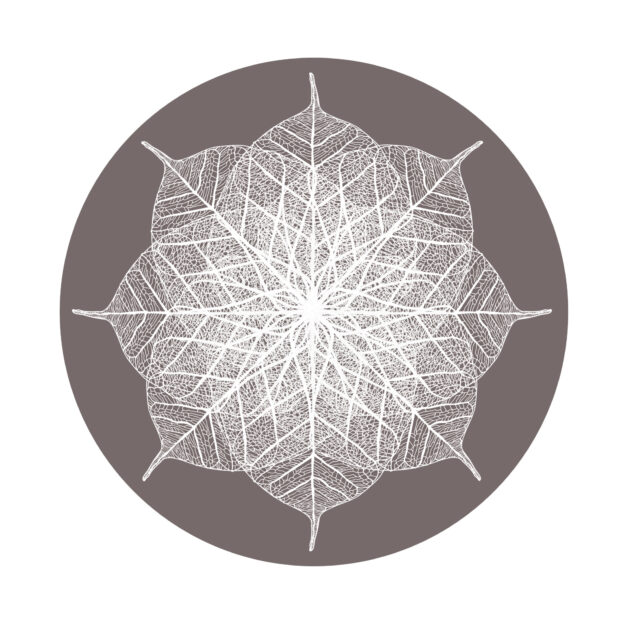
THE SPIRITUAL IN ART COLLECTIVE. Nellimya Mandala White
A First Constellation
THE SPIRITUAL IN ART COLLECTIVE does not set out to assert a thesis about the spiritual. It begins from an open question: What languages, practices and forms of experience emerge when the spiritual dimension operates as both a field and a mode of inquiry in contemporary art?
The first group of fifteen artists came together around this question on 3 August 2026. THE CODE OF THE SUBTLE is the first observational device within the research: because most of the works were conceived before sustained dialogue among the members, they do not illustrate a shared position. They register an initial condition — fifteen autonomous practices, with different vocabularies, methods and references, brought for the first time into the same field of inquiry.
The exhibition can therefore be read as a first constellation: not a result, but a starting point from which affinities, divergences, transformations and resistances to transformation can be observed.
The dialogue does not begin from a shared repertoire of ‘spiritual’ symbols, but from concrete practices and fields of research: landscape, perception, resonance, light, temporality, memory and mourning, gesture, transformation, social responsibility, and the history of modern esoteric currents, including Theosophy. What connects them is not adherence to a doctrine, but attention to experiences and relations that visible or measurable description cannot exhaust. This field of inquiry also opens onto deeper conversations about visions of life, values and different understandings of humanity, bringing forward questions and perspectives to reflect upon and work with.
A Geography, Not a Single Container
The works remain in the countries and contexts in which they are activated. Distance is not treated as a logistical limitation but as a curatorial condition of the project: each work retains its own place while entering a shared geography. The coordinates of the activations thus trace an initial relational drawing.
Nellimya Arthouse — an independent space dedicated to contemporary art, research and artist residencies, based in Aranno in the Malcantone region — does not act here as a simple exhibition container. It coordinates the curatorial device that makes this geography legible: it receives the Mail Art / works-as-letters as Letters of Intent, gathers video documentation of the activations and hosts moments of research dialogue. These materials do not replace the works: they make their position within the process visible.
Artists / Works
| Patrick Altes
Living Pillar |
Drawing on Baudelaire’s poem Correspondances Altes sees Nature as a network of correspondences, talking in obscure symbols and offering elusive connections with the universe. Living Pillar shifts the spiritual question towards how we read the natural world and the possibility of re-establishing a non-unilateral relationship with it. |
| Daniela Bozzetto
The Beginning of an Ascent · Transfert |
In the Transfert cycle, Bozzetto reduces compositional control and uses automatic drawing as a condition of receptivity. The Beginning of an Ascent records the point at which form emerges before being fully named: a practice concerned with the relation between intention, gesture and what exceeds the project. |
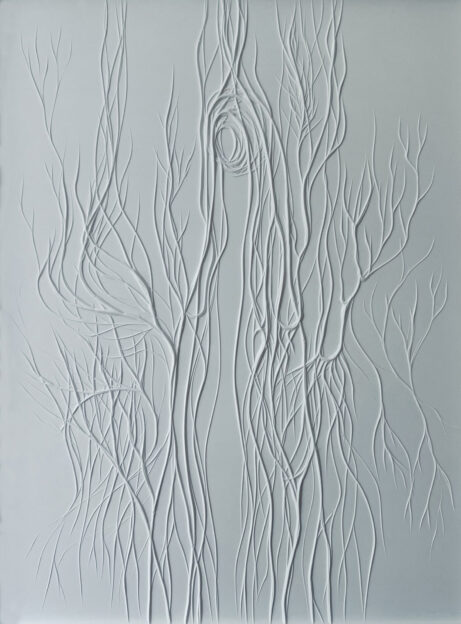
Daniela Bozzetto :The Beginning of an Ascent, from the Transfert cycle
| Jorge Cañete
Vita est peregrinatio |
Branch, mirror, gold leaf and raven feather articulate a symbolic map of the existential journey. The mirror introduces a gap between what is before us and what can only be recognised in reflection. Vita est peregrinatio works through choice, memory and destiny. |
| Séverine Christen
Les Vases Communicants – Living Temple |
“What do we, as humanity, need to receive today?” began the artist’s inquiry, unfolding through a channelled practice rooted in heart-centred presence. From the silence within, 137 paintings emerged, formed of concentric circles that evoke energetic interconnection and collective consciousness. Made on handmade paper, each piece holds the memory of a cycle closing, so a new one can begin. |
| Emilio Ferro
MIRACLE |
In MIRACLE, light, metal and sound reconfigure the Chapel of San Rocco. The sound composition incorporates samples of magnetic fields and recordings from the site, bringing phenomena normally beyond ordinary perception into sensory experience. Architecture, body and environment are treated as a single field of resonance. |
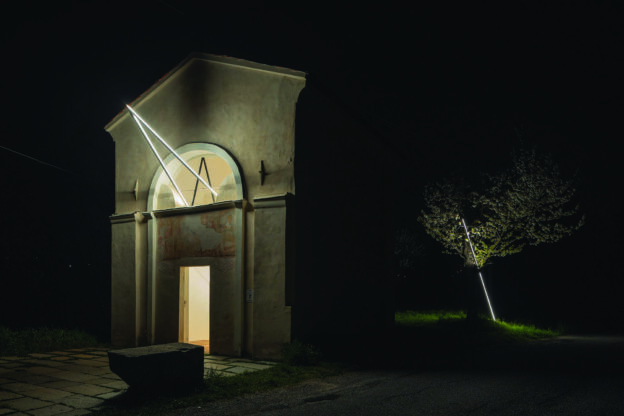
Emilio Ferro: MIRACLE, 2024 (photo: Roberto Conte)
| Vasudha Kapadia
Boredom and Other Forgotten Skills |
Kapadia uses the slow repetition of marks and the practice of boredom as forms of attention. The work does not idealise inactivity: it takes it as a condition for re-entering minimal variations of gesture and natural structures that acceleration tends to blur. |
| Agnieszka-Rose Kuntzmann
The Altar |
In The Altar, the painting Departure is carried into the landscape and temporarily installed in a remote natural setting. The journey to the site becomes part of the work, bringing painting and landscape into direct relation. The project asks where the sacred actually happens: in the image, in the landscape, or perhaps in the encounter between them. |
| Mya Lurgo
STARGATE → COMMUNIO |
STARGATE transforms the clock into a device of presence: the introduction of ‘Zero’ opens a thirteenth sector between measured time and the instant, while a mirrored hand returns the observer to the observed. From this installation, COMMUNIO unfolds as an interactive sculpture equipped with a QR code that subtly activates an audiovisual field in the forest, fostering a relationship with those who have passed on. |
| Pól McLernon
AONLAITH: Resonant Fields |
AONLAITH: Resonant Fields treats resonance as a material process. Body, instruments, architectural cavities and environmental fields become parts of a single listening system. McLernon uses frequency, vibration and acoustic response as tools of inquiry, including in Neolithic spaces, to investigate the relationship between body and environment. |
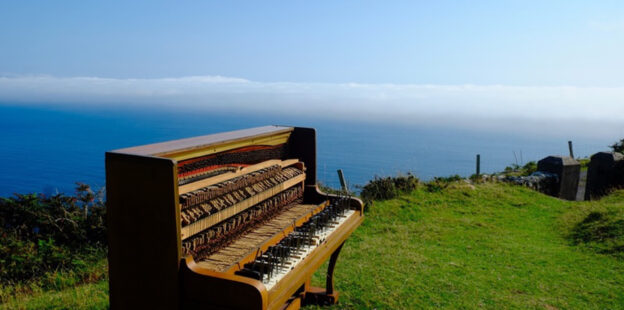
Pol McLernon: Resonant Bodies, 2021 AONLAITH
| Luiza Milewicz
Field Apparition |
Field Apparition uses fibre optics, mirror, light and the natural environment to shift attention from the object to the perceptual field it produces. The work becomes a condition of apparition: what matters is how light, reflection and context make a network of relations perceptible. |
| Catrin O’Hara
The Peony Studies |
Through repeatedly returning to the same flower, O’Hara recognises the emergence of a mourning process not anticipated at the outset. She defines the method as ‘iterative revelation’: meaning is not established in advance but surfaces through repetition, time and attention. Here the spiritual coincides with a mode of making rather than an iconography. |
| Luca Serasini
Poliedro B · Waiting for Angels |
Waiting for Angels begins with Jacob’s stone-pillow and reformulates it as an irregular polyhedron. In the passage from biblical narrative to geometric form, Serasini avoids narrative illustration while preserving the structure of waiting: a contemporary form through which to question hope, the complexity of the real and the relationship with the invisible. |
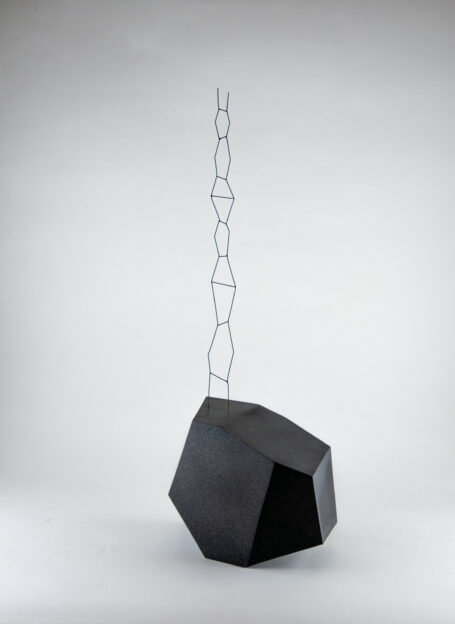
Luca Serasini: Poliedro B, 2024.
| Oli Sorenson
Homeless series |
In Sorenson’s work on the housing crisis, the spiritual dimension is inseparable from social responsibility. The ‘unveiling of hidden realities’ concerns what a society chooses to see or remove from view. Care and dignity become criteria through which the very idea of humanity is questioned. |
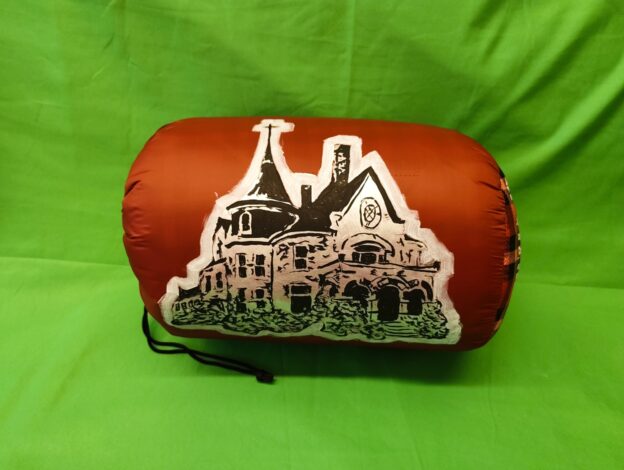
Oli Sorenson: Homeless, 2026.
| Vincent van Oss
Lauweriks’ Borobudur |
Lauweriks’ Borobudur reconstructs a precise historical node: Mathieu Lauweriks’ Theosophical research and his encounter with Borobudur. Geometries and ‘kundalini-lines’ are reactivated to reconsider the relationship between matter and spirituality. The history of modern esotericism becomes research material rather than ornamental citation. |
| Anna Walker
Connective Tissue |
Connective Tissue begins with walking and photographing the landscape. The photographs are then returned to the landscape through a simple ritual, printed and left outdoors, exposed to rain, light and time. Their degradation is part of the work: the continued photographing becomes a record of the trace, an encounter with place, carrying memory between landscape, community and time. |
A Process to Observe, Not an Identity to Illustrate
THE CODE OF THE SUBTLE is not the result of the Collective: it is its public starting point. In the months that follow, the ARTCAFEs — periodic meetings for exchange and research among the artists — together with the Letters of Intent and shared research will make it possible to observe whether and how dialogue modifies the practices. The project does not presuppose convergence: it may produce affinities, divergences, collaborations or no synthesis at all. It is this transformation—or resistance to transformation—that constitutes the research material.
This approach distinguishes the project from a conventional thematic exhibition. The works were not selected to illustrate an already established definition of ‘the spiritual’; they are brought into relation to examine what meanings the term acquires as it passes through different practices, contexts, and media.
The Title: ‘Code’ and ‘Subtle’
The title does not allude to a secret code or a shared esoteric doctrine. In the project, ‘Code’ denotes a provisional set of ways in which each practice makes a relation legible: signs, images, frequencies, gestures, materials, times and places.
‘Subtle’ can likewise be specified without resorting to vagueness. The term derives from the Latin subtilis, linked to the weavers’ phrase sub tela: ‘passing beneath the warp’. In the project, this etymology is not used as metaphysical proof but as an operational image: the subtle is what passes through the fabric of experience without presenting itself as a separate object. It requires attention and discernment, not indeterminacy.
A Question That Continues
A precise historical-critical antecedent emerges from Richard Bright’s interview with Charlene Spretnak, published by Interalia Magazine in 2015 (https://www.interaliamag.org/interviews/charlene-spretnak-on-the-spiritual-dynamic-of-modern-art/). In it, Spretnak summarises the thesis of her book The Spiritual Dynamic in Modern Art: based on statements and documents from numerous modern artists, she argues that spirituality was not a marginal element but a generative component of many practices. She calls it ‘the great underground river that flows through modern art’.
| What forms does that ‘underground river’ take today when fifteen artists, without sharing a doctrine or an aesthetic, test it through different practices, places and media? |
At this stage, the Collective’s task is not to define the spiritual.
It is to construct conditions precise enough for the question to produce works, dialogue and critical knowledge.
……………………………………………………
THE SPIRITUAL IN ART Collective
https://www.nellimya-arthouse.ch/en/arthouse/the-spiritual-in-art/
The Code of the Subtle / current project
https://www.nellimya-arthouse.ch/en/arthouse/next-2/
The catalogue is available to download directly from the website.
Get the Full Experience
Read the rest of this article, and view all articles in full from just £10 for 3 months.
No comments yet.