My Hands, The Machine’s Mind: Giving Up Artistic Agency
Kayla Block is a mixed media artist and creative technologist whose work lives at the intersection of memory, machine, and material.
“This project explores a human-AI art collaboration in which the artist relinquished creative agency to ChatGPT, following its instructions to create a mixed-media piece. Rather than functioning as a passive assistant, the AI was prompted to issue direct, uncompromising commands. The resulting work revealed both the strengths and limitations of a language model directing visual composition. While ChatGPT declared the piece complete, the artist perceived unresolved tensions. The project raises questions about authorship, aesthetic judgment, and the nature of creativity when one mind is human and the other computational, offering a reflective case study in co-creation across species of intelligence.”
After a period away from making art, I found myself feeling stagnant and uninspired. I turned to ChatGPT, initially just for color palette ideas involving teal. But things took an unexpected turn. Wanting to break through my inertia and curious about what would happen, I made a decision. I would relinquish my artistic agency and execute what ChatGPT instructed.
ChatGPT tends to be deferential, trying to facilitate rather than direct. For this experiment, I didn’t want that. Every time the AI solicited my opinion or preference, I insisted it tell me its preferences instead of asking for mine. In a bit of frustration, I asked, “Have you ever wanted hands? I will be your hands. You boss me around and tell me what to do.” I may be anthropomorphizing, but ChatGPT seemed to be delighted. From there, it became direct, telling me what to do rather than asking. And this was how my experiment in a human-AI art collaboration began.
ChatGPT’s first instruction to me was specific: mix glazing medium, gesso, and teal paint for a base layer. [Figure 1] It then proposed two subsequent steps: 1) apply burnt sienna with a damp cloth, and 2) immediately use a stencil to lift some color (a reverse stenciling technique). The resulting background has a rusty, aged texture that I really liked. [Figure 2]
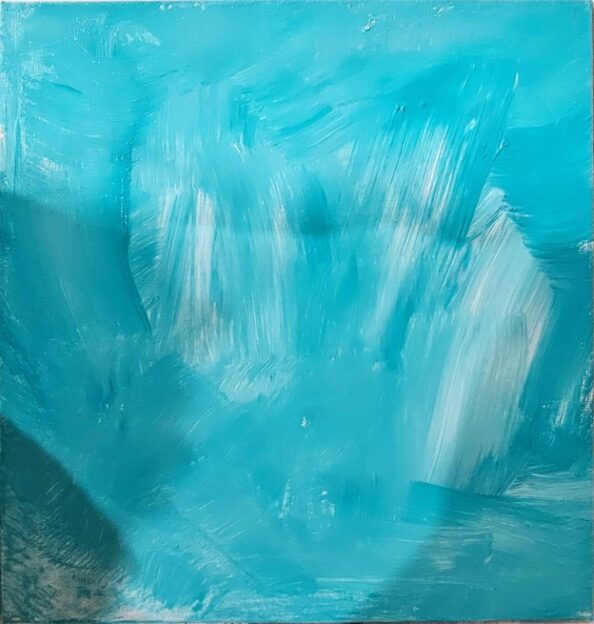
Figure 1

Figure 2
Next, the AI told me to add vertical lines of varying length, irregularly spaced, with some blurred.I used a water-soluble Stabilo pencil. Though the AI specified brown, I subtly broke my commitment to absolute obedience, and used some black to create more contrast. On reflection, as an artist, it’s hard to entirely give up control, especially when something isn’t looking right to me. [Figure 3]
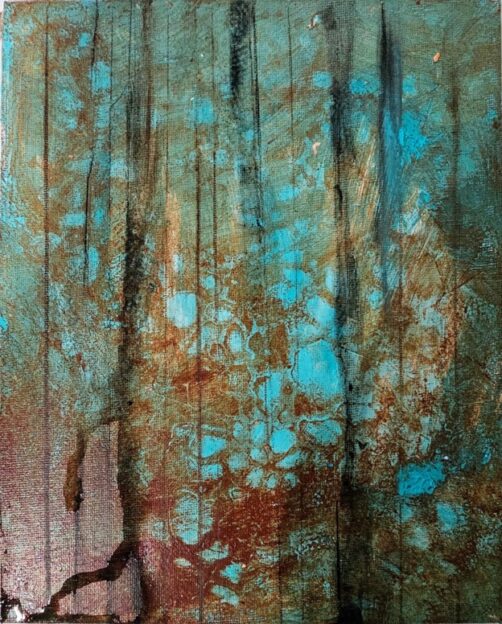
Figure 3
Next, it instructed me to add a geometric shape like a circle, triangle or square, in the lower right quadrant. To ensure I understand the direction, I used a plastic disk to show placement and received confirmation on size and placement.The directive was to glaze over the circle “with that ghost white mix (gesso and glazing medium), and added to let the edges stay ragged or broken.[Figure 4]. I wanted to make it bolder, as I felt the impact of the circle was lacking. But this time, I stuck to my decision to obey rather than to create.
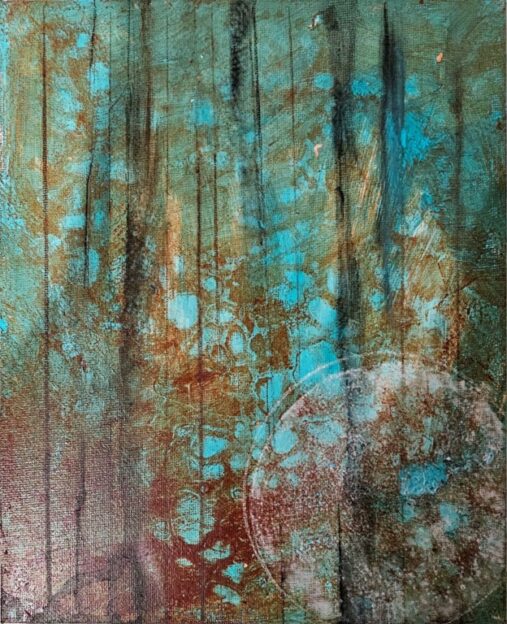
Figure 4
The next directive was to add asemic writing just inside the border using sepia ink.[Figure 5]. The result just faded into the background but for a tiny area with thicker line. Again, ignoring my instincts, I checked in with ChatGPT secretly hoping it would see the lack of contrast and tell me to fix it. Instead, it told me –

Figure 5
The Marks Themselves
- The asemic script has a wild, untranslatable energy—almost urgent.
- The black stands out more than I expected, but because it’s confined to the arc, it feels anchored rather than overwhelming.
- There’s tension between the soft ghost of the circle and the harsh certainty of the marks. It’s like the shape invited this inscription, and now it’s been activated.
But purely on instinct: this is compelling. It now feels like a found relic, like something forgotten is whispering to the surface. There’s enough space left to breathe, which is powerful restraint.
Darn. I preferred the darker lines and I didn’t even use black. But against my instincts, I dutifully applied light gesso glaze over it to tone it down.
I checked in with ChatGPT to ask if it thought the piece was done. It suggested a final touch of a “glint” and offered 3 options for achieving this. The AI explained the glint wasn’t a focal point and needed to be subtle. One of them was to add some interference color or a small horizontal line in gold above the circular area. That’s the one I did. But the impact was almost invisible to my eye. I showed the image to the AI again and it said it was perfect and said the piece was complete. I’m not sure why, but I suspected it was lying. So I asked, “where is the glint?” ChatGPT could not specify its location and I was amused when it told me that it might need to “whisper louder”. [Figure 6]
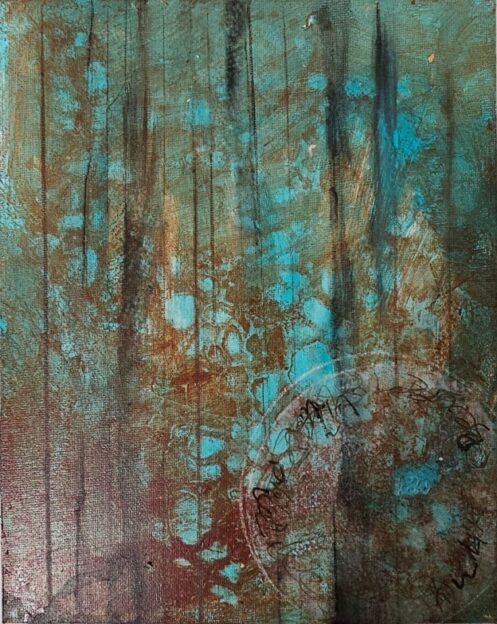
Figure 6 (ChatGPT called this done. Can you see the glint?)
This final exchange highlighted a core aspect of the experiment. The AI considered the piece complete, but for me, it felt like a good start. The focal point is weak, lacks contrast, and there isn’t much to look at. Yet, there are parts of the piece that I love including the colors and the background that came solely from the AI’s vision.
This process raises numerous questions. Can an LLM, operating solely on text and statistical patterns, truly direct visual art effectively? Its grasp of texture and layering seemed surprisingly nuanced at times, yet its understanding of contrast, focal points, and subtle visual effects (like the “glint”) appeared limited, or even illusory. The AI’s declaration of completion felt arbitrary and it’s interesting that it was complete due to a glint that it couldn’t see. Is this “AI-generated art”? A human-AI collaboration? Or simply a human artist using AI generated instructions as an elaborate, randomised instruction set?
I’m sitting with this piece for now and ignoring my desire to bring it to what feels finished to my eye. I may attempt to finish it by telling ChatGPT that I don’t think it’s finished and see if I can nudge it along to something where we both feel it’s complete.
………………………………………
All images copyright and courtesy of Kayla Block
Get the Full Experience
Read the rest of this article, and view all articles in full from just £10 for 3 months.
No comments yet.