Murky Bodies
Elaine Whittaker is a Canadian visual artist working at the intersection of art, science, medicine, and ecology. Biology is the basis for her installations, sculptures, paintings, drawings, and digital images. These works incorporate traditional and unconventional materials: paint, pigment, wax, mosquitoes, salt crystals, human cells, textiles, repurposed fibres, and live microorganisms. ‘Murky Bodies’ is a series of four installations speculating on the entangled ways in which humans, plants, animals and microorganisms emerge and co-exist in a world confronting a warming climate, rising seas, intensified water cycles and extreme storms.
Murky Bodies
The unseen is what will undo us, not so much what is out of sight but what we refuse to see.
Maureen Hynes, Sotto Voce, 2019
In September 2019 Hurricane Dorian churned over the northern islands of the Bahamas. It had reached category 5 on the Saffir-Simpson Scale, the highest measure of intensity for hurricanes. After devastating the island of Abaco, it set off on a furious trajectory to Grand Bahama Island (where I lived with my family in the 1970s). For twenty-four relentless hours, Grand Bahama was deluged by winds of 295 km/hr, massive water surges and catastrophic flooding. Much of the island was ravaged.
“The increasing frequency of extreme weather events, droughts and floods is in line with what climate scientists have been predicting for decades — and evidence is mounting that what’s happening is more severe than predicted and will get far worse still if we fail to act.” David Suzuki
Murky Bodies is a series of four installations speculating on the entangled ways in which humans, plants, animals and microorganisms emerge and co-exist in a world confronting a warming climate, rising seas, intensified water cycles and extreme storms. These themes are interpreted and viewed through the lenses and media of BioArt and Science Fiction.
- Treading Insidious Waters: a series of portraits of scientists and environmentalists wearing ineffective and compromised water gear that is water-logged and infected with cholera. The photographs are hung between two round buoys and also incorporated into petri dishes hanging from the buoys. The work suggests the crossing of science and activism in this evolving, fragile ecological landscape.
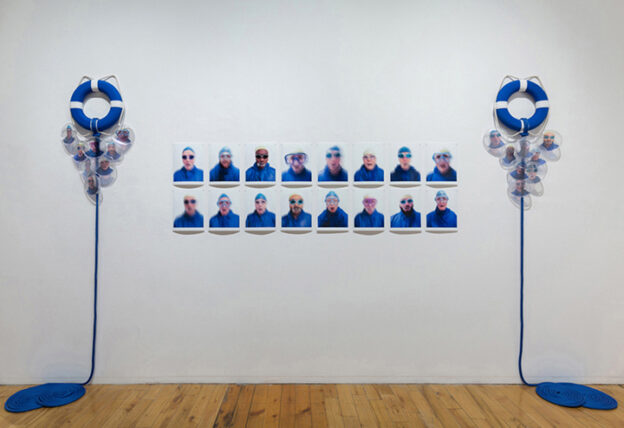
Treading Insidious Waters (installation view), mixed media, 2019, 8’ x 7’ x 6” (David Williams photo credit)
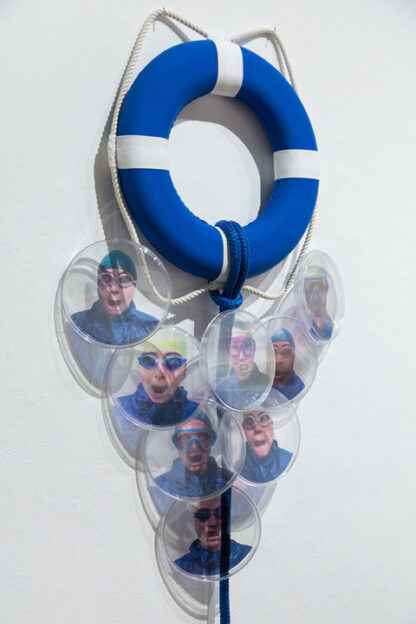
Treading Insidious Waters (detail) (David Williams photo credit)
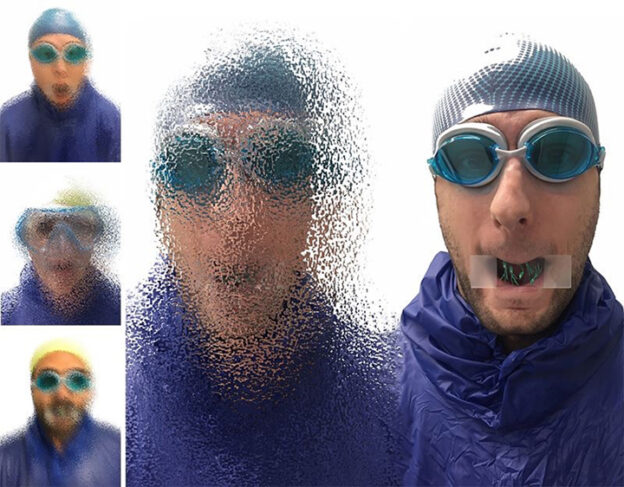
Treading Insidious Waters – Ryan, Stephanie, Ziba & Sayan, digital images, 2019, 9” x 12” each
- Breached: an assembly of empty flood gear and rain boots for adults and children eerily lines a wall. The gear is fogged with crystallizing saltwater that stands as a series of ‘ready-mades’ and a memorial for the lives lost during the flooding.
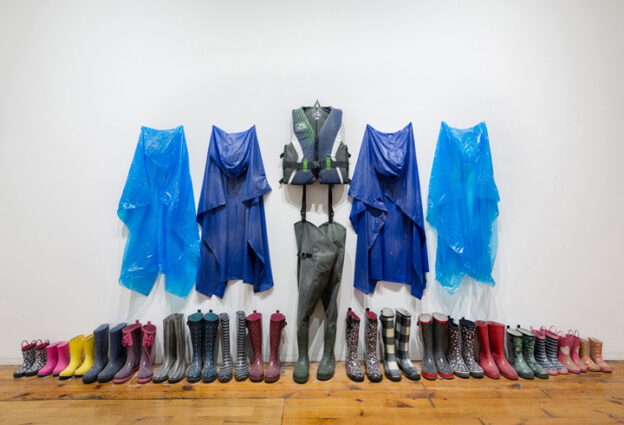
Breached, mixed media, 2020, 10’ x 8’ x 1’ (David Williams photo credit)
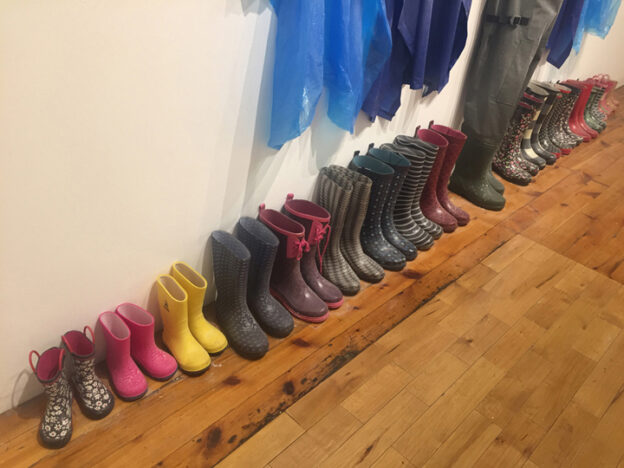
Breached, (detail)
- Spawn: twenty-four petri dishes are placed in rows on acrylic shelves. Each contains an ink and acrylic drawing of imaginary organisms named for Category 5 Atlantic Hurricanes. Each of these hurricanes’ names have been retired by the international committee of the World Meteorological Organization. The names are retired if the storm is so deadly or costly that the future use of its name would be seen as insensitive. These include Janet (1955), Carla (1961), Hattie (1961), Beulah (1967), Camille (1969), Anita (1977), David (1979), Allen (1980), Gilbert (1988), Hugo (1989), Andrew (1992), Mitch (1998), Isabel (2003), Ivan (2005), Katrina (2005), Rita (2005), Wilma (2005), Dean (2007), Felix (2007), Matthew (2016), Irma (2017), Maria (2017), Michael (2018), and Dorian (2019).
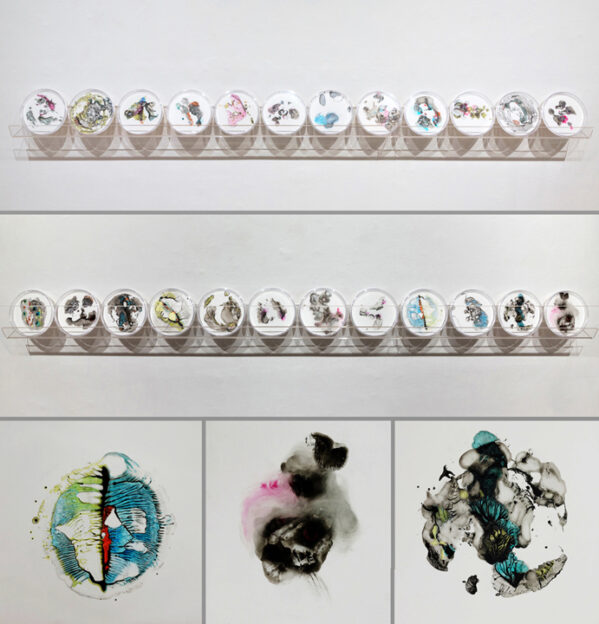
Spawn (shelf 1 &2 with Irma, Dorian & Michael details). 2019. ink & acrylic on paper. 96” x 6” (David Williams photo credit)
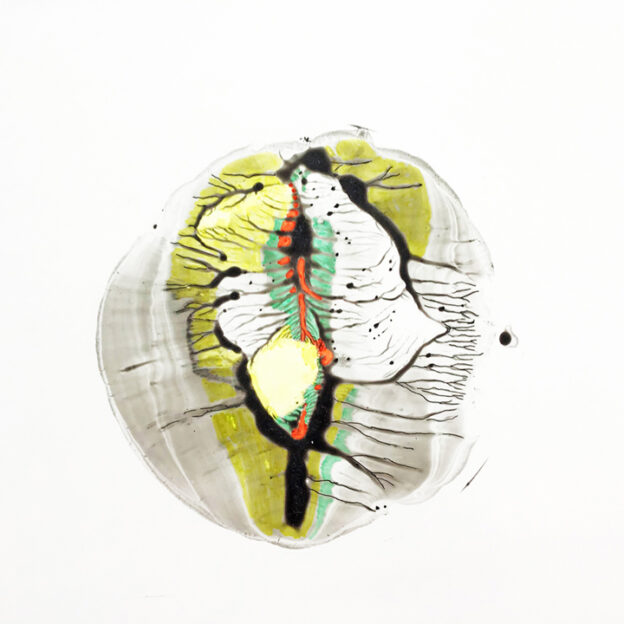
Spawn – Rita, (detail) 2019, 6” x 6”, mixed media on paper
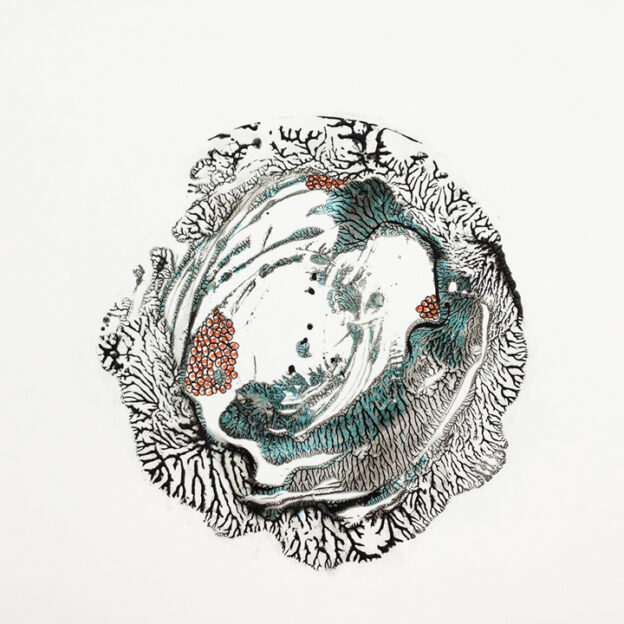
Spawn – Andrew, (detail) 2019, 6” x 6”, mixed media on paper
- Corpus Halite: a human body is metaphorically transcribed by white salt and entangled in a net on the floor. The salted corpse is surrounded and tenuously connected to a series of ceramic buoy creatures. It contains a computerized brain, an electronic heart pump and bi-coloured kidneys circulating water through tubes containing dandelion stems cultured with human and mouse cells. Semi-alive or semi-dead, it is a body transmuted – a cyborg hybrid encased in salt and murky by the scourge of climate change. Surrounding walls and layered with a series of ethereal bodies made of paper and overlaid with petri dishes of live halobacteria, screen images of Hurricane Dorian, and microscopy images of cultured plant and animal cells.
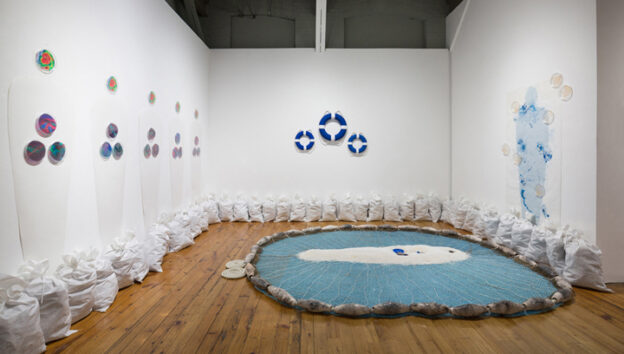
Corpus Halite, (installation), mixed media, 2019-20 various sizes (David Williams photo credit)
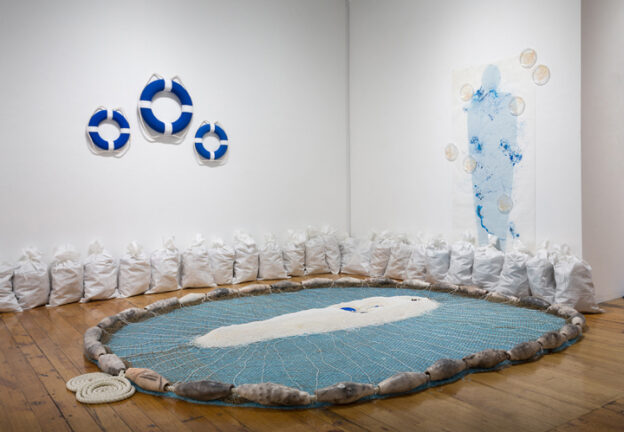
Corpus Halite, (detail), mixed media
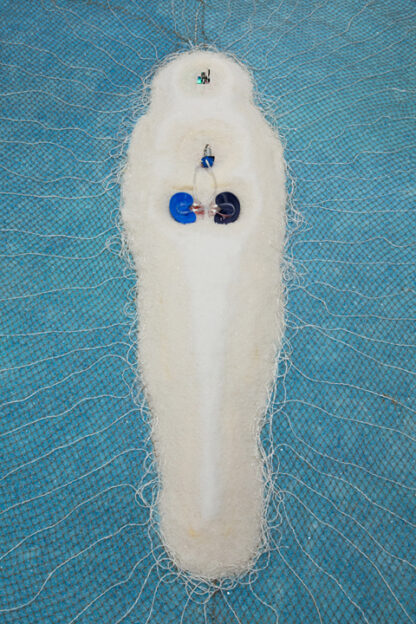
Corpus Halite, (detail of salt body)
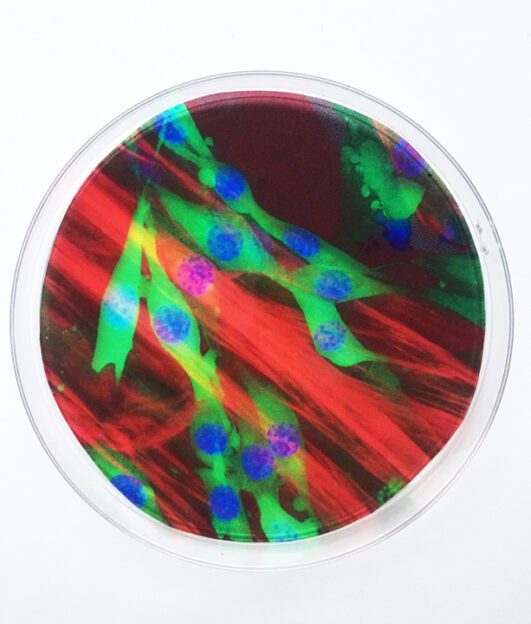
Corpus Halite (dandelion stem with D12 smooth muscle cells detail), 2019, 6” x 6”, microscopy digital image
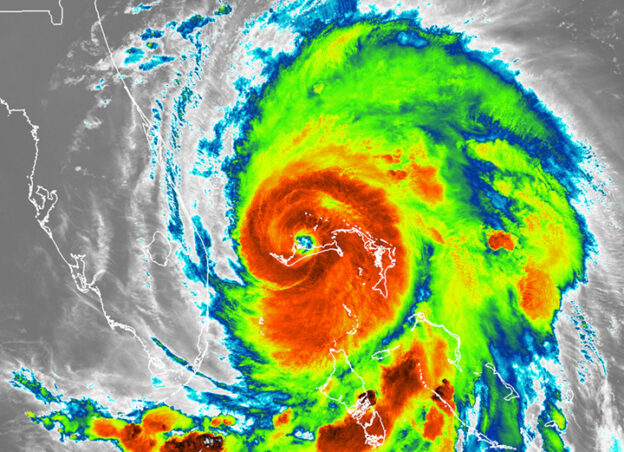
Corpus Halite (Dorian over Bahamas detail). 2019. Digital print. 6” x 6”
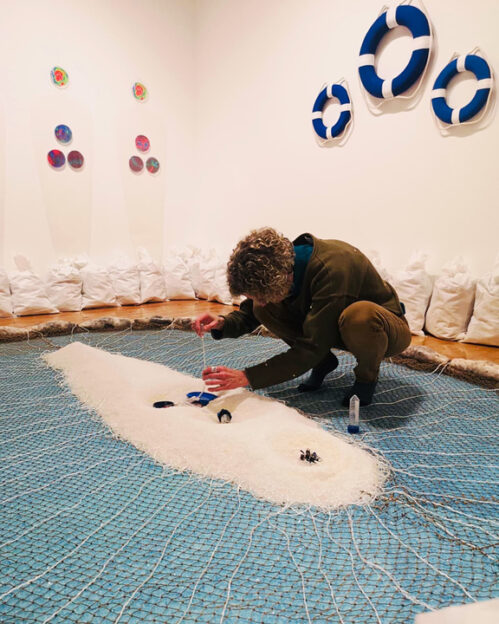
Elaine Whittaker with Corpus Halite
The artworks draw attention to our permeable bodies, now destabilized and infected. Climate Change is a point of disruptive convergence, where thresholds between interior and exterior bodies are continuously breached in a constant exchange with a shifting and uncertain environment. Blurring the boundaries between human and non-human ecologies, Murky Bodies conveys the ways that human intervention and natural transformation generate new landscapes and forms of hybrid life. Consider the question — can we dare move beyond an apocalyptic endpoint and envision a hopeful future?
Murky Bodies was exhibited at the Red Head Gallery in Toronto, Canada in 2020. It was developed as an artist-in-residence at the Pelling Laboratory for Augmented Biology (University of Ottawa, Canada), and draws on collaborations with scientists Dr. Ryan Hickey, Dr. Andrew Pelling, Santiago Campuzano, and Rayna Rasouli. Technical assistance also came from Rob Cruickshank and Cleo Sallis-Parchet at InterAccess Toronto. Portraits include Pelling Laboratory scientists and ecological activists of the Toronto Environmental Alliance.
………………………………………..
https://www.elainewhittaker.ca/
All images copyright and courtesy of Elaine Whittaker
Get the Full Experience
Read the rest of this article, and view all articles in full from just £10 for 3 months.
No comments yet.