Perceiving energy, forces and form
With an interest in astronomy and physics, Lisa Pettibone’s practice investigates the cosmos in terms of energy, forces and form as filtered through human perception. She creates sculpture, installation and print to explore areas where humans and nature intersect through the lens of science.
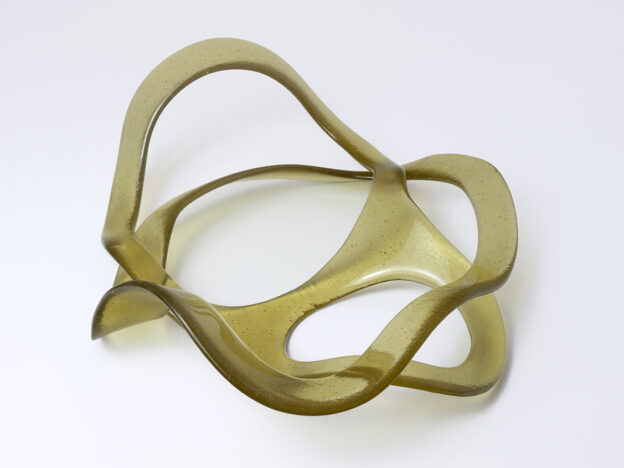
Entangled. Cast and slumped glass. 38 x 30 x 28cm
Richard Bright: Can we begin by you saying something about your background?
Lisa Pettibone: I grew up in California in the San Francisco Bay Area. My father, a physicist, worked at Lawrence Livermore Lab, a nuclear research facility in Livermore, a quiet suburban town surrounded by hills and vineyards. As a child, I remember watching the Apollo Moon landings with my dad and later wanting to be an astronaut. However, my creative side was stronger and I ended up with a degree in graphic design from California College of Arts and Crafts and working for several SF studios before moving to the UK in 1991. Specialising in book design, I met my British husband at a small publisher, decided to stay and eventually worked as an art director for the BBC. During this whole time, in stops and starts, I cultivated an interest in art, specifically glass sculpture, leading to a degree in 3D Design in Glass from University of the Creative Arts Farnham in 2005. A continuing interest in art projects related to scientific concepts (especially physics) motivated me to enrol on the MA Art and Science course at Central Saint Martins, UAL London where I drew these passions together in research about the aesthetics of gravity in 2016-2018.
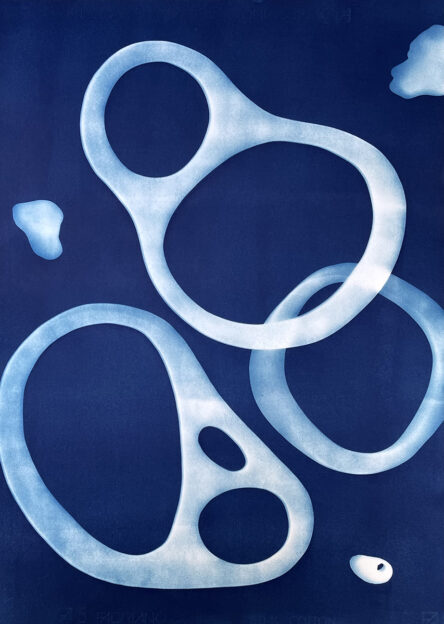
Erebus 1. Cyanotype print on 50% cotton Fabriano paper. 63 x 49cm
RB: What is the underlying focus of your work? In particular, what are the thinking processes and knowledge practices that guide your artistic research?
LP: During my BA in Glass I began to question our relationship with nature, how we frame it through observation as something separate from ourselves. I studied the early abstract artists such as Kandinsky who expressed the energy and dynamism of the natural world through shape, rhythm, colour and spatial relationships. Interestingly he avoided the use of green in his paintings (which he saw as bourgeois) in favour of a ‘modern’ approach. The process of distancing ourselves from a verdant environment developed further in modern architecture (think Le Corbusier) and painting with Mondrian for example, who sought an alternative visual language for expressing natural forces. I wanted to make work that was contemporary but acknowledged our relationship with the earth, creating outdoor sculptures with mirrored surfaces and forms that merged with their environment rather than stood in contrast to it.
I was especially drawn to work that expressed the energy present in constructed form. By bending and stretching glass, I was able to record natural movement and capture some of the transitional energy in the final sculpture while it was under the influence of heat and gravity in the kiln. My studio has become a lab for exploring this endlessly fascinating process.
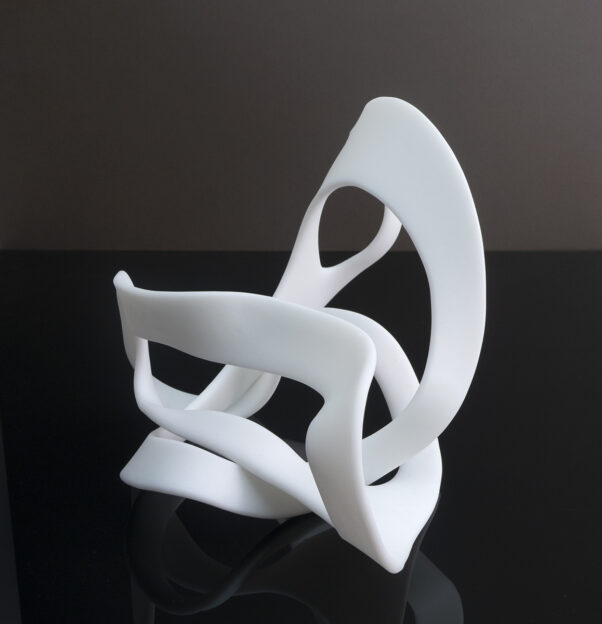
Evolution 1. Cast, slumped and hand-bent glass. 36 x 38 x 32cm
RB: Have there been any particular influences to your ideas and work?
LP: While I was at CSM I reached deeper into science to widen my perspective of how we build perception by studying astrophysics and neuroscience concepts (reading papers, popular writing and contacting scientists) and combining that with philosophical approaches. Influenced by Tuesday philosophy lectures at CSM in 2017, I began to love where my mind went with this heady combination and have cultivated this approach since. Much of my ongoing work touches the phenomena of perception and is enriched by writers such as quantum physicist Carlo Rovelli and philosophers including Maurice Merleau-Ponty.
In terms of artists, I’m fond of Modernists Naum Gabo and Alexander Calder – their clear-eyed view of how to ‘draw’ natural forces with materials and fabrication are clever and adventurous. Balance is a constant factor in my work, either visual or physical and I’ve learned from them. I seek out artists that investigate how light interacts with form so Dan Flavin, Olafur Eliasson, Bridget Riley and Rana Begum come to mind. The emotional and organic qualities (especially at larger scales) of Louise Bourgeois’s sculptures and installations stay with me as well as those of Tony Cragg.
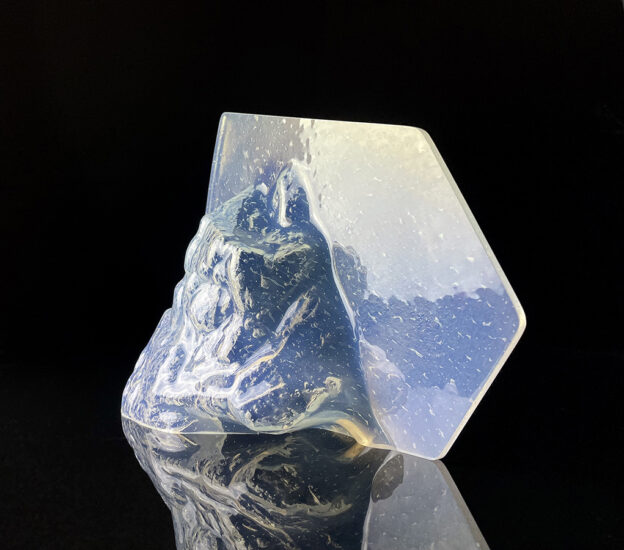
Carapace. Slumped glass. 22 x 35 x 15cm
RB: From September 2018 to September 2019, you were artist-in-residence at Mullard Space Science Laboratory (UCL) following the progress of the Euclid Mission, a European Space Agency initiative to explore the dark universe. Can you say more about your residency?
LP: While researching aspects of gravity during my MA, I became curious about the phenomenon of gravitational lensing (distorted light in space) so I contacted Mullard Space Science Laboratory (part of UCL) in Surrey and was put in touch with Tom Kitching who was science lead for the VIS instrument on the Euclid Mission telescope. We had an amazing discussion and he pointed out parallels between lensing and several of my glass sculptures – I remember being really buzzed after our talk and delighted he agreed to meet up once a month to carry on the discussion. This was my first taste of the conundrum of dark matter and a space science lab and I wanted more.
In May 2018 we agreed I should become artist-in-residence at MSSL with an emphasis on the Euclid Mission. I scrambled to find funding for a two-day a week year-long residency and was incredibly fortunate to receive an Arts Council England Grant. This allowed me to research the mission, run lab-wide creative workshops, make a film and develop new work for an exhibition. Importantly, I was able to probe the philosophical implications of invisible matter and the role of science in perception. I discovered the writing of physicist and thinker David Bohm whose ideas opened modes of understanding the cosmos as a unified whole and the construction of scientific knowledge (Science, Order and Creativity, Bohm and Peat 1987).
Scientists were amused and curious at my arrival but welcomed me into labs, cleanrooms, technical workshops and meetings. I interviewed 13 of the VIS Instrument scientists and ran nine art activities in their common room (which doubled as my office with a fantastic selection of science magazines). Tom sent me to the European Space Agency in the Netherlands to speak with the Euclid Mission managers Giuseppe Racca and Rene Laureijs and many of the team. He then arranged for me to attend the yearly Consortium meeting, that year in Helsinki, where I ran the largest and most successful art project of the residency. The Fingertip Galaxy painting with the finger prints of over 250 attendees, later become a plaque (with poetry) on the Euclid Space craft, launching in July 2023.
The final show included two installations, several glass sculptures, photography and a special edition screen print. The experience was transformative and continues to feed my thinking and aesthetic today.
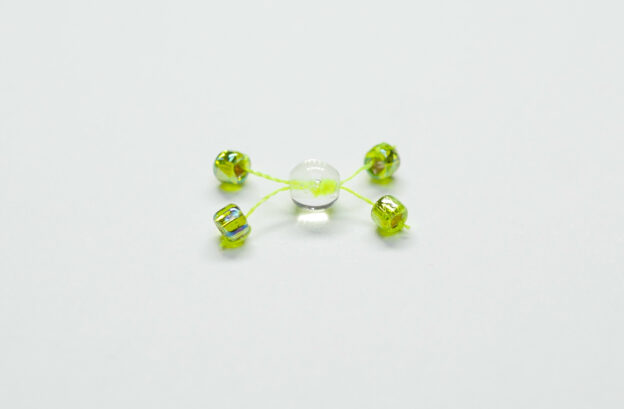
Verdant. 8 x 14mm, artwork in the Moon Gallery on the International Space Station, Feb-Dec 2022. Glass and thread microgravity sculpture based on the structure of the chlorophyll molecule.
RB: Can you say something about your work Verdant ?
LP: The Moon Gallery Foundation launched an open call in 2021 for artists to contribute to the first gallery in space aboard the International Space Station. Luckily, I heard about it through another space organisation called ArtMoonMars just in time. The artworks were severely restricted in size: it had to fit in a 10 mm square space viewable from one side. Immediately one grasps the unique qualities of sending ideas into space – concepts expand to take on more universal concepts and the working perspective shifts. Thoughts sped forward – if I were to live in space, it would be the lush greenness of earth I’d miss most. Living in rural Surrey near forests and surrounded by trees it seemed that this colour was both aesthetically and biologically connected to my wellbeing. And then there is the opportunity to make a zero-gravity sculpture and the prospect of seeing it move freely. Verdant combined these ideas: the clear and green glass beads are tethered together by fluorescent green thread representing the core structure of the chlorophyl molecule. Its flexible form adapted to its tiny space as it floats and turns. In fact, from video footage taken within the ISS cupola, the little sculpture bent itself into a corner, gleaming in the unfiltered light of space. 64 artists were selected for this exceptional experience and Verdant returned from its 11-month stay in weightlessness in January 2022. The Moon Gallery Foundation plan to send 100 artists in the first gallery on the Moon in the next few years (I’m sure they will).
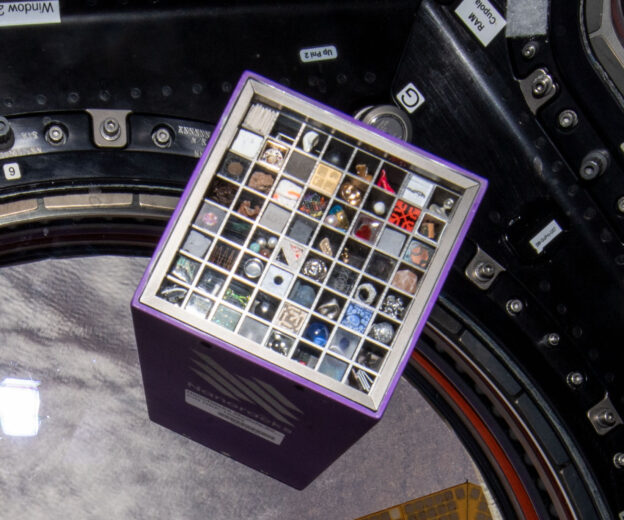
Moon Gallery Test Flight ISS Cupola https://moongallery.eu/
RB: From your experience what do you feel art can do for those involved in space exploration?
LP: Having sent two artworks into space (Euclid Mission plaque and Verdant) I’ve thought a great deal about this and the subject is fascinating. I believe another genre of art is certainly emerging as space exploration expands. Humans have always taken their culture with them wherever they travel. This includes personal objects connected to family or loved ones to useful or decorative things that reflect a wider cultural aesthetic. We are still finding mosaic floors, pottery and jewellery left by the Romans throughout the UK and they continue to give us clues about how they lived and what was important to them. Our era will do the same but reflect the novel circumstances we find ourselves in, for example, a moon settlement will require objects that take into account low gravity (1/6 the Earth) and perhaps digital art that is easier to transport. Art making will be transformed – an exciting prospect!
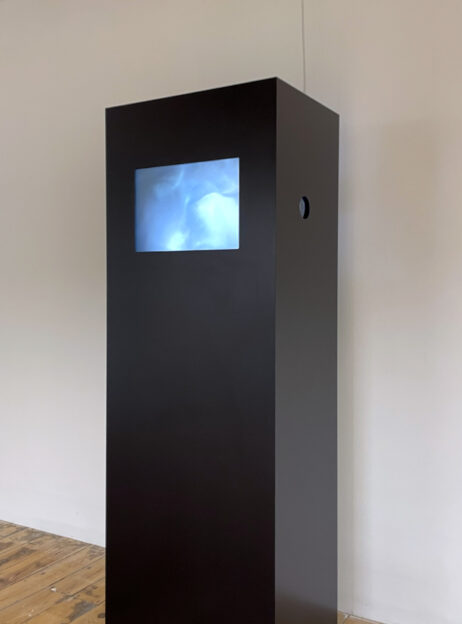
Truth in Illusion. Projected light installation, wood, glass, lights, motors. 180cm x 75cm x 47cm
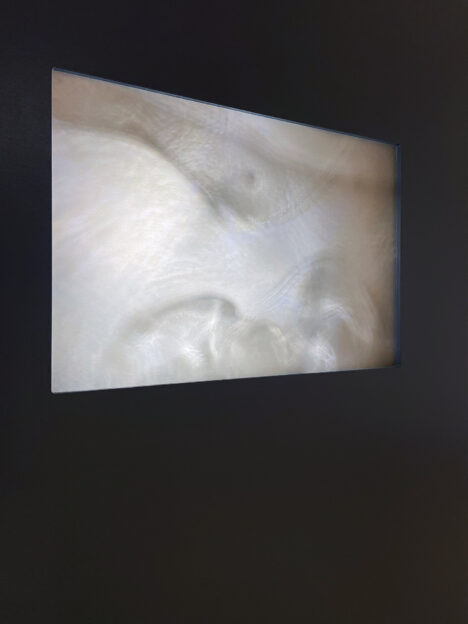
Truth in Illusion (detail). Projected light installation, wood, glass, lights, motors. 180cm x 75cm x 47cm
RB: Can you say something about your installation, Truth in Illusion, and the works Enfolding (glass sculpture) and Language of Light 1 (C-type photo print)?
LP: These works grew out of the residency at MSSL Space Lab and touched on both scientific and philosophical concerns. Truth in Illusion (now at the exhibition ‘Seismic’ at Giant Gallery, Bournemouth, UK) is a glass and light projection piece. It was a response to comprehending the twisted galaxy light (gravitational lensing) that helps cosmologists detect dark matter structure in the universe. Through mathematics they are able to untwist the light and ‘see’ the real galaxy and map threads of dark matter. David Bohm’s thinking regarding the construction of perception was helpful in arriving at the final concept. He said paradigms in science are fixed theories that can be changed only through an assimilation of new information. When we see a new reality, we cannot un-see it and the paradigm is transformed. I tried to give viewers an experience of this transformation.
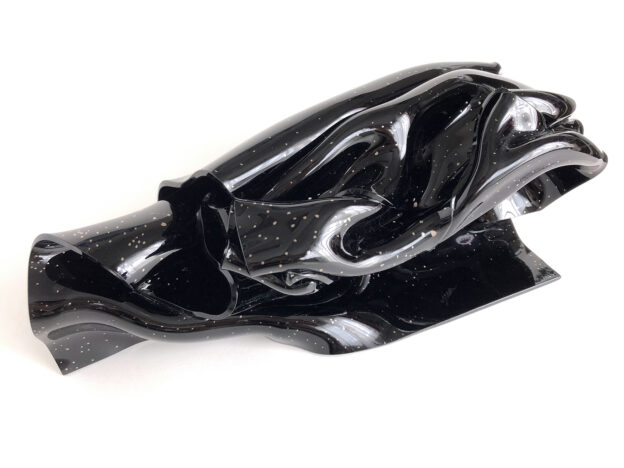
Enfolding. Platinum lustred glass, 28 x 12 x 9cm
Enfolding relates to Bohm’s concept of the Implicate and Explicate Universe. He describes a folding and enfolding of the real (explicate) and sensed (implicate) in the cosmos where some aspects of existence reveal themselves and others are implied. The sculpture is black glass with platinum lustred star-like dots, folded as it collapses in the kiln and reminiscent of the rather two-dimensional night sky we normally see. In fact, the universe is three-dimensional, filled with forces and form (although much of it is invisible).
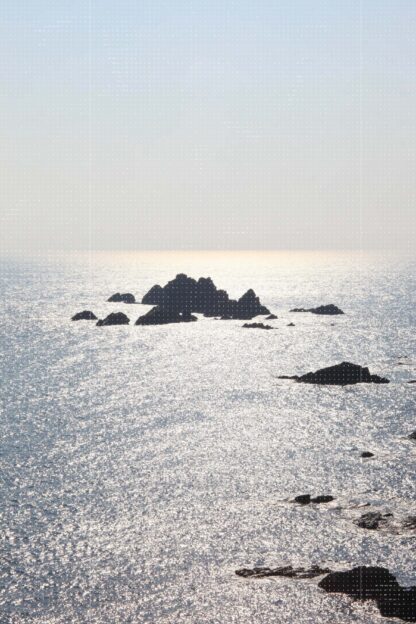
Language of Light 1
Photo montage, C-Type print, 55 x 40cm (ed of 5)
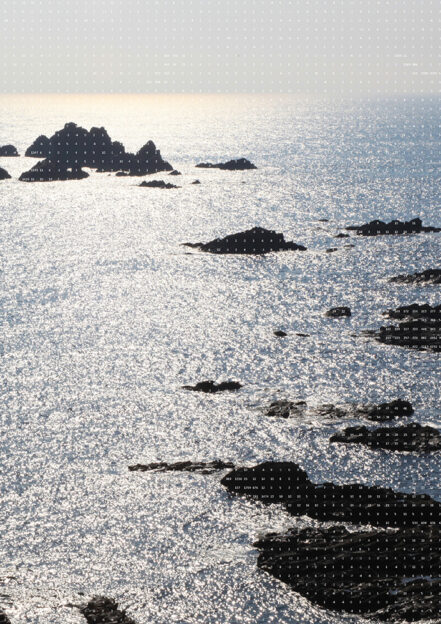
Language of Light 1 (detail). Photo montage, C-Type print, 55 x 40cm (ed of 5)
Language of Light 1 addresses the alternate ways science and artists describe light. As an artist, the sensory experience of sunlight at Lizard Point in Cornwall, drew me to capture it on film. At the lab I was given astral data that was used to test the CCDs of the Euclid telescope detector – a vast series of numbers expressing light levels. Higher numbers appear where galaxies or cosmic rays are detected. By layering these in an image I was able to make room for the two approaches to coexist. This intrinsic need for the sensory is reinforced by philosopher Maurice Mearleau-Ponty. He said the body is the first site human experience, the first site of knowledge. In the essay The Eye in Mind he warns us that science can lose touch with these essential experiences. Toward the end of the residency, I realised that this is what I could contribute to the lab, activities rich in sensory feedback.
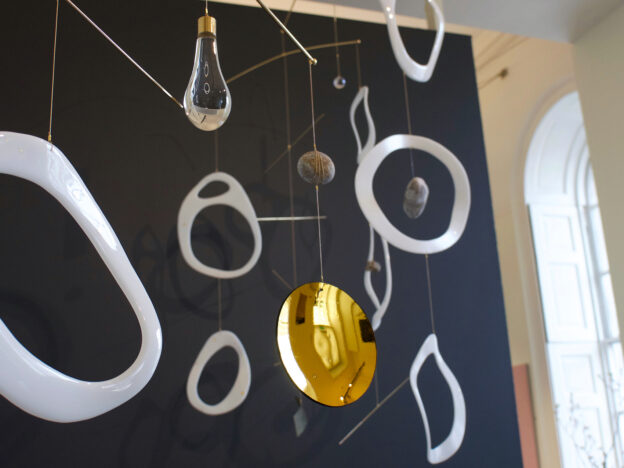
Instrument of Thought: A Meditation on Matter and Light
A two-part kinetic sculpture related to the perception of light and matter through scientific concepts. Seen at Somerset House London for Collect Int’l Art Fair 2022. 180 x 200 x 200cm
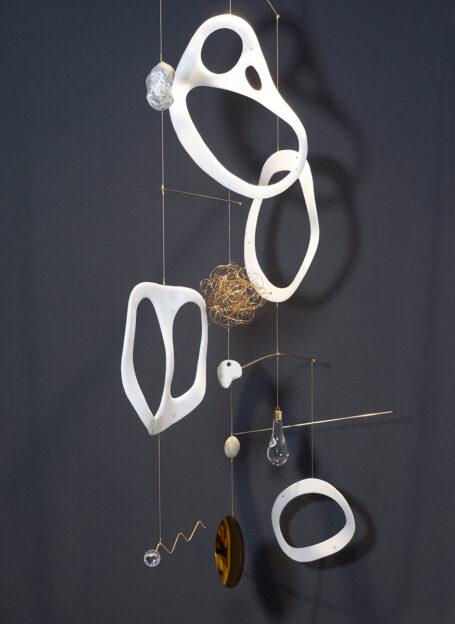
Instrument of Thought: A Meditation on Matter and Light. A two-part kinetic sculpture related to the perception of light and matter through scientific concepts. Seen at Somerset House London for Collect Int’l Art Fair 2022. 180 x 200 x 200cm
RB: In your mobile work, Instrument of Thought: A Meditation on Matter and Light, you state that it “subtly relates to transformative scientific concepts that have reshaped our perception of the universe.” Can you say more about this work and the various elements it contains?
LP: Instrument of Thought was a year and a half in the making during Covid (shown at Collect/Somerset House in 2022 and the Aesthetica Art Prize exhibition 2023) so I had time to play with sculptural abstractions of theories in physics I find perplexing. Essentially a multi-part mobile made of glass, brass and other objects, the sculptural elements move relative to each other in constant motion. For example, the large white glass shapes echo scientists’ diagrams of dark matter halos, a phenomenon where cosmologists believe gravity from dark matter corrals luminous matter into stars and galaxies in voids between its structures. This invisible force is often described as the skeleton of the universe. Another object, a brass wire ball, tackles theories about the illusive electron – its location in the atom can’t be pinned down and it hovers at a vast distance from the nucleus. Our world is composed of mostly empty space and very little visible matter (voids again…). These gifts of science have altered my perception of reality and my approach to art making.
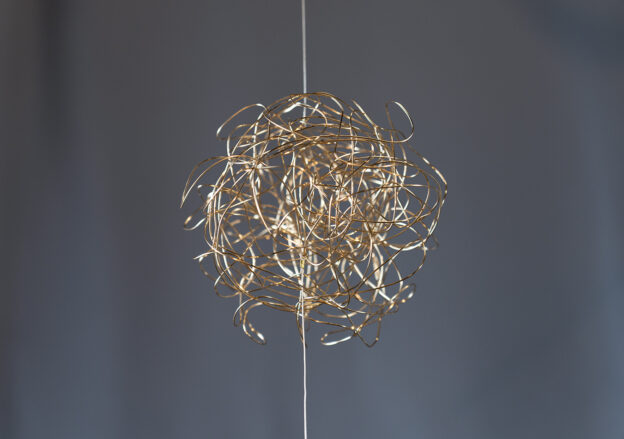
Instrument of Thought: A Meditation on Matter and Light (detail)
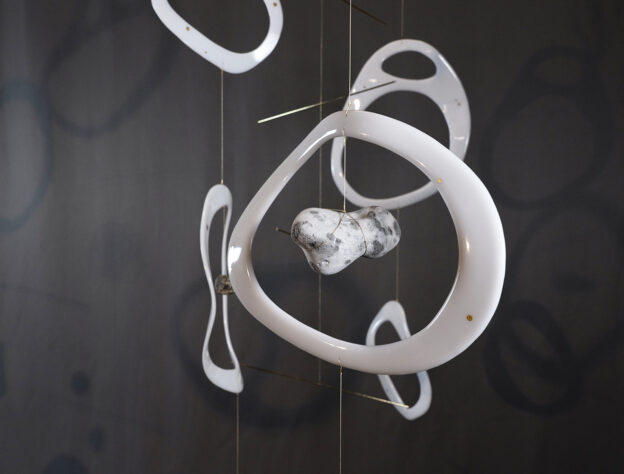
Instrument of Thought: A Meditation on Matter and Light (detail)
Instrument of Thought: A Meditation on Matter and Light from Lisa Pettibone on Vimeo.
RB: Pushing the boundaries of the medium is a natural part of the art making process because, in some ways, the artist is exploring the medium itself. What boundaries do you wish to push with the medium that you use?
LP: I agree, ideas work in tandem with the limits of the material. The medium I choose has qualities I can push to convey thoughts but in a way the material becomes the thought too. Glass has an incredible capacity to deliver so many sensations, often with contrasting characteristics: appearing soft but feeling hard, transparent but solid, stretchy but rigid. The extreme ends of bending and slumping sheet glass interests me as a way to capture formation in process – liminal states of matter where tension and heat create a transient form. There is a lot of testing just to see what it will do, experimenting that comes out of curiosity and a need to express something physical. I match this manifested sensation with an emerging concept, pushing the concept through the material, letting it act as a visual language. I have a deep reservoir of technical knowledge about glass so now I’m confident exploiting it. However, it is technically slow and, except for mould making and cutting, much of the results happen in the secrecy of the kiln. Not in control of the final results, I relinquish the form to nature (heat and gravity) to complete each piece. The props I handmake to control the fall become a starting point, a good guess at what the conditions will give me. It’s no wonder why I’m obsessed with gravity – it’s a companion in my creative process.
As a release from the slow technical processes of glassmaking and a need for hands-on making, I often turn to paper or fabric to sculpt. Quickly done, little models are scattered around the studio. Also, a 2D material that can be bent, folded or stretched into 3D forms, paper also has the advantage of carrying imagery. My graphic design background gave me an eye for the power of photography, for example I use research or travel photos in the mix, adding layers of meaning and aesthetic appeal.
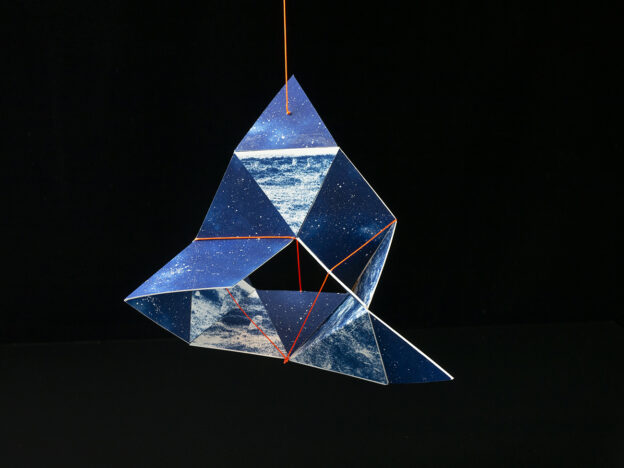
Parallax 2 (detail). Cyanotype print paper sculpture with thread on wood and wire stand. 23 x 42 x 14cm
RB: What future projects are you currently working on?
LP: Recently I completed a 6-month residency at University of the Creative Arts Farnham glass department and l came way with boxes of experiments that will take the next year to resolve. One project, Flesh of the World, relates to a phrase Merleau-Ponty used to describe ourselves as an aspect of the material environment we inhabit. Humans are another version of the elements that make up plants, stone, air and water – our porous existence relies on this relationship. Enamel coloured and folded glass forms are at early stages of expressing this idea. Also, I am investigating native American beliefs concerning materiality and wholeness to add to enrich this understanding. Their ideas about the cosmos are a provocative counterpoint to scientific interpretations.
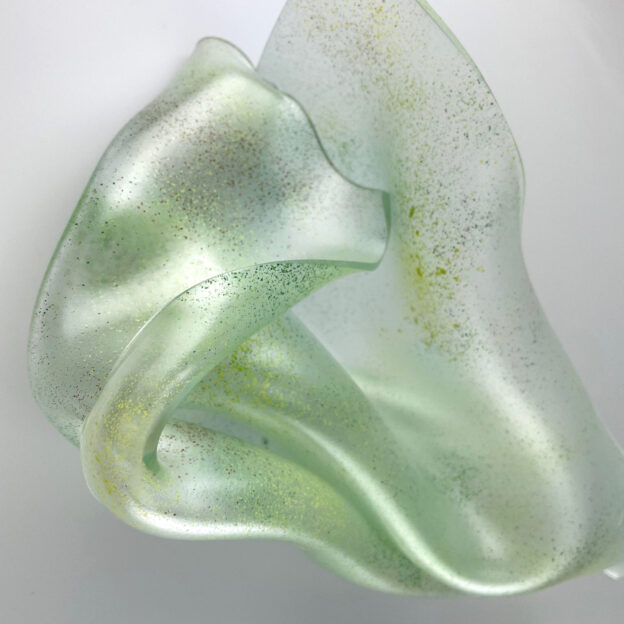
Flesh of the World
The university was testing a new high resolution 3D printer so I produced three Moon rocks from the fantastic online resource Astromaterials 3D (NASA) that are destined for another project – one will be cast in bronze another in glass. I’m planning some new suspended sculptures with these.
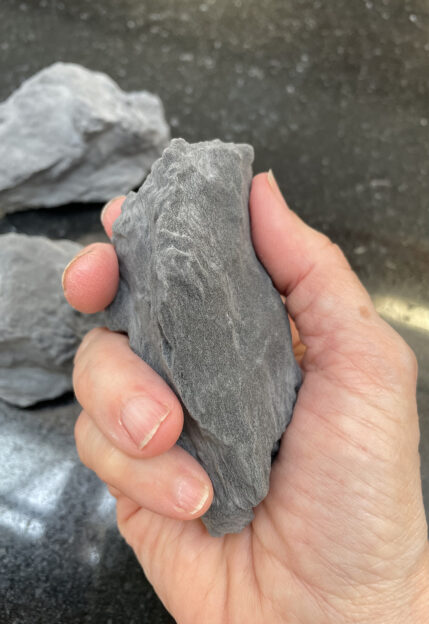
Moon rock.
I recently completed the embroidered embellishment of a photo polymer etching. It was printed from a digital copy of an archival glass plate taken by Edwin Hubble in October 1923 of the Andromeda Galaxy. A pivotal moment in astronomy Hubble realised that universe was magnitudes larger than previous calculations, the prints relate to perceptual shifts in understanding through telescope observation. One hundred years later, just this week, the Euclid Mission released its first deep field images revealing never before seen layers of galaxies that will push this further – I’m eager to work with these images too so have been in touch with ESA about this.
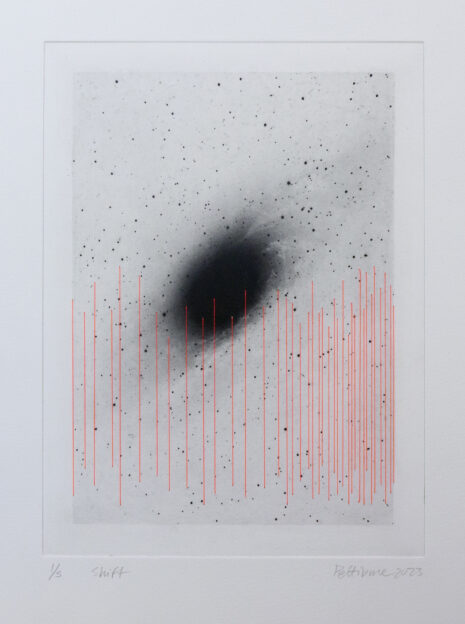
Shift, photopolymer etching with embroidery.
………………………………...
All images copyright and courtesy of Lisa Pettibone
Get the Full Experience
Read the rest of this article, and view all articles in full from just £10 for 3 months.

No comments yet.