Suki Chan: CONSCIOUS
Suki Chan is a London based artist and film director. Her films take audiences on an immersive journey and shines a light on subjects that are under-represented across the human condition: from dementia, sight-loss, identity to belonging. Dr Marius Kwint, Reader in Visual Culture at the University of Portsmouth, discusses her recent installation, ‘CONSCIOUS’, which explores the future of our individual and collective consciousness, weaving a narrative through the secret lives of bees, humans and artificial intelligence. The multi-platform project brings together the diverse, subjective perspectives of scientists and ordinary people, whose stories unwrap layers of thinking and preconceptions about individual and collective consciousness.
Suki Chan: CONSCIOUS
Danielle Arnaud, London, 18th March – 7th May 2022
Bluecoat, Liverpool, 12th March – 12th June 2022
Conscious Teaser from Suki Chan on Vimeo.
The London version of Suki Chan’s near-duplicated exhibition takes place in a home partly converted into a gallery, while in Liverpool it is in a gallery made to resemble a home, or at least an institutional one. Much of her video, audio and installation work portrays real or typical places: nocturnal London; the sweeping expanses of the Northumberland coast; abandoned Syrian villages in the Israeli-annexed Golan Heights; a roomful of old wooden school desks with inkwells; or a Hakka roundhouse in China of the kind where her grandmother grew up. In CONSCIOUS, three of Chan’s recent films on memory and dementia are situated amid trappings of retiring domesticity. There is an assortment of old chintzy tea ware, while, at Bluecoat, the high-backed chairs and sofas in carpeted rooms of bland grey, beige and pink invite visitors to sit and sample the terminal repose of a care home resident, accompanied by walking frames and wheelchairs. The outlooks of the elderly, with whom one is invited to empathize in these settings, are, however, far from dull or depressing.
The teacups and pots emanate the sound of conversation about dementia from installed loudspeakers (rather like the desks in Chan’s 2012 sound installation A Hundred Seas Rising, whose inkwells had loudspeakers playing back a multitude of interviews on the theme of revolution, orchestrated into wave-patterned crescendos and diminuendos across the space). Together, this verbally animated crockery forms the work A Cup of Ye Old Faithful (2022), which was made with the support of the Henry Moore Foundation from conversation recordings with the inhabitants of the Belong Care Village, Crewe, where the artist had a residency under Bluecoat’s ‘Where the Arts Belong’ programme. The quotidian ceremony of teatime is a way of anchoring the day and re-establishing civility; here, the vessels, each unique within the display, some cracked and broken, rendered fragile by use, serve as metaphors to the materiality of consciousness and indeed all life. What approximates to the soul needs a dwelling-place, a mortal coil, a tangible substrate, which is of course fallible, fragile and finite. Portraits, figures and talking heads are refreshingly few in Chan’s work, freeing the viewer to sense the poetry in our earthly habitats instead.
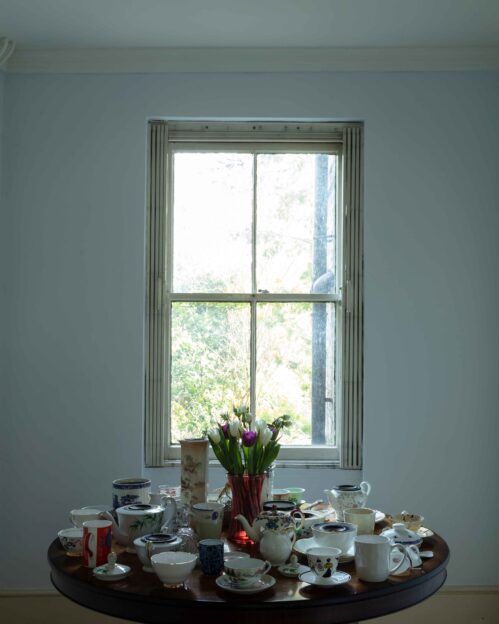
Suki Chan A CUP OF YE OLD FAITHFUL 2022
Antique table with crockery and 8 channel audio installation 104.5 x 120 cm (Danielle Arnaud Gallery. Installation view by Oscar Proktor)
This kind of freighted imagery is multiplied in Chan’s films, which reward repeated viewing. They are constructed mainly through a restrained visual vocabulary consisting of somewhat defamiliarizing close-ups and microscopic or aerial views, the feeling of three-dimensional space heightened by Dominic Scherrer’s atmospheric scores. In the twelve-minute film Memory (2012, at Bluecoat only), we listen to Cold War RAF pilot Dave Linney and war historian Robert Turner recollect the excitement, danger and occasional tragedy of military and private flying. In a parade of analogies, their words hover sonorously over moist, flesh-like cave interiors, the strange limestone deposits resembling sinews, connective tissue and the brain’s cortical surface. We then zoom out from parched and crazed mudflats, to clouded satellite views of the UK landscape and eventually its dendritic road patterns glowing by night under street lighting, and similarly branching fruit-fly neurons fluorescing under the microscope. Time-lapse confocal neural imagery from William Constance and Darren Williams at King’s College London tops and tails the film.
In the seventeen-minute Hallucinations (2019), there are worn teddy bears, hands on fabric and keyboards, briefly the faces of the two interviewees living with dementia (Pegeen O’Sullivan and Wendy Mitchell), and the backs of festooned photographs with the subjects written on them for the benefit of the latter. As Mitchell tells of her changed perceptions and greater appreciation of the fleeting moment, we are able to enjoy the reflections of wintry trees in water caressed by the breeze with a few fallen leaves floating by. Then come her concluding reflections on death (and the sorry illegality of assisted dying in the UK), while the camera tracks backwards into a long canal tunnel, the speck of light at the mouth gradually disappearing into the enveloping darkness.
HALLUCINATIONS Trailer from Suki Chan on Vimeo.
Part of the now extensive field of health-related artwork stressing intersubjective compassion, and hence exploring the diversity of human experience under the various conditions of our mortal shells, CONSCIOUS is less about consciousness in general than perception – a recurrent topic for Chan – and memory in the context of dementia. Although dementia is the medical equivalent of climate change – grim and accumulating, with scant hope of solution — her two main interviewees in Hallucinations and Fog in my Head have managed to find positive aspects to the affliction. O’Sullivan, whose beautiful photographic portrait graces both versions of the exhibition, is daughter of the famous Irish novelist and socialist Liam O’Flaherty. She amusingly confesses: “I think my difficulties have all been internal. I think I make them all up.” Mitchell, after having been diagnosed with early onset dementia at the age of 58, says:
Dementia has given me the gift of time; appreciating time again. We go about our lives wishing for the weekend, wishing for the next holiday, wishing for next year, and it’s taught me not to do that, because you don’t know what tomorrow will bring. It’s seeing the tiny detail that we miss, and it’s gone in a flash if you don’t look, and dementia has given me that gift of just sitting, and watching, and seeing the tiniest of things. You know, I’ll see a bird high up in the tree, just sat looking out over the world, and that is a special gift, because in a moment, it’s flown away and you’ve missed it. (Hallucinations, 2020, 9:24 – 10:22)
Following her diagnosis, Mitchell wrote her first book, Somebody I Used to Know, and finds herself more sociable than she used to be. She is the narrator and chief subject of the longer and more ambitious Fog in My Head (36’, 2021, developed with the support of Film London), where the pictures are more directly illustrative of the words, though still with plenty of aesthetic lingering on ordinary or under-appreciated things. For example, we become entranced by sunlit muslin curtains wafting in the breeze through an open patio door, or the brain-like shape of a natural beehive, presenting an analogy to consciousness. We listen to Mitchell describe her seeing what was effectively the friendly ghost of her late mother and her coping strategies for the loss of spatial and navigational functions (which are much of the basis of memory), including photos on cupboard doors of their contents. I did not previously realise what difficulties the opaque uniform minimalism of modern cupboard and wardrobe design must present to the memory impaired.
At Danielle Arnaud’s private view, conversing over tea and cakes in the sunny garden on one of the first fine afternoons of the year, I asked the opinions of other visitors who had personal experience of loved ones with dementia. They found the films very moving, especially in these evocatively domestic settings, but also convincingly realistic, and the positive messages appropriate. The question of art that is ‘about’ a socially important subject, and one that is widely recognised as such, also came up. How does one culturally position work that has educational aims, in the midst of artistic traditions of autonomy, rebelliousness and sometime egotism? Chan replied that she learned the importance of respect for the elderly and the paramount value of care mainly from her grandmother and her culture. We can infer from that that respect and care, and artistic practices that amplify other voices while creating distinctively new aesthetic experiences, helping audiences to appreciate their time on earth, are happily achieving full artistic legitimacy. Amid all, they hold out the hope and model for a better time of it when each of our times come.
Marius Kwint (April 2022)
Get insight into Suki Chan’s Bluecoat exhibition CONSCIOUS in a newly commissioned film by the gallery. Hear from the artist as she discusses her fascinating work, her vision for the exhibition and how it came together in our gallery. Film by Ben Potts
…………………………………..
All images copyright and courtesy of Suki Chan
www.thebluecoat.org.uk/whatson/suki-chan-conscious
www.daniellearnaud.com/index.html
Get the Full Experience
Read the rest of this article, and view all articles in full from just £10 for 3 months.

No comments yet.