(Transient) Bodies
Issue 87 January 2025

Whales- a Deeper Dialogue
Tessa Campbell Fraser is a British painter and sculptor based in Oxfordshire UK. Born in Edinburgh, she studied at Chelsea School of Art and afterwards established herself as one of the country’s leading animal artists. Her exhibition, ‘Whales- a Deeper Dialogue’ seeks to unravel the interspecies communication between man and animal that is currently a hot topic in scientific research.

Transient Bodies
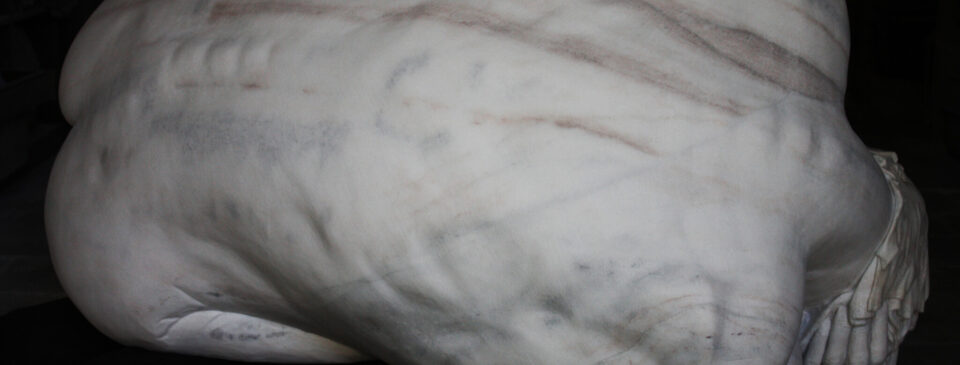
Julian Voss-Andreae, a German sculptor based in Portland (Oregon, USA) is widely known for his striking large-scale public and private commissions often blending figurative sculpture with scientific insights into the nature of reality. His sculptures are frequently shown at international art fairs and galleries and can be found in major collections all over the world. Voss-Andreae’s work has been featured in print and broadcast media worldwide and videos of his sculpture have gone viral with tens of millions of views. His expertise in diverse fields of science and a deep passion for the mysteries of the world have been a continual source of inspiration for his work.

Visceral Landscapes
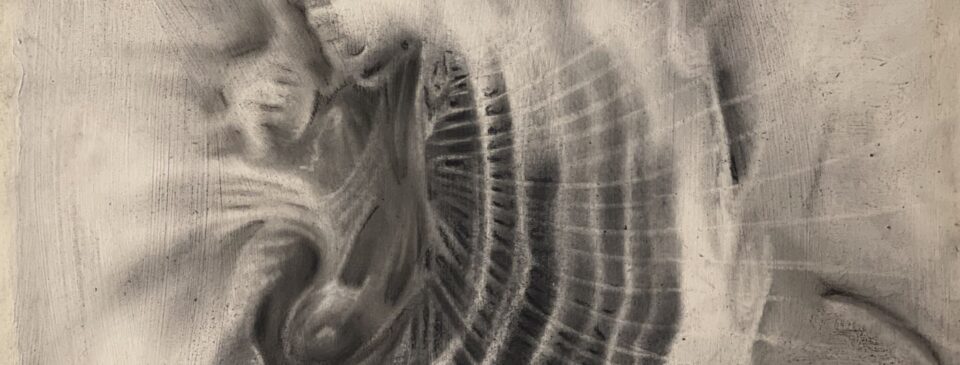
Pascale Pollier’s work attempts to capture the point where art and science meld. An alchemist at heart, her work begins with observation and experimentation, and is steeped in solid scientific research and findings.
Her inspiration is drawn from observing the internal and external human body in all its diversity, life and nature in all its beauty, strength, fragility, disease, mortality, immortality and death. New technologies and philosophies, quantum physics, nanotechnology, animatronics are amongst her interest and are important in her work.

NILS-UDO: Towards Nature
NILS-UDO is a German artist from Bavaria who has been creating environmental art since the 1960s when he moved away from painting and the studio in 1972 and began to work with, and in, nature. He began as a painter on traditional surfaces, in Paris, but moved to his home country in Bavaria and started to plant creations, putting them in Nature’s hands to develop, and eventually disappear. As his work became more ephemeral, he introduced photography as part of his art to document and share it. In this interview with art and ecology author, John K. Grande, he discusses his ideas and work.

A Vulnerable Border
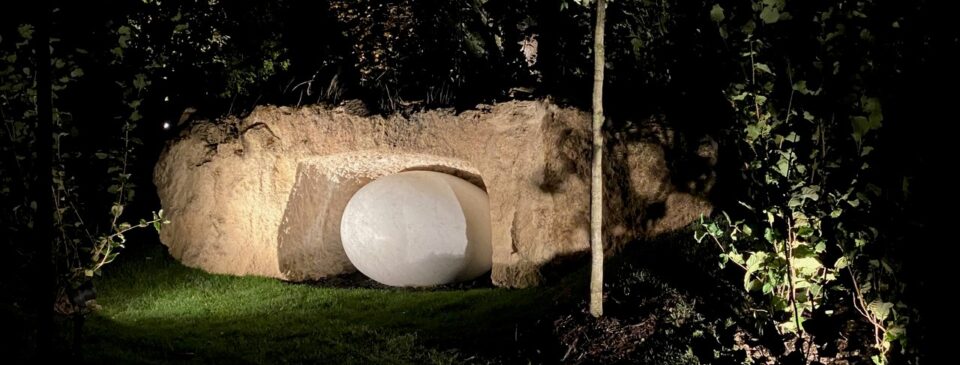
Chantal Pollier is a visual artist who prefers to work with stone. (and in wax, glass, drawings, and photography) All her work holds references to temporality and transience. Many are rooted in science, with a particular interest in geology, biology, anatomy and morphology. The way in which collaborating artists and scientists can enter each other’s territory, and the extent to which they can thereby add new dimensions to both their own work and that of their partners, leads to refreshing perspectives.
Murky Bodies
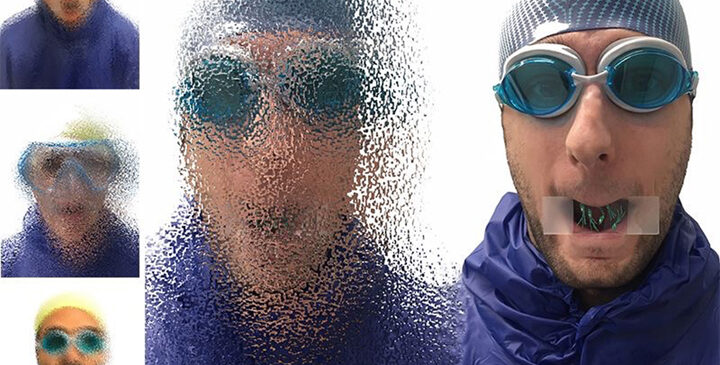
Elaine Whittaker is a Canadian visual artist working at the intersection of art, science, medicine, and ecology. Biology is the basis for her installations, sculptures, paintings, drawings, and digital images. These works incorporate traditional and unconventional materials: paint, pigment, wax, mosquitoes, salt crystals, human cells, textiles, repurposed fibres, and live microorganisms. ‘Murky Bodies’ is a series of four installations speculating on the entangled ways in which humans, plants, animals and microorganisms emerge and co-exist in a world confronting a warming climate, rising seas, intensified water cycles and extreme storms.

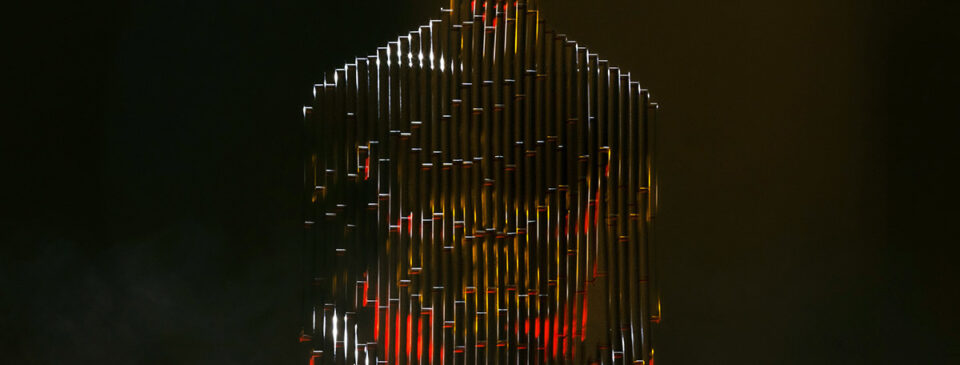
Forming
Artist and writer, Richard Bright, has addressed the relationship between art, science and consciousness for over 40 years. He studied Fine Art and Physics before founding The Interalia Centre in 1990. Since then, he has lectured extensively on art and science and written articles on James Turrell, Andy Goldsworthy and Susan Derges, among others. He has exhibited both nationally and internationally and was the recipient of the ‘Visions of Science’ Award, The Edge, Andrew Brownsward Gallery, University of Bath (Second Prize Winner). Co-author of ‘The Art of Science’ (Welbeck Publishers, 2021). In ‘Forming’, he shows some of his latest work that explores flow and transience.

‘Cosmic inflation’: did the early cosmos balloon in size? A mirror universe going backwards in time may be a simpler explanation
Neil Turok is the inaugural Higgs Chair of Theoretical Physics at the University of Edinburgh. He holds the Roger Penrose Visiting Professorship at Perimeter Institute for Theoretical Physics in Canada where he is emeritus Director. Before that he was Chair of Mathematical Physics at Cambridge and Professor of Physics at Princeton.
Neil’s day job is developing and testing fundamental physics theories of the universe. His first-principles predictions of correlations between the temperature and polarisation of the cosmic background radiation (CBR), and the CBR and the galaxy distribution have been confirmed at high precision. His work also ruled out several popular theoretical models. Recently, he showed how a CPT-symmetric universe could provide the simplest-yet explanation of the cosmic dark matter, the large scale properties of the universe and the primordial density variations.
In 2008 Neil won the TED prize for his research and for AIMS. In 2016 he was made an Honorary Fellow of the UK Institute of Physics and was awarded the John Torrence Tate Medal of the American Institute of Physics for International Leadership in Physics. In 2018 he was appointed an Officer of the Order of Canada.

The whole story of human evolution – from ancient apes via Lucy to us
John Gowlett is Professor of Archaeology and Evolutionary Anthropology, Department of Archaeology, Classics and Egyptology, University of Liverpool.
A British Archaeologist born in the Isle of Man, based in the University of Liverpool, he is collaborating with colleagues on projects in Kenya. He has worked on archaeological sites around the world for many years, and has particular interests in fire and in the evolution of form in tools. He is currently mainly involved with research on the extinct volcano of Kilombe in Kenya, which has a record 2 million years long.

Cosmology is at a tipping point – we may be on the verge of discovering new physics
Andreea Font is a Reader in Theoretical Astrophysics, Liverpool John Moores University.
“I am a theoretical cosmologist and my interests are in the formation and evolution of galaxies, in particular in the formation of our own galaxy, the Milky Way. To this aim, I build computer simulations that follow the evolution of Milky Way-type galaxies since their birth until the present time.
I am particularly interested in making detailed comparisons between cosmological simulations of the Milky Way and the most up-to-date observational data in our Galaxy, for example, the data obtained from the Gaia satellite. Examples of my recent work include modelling of stellar haloes of Milky Way-type galaxies and of satellite dwarf galaxies orbiting these systems.
I also have an interest in deciphering the nature of dark matter and, to this aim, I develop models that help us distinguish between various possible dark matter particle candidates using cosmological simulations.”

Why do humans deteriorate with age? It’s a biological puzzle
Owen Jones is an Associate Professor at the University of Southern Denmark.
“My primary interests are explaining and describing demographic patterns across the ‘tree of life’. However, my research interests are varied and range from climate change, macroevolution and macroecology, to senescence and population dynamics.
Before my appointment at the University of Southern Denmark I spent a couple of years working on similar things as a research scientist at the Max Planck Institute for Demographic Research in Rostock, Germany. In addition, I spent some time working with Dr Jinliang Wang at the Institute of Zoology (London) on population genetics.
My first post-doc, based at Imperial College London, was on the LITS project, a database of UK-based long-term individual-based time series data sets.”